Explanation Physics
 Call Kai
 Learn
Learn Practice Test
 Spaced Repetition
 Match
Match Flashcards
 Knowt Play
1/18

There's no tags or description
Looks like no tags are added yet.
Name | Mastery | Learn | Test | Matching | Spaced | Call with Kai |
|---|
No analytics yet
Send a link to your students to track their progress
19 Terms
Stationary waves on a guitar
Waves are produced and travel to the boundaries and are reflected towards each other
Two waves travelling in opposite directions interfere/superpose with each other
This produces fixed boundaries of zero amplitude called nodes
In some positions the waves always cancel/ interfere destructively to give zero amplitude/no vibration/nodes
In some positions the waves interfere constructively to produce positions of maximum amplitude/max vibration/antinodes
Photon explanation of threshold frequency
According to classical theory, the threshold frequency shouldn't exist -> if light was a wave, low energy intense light should be able to release electrons
But the emission of only electrons depends on the frequency (energy) of the light as the energy of a photon is E =hf
There is an one to one interaction between a single incident photon and a single electron
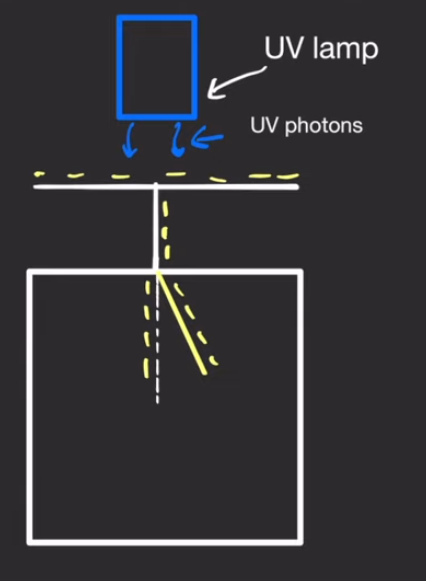
Gold leaf Electroscope
If we being a UV light source there will be emission of electrons from the surface
Number of surplus electrons that remain on the surface will decrease with time → i.e. the negative charge on the plate will decrease, meaning that the gold leaf would fall
This happens because:
There is a minimum amount of energy required to release an electron and photons must supply this energy in one interaction
UV photons can do that as their energy E=hf is greater than the work function
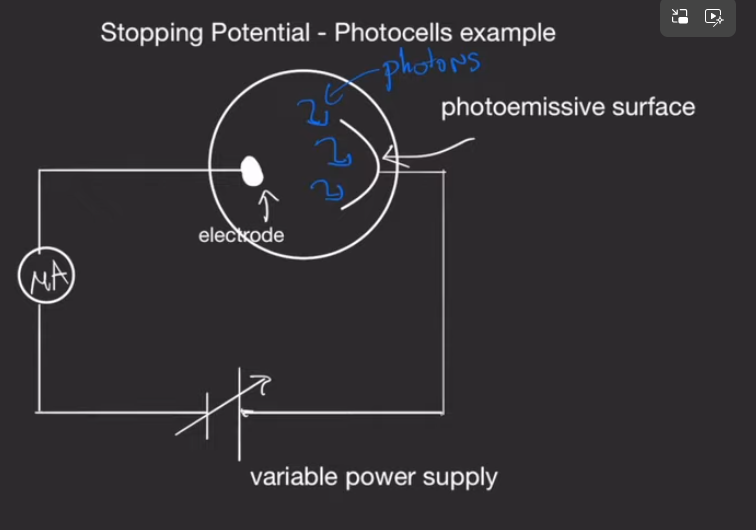
Stopping potential - Photocells example
Photocells demonstrate the photoelectric effect:
If photons of energy higher than the work function of the photoemissive surfaces are incident electrons will be released
These electrons are then detected as current by the ammeter in the circuit
If the intensity of the incident radiation is increased:
More photons per second are incident of the surface
More electrons are released per second from the surface
the current in the circuit increases as it is the rate of flow of charge
Ionisation and Excitation in a mercury fluorescent tube
Electrons passing through the tube collide with electrons in the mercury atoms
They transfer energy and the mercury electrons go into higher energy levels
Excited electrons then de-excite to lower energy levels
Emitting a photon of equal energy difference to the energy difference between the energy levels
The emitted photon is in the UV range
The coating of the mercury tube absorbs UV photons and electrons in the coating are excited to higher energy levels
Atomic electrons de-excite to a previous lower level and emit lower energy photons
Energy levels
When electrons absorb a photon, they go up in energy level and excite
When electrons de-excite and go down in energy they release a photon, equal to the energy level difference
Why are energy levels negative
Energy levels are negative as to remove an electron, energy must be supplied
Once free an electron has zero energy
Wave particle duality
Photoelectric effect suggests that electromagnetic waves have a particle nature
Electron diffraction suggests that particles have a wave nature
Particle behaviour
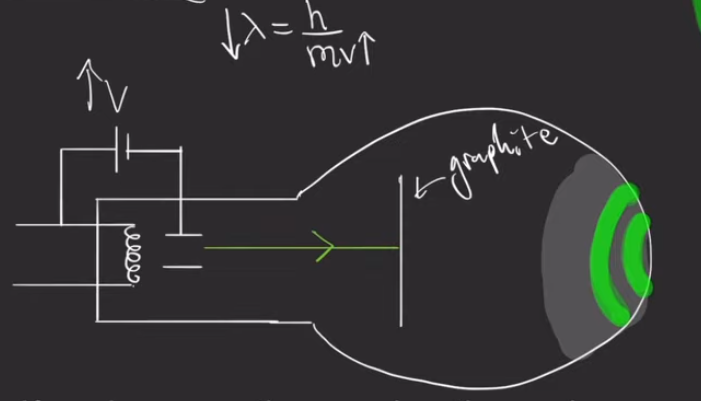
Pure particle behaviour would produce a pure spot of light with some particles scattered randomly
However the pattern seen shows diffraction, which is a pure wave property
Bright rings occur where constructive interference occurs, similar to the diffraction grating formula
What happens when V increases? (Electron diffraction experiment)
If pd increases (Accelerating p.d) the momentum of the electrons increases
So their De Broglie wavelength decreases
I.e. The diameter of the rings pattern will decrease
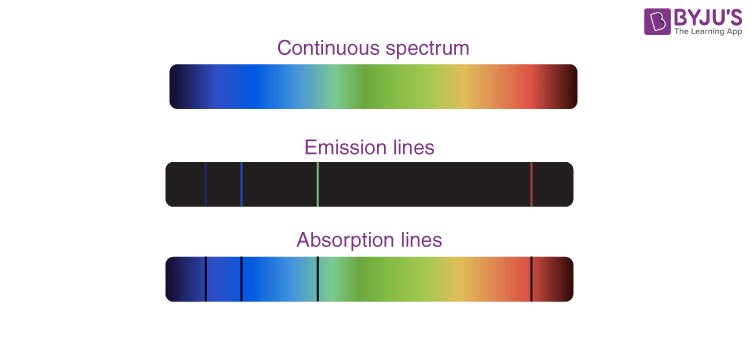
Line emission spectrum
A set of discrete bright lines on a dark background, produced when excited atoms emit photons as electrons drop to lower energy levels → photon energies correspond to downward transitions.
Line spectra exist because atomic energy levels are discrete
Emission and absorption line positions match for the same gas (same energy gaps)
How they form:
If a low-pressure gas is excited (e.g. in a discharge tube), electrons in atoms can move to higher energy levels
When they return to lower levels, they emit photons with energies equal to the differences between levels
This is because only certain energy differences exist, only certain photon frequencies/wavelengths appear.
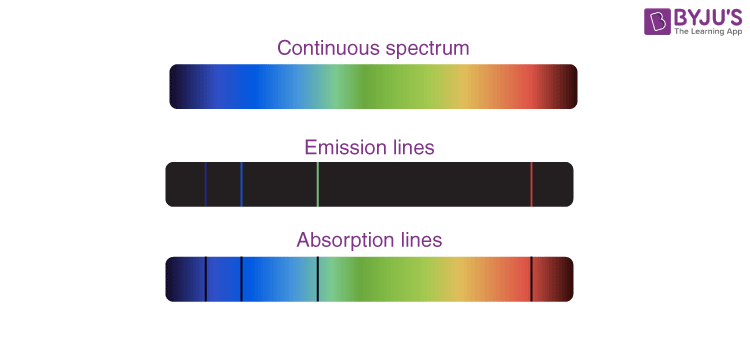
Line absorption spectra
A continuous spectrum with discrete dark lines removed, produced when atoms absorb photons of specific energies that match allowed transitions → only photons with exactly the right energies are absorbed (matching energy gaps)
Emission and absorption line positions match for the same gas (same energy gaps)
How they form:
If white light passes through a cooler gas, atoms absorb photons whose energies match allowed upward transitions
Those wavelengths are missing from the transmitted light, so dark lines appear
Explain why a dark fringe produced
phase difference is 180° or π / path difference is λ2 / anti phase
Destructive interference
Explain why some waves can be polarized but others cannot
Transverse waves oscillations are perpendicular to direction of energy transfer
Whilst longitudinal waves oscillation are parallel to the direction of energy transfer
Polarisation is restriction of displace vector to one plane
Explain how the minima of intensity occur
Two waves superpose/interfere with each other when they move in opposite directions towards each other
This means for minima to be observed, they are permanently in anti-phase with each other
Explain how electron diffraction shows evidence for wave nature of electrons
Particle behaviour would only produce a patch/circle of light/small spot of light
Wave property shown by diffraction or interference
Graphite causes electron waves to spread out or electrons to travel in particular directions
Bright rings/maximum intensity occurs where waves interfere constructively/ are in phase
State and explain what happens to the value of angle θ for the first order beam if the wavelength of the monochromatic light decreases
angle θ gets smaller (1)
because path difference gets smaller/d constant, (λ smaller) so sin θ smaller
Describe what the observer would see as Q is rotated slowly through 360
Variation in intensity between max and min (or light and dark) (1)
Two maxima (or two minima) in 360° rotation (1)
Explain briefly how energy is transmitted in this sound wave
Particles in the transmitting medium are made to vibrate/given energy
Compression/region of increased pressure (or rarefaction) causes nearby particles to vibrate/have energy/move