Lecture 1
 Call Kai
 Learn
Learn Practice Test
 Spaced Repetition
 Match
Match Flashcards
 Knowt Play
1/45

Earn XP
Description and Tags
Heroes, heroines, and narrative in paintings
Name | Mastery | Learn | Test | Matching | Spaced | Call with Kai |
|---|
No analytics yet
Send a link to your students to track their progress
46 Terms
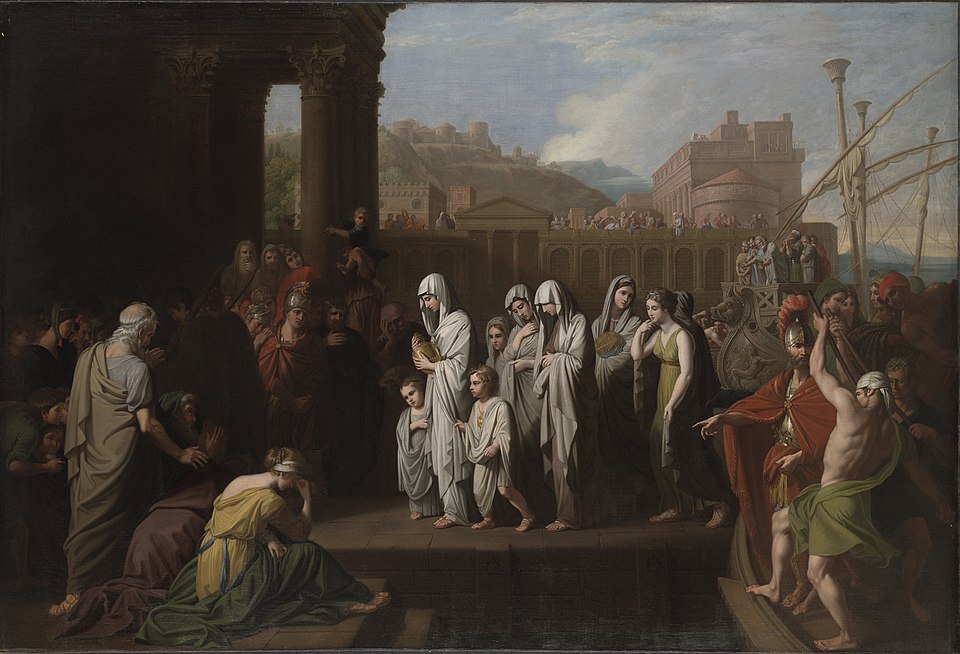
Benjamin West, Agrippina Landing at Brindisium with the Ashes of Germanicius (1768)
exemplifies a reawakened interest in the noble values of classical antiquity—stoicism, self-sacrifice, generosity, patriotism—that influenced artists and writers as well as politicians in the second half of the eighteenth century.
West here depicts a dramatic episode from Roman history. Agrippina, widow of the assassinated and much-admired general Germanicus, is seen arriving with the ashes of her slain husband. Crowds of mourning citizens greet her as she starts on her way to confront the Emperor Tiberius, widely believed to have arranged for Germanicus’s murder.
she is shown going throuh grief - these intense emotions must be represented - the light highlights the min characters
oil on canvas
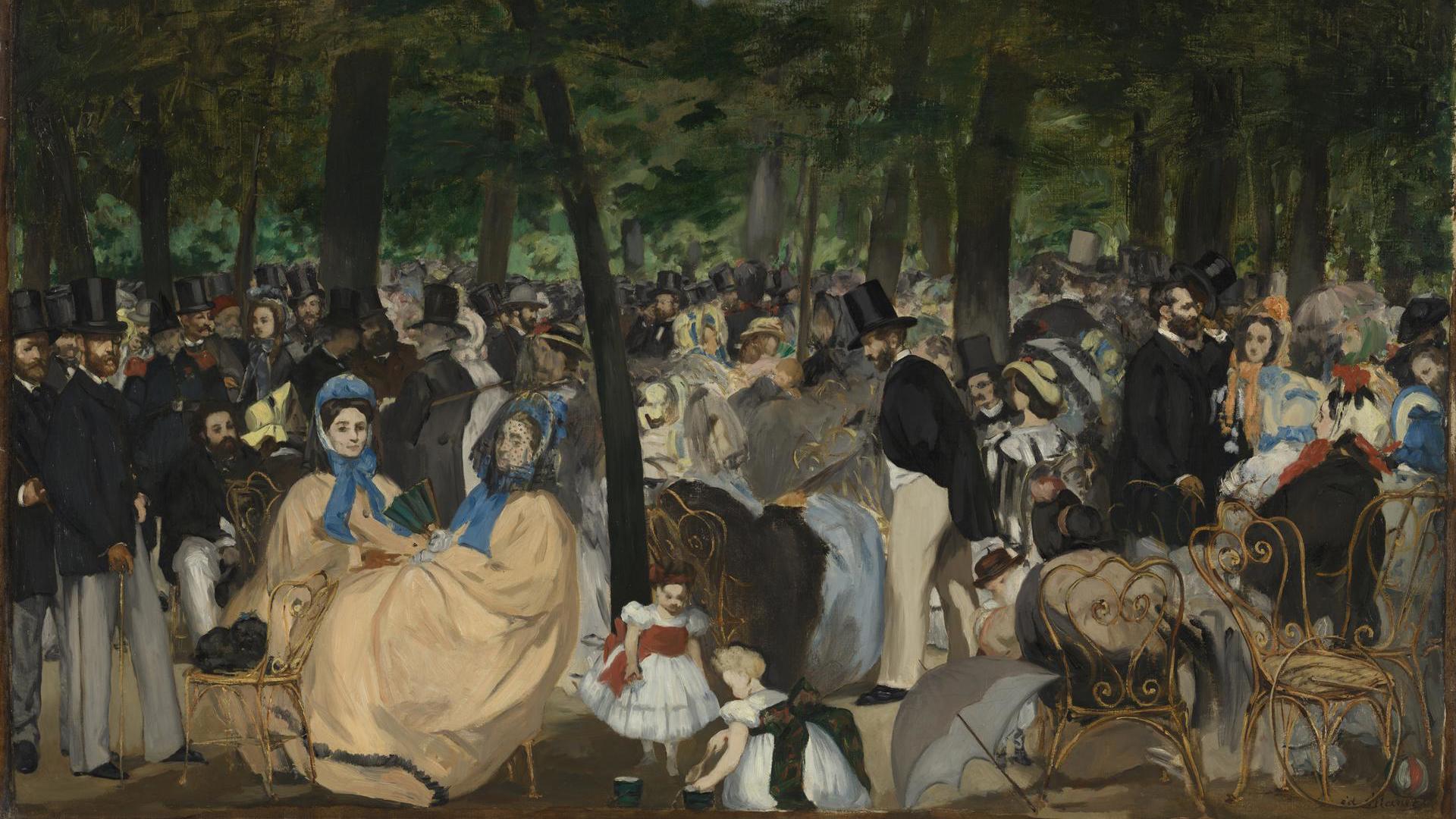
Edouard Manet, Music in the Tuileries (1862)
A fashionable and wealthy crowd that includes many artists and intellectuals has gathered in the Tuileries Gardens to listen to one of the twice-weekly concerts given there. Manet himself stands at the far left of the picture holding a cane, his body cut by the edge of the canvas and partly obscured by the man in front of him, the animal painter Comte Albert de Balleroy. He is a participant in the scene but also slightly detached from it.
Painted in 1862, this was Manet’s first major painting of contemporary life in Second Empire Paris (1852–1870) and is an early example of his interest in urban leisure, a subject that would preoccupy him for the rest of his life, as it would the Impressionists. But it is also a group portrait of Manet and his family, friends and associates.
The painting has the status of an artistic manifesto and has justifiably been described as the earliest example of modern painting due to its subject matter and technique.
oil on canvas
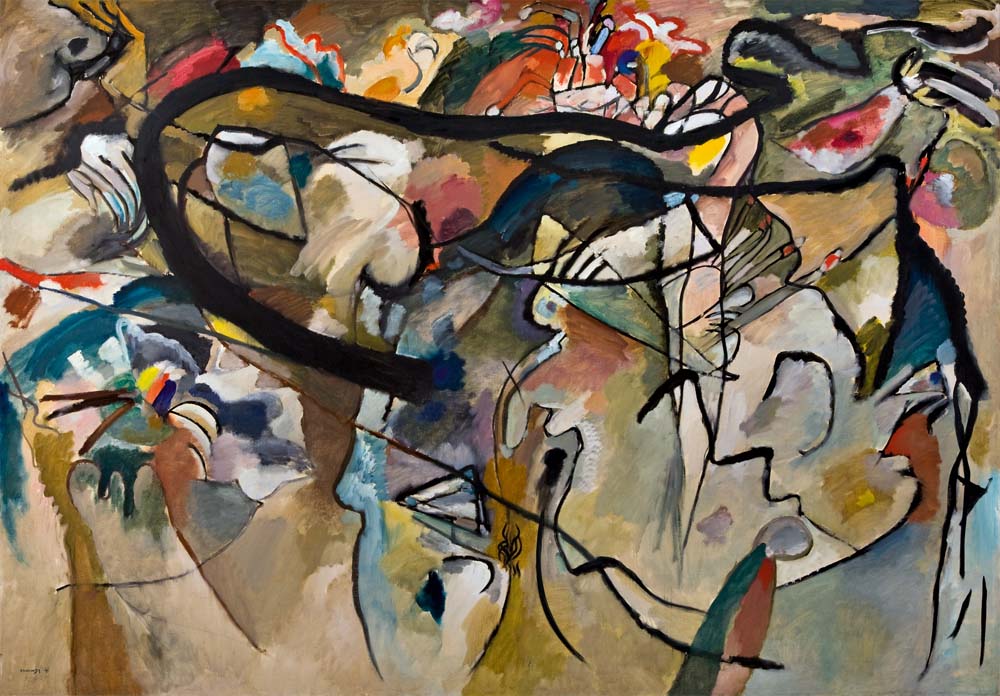
Wassily Kandinsky, Composition V, (1911)
The very size of Composition V indicates the significance that Kandinsky himself attributed to this work. The painting provokes a diversity of problems. To concentrate on one of the more distinct of these, it evidently lacks space in the traditional sense. There appears to be neither volume nor interstices; there is no indication of foreground or background, no evidence of light or atmosphere which may create the illusion of space. The pictorial elements are not applied in order to depict existing objects or to characterize tangible materials. Moreover, the work is not based on the perception or observation of things in nature.
oil on canvas
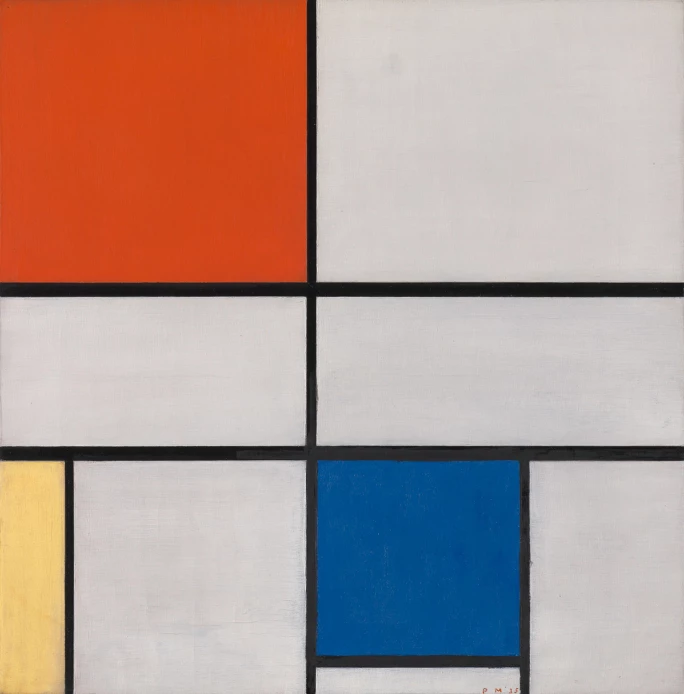
Piet Mondrian, composition C with Red, Yellow, and Blue (1935)
one of a series of works, composed of straight black lines and areas of primary colour, that mark the culmination of Mondrian's efforts to create a purely spiritual form of modern painting.
oil on canvas
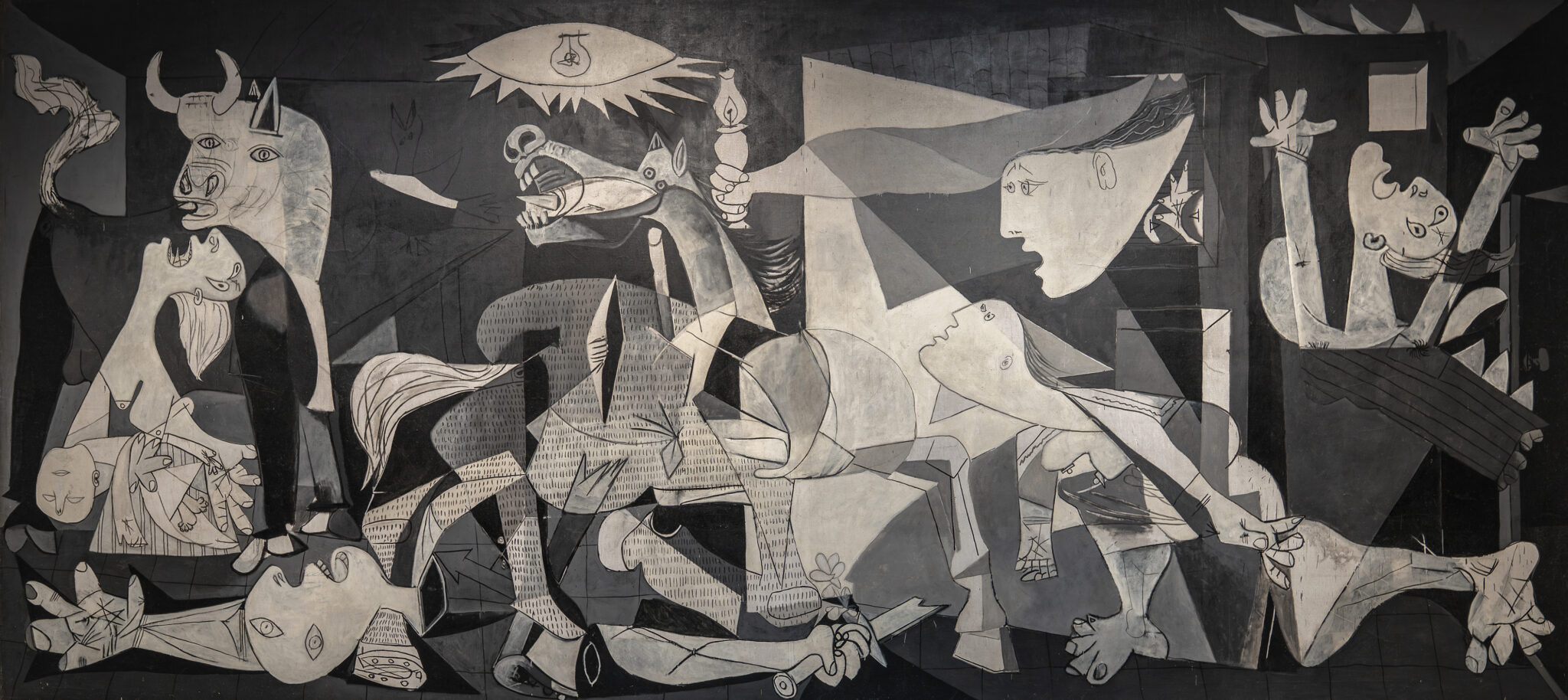
Pablo Picasso, Guernica (1937)
n 1937, Pablo Picasso expressed his outrage against war with Guernica, his enormous mural-sized painting displayed to millions of visitors at the Paris World’s Fair. It has since become the twentieth century’s most powerful indictment against war, a painting that still feels intensely relevant today.
In 1936, a civil war began in Spain between the democratic Republican government and fascist forces, led by General Francisco Franco, attempting to overthrow them. Picasso’s painting is based on the events of April 27, 1937, when Hitler’s powerful German air force, acting in support of Franco, bombed the village of Guernica in northern Spain, a city of no strategic military value. It was history’s first aerial saturation bombing of a civilian population.
oil on canvas
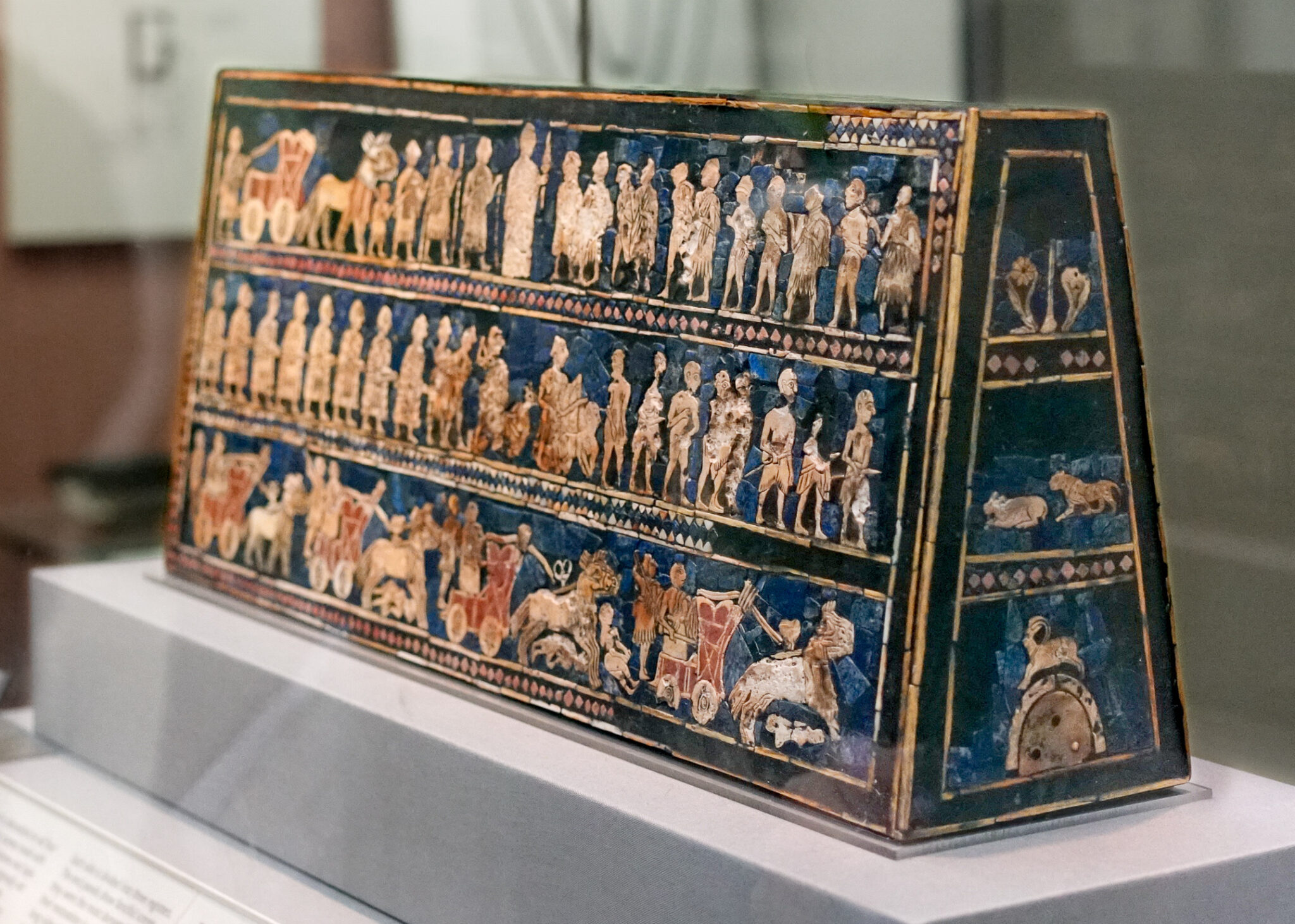
The Standard of Ur, (2600–2400 B.C.E) Southern Iraq
The Standard of Ur is a fascinating rectangular box-like object which, through intricate mosaic scenes, presents the violence and grandeur of Sumerian kingship.
mosaic
generations passing on stories to new ones
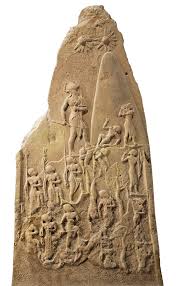
Victory Stele of Naram-Sin, (2254-2218 B.C.E.)
This monument depicts the Akkadian victory over the Lullubi Mountain people. In the 12th century B.C.E., a thousand years after it was originally made, the Elamite king, Shutruk-Nahhunte, attacked Babylon and, according to his later inscription, the stele was taken to Susa in what is now Iran.
limestone carving
these pictures remiknd us that humans are drawn to story telling
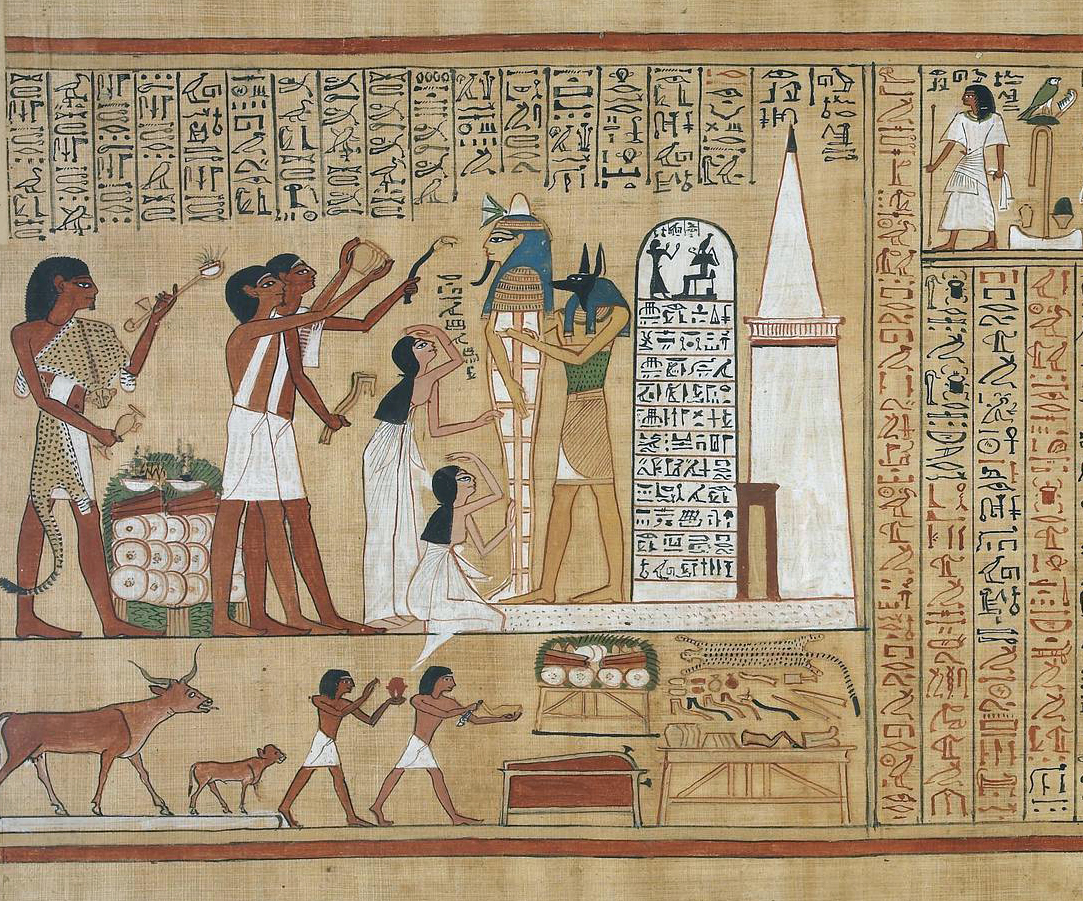
Hunefer’s Judgement in the presence of Osiris, Book of the Dead of Hunefer, c. (1275 B.C.E)
Hunefer and his wife Nasha lived during the Nineteenth Dynasty, in around 1310 B.C.E. He was a “Royal Scribe” and “Scribe of Divine Offerings.” He was also “Overseer of Royal Cattle,” and the steward of King Sety I. These titles indicate that he held prominent administrative offices and would have been close to the king. The location of his tomb is not known, but he may have been buried at Memphis.
Hunefer’s high status is reflected in the fine quality of his Book of the Dead, which was specially produced for him. This, and a Ptah-Sokar-Osiris figure, inside which the papyrus was found, are the only objects which can be ascribed to Hunefer. The papyrus of Hunefer is characterized by its good state of preservation and the large, and clear vignettes (illustrations) are beautifully drawn and painted. The vignette illustrating the “Opening of the Mouth” ritual is one of the most famous pieces of papyrus in The British Museum collection, and gives a great deal of information about this part of the funeral.
illuminated papyrus
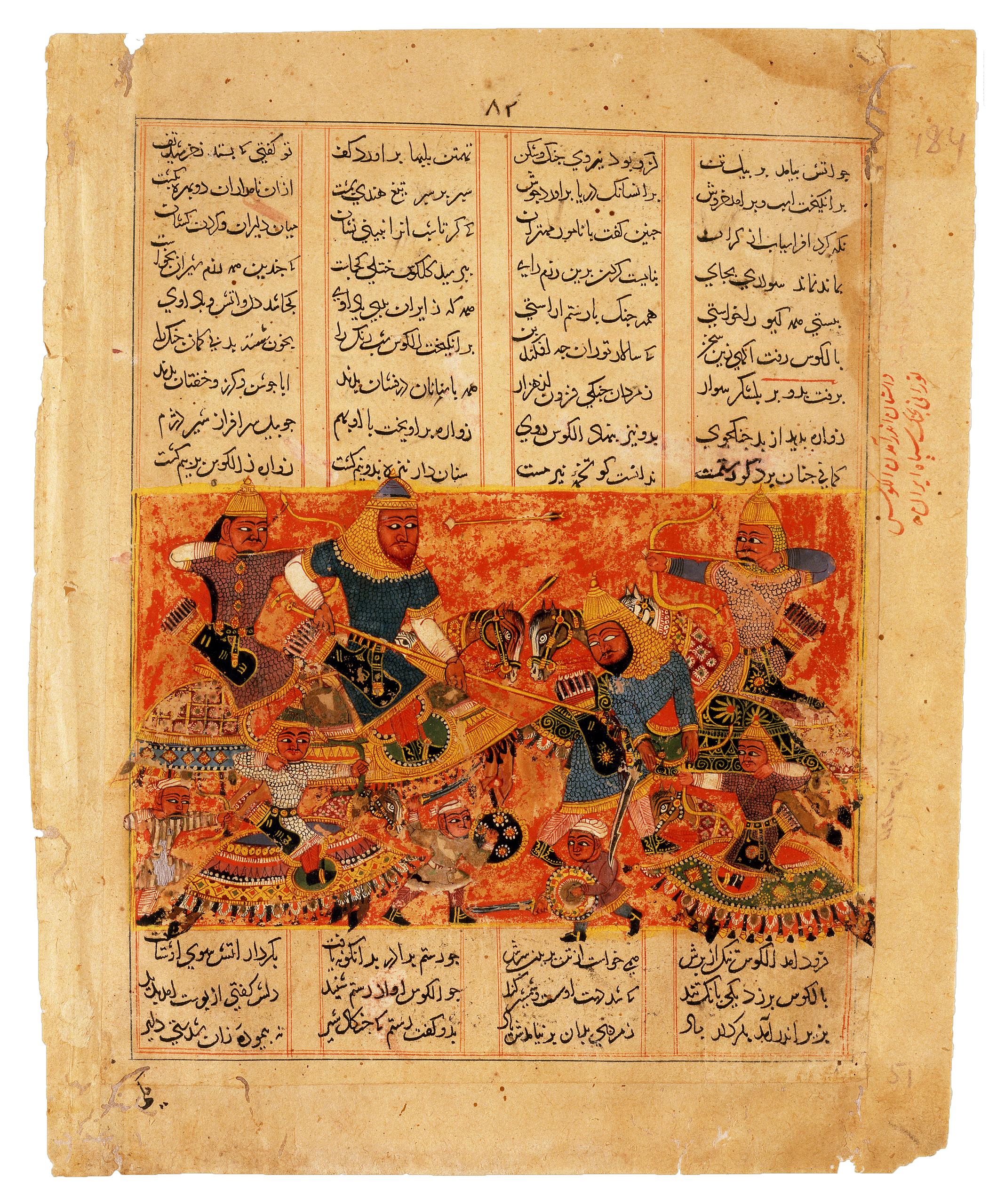
‘Rustam Kills the Turanian Hero Alkus with his Lance’ (1450)
This miniature comes from a manuscript made by an artist who was highly influenced by Jain art from western India. Both the intense palette and the depiction of figures differ from those found in other Islamic painting.
Rustam is portrayed without his customary leopard helmet and tiger caftan. An unusual detail is Alkus, the whites of his eyes showing as he begins his death throes. The hierarchic perspective in which the heroes are largest and figures in front are smaller is also curious.
from a Jainesque Shahnama manuscript, likely produced in the Sultanate of Delhi
Watercolour and ink on paper
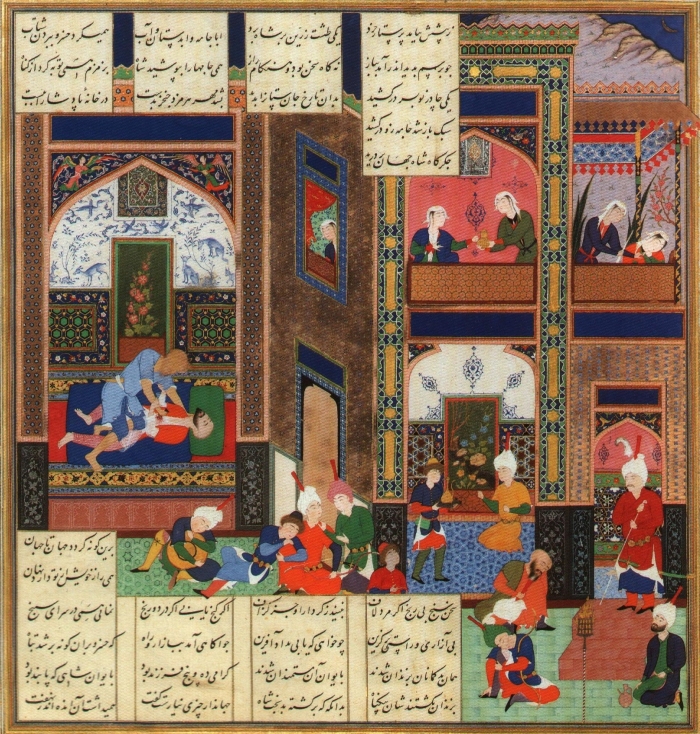
The assassination of Khosrau II in a manuscript of the Shahnameh of Shah Tahmasp made by Abd al-Samad (1535)
After many years of honest rule, Khusrau Parviz became unjust and his chiefs plotted to overthrow him. The conspirators placed his eldest son, Shuriya, on the throne and imprisoned Khusrau with his beloved Shirin. However, the power of the deposed shah was still feared and Shuriya’s advisors pressed him to order his father’s assassination. A foulsmelling killer was found and soon he entered Khusrau’s chamber and stabbed him through the heart. This work is one of the few by the young artist 'Abd al-Samad, who left for India in the 1540s and was instrumental in founding the Mughal school of painting.
Opaque watercolor, ink, silver, and gold on paper
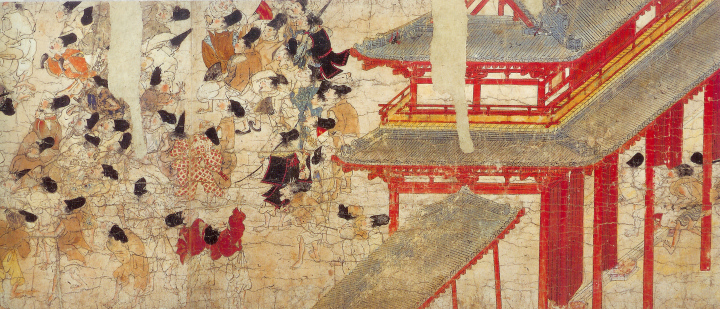
Ban Dainagon Ekotoba (The Tale of Great Minister Ban) by Tokiwa Mitsunaga (12th century)
Mitsunaga lived during a very dramatic period for Japan. This relates to important historical events that took place between 1156 and 1185, involving the clans of Taira and Minamoto. Therefore, the flows of power concentration and intrigues filled the world of Mitsunaga during his most productive period.
ink on paper
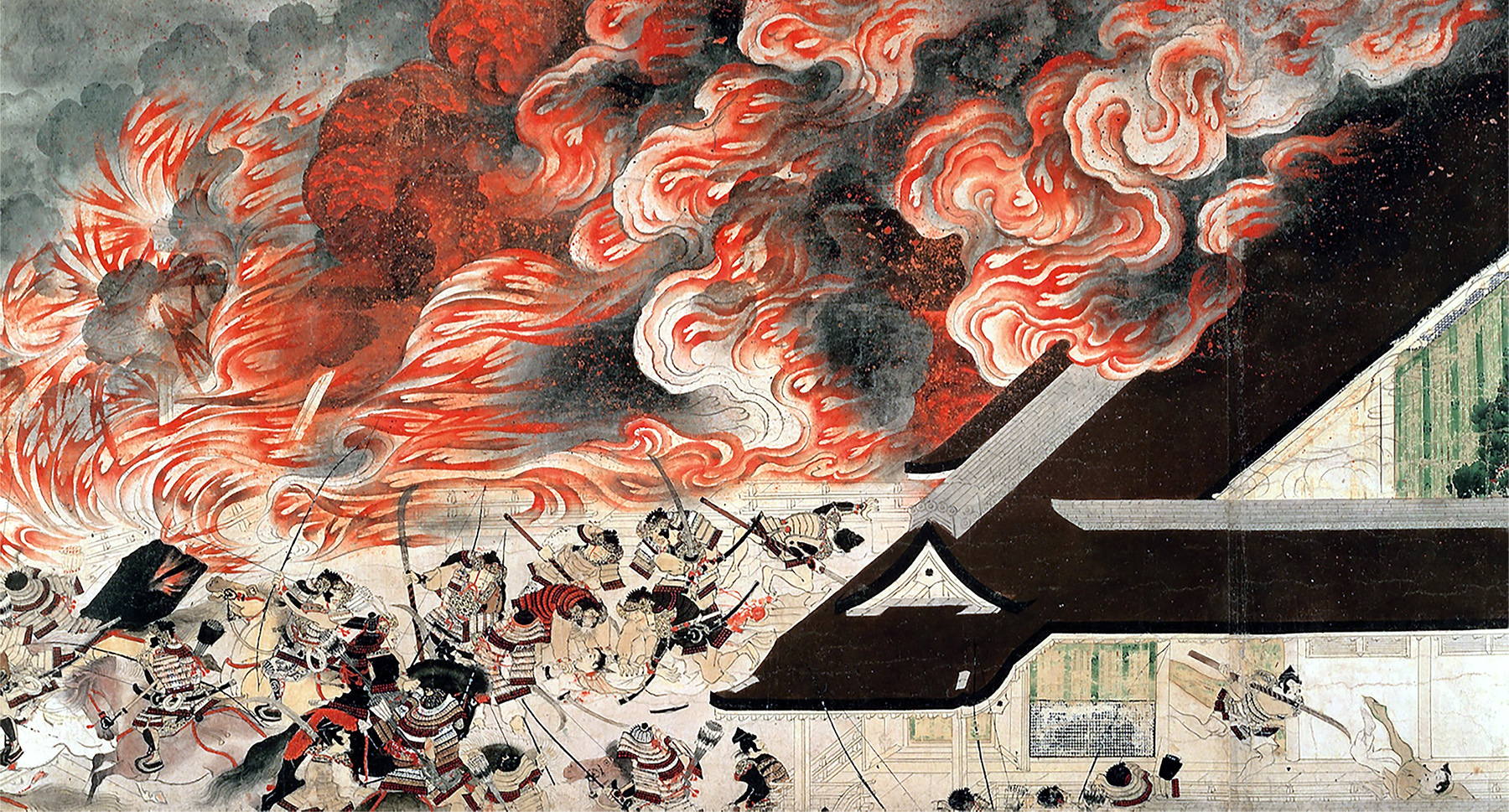
Night Attack on the Sanjô Palace (second half of the 13th century)
This begins in a brief introduction to a complicated yet fascinating chapter in Japanese history. Incredibly, the appalling incident at Sanjô Palace depicted on the scroll was but one chapter in the vicious Heiji Insurrection of 1159–60. This short war, with two other famous conflicts before and after, punctuated a brutal epoch that came to a close in 1192 with the establishment of the Kamakura shogunate. The stories of these flashpoints of blood thirst, collectively called gunki monogatari, or “war tales,” have inspired a huge body of art over the centuries. The Night Attack on the Sanjô Palace, once part of a larger set that pictorialized the entire Heiji incident, survives with two other scrolls, one of them only in remnants.
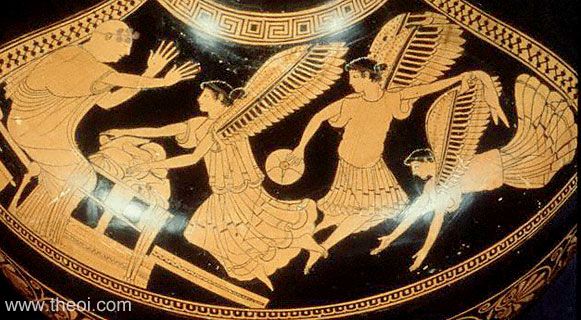
Phineus & the Harpies (ca 480 B.C. Late Archaic)
Three winged Harpies snatch food from the table of the blind king Phineus. The old, balding man raises his hands to ward off the creatures.
teracotta vases painted with liquid clay called slip
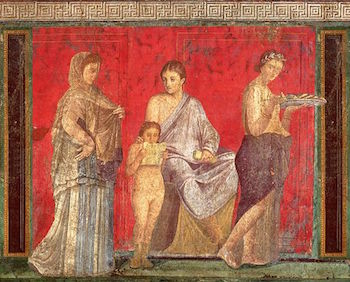
Dionysian Cult Cycle at the Villa of Mysteries, Pompeii (before 79 C.E.)
These are large-scale figures painted on three walls that we think depicts a Dionysian cult ritual. At this time, what we call “mystery cults,” which were religions that came from the East, were not entirely okay. The state religion was still the only official religion that was allowed.
fresco
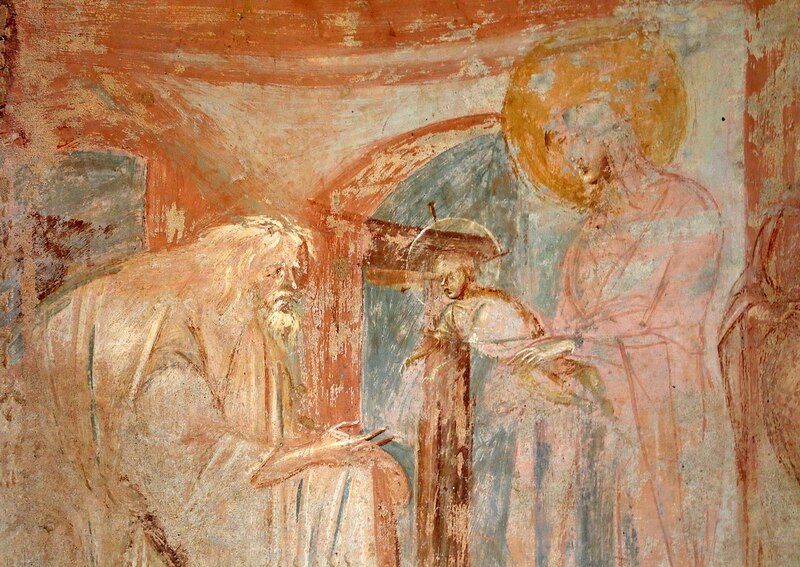
Castelseprio frescoes (ca. 700)
A small church outside Castelseprio contains a cycle of Marian images discovered in 1944. Known as Sta. Maria foris Portas (St. Mary outside the Gates), the current triconch was originally single-apse.
In addition to the Hetoimasia on the chancel arch and scenes of the Annunciation, Visitation, Journey to Bethlehem, Nativity, Adoration of the Magi, and Presentation of Jesus in the Temple, a rare fresco shows Mary undergoing a trial by drinking bitter water in the Temple. This ordeal, based on the biblical book of Numbers 10:11–31, was meant to reveal whether a woman had been an unfaithful wife. Another scene shows a dreaming Joseph, Mary's husband, being reassured by an angel that this unfaithfulness did not occur.
frescoe
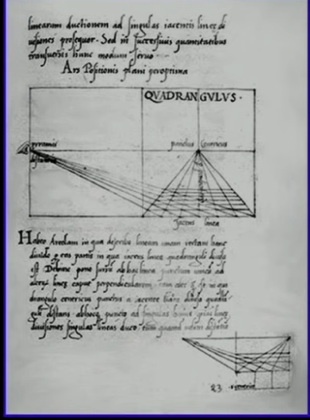
Leon Battista Alberti, De pictura (1435)
Leon Battista Alberti first wrote De pictura in 1435, in which he described, in words and illustrations, the geometrical principles of perspective in painting. The following year he wrote a version in the Tuscan dialect, Della pittura.
istoria - pictures based on text; father of storytelling
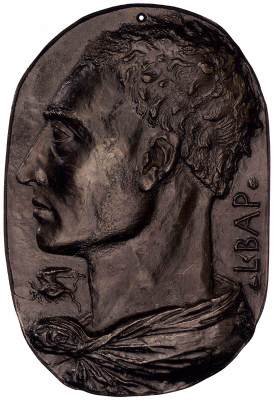
Leon Battista Alberti, Bronze Self-Portrait (1435)
Alberti's first appearance in Florence was in 1434, the year of Cosimo de' Medici's return from exile. It was apparently during his time in Florence that Alberti executed a large self-portrait medal in bronze. He shows himself in strict profile, wearing a classical cloak, as indicated by the knot, and a severe haircut based on classical models. Alberti was clearly in the vanguard of artistic developments, for this is one of the earliest, if not the earliest, of Renaissance portrait medals, and also the first independent self-portrait by a Renaissance artist and the first to show the artist dressed in the antique style.
bronze carving
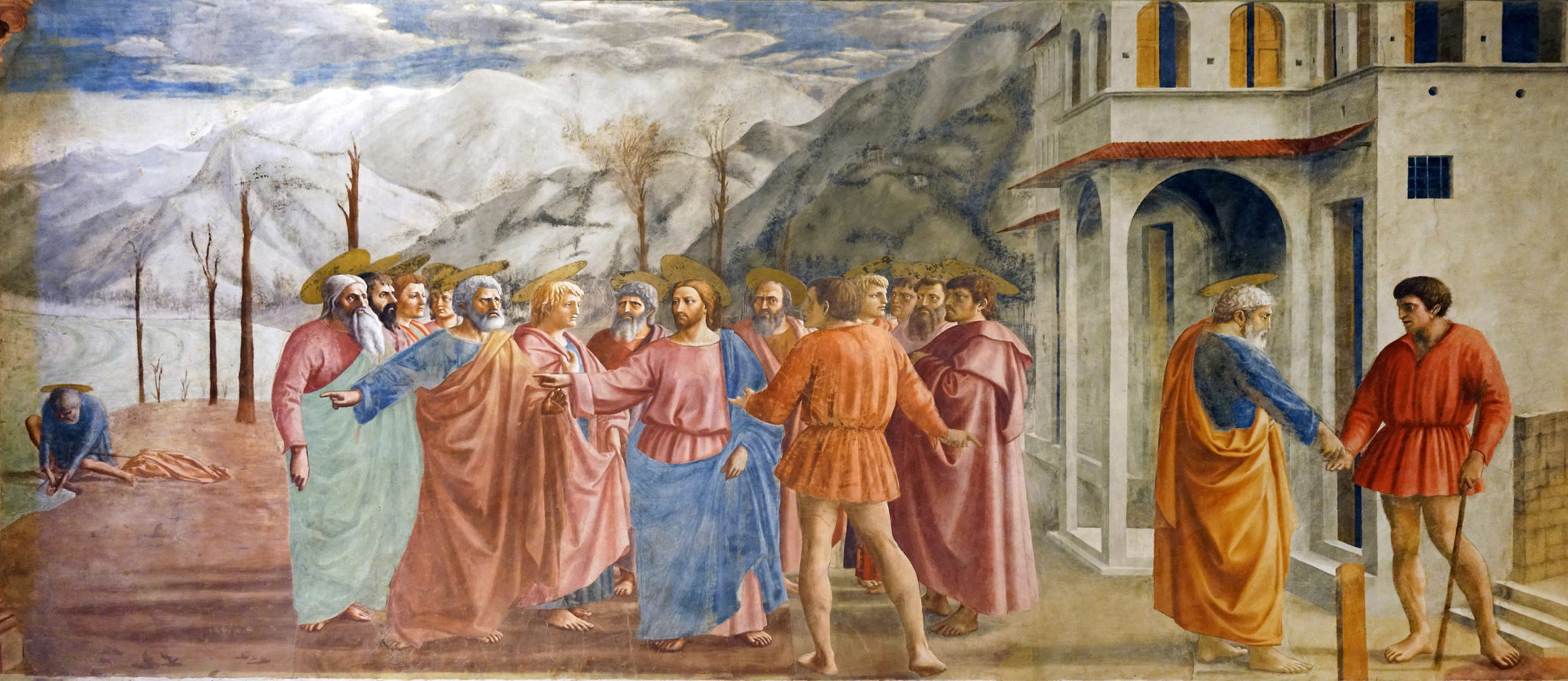
Masaccio, The Tribute Money, (1427)
In the Tribute Money, a Roman tax collector (the figure in the foreground in a short orange tunic and no halo) demands tax money from Christ and the twelve apostles who don’t have the money to pay.
frescoe
This way of telling an entire story in one painting is called a continuous narrative.; spectator needing to enter the picture which creates a new approach to experiencing art
Santa Maria del Carmine in Florence
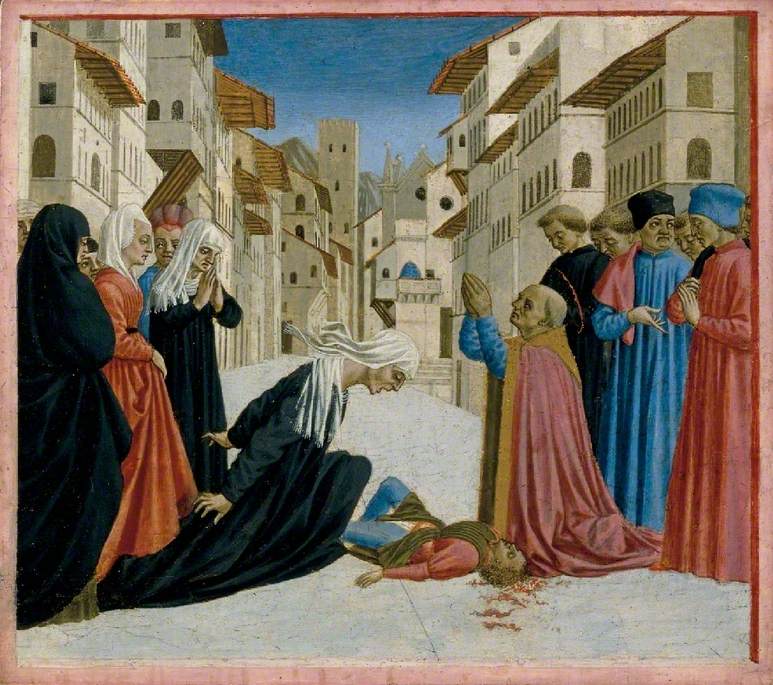
Domenico Veneziano, A Miracle of Saint Zenobius (c. 1445)
It depicts the 4th-century Bishop of Florence resurrecting a child for a French pilgrim, a key miracle in his lore.
tempera on panel
St Lucy Altarpiece, painted in the mid-1440s for the small church of S Lucia de'Magnoli in Florence
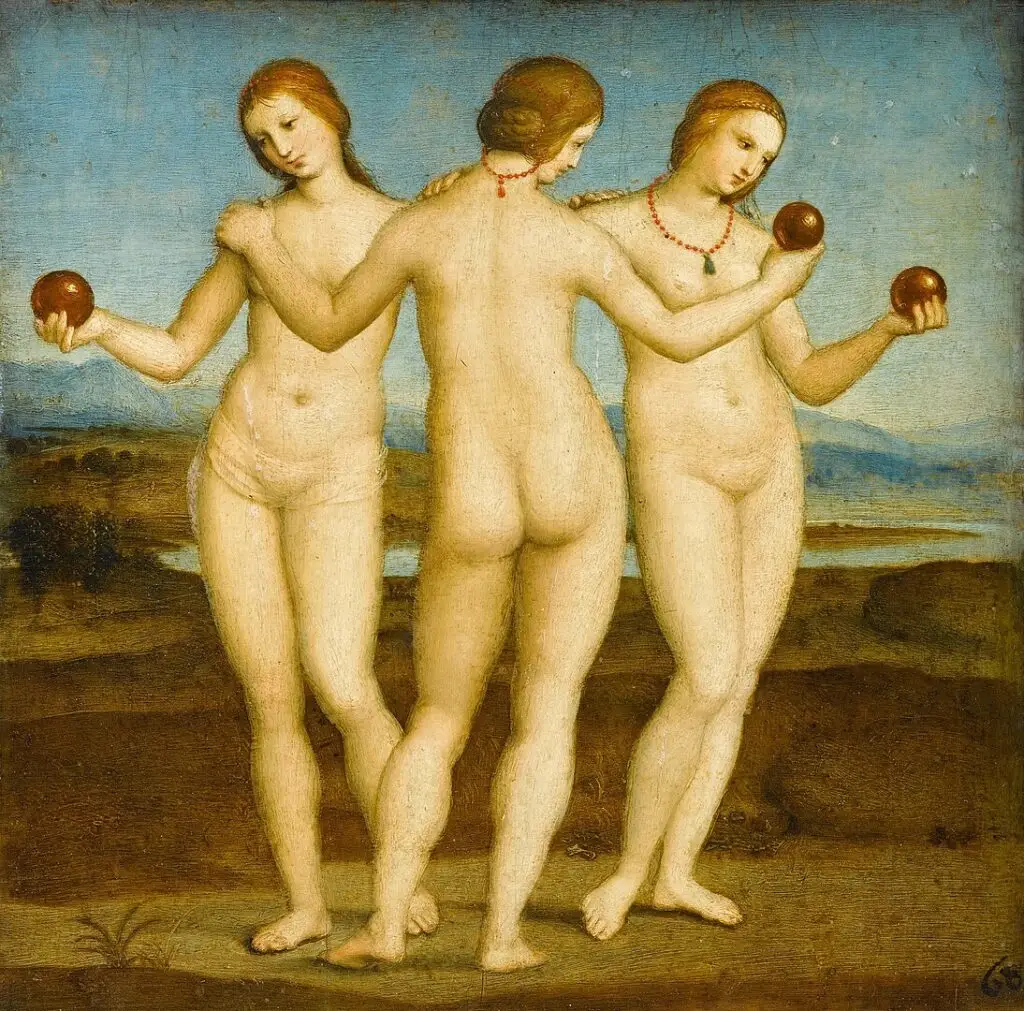
Raphael’s “The Three Graces,” (1505)
significant work from the High Renaissance master’s early period. This relatively small panel painting captures the classical subject of the three mythological Graces Notably, this work is considered one of Raphael’s first explorations of the female nude, depicting the figures with a delicate harmony and serene elegance that would come to characterize his mature style.
oil painting
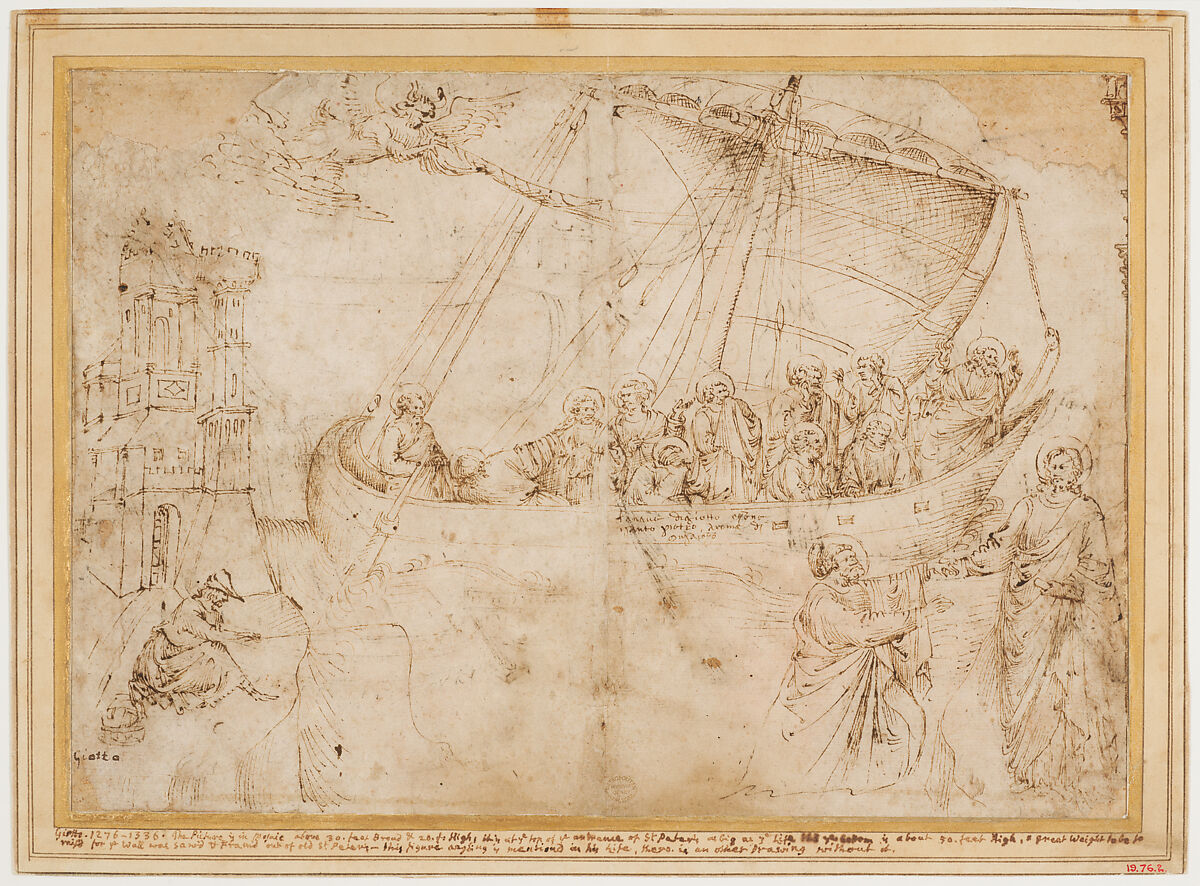
Giotto's "Navicella" - The Calling of St. Peter (verso) (1298-1300)
The early fifteenth-century painter Parri Spinelli, like many others, looked to the authority of the great Florentine artist Giotto di Bondone for inspiration. This large drawing is a free copy after Giotto’s monumental mosaic (since destroyed) in the portico of Old Saint Peter’s Basilica in Rome, as the inscription on the side of the boat indicates. The scene represents a miracle described in the Gospel of Matthew in which Christ saves the Apostles from a storm at sea. Though Parri’s penwork is at times halting, revealing the cautious hand of a copyist, he also took creative liberties in his composition. For example, it appears he enlarged the figures of Christ and Saint Peter and brought them to the foreground. Here, in a momentary lapse of faith, Peter sinks into the water but is rescued by Christ’s hand. The sheet was part of a bound volume that Parri would have kept for reference in composing his own designs.
Pen and brown ink (recto and verso). glued onto a secondary backing sheet of paper drawn in pen and brown ink, over black chalk
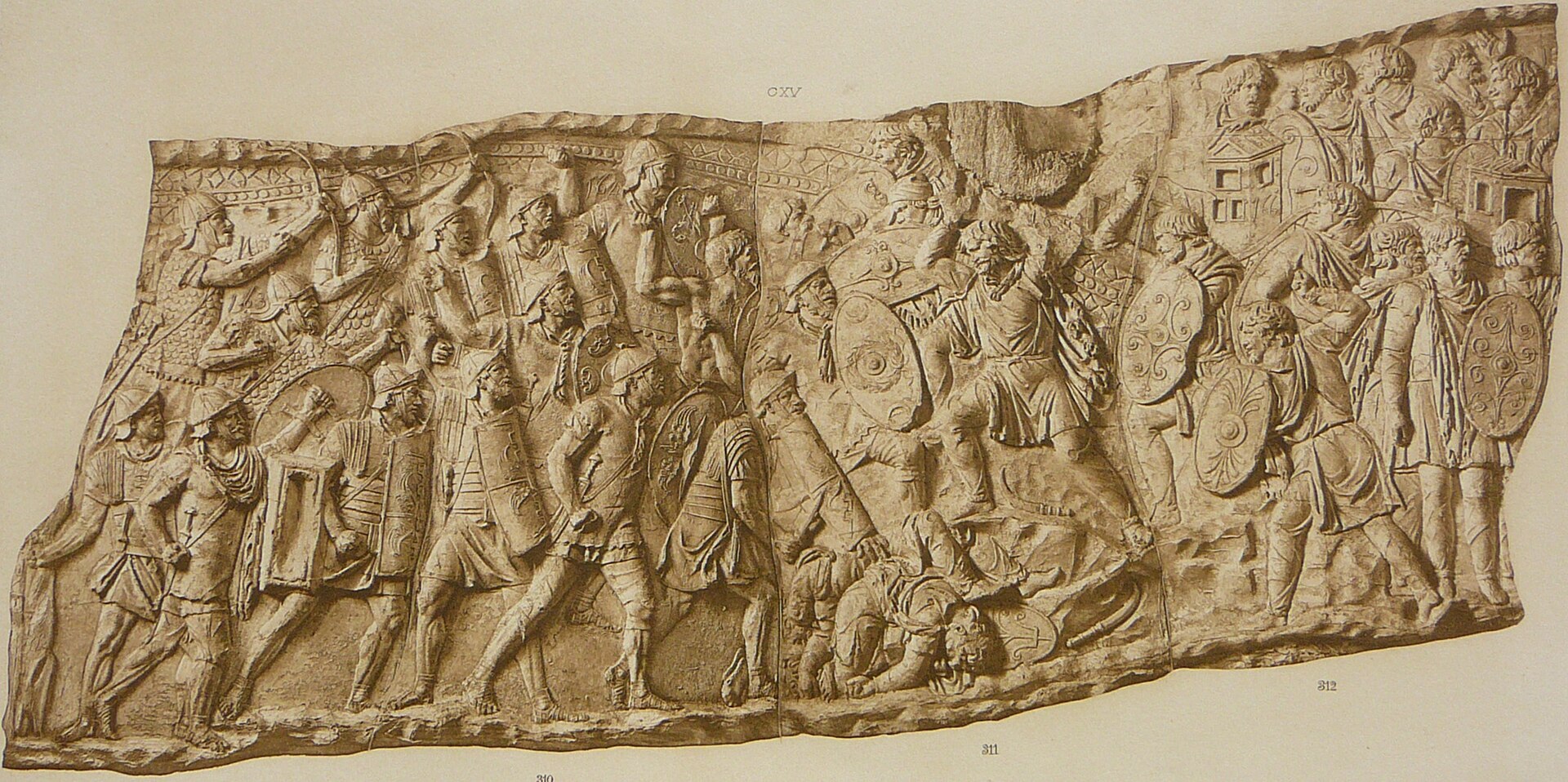
Column of Trajan (113 AD)
The relief portrays the Dacian Wars, specifically scenes of conflict between Roman armies and Dacian forces.
Documentation: This particular image appears to be a plate from a scholarly documentation of the reliefs, specifically Conrad Cichorius's "Die Reliefs der Traianssäule".This image depicts a battle scene from the reliefs on Trajan's Column in Rome.
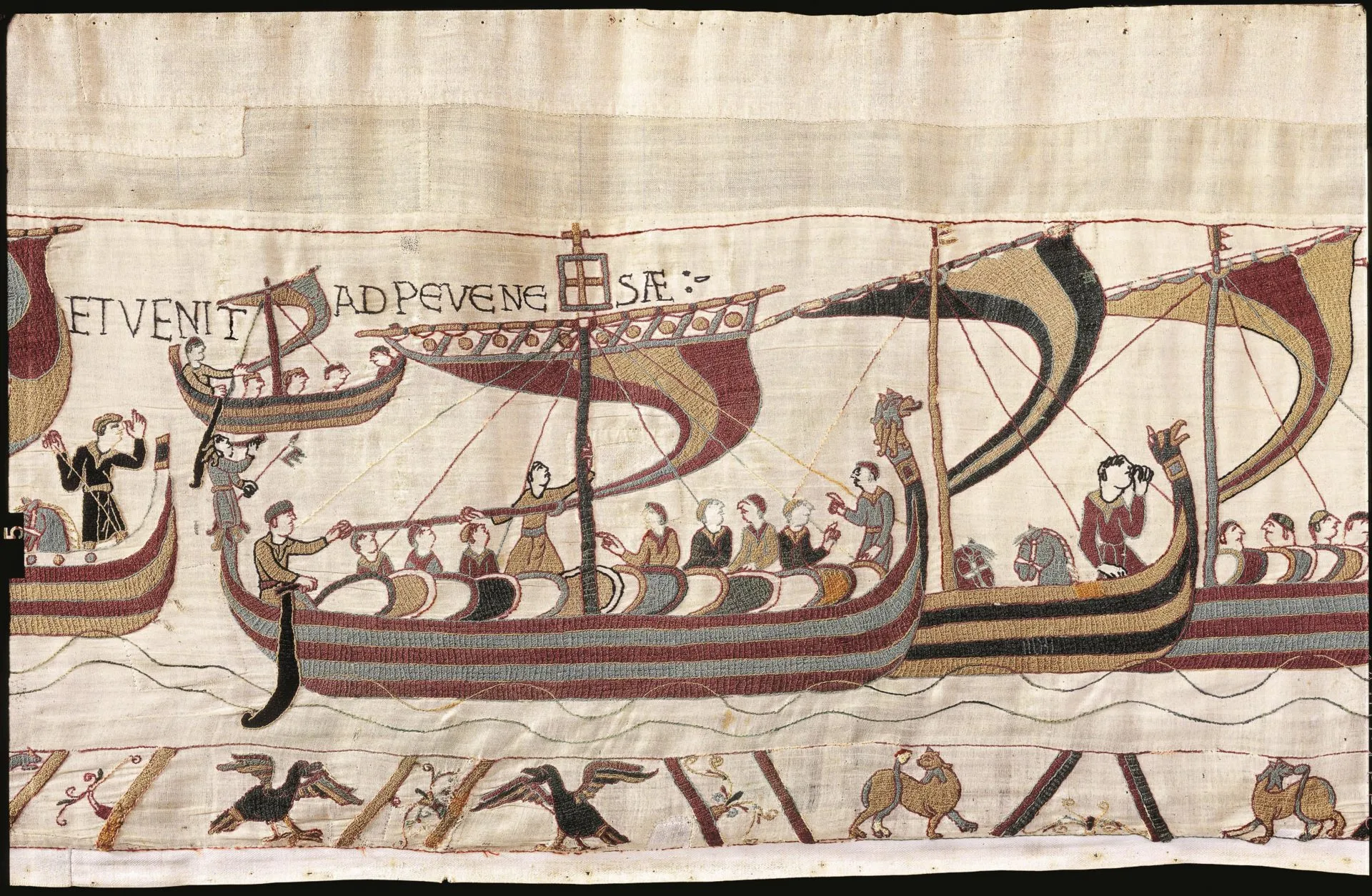
Bayeux Tapestry (c. 1070-80)
The exact origins of the Bayeux Tapestry are shrouded in mystery, but it is widely accepted that it was probably commissioned by Bishop Odo, a half-brother of William the Conqueror. As such, though rich with narrative insight into the Norman Conquest, it must be contextualized as a piece of propaganda that celebrated and legitimized William’s claim to the English throne.
The tapestry chronicles events from 1064 leading up to and including the decisive Battle of Hastings in 1066, which earned William his reputation as “the Conqueror.” It details a dispute over who was rightful heir to King Edward the Confessor, who died in January 1066. Harold Godwinson was initially coronated but William of Normandy soon challenged him for the title. After killing Harold in the Battle of Hastings, William crushed rebels across the country and built castles to establish his power. Norman rule brought significant cultural transformations to a previously Anglo-Saxon kingdom, many of which continue to shape English society today.
norman conquest depicted; scenes include death of english king william; edward the confessor arrives on his death bed; until 19th century tapestry was most expensive median
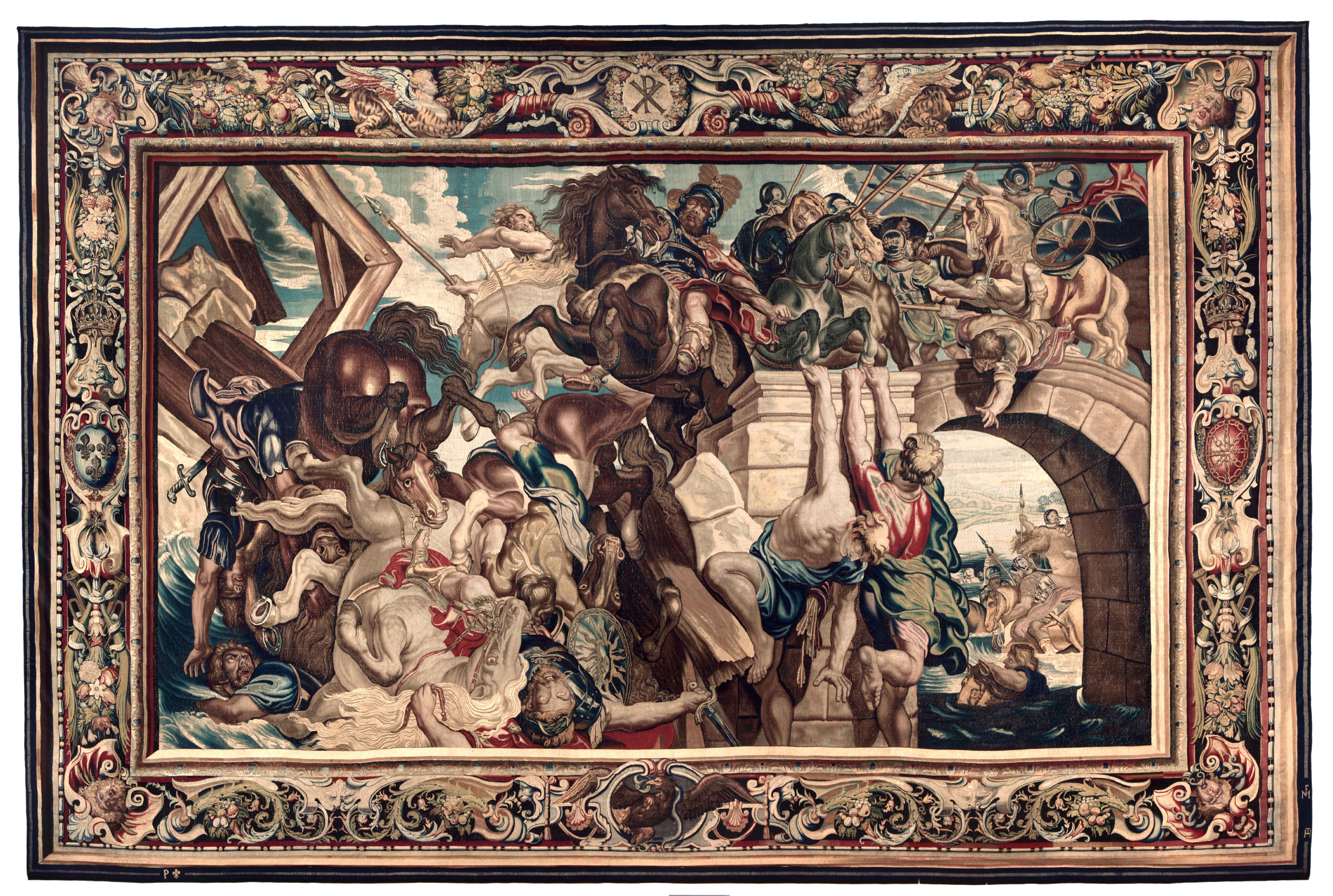
Peter Paul Rubens, Tapestry showing the Triumph of Constantine over Maxentius at the Battle of the Milvian Bridge (1623-1625)
This tapestry shows the dramatic conclusion of the Battle of the Milvian Bridge fought between two leaders of ancient Rome, Constantine and Maxentius, in 312 CE. As part of their strategy, Maxentius’s army knocked down a stone bridge and replaced it with a temporary wooden one, which could be pulled down easily if they needed to retreat. When Maxentius and his troops were forced back by Constantine’s army, the bridge unexpectedly collapsed beneath them, sending horses and soldiers tumbling into the Tiber River below. After this victory, Constantine became the sole ruler of the Western Roman Empire.
The defeated Maxentius is pictured upside down at the bottom center of the composition. Around him, horses and men fall in a tangled mass of arms, legs, bodies, and heads. At the edge of the bridge, a terrified soldier desperately attempts to prevent his horse from falling. Two soldiers cling to the bridge with their fingertips, anxiously trying to hang on. Constantine’s army relentlessly charges forward in the upper right.
Flemish (active Italy, Antwerp, and England), 1577–1640
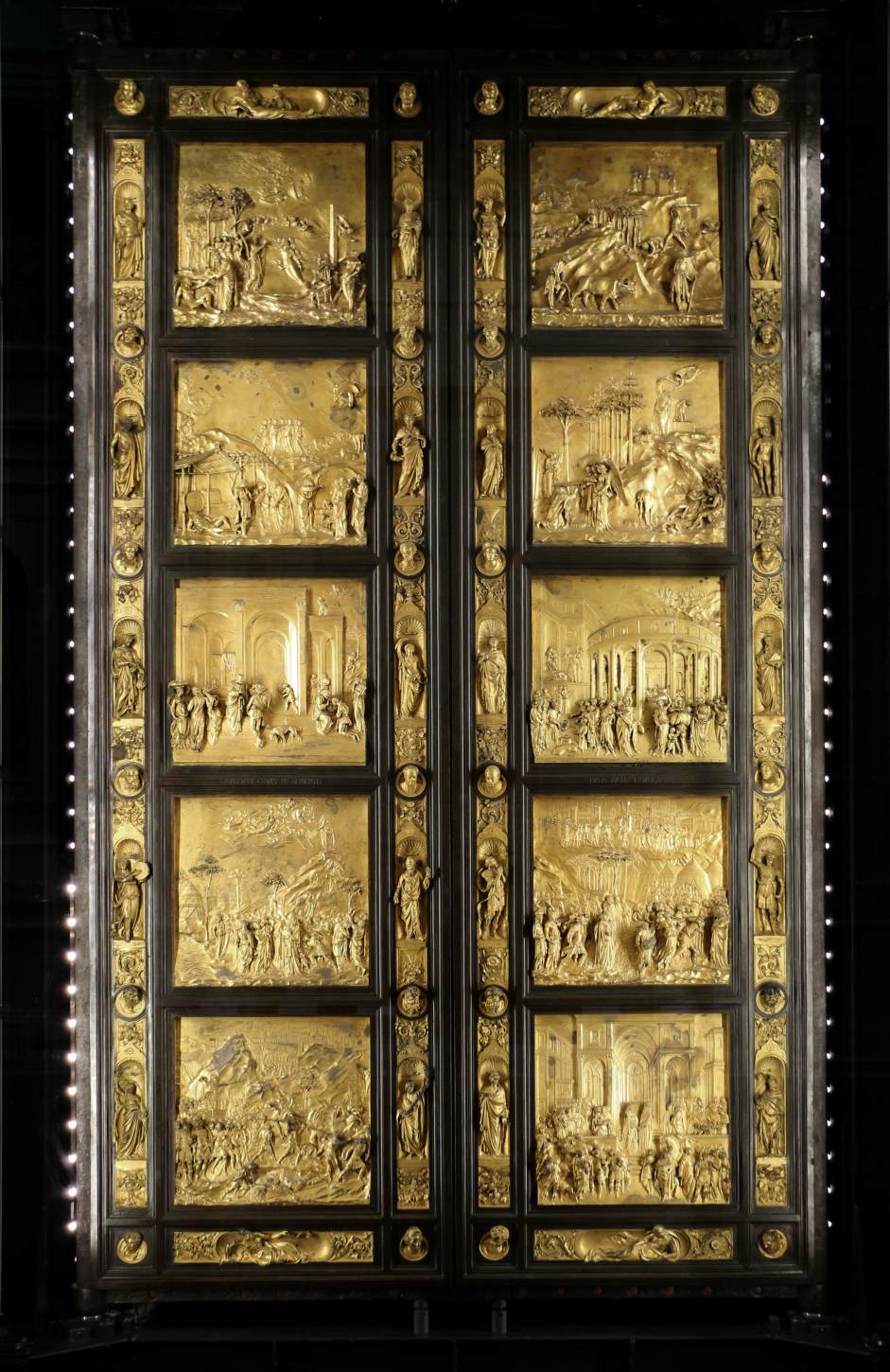
Lorenzo Ghiberti, Gates of Paradise, East Doors of the Florence Baptistry, bronze, (1425–52)
Lorenzo Ghiberti's Renaissance Masterpiece provides an unprecedented opportunity to see three of the bronze doors’ famous narrative reliefs of Old Testament subjects,
The Adam and Eve Panel documents Ghiberti’s earliest work on the doors and features a splendid depiction of nude figures in a landscape set off by angelic hosts. Ghiberti combined four major episodes from the story of Adam and Eve into this harmonious panel. The creation of Adam, illustrated in the foreground on the far left, shows Adam in a state of semiconsciousness, rising in response to God’s life-giving touch. In the center, as angels look on, God forms Eve from one of Adam’s ribs. The temptation of Adam and Eve by the serpent is shown in the background on the left, while the right side of the panel depicts the couple’s expulsion from Eden. Subtle shifts in the scale of the figures reinforce discrete episodes in the story of the Creation. Ghiberti modulated the scale and degree of projection of the angels to visually separate the four scenes.
In the Jacob and Esau Panel, Ghiberti employed a new system of linear perspective to construct the narrative. He arranged the episodes of the story around a vanishing point framed by the central arch of a Renaissance loggia. This panel, with its nearly three-dimensional foreground figures, masterful use of scientific perspective, and impressive architecture, shows that the artist was at the vanguard of Florentine illusionism and storytelling. In the panel, Jacob obtains the birthright of his elder brother, Esau, and the blessing of their father, Isaac, thus becoming the founder of the Israelites. Rebekah is shown giving birth to the twins beneath the arcade on the far left. On the rooftop in the upper right, Ghiberti depicted her receiving the prophecy of her sons’ future conflict.
Framed inside the central arch, Esau sells his rights as firstborn to Jacob, who offers his hungry brother a bowl of soup in exchange. In the front center of the panel, Isaac sends Esau hunting, and, in the right foreground, Jacob kneels before the blind Isaac, who, feeling a hairy goatskin on Jacob’s back, believes him to be Esau and mistakenly gives him the blessing due to the eldest son.
In the David Panel, Ghiberti illustrated the young David’s victory over the giant Goliath. David is shown in the foreground cutting off the giant’s head after knocking him down with a stone. Above this episode, King Saul—clearly labeled and elevated over the fighting Israelites and Philistines—leads his troops in a rout of the enemy. A cleft in the mountains beyond reveals David and his followers carrying Goliath’s head in triumph toward Jerusalem.
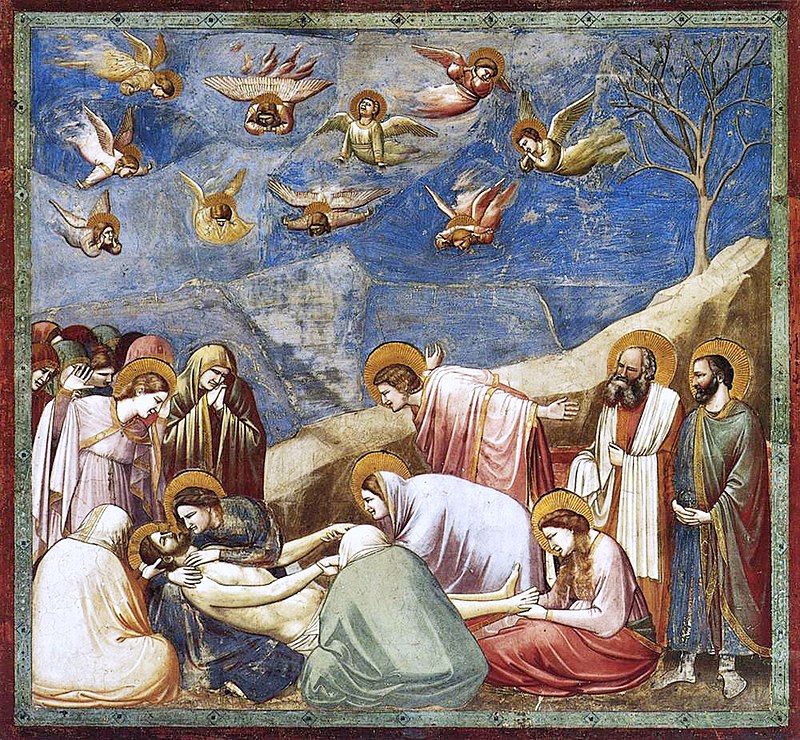
Giotto, Scrovegni Chapel frescoes (1302-05)
The work is the greatest fresco masterpiece of the artist and testifies to the profound revolution that the Tuscan painter brought to Western art. The cycle frescoed by Giotto in just two years, between 1303 and 1305, unfolds over the entire interior surface of the Chapel narrating the History of Salvation in two different paths: the first with the Stories of the Life of the Virgin and Christ painted along the aisles and on the triumphal arch; the second begins with the Vices and Virtues, addressed in the lower section of the main walls, and ends with the majestic Last Judgement on the counter-façade.
Padua, Italy
life size frescoes from the life of christ - tremendous leap for narrative painting
paint humans who have volume and weight
parent hand over baby to the high priest
ritual purification after 40 days after child's birth
he is telling Mary a soul will pierce her soul
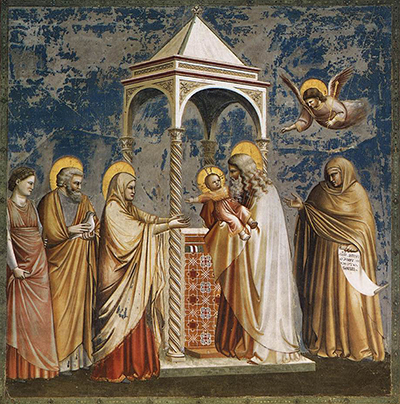
Giotto Di Bondone, Presentation of Christ at the Temple (c.1320)
It is a series of images showing activities around a Jewish tradition, from entrance to the temple to completion of the procedure. Jesus Christ is known as the Saviour in the bible. This painting shows Jesus, just about to undergo one of the Jewish traditions, known as dedication. Traditionally, it was a requirement in the Law of Moses that every firstborn male is dedicated. 'As it is written in the Law of the Lord, every firstborn male is to be consecrated to The Lord.' Luke 2:23.
The Abduction of Deianira, Antonio del Pollaiuolo (Florence, ca. 1432–1498
When the centaur Nessus abducted Deianira, her lover, Hercules, shot him with a poisoned arrow. The dying centaur convinced Deianira that his blood would make a powerful love potion and Deianira sent Hercules a cloak soaked in Nessus’s blood. Putting it on, Hercules was poisoned and died. Deianira then took her own life in remorse. This portrayal of the legend, one of the most famous Renaissance paintings in any American collection, is universally admired for Antonio del Pollaiuolo’s accomplishment in rendering the human body in dramatic action. Equally imposing if less widely acknowledged is the sophistication of its panoramic landscape background depicting Florence and the Arno Valley.
invents a new kind of Hercules - shrewd character with a tough body that is strong
bodies become more convincing - realistic story telling
painter wants to make the story more relevant to the audience
Oil on panel, transferred to canvas
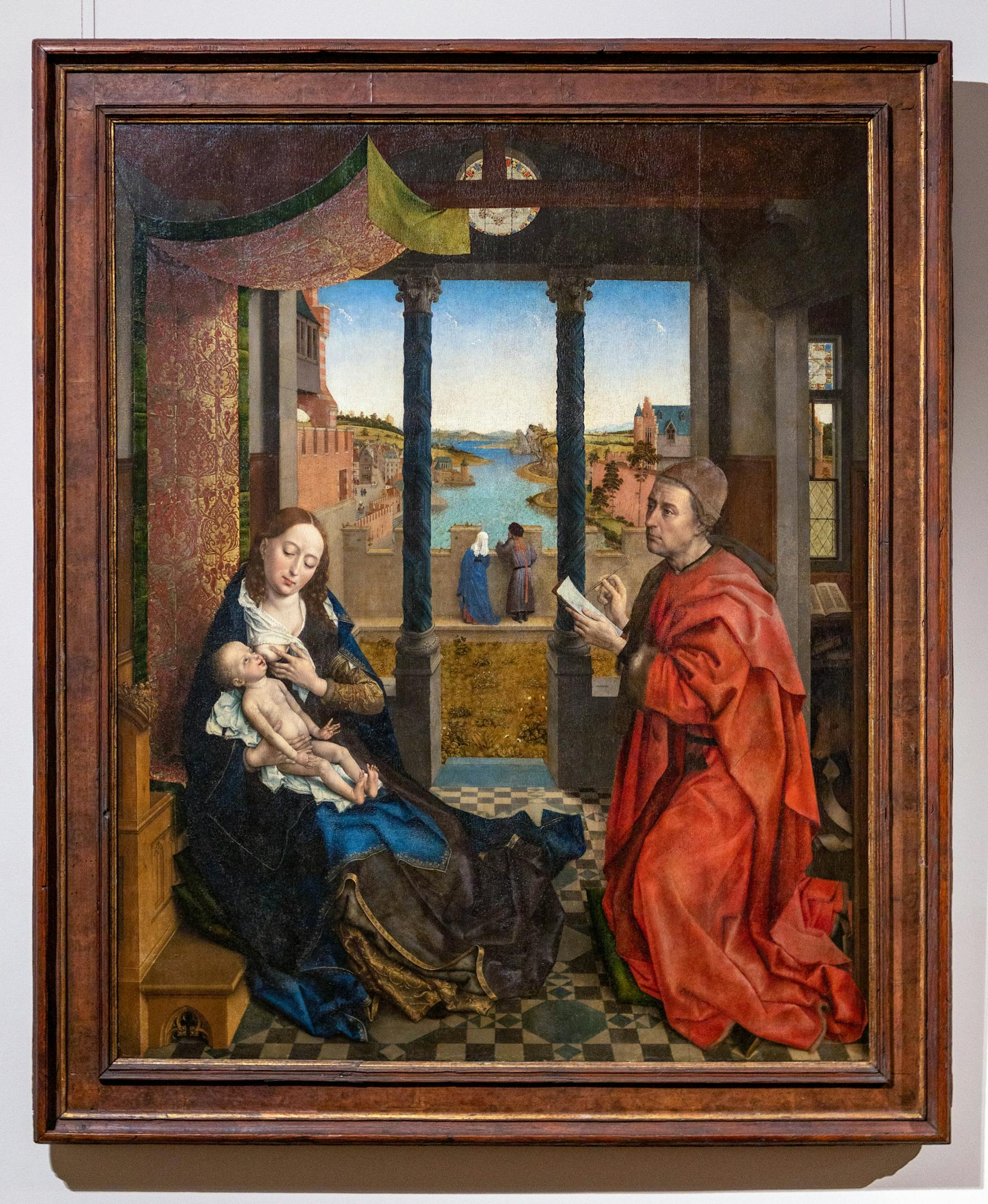
Saint Luke Drawing the Virgin, Rogier van der Weyden, (c. 1435)
oil paint
Belgium
The Northern Renaissance also tended towards this devotional imagery being more naturalistic to convey that the transcendental and sacred are undisputedly involved in earthly life. The focuses and tendencies of this period is exemplified in van der Weyden’s “Saint Luke Drawing the Virgin,” making it a quintessential representation of the early Northern Renaissance artistic movement. This painting is a prime example of the artistic advances made during this period in creating more naturalistic and detailed work than ever before.
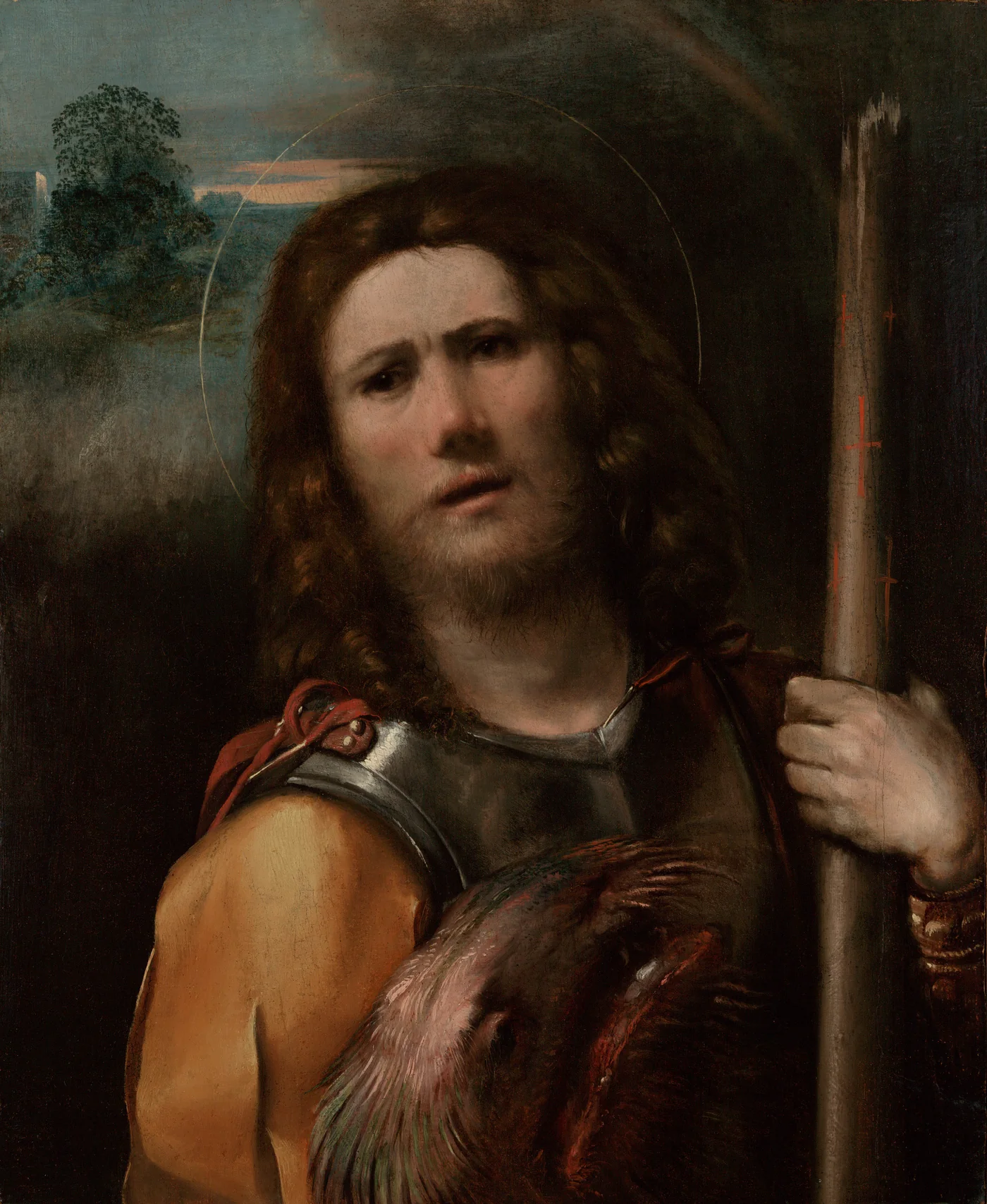
Dosso Dossi, 1515 Saint George
Dosso Dossi depicted the aftermath of Saint George's battle with the dragon, in which he wields the creature's bloodied head and the lance broken during the fight. Under an emerging rainbow, the victorious patron saint of Ferrara, Italy, emerges from the darkness of the battle. Dossi poignantly expressed his subject's recent emotional turmoil in the saint's penetrating expression. He appears weary yet resolute in his triumph.
The symbols of Saint George's Christian faith--crosses rendered in vivid strokes of red paint as though the blood of his opponent drips down its shaft--mark the weapon. The color of the crosses echoes the blood ringing the beast's mouth and also symbolizes the blood of Christ.
ambiguous / dreamy states of mind
the elusive modes of characters complemented by the setting
the halo depicted through nature background
oil paint
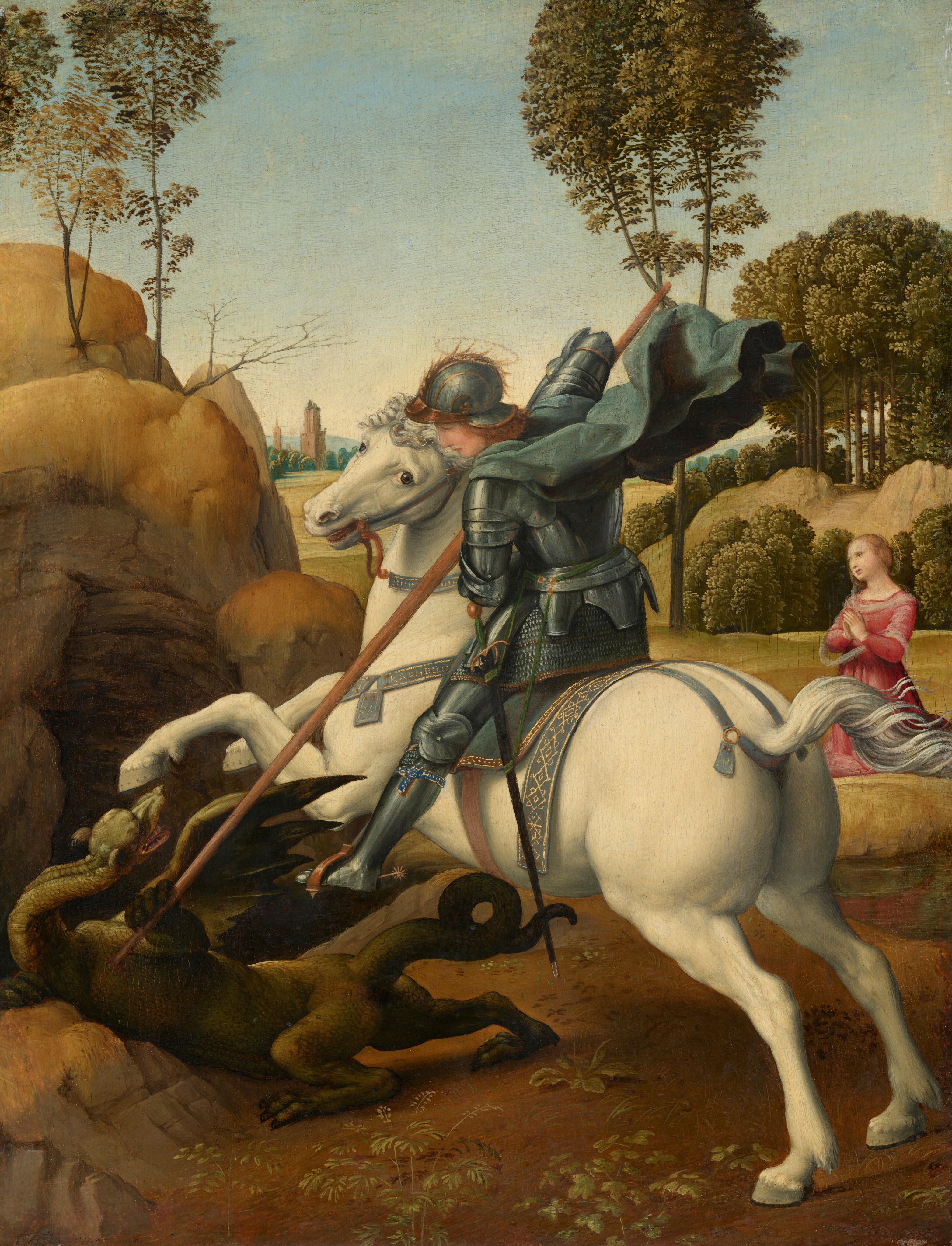
Raphael, Rafaello Raffaelo di Giovanni Santi, Saint George and the Dragon
(c. 1506)
Saint George and the Dragon, one of two versions of the theme by the artist, belonged to a series of miniature panels that Raphael painted in Florence for the celebrated court of Urbino. A Roman soldier of Christian faith, Saint George saved the daughter of a pagan king by subduing a dragon with his lance; the princess then led the dragon to the city, where the saint killed it with his sword, prompting the king and his subjects to convert to Christianity.
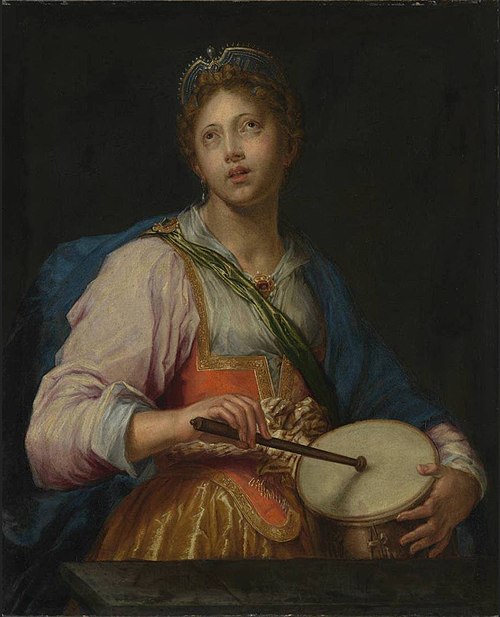
Pieter de Witte, The Daughter of Jephtah (1600)
After defeating the Ammonites, Jephthah returns to his home, and the first person to come out to greet him is his one and only daughter. Jephthah tears his clothes and tells his daughter about his vow. She then tells him to honor his vow but to allow her to go to the mountains with some companions for two months to mourn her virginity. Jephthah permits this request, and then we are told he “did to her according to the vow which he had made” (Judg. 11:39).
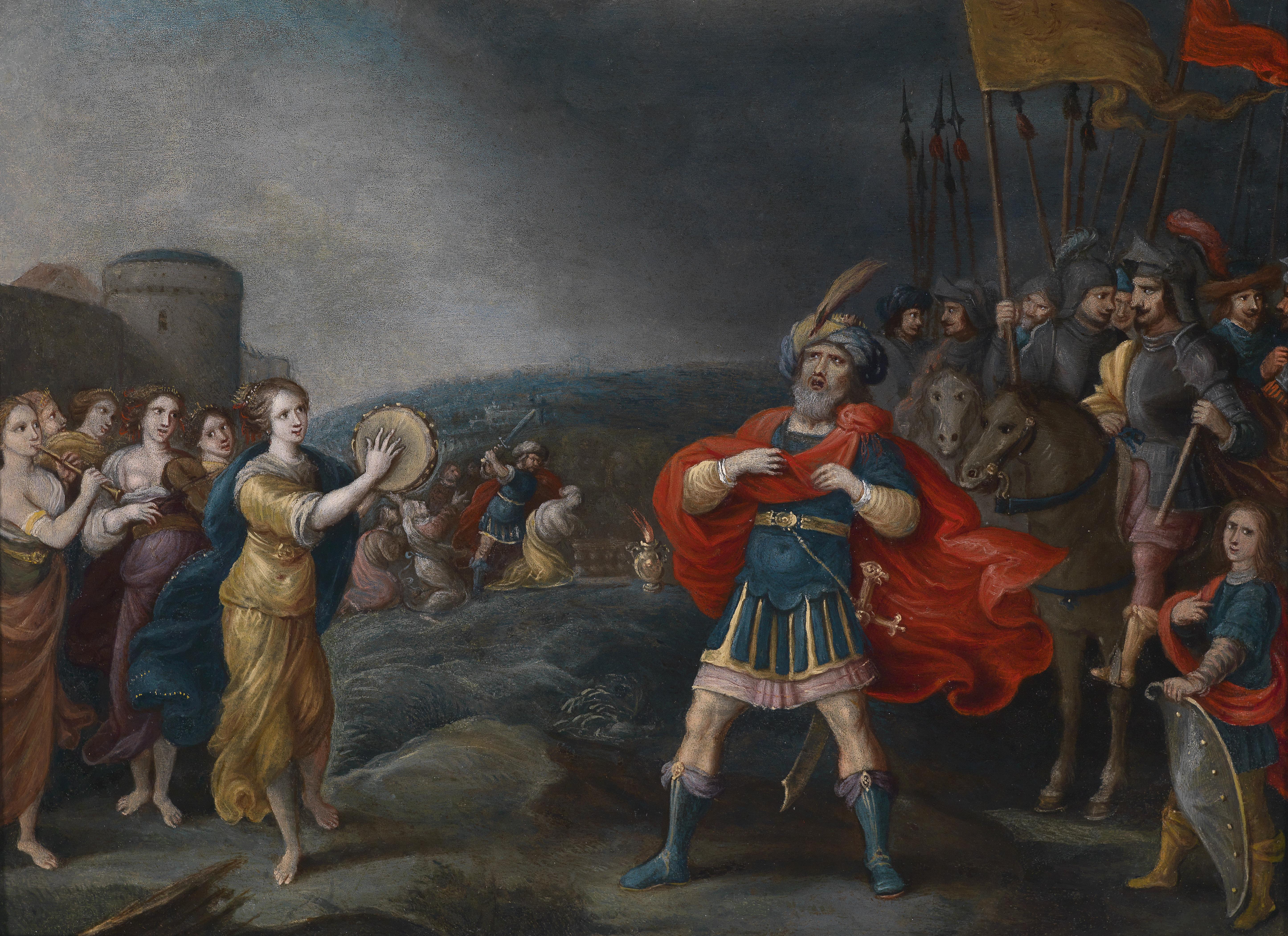
Hieronymus Francken III, Jephta meeting his daughter, (c. 1650)
Jephtah kills his daughter as sacrifice; he said to sacrifice the first person who comes in his house - she is the first person who sees him - sophisticated storytelling
oil on copper
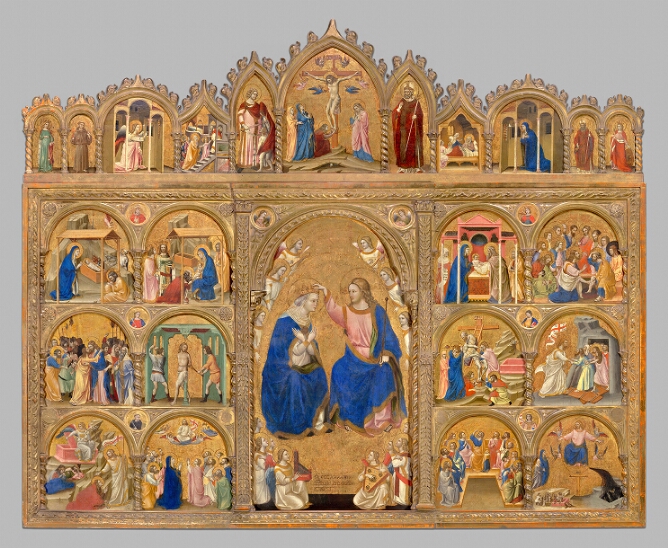
Coronation of the Virgin Altarpiece polyptych(1344), Guariento di Arpo
Mary’s coronation as Queen of Heaven occupies the center of the altarpiece, with smaller narrative scenes and representations of saints and angels surrounding it. The altarpiece illustrates the major events of the New Testament in pictorial form. It likely occupied the place of honor above the main altar in the church of San Martino in Piove di Sacco, outside of Padua.
story unfolds in time and may contain many episodes
painters in the Renaissance would attempt to depict various episodes of story, especiially the life of Christ
story unfolds left to right, top to bottom
central naive shows the object of devotion
Tempera and gold leaf on panels (32)
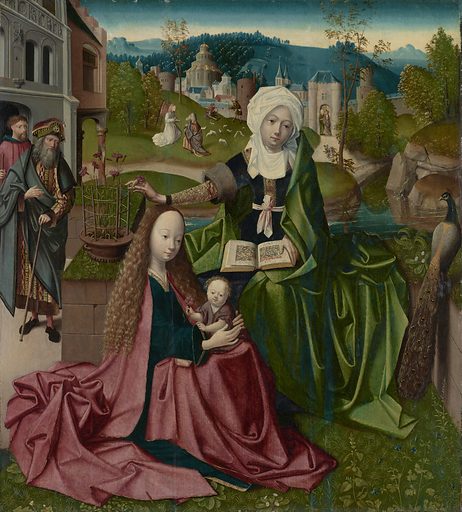
Virgin and Child with Saint Anne. Artist: Unknown, Haarlem, Netherlandish, Date: ca. 1495.
the virgin and child and st anne - Mary’s mother
pic about Mary’s lineage - flashbacks in the garden - Mary’s father shown
oil on panel
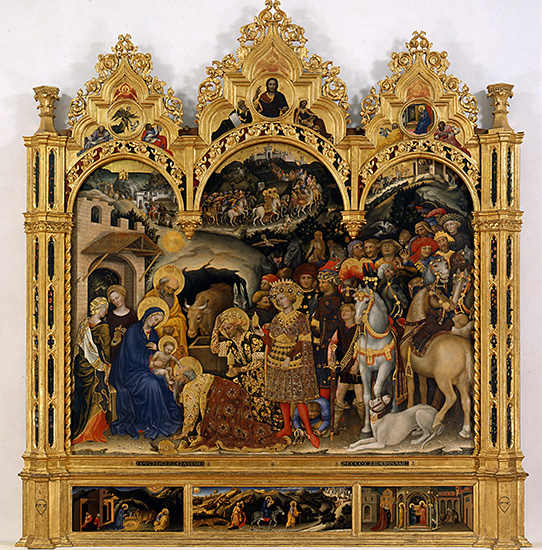
Adoration of the Magi, Gentile da Fabriano, 1423, Europe / Southern Europe / Italy
The altarpiece depicts several Gospel stories surrounding the birth of Christ as they were retold in the Middle Ages and Renaissance. In the main panel, three Magi (wise men and kings believed to come from unknown, eastern lands) offer gifts to the newly born Christ child. Their adventure begins in the background: smaller scenes of the Magi fill an extraordinary landscape in the three arches above, allowing us to follow their journey in a cartoon-like, continuous narrative.the magi, standing on the mountain and seeing the star
Herod is worried as he is the king; who world is in the event taking part
Tempera paint, Panel
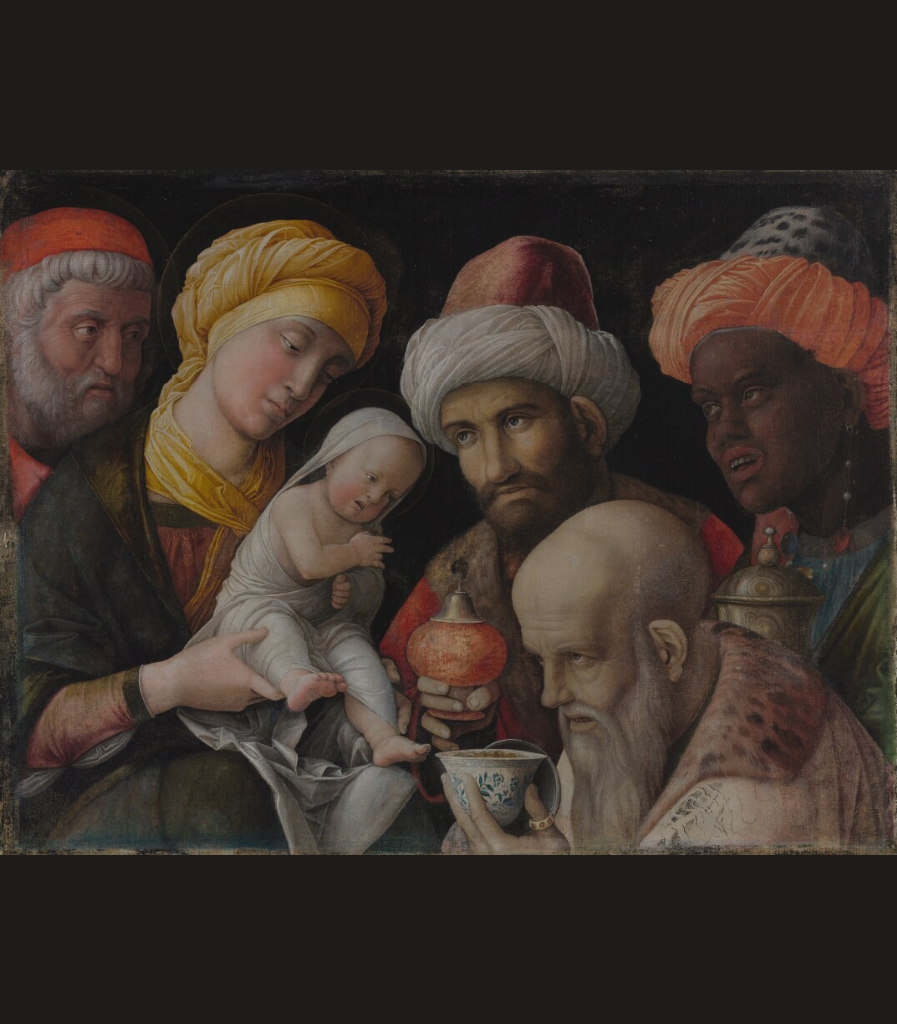
Adoration of the Magi, ca 1495–1505, Andrea Mantegna
Three kings pay homage to the Christ Child, who in turn makes a sign of blessing. Jesus Christ, his mother the Virgin Mary, and Mary's husband Joseph have haloes and wear simple garments, while the Magi are dressed in exotic clothing and jewels and bear exquisite gifts. Caspar, bearded and bareheaded, presents the Christ Child with a rare Chinese cup, made of delicate porcelain and filled with gold coins. Melchior, the younger, bearded king behind Caspar, holds a Turkish censer for perfuming the air with incense; on the right, Balthasar the Moor carries a covered cup made of agate.
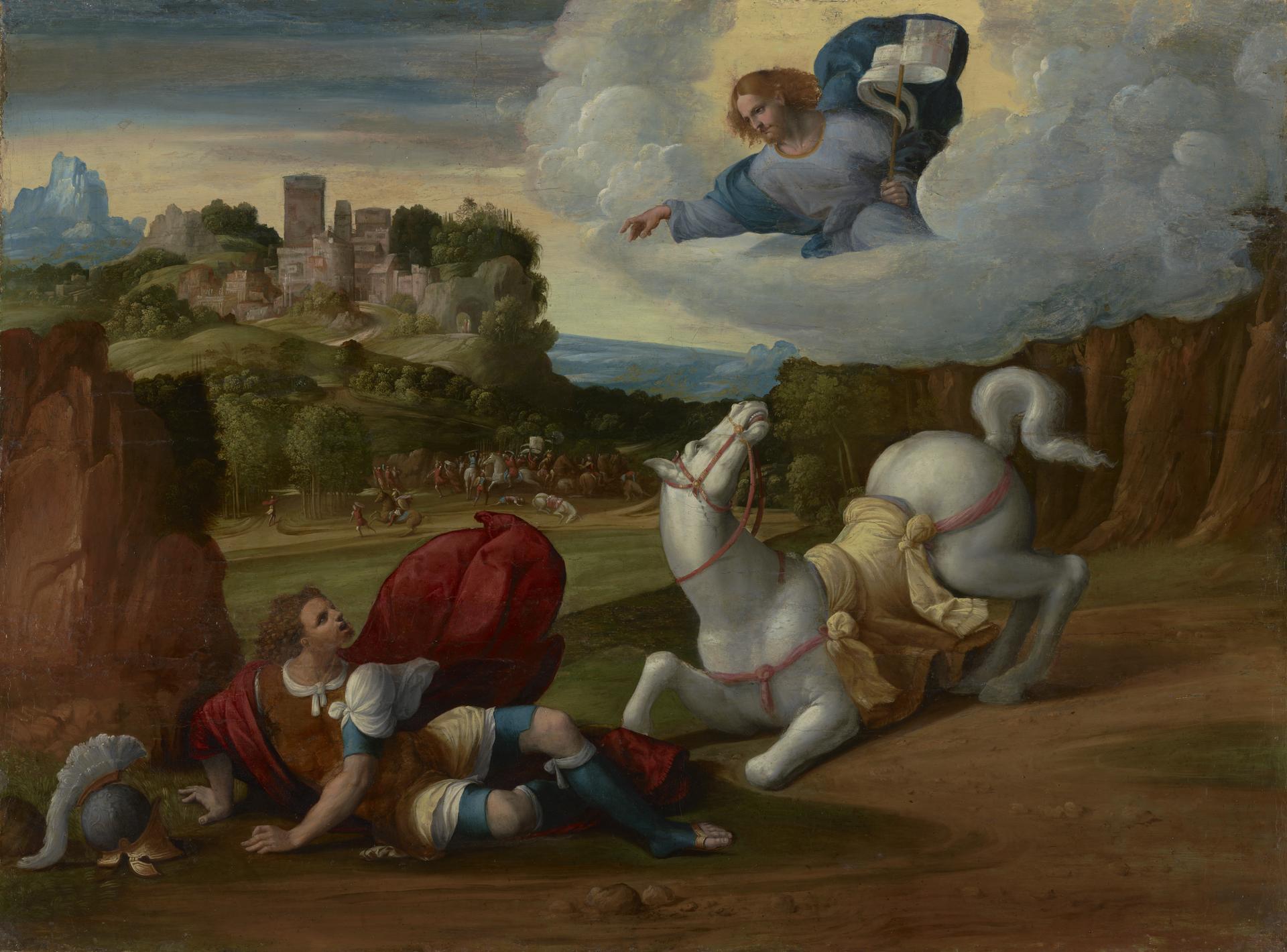
The Conversion of Saint Paul
Artist: Benvenuto Tisi, called il Garofalo (Italian, Ferrara, 1481–1559)
Saints Peter and Paul, patrons of Rome and the Papacy, are typically paired in Italian art, and these two pictures must have been executed as pendants, the more so as they each portray the moment of the apostles' calling rather than the more frequently encountered scenes of their martyrdoms. In the Borghese inventory of 1693, there were listed two pictures of the Conversion of St. Paul attributed to Garofalo and a third, without attribution, that hung as a pendant to Garofalo's Calling of Saint Peter.
Saul’s life turning point shown as he is chosen by god
he will be paul the preacher
you have to know the accounts of saul’s life biblical.
telling a story with a single image is the hardest way
narrative painting has a lot of common with drama and opera on stage
oil on panel
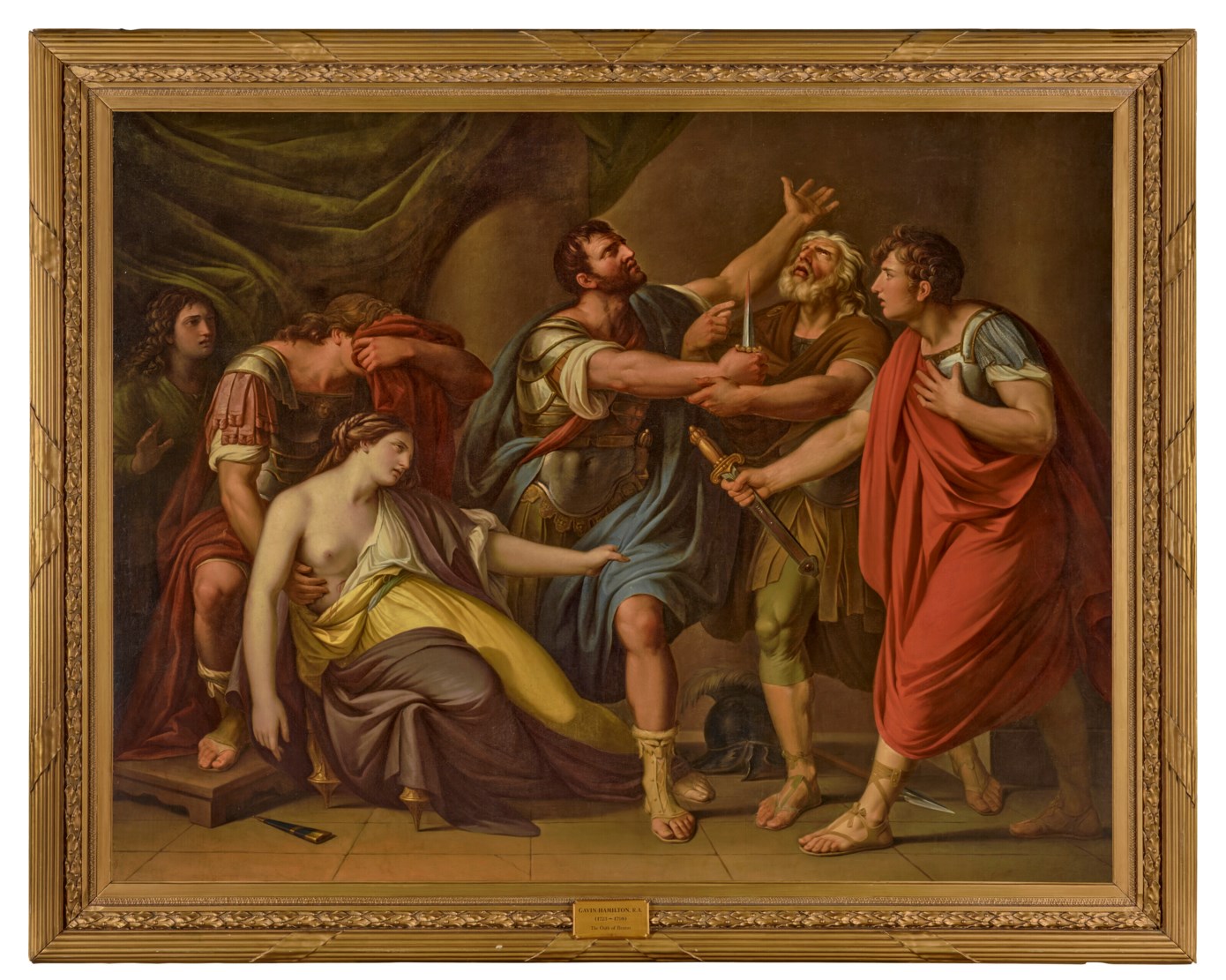
The Death of Lucretia, Gavin Hamilton, 1763 to 1767
According to legend, the death of Lucretia, a virtuous noblewoman during the reign of the tyrant King Tarquin, was a pivotal event in the foundation of the Roman republic. After being raped by the king’s son, Lucretia stabbed herself in the presence of her husband Collatinus, her father, and two companions-in-arms, Lucius Junius Brutus and Valerius Publicola. Dying, she begged them to seek revenge. In Hamilton’s painting, she is shown collapsing against her husband, who covers his face in grief. Brutus holds up the bloodstained dagger and, joined by Lucretia’s father and Valerius, swears an oath to overthrow Tarquin. From this moment, Brutus leads the revolt; Tarquin and his family are expelled, and the Roman republic is established.
much like thetrical scene - characrers are shown as if on stage
scene5ry props - emphasis on desired action
heart of the matter is chosen by artist
oil on canvas
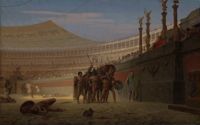
Ave Caesar! Morituri te salutant (Hail Caesar! We Who Are about to Die Salute You)
Artist: Jean-Léon Gérôme (French, 1824–1904)
Gérôme considered this painting, submitted to the Salon of 1859 in Paris, one of his most successful compositions. Roman gladiators were an unusual subject, even for historicizing painters like Gérôme. While these scenes look like fanciful reconstructions (especially when seen through the lens of American cinema, which drew heavily on such canvases for inspiration), Gérôme was in fact greatly preoccupied with historical accuracy, studying archaeological excavations and antique weapons. The title is taken from an episode in Suetonius’s Life of the Caesars (second century A.D.); criminals and captives greeted the emperor with these words.
almost like a film epic
gladiators salturte emperor before the fight
details telling a story; blood on floor, dead men behind the victory, artists show what has happened before with clues
Oil on canvas
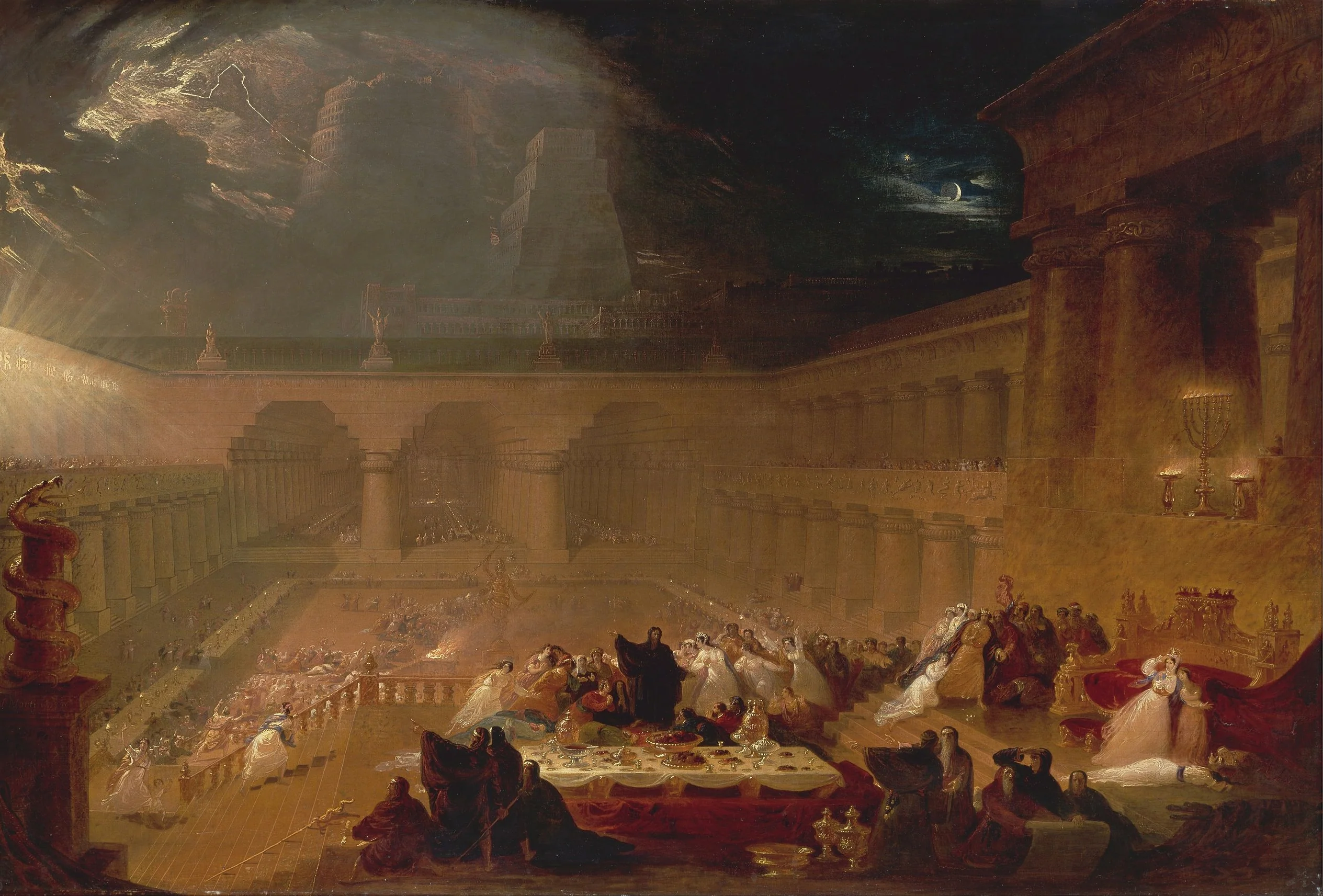
Belshazzar’s Feast, John Martin 1820
John Martin was a 19th century British artist noted for his dramatic depictions of disasters and/or impending disasters.
Here are two of his interpretations of the Biblical story of Belshazzar’s Feast, in which the arrogant ruler of Babylon shows his disdain for the enslaved population of Israelites by using their sacred vessels — stolen from their temple — to serve wine at a huge celebratory feast.
A hand appears and foretells Belshazzar’s destruction and punishment for his arrogance by writing on the wall (from which we get the modern usage of the phrase) in cryptic glowing inscriptions.
Belshazzar is unable to read the writing on the wall. The prophet Daniel is summoned to interpret the inscriptions, and informs Belshazzar of their meaning. Belshazzar, unwilling to be taught humility, ignores the warning and soon after meets his fate.
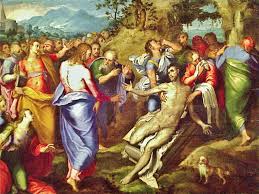
The Resurrection of Lazarus, Artist: Marco Pino 1570
In 2008, Pope Benedict XVI said that the Gospel story of the raising of Lazarus, "shows Christ's absolute power over life and death and reveals His nature as true man and true God" and that "Jesus' lordship over death does not prevent him from showing sincere compassion over the pain of this separation."
spectators telling the story
narrative contrents may be seen differently by different spectators
the artists puts us into the picture
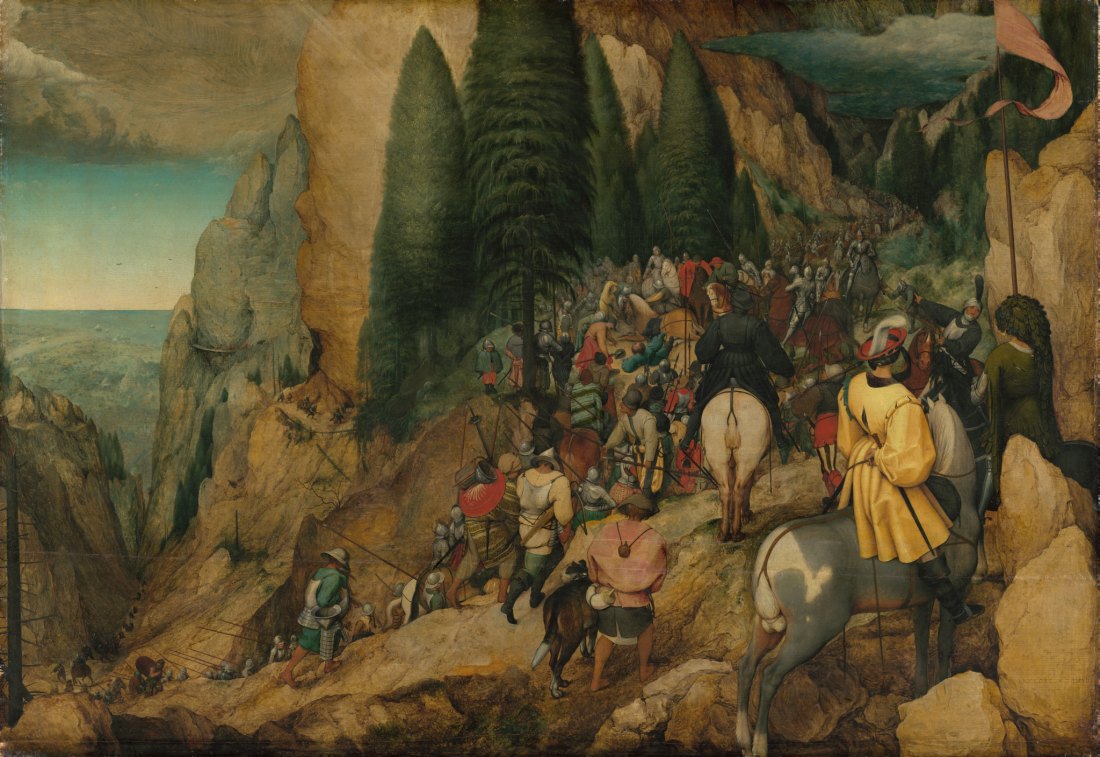
Pieter Bruegel the Elder ca. 1567 The Conversion of St Paul |
|
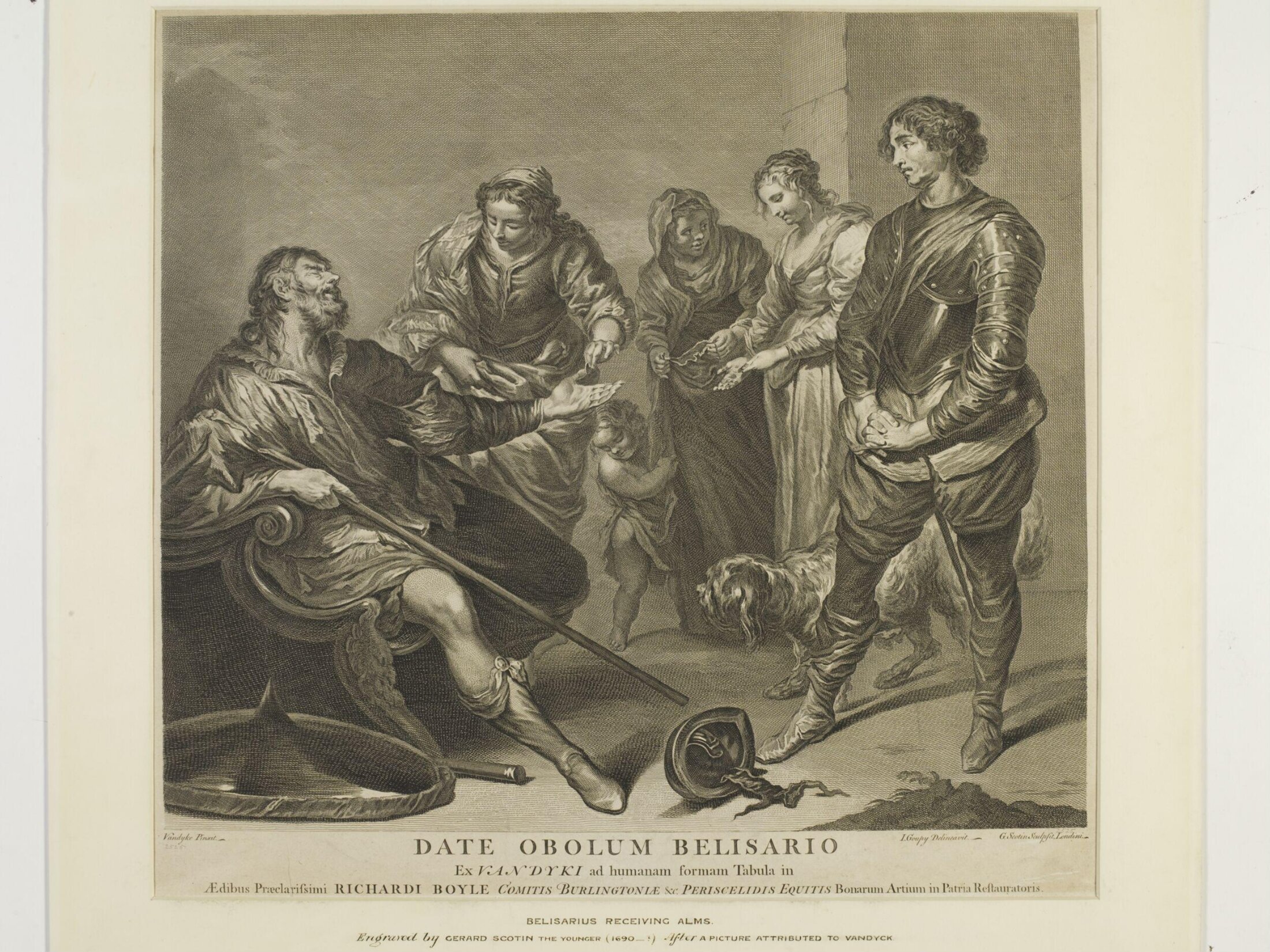
Anthony Van Dyck, Belisarius Receiving Alms
The blind Belisarius begging at left, his shield and baton in lower left, three women placing coins in his hand, watched by a Roman soldier and a dog at right; after Anthony van Dyck. 1748
Etching and engraving
soldier was absorbing moral of the story andc learning - learning was a purpose of histpry painitngs