CHAPTER 9 - Glycolysis, Citric Acid Cycle, & Electron Transport Chain
 Call Kai
 Learn
Learn Practice Test
 Spaced Repetition
 Match
Match Flashcards
 Knowt Play
1/30

There's no tags or description
Looks like no tags are added yet.
Name | Mastery | Learn | Test | Matching | Spaced | Call with Kai |
|---|
No analytics yet
Send a link to your students to track their progress
31 Terms
Glucose is catabolized to:
CO2 and H2O.
Energy is released, used to make ATP.
What is the equation for cellular respiration?
C6H12O6 + 6 CO2 --> 6 CO2 + 6 H2O + energy
Aerobic respiration includes what (4) processes
Glycolysis.
Pyruvate oxidation
Citric Acid Cycle.
Electron transport.
Where does glycolysis occur?
How many molecules of ATP are made?
Occurs in the cytoplasm.
Generates a NET of 2 ATP.
Where does Pyruvate Oxidation and the Citric Acid Cycle occur?
How many ATP does it produce?
Occurs in the matrix of the mitochondria.
Generates 2 more ATP.
Where does the electron transport chain occur?
How many ATP does it produce?
Occurs in the inner membrane of the mitochondria.
Generates about 26-28 ATP.
How many ATP are produced during cellular respiration?
Glycolysis - 2 ATP.
Pyruvate Oxidation/Citric acid cycle - 2 ATP.
Electron Transport Chain - 26 to 28 ATP.
TOTAL - 30 - 32 ATP
Glycolysis harvests chemical energy by:
Oxidizing glucose to pyruvate.
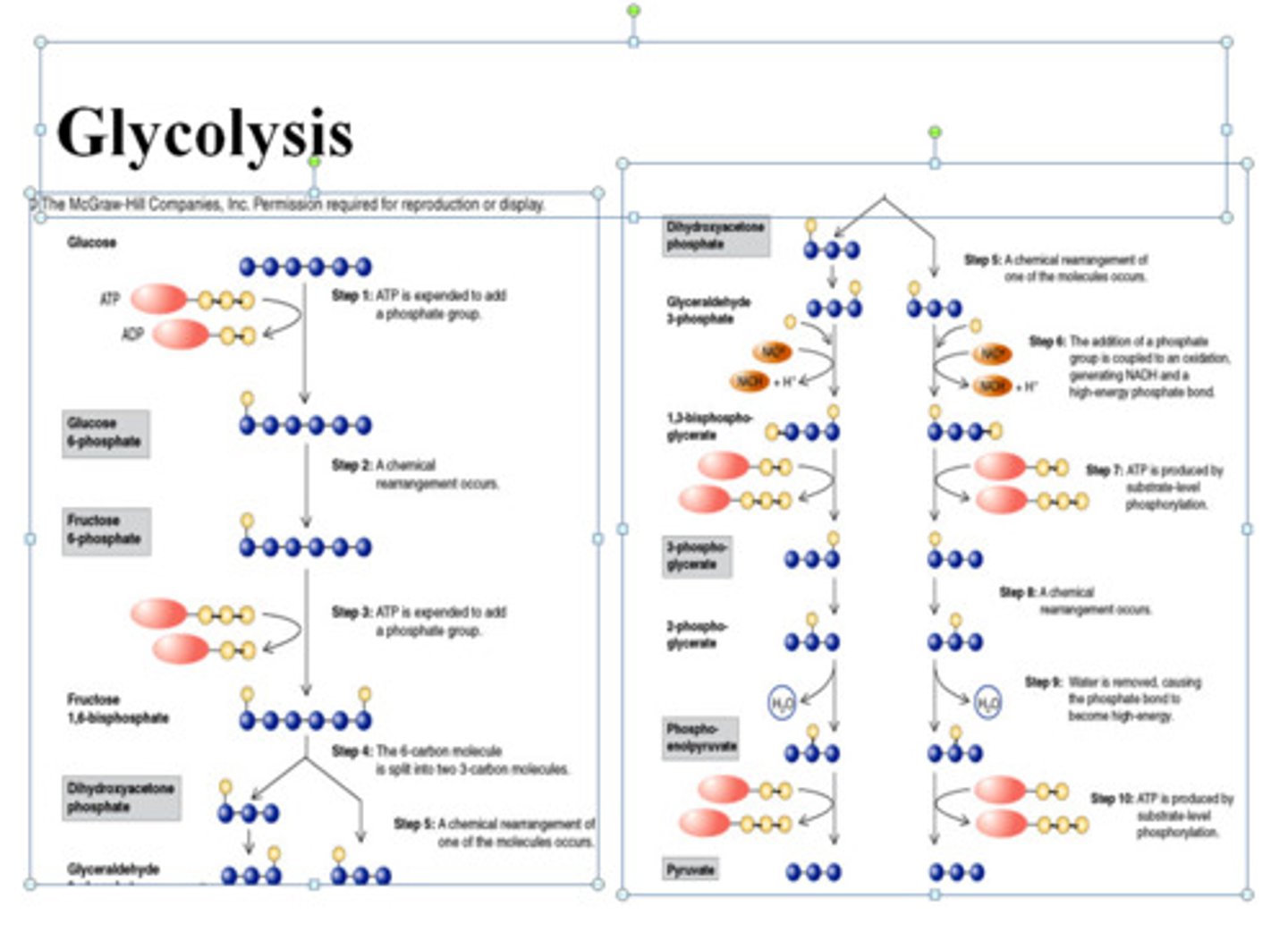
What happens during the energy-investing and energy-harvesting phases of glycolysis?
Energy-investing phase of glycolysis (first 5 reactions)
Glucose is converted to 2 G3P (endergonic reaction)
2 molecules of ATP are used (exergonic)
Energy-harvesting phase of glycolysis (last 5 reactions)
2 G3P are converted to 2 Pyruvate
(BOTH exergonic / oxidation reactions occur)
2 NAD+ reduced to 2 NADH (reduction)
4 ADP converted to 4 ATP via substrate-level phosphorylation (endergonic)
NAD+ is used to:
transfer high energy electrons
How many ATP are used to start glycolysis?
How many ATP are made?
What is the net gain of ATP?
2 ATP are used to start glycolysis.
4 ATP are made.
NET = 2 ATP.
The final product of glycolysis?
2 pyruvic acids.
2 ATP (NET gain)
2 NADH.
FROM ONE GLUCOSE MOLECULE.
What happens after glycolysis depends on:
If oxygen is present or not.
If oxygen is plentiful after glycolysis, what happens?
Pyruvic acid is transported into the mitochondria --> aerobic respiration occurs:
Pyruvate oxidation
Citric acid cycle
Electron transport chain
If there is not enough oxygen after glycolysis, what happens?
Lactic acid or Alcoholic Fermentation
2 Pyruvate are reduced to lactic acid - or - ethanol & CO2
2 NADH from glycolysis are oxidized to 2 NAD+
2 NAD+ are recycled back to glycolysis so that glycolysis can continue and at least 2 ATP are produced per glucose in the absence of oxygen
NOTE: There's a limited amount of NAD+ in the cell.
Before the two pyruvic acid molecules from glycolysis can enter the citric acid cycle, what must happen?
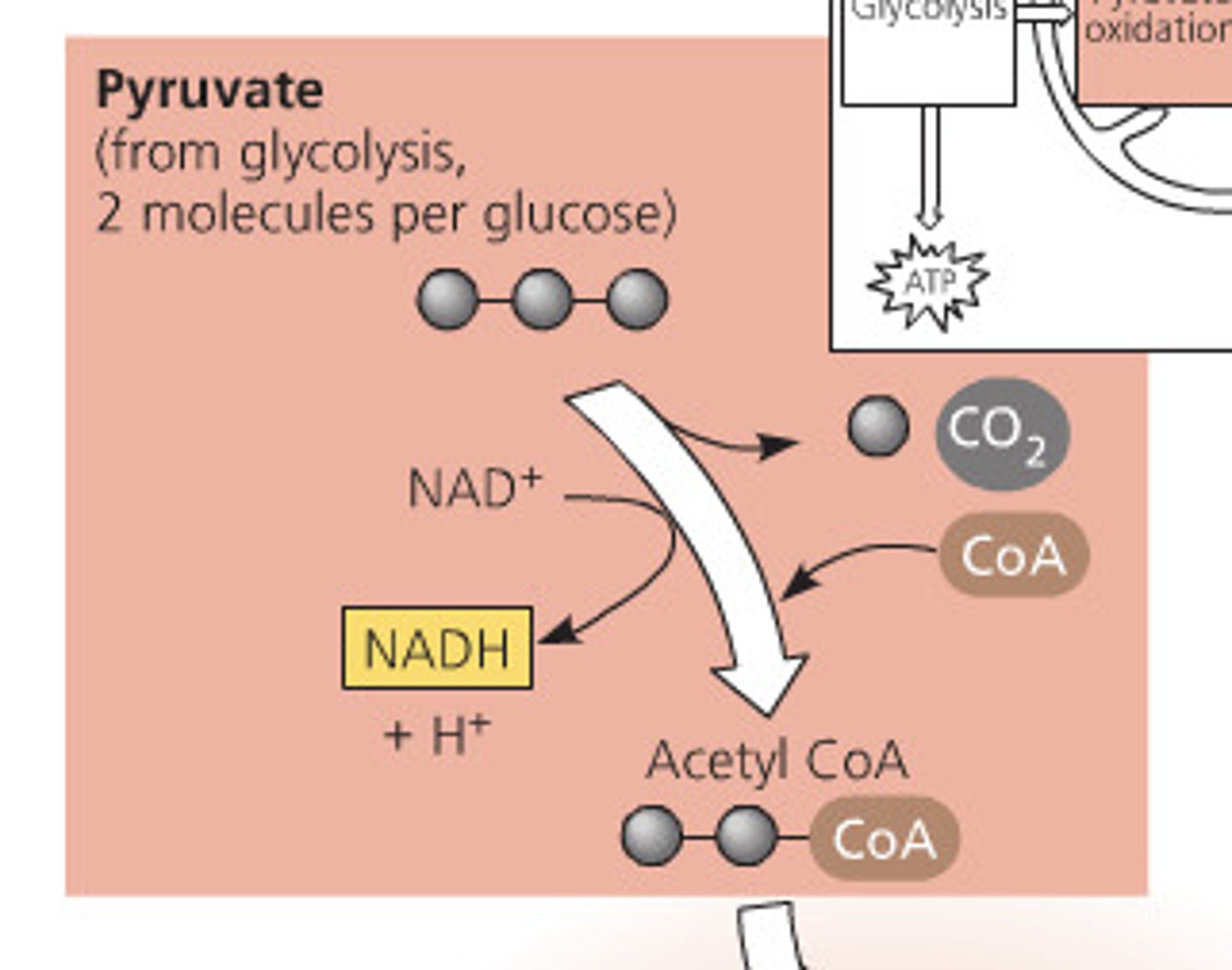
Pyruvate oxidation occurs
Each molecule of pyruvate must be oxidized to to acetyl-CoA and CO2 and NAD+ is reduced to NADH
Because glycolysis produces 2 pyruvate, pyruvate oxidation produces:
2 Acetyl-CoA
2 CO2
2 NAD+ are reduced to 2 NADH
What happens to the two-carbon acetyl-CoA after pyruvate oxidation?
Enters the citric acid cycle when the 2-C acetyl-CoA molecule combines with a 4C molecule (oxaloacetate) forming 6C citrate (citric acid)
CoA (coenzyme A) acts as a coenzyme in this reaction and helps enzymes to fix the 2C portion of acetyl-CoA into the cycle
The CoA is then removed and recycled back to pyruvate oxidation to be used again
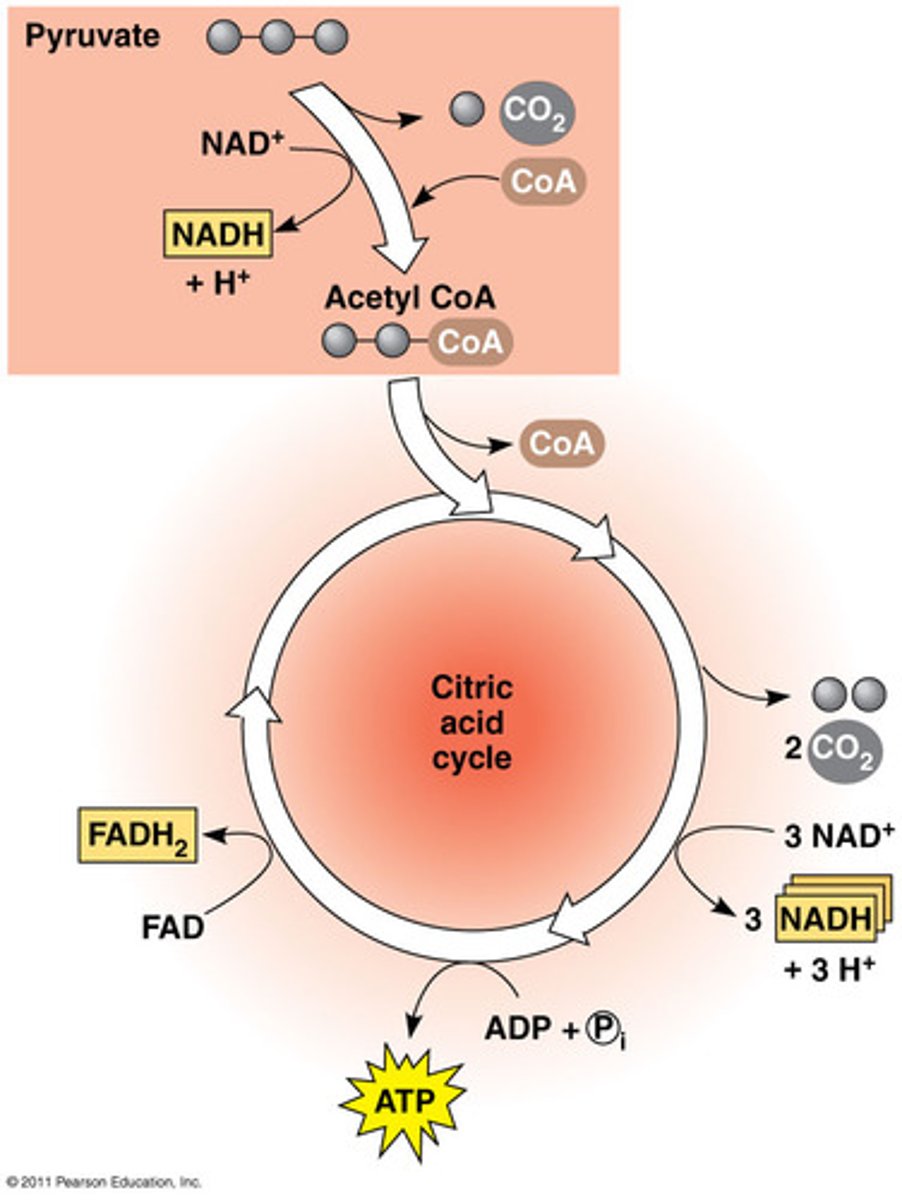
What is produced for EACH of the acetyl-CoA molecules that enter the Citric Acid Cycle?
2 CO2.
1 ATP.
3 NADH.
1 FADH2.
Since 2 Acetyl-CoA are produced per molecule of glucose, the citric acid cycle will occur twice and produce the following:
4 CO2.
2 ATP.
6 NADH.
2 FADH2
After the citric acid cycle, how many NADH have been made per glucose total?
10 NADH.
2 from glycolysis.
2 from pyruvate oxidation
6 from citric acid cycle.
What happens to the 10 NADH and the 2 FADH2 from glycolysis and the citric acid cycle?
They are sent to the electron transport chain.
How many NADH and FADH2 are produced total after glycolysis and the citric acid cycle?
What do each of these contain?
Where do they go?
10 NADH
2 from glycolysis.
2 from matrix rxn.
6 from citric acid cycle.
2 FADH2
2 from citric acid cycle.
Each of these contain chemical energy that needs to be transferred to ATP.
They go to the electron transport chain.
Generally, what does the electron transport chain do to the 10 NADH and the 2 FADH2? What happens to them?
NADH and FADH2 are oxidized
regenerating the NAD+ and FAD needed in pyruvate oxidation and the citric acid cycle
Where does Electron Transport chain occur?
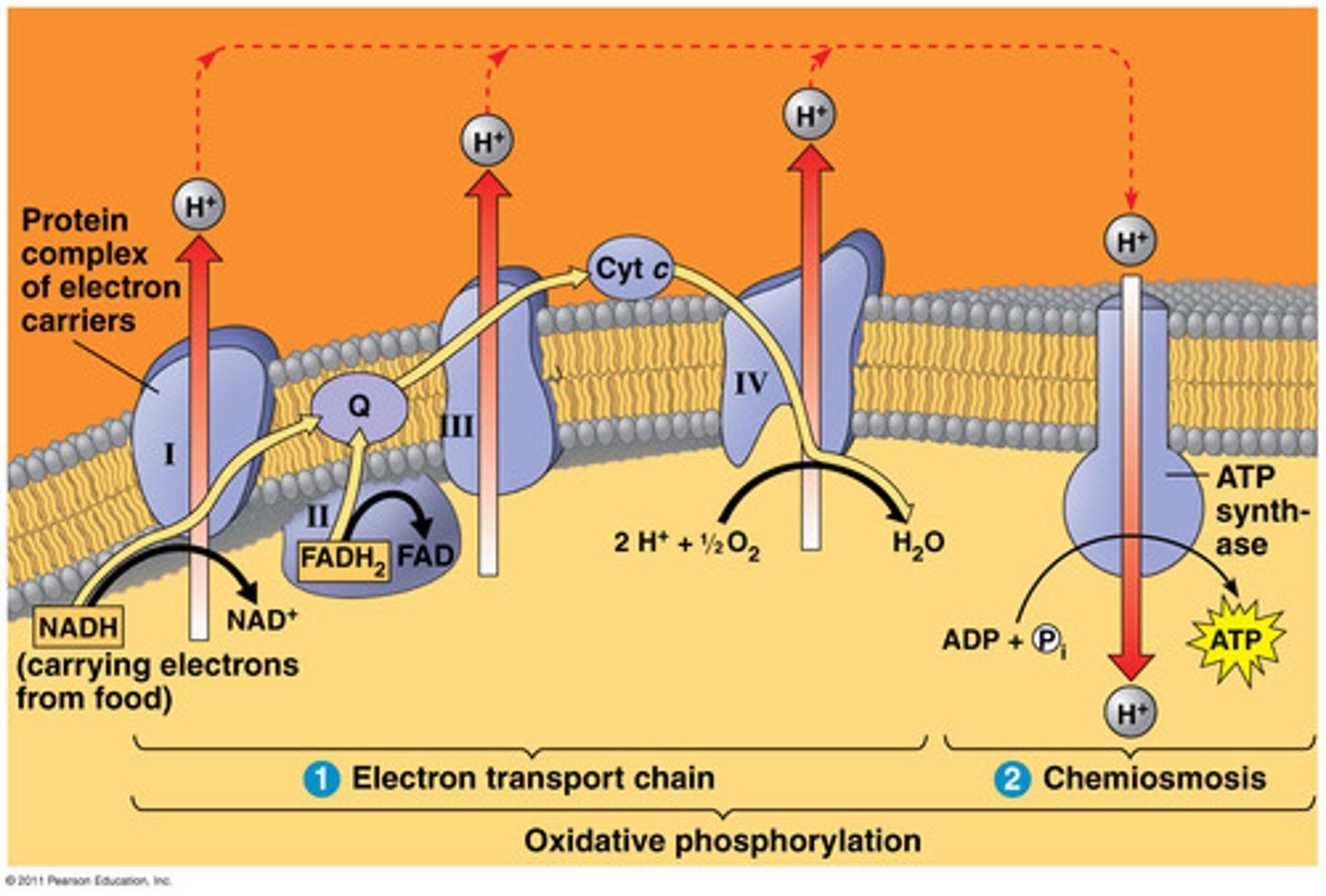
On the INNER membrane of the mitochondria.
What are enzyme complex I, II, and III?
Where do they get their energy?
Active transport proteins.
Get their energy from high energy electrons from NADH.
Explain the electron transport chain:
NADH and FADH2 are oxidized and electron carriers in the ETC are reduced
Electrons move down the ETC via a series of REDox reactions
Energy from e- drives proton pumps and H+ ions are pumped into the intermembrane space of the mitochondria.
At the end of the ETC, low energy e- combine with H+ and oxygen atoms to form water
O2 is the final electron acceptor molecule
H+ diffuses down its concentration gradient through ATP synthase (exergonic - chemiosmosis) and provide energy for the synthesis of ATP from ADP and P (endergonic)
Approx. 26 - 28 ATP produced / glucose
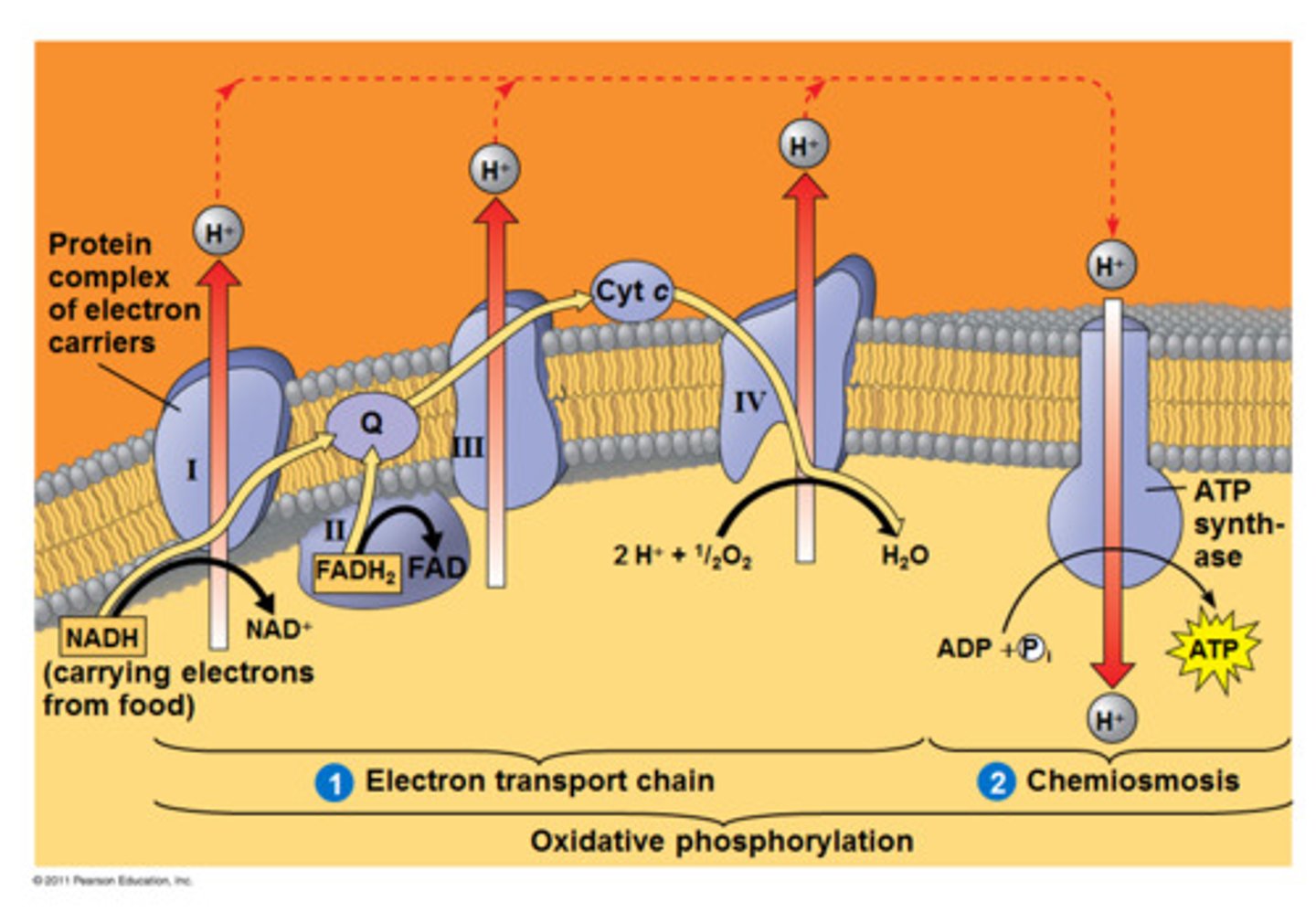
What does the electron transport chain create?
A proton gradient.
How many ATP are produced from cellular respiration for each sugar molecule that is oxidized?
30 - 32 ATP.
Glycolysis is stimulated by:
High concentrations of ADP.
The enzyme phosphofructokinase is an allosteric enzyme that regulates glycolysis. Glycolysis is inhibited by:
High concentrations of ATP.
High concentrations of Citrate.
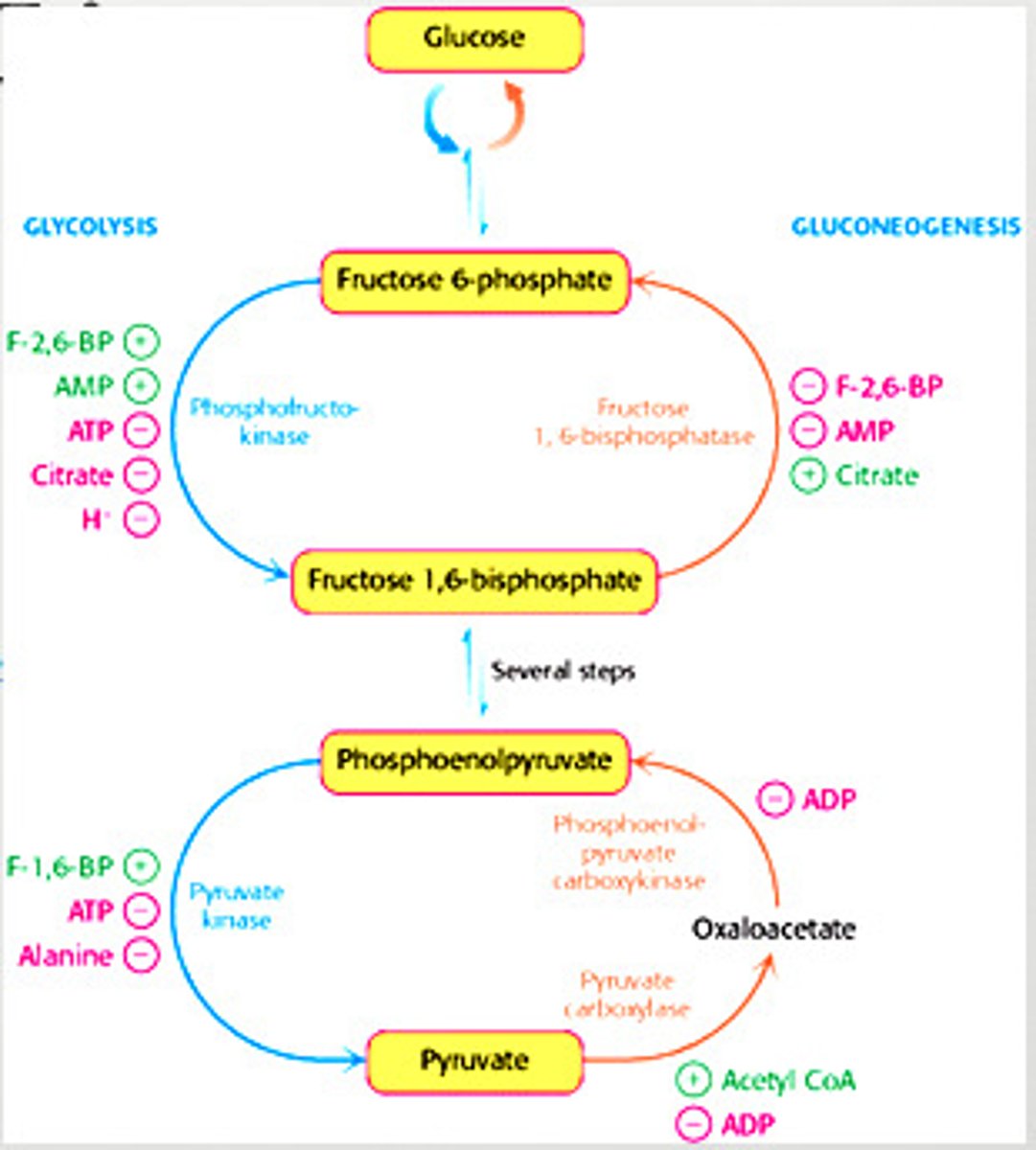
The enzyme phosphofructokinase is an allosteric enzyme that regulates glycolysis. Glycolysis is activated by:
High concentrations of AMP/ADP
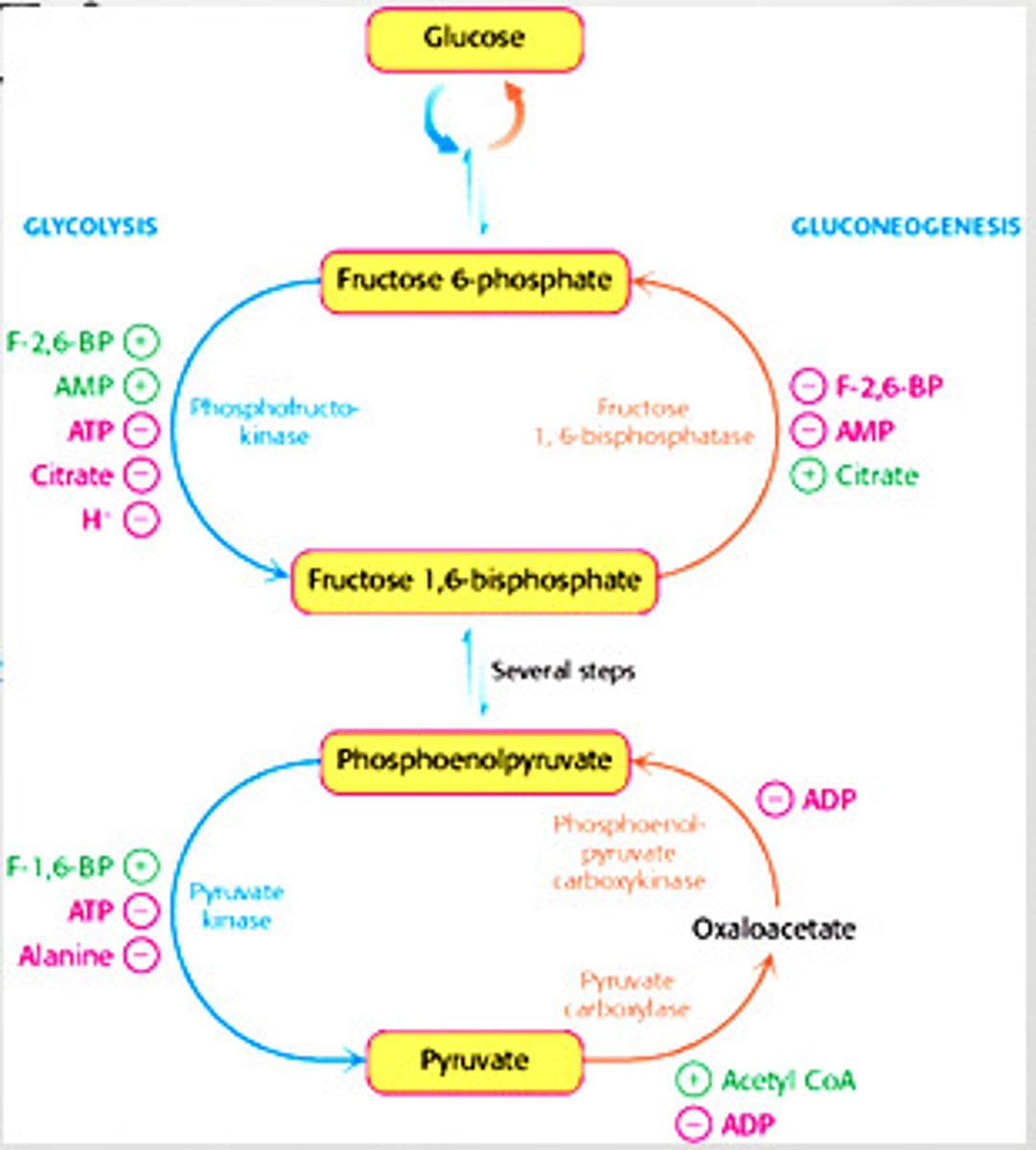
Many enzymes throughout the respiratory cycle are subject to feedback inhibition. What is this?
When the product of a reaction inhibits the enzyme catalyzing the reaction.