ECO 202 Test 2
0.0(0)
Studied by 1 person Call Kai
 Learn
Learn Practice Test
 Spaced Repetition
 Match
Match Flashcards
 Knowt Play
Card Sorting
1/58

Earn XP
Description and Tags
Last updated 3:55 AM on 11/10/22
Name | Mastery | Learn | Test | Matching | Spaced | Call with Kai |
|---|
No analytics yet
Send a link to your students to track their progress
59 Terms
1
New cards
Money
Assets that people are generally willing to accept in exchange for goods, services, or payment of debts
2
New cards
Why was money invented?
To make facilitating exchanges more efficient
3
New cards
Self-Fulfilling Valuation
Money is not backed by bullion, rather it is backed by the fact that we are confident in other accepting the money.
4
New cards
Money, Income, Wealth
Any currency that represents a barter value, the total amount of money someone receives, the total amount of money someone is worth
5
New cards
The Central Bank
Controls the quantity of money, which affects interest rates and spending
6
New cards
M1
Currency in Circulation + checking account deposits + savings account deposits
7
New cards
M2
M1 + other things
8
New cards
Bank's Balance Sheet Assets
Reserves, Loans, Securities
9
New cards
Bank Reserves
The sum of deposits kept as Vault Cash and deposits the bank has with the Federal Reserve
10
New cards
Bank Profit?
Banks make a profit by loaning out money at a higher interest rate than they paid for their deposits
11
New cards
Banks creating money
Making loans from their excess reserves, because that technically generates a deposit entry.
12
New cards
Primary Goal of a Bank
Make a profit, although the Fed may rely on them
13
New cards
Fractional Reserve Banking System
A system in which banks keep less than 100 percent of deposits in reserves
14
New cards
Bank Run
Many depositors simultaneously deciding to withdraw money from a bank
15
New cards
Bank Panic
Many banks simultaneously experiencing runs at the same time
16
New cards
Central Bank as Lender of Last Resort
Makes loans to banks that cannot borrow funds elsewhere, allowing the smaller banks to pay off depositors.
17
New cards
Federal Reserve Act
Gave the Federal Reserve the authority to make "discount" loans to banks, with the hope of putting an end to bank panics
18
New cards
Federal Deposit Insurance Corporation (FDIC)
Designed to insure deposits in most banks up to a limit, allowing them to refund money lost in checking accounts that go out of business, reassuring most depositors that their deposits are safe.
19
New cards
How many Federal Reserve Districts are there?
12, each with its own Federal Reserve bank
20
New cards
Board of Governors info
In Washington DC, 7 members, appointed by President, approved by Congress, 14-year nonrenewable terms, chair serves 4-year renewable term.
21
New cards
Securitization
A process that creates a secondary market in which loans are bundled together and sold in financial markets
22
New cards
Shadow Banking System
Investment Banks, Hedge Funds, other nonbank financial firms that function like commercial banks
23
New cards
Difference of Shadow Banking
Weren't regulated by federal government agencies, more highly relied on borrowed money, don't have FDIC (MORE RUNS)
24
New cards
Maturity Mismatch
When short-term lenders refused to renew their loans forcing shadow banks to get their money from banks, the banks couldn't get it as it had been invested long-term
25
New cards
Monetary Policy
The actions the Federal Reserve takes to manage the money supply and interest rates
26
New cards
Fiscal vs Monetary
Executive Branch vs Fed
27
New cards
Monetary Policy Tools
1. Open Market Operations
2. Discount Policy
3. Reserve Requirements
4. Interest on Reserves
2. Discount Policy
3. Reserve Requirements
4. Interest on Reserves
28
New cards
Federal Open Market Committee (FOMC)
A committee of the Fed that sets their interest rate policies
29
New cards
Makeup of FOMC
Meet 8 times a year, 12 members: 7 Board of Governors, President of Fed bank of New York, 4 of 11 other Federal Reserve Banks
30
New cards
Open Market Operations
The buying and selling of Treasury Securities by the Federal Reserve to control the money supply
31
New cards
Treasury Securities
Bills, Notes, Bonds sold and issued by US treasury to borrow money in order to fund the budget deficit
32
New cards
Maturity of Bills
33
New cards
Maturity of Notes
2-10 years
34
New cards
Maturity of Bonds
>30 years
35
New cards
Purchase/Sale of Treasury Securities
Purchase increases reserves, increases money supply and vice versa.
36
New cards
Money Supply and Interest Rates
A decrease in the interest rate on reserves generally causes the money supply to increase, as it increases the amount of loans banks make
37
New cards
Quantity Equation
Money Supply (M) x Velocity of Money (V) = Price Level (P) x Real Output (Y)
38
New cards
Quantity Theory of Money
Quantity Equation with constant velocity, Irving Fisher argued because the number of times a dollar is spent is based on factors that don't change often
39
New cards
Inflation Rate (not constant V)
Delta M + Delta V - Delta Y = Delta P
40
New cards
How can governments be careful of inflation
By only issuing bonds in amounts that private investors will buy
41
New cards
ADAS model
Determines real GDP and Price Level <-- Axes
42
New cards
Variables that shift AD
Government purchases (GP,R), Income taxes (C,L), Interest Rates (C-I-NX,L), Business Taxes (I, L), Expectation of Future Incomes (C-I, right), Net Exports (NX, L), Real GDP differences (NX, L)
43
New cards
What determines the long-run real GDP?
Number of workers, capital stock, and the available technology
44
New cards
What is Real GDP in LRAS model?
Potential GDP, meaning Full Employment (only structural or frictional unemployment present)
45
New cards
What determines the LRAS
Potential GDP increases (number of workers in the economy, more machinery/equipment, technological changes)
46
New cards
SRAS slope
Positive, because as price level increases, prices of inputs rise more slowly (higher prices = higher profits)
47
New cards
What shifts both LRAS and SRAS?
Change in Potential GDP, cost of production, supply restrictions
48
New cards
Variables that only shift SRAS
Increases in LABOR CAPITAL (R), technological change (R), inflationary expectations (L), unexpected changes in the price of an important natural resource (L)
49
New cards
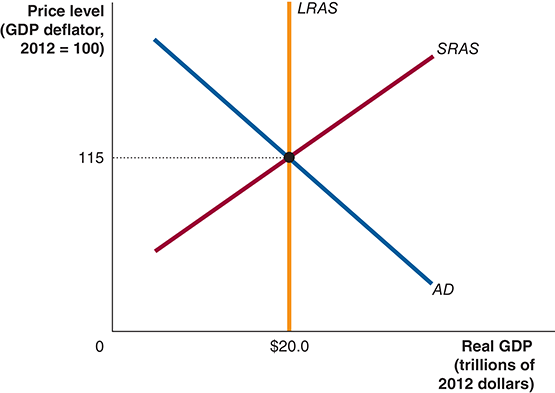
Long-run Macroeconomic Equilibrium
Real GDP = LRAS = Potential GDP, natural rate of unemployment
50
New cards
What effects does a change in short-run equilibrium have?
Below potential = Recession, below price level = deflation, vice versa
51
New cards
How does an economy return to long-run equilibrium
People adjust to the change in price level, leading SRAS to shift to meet the AD or vice versa
52
New cards
Unemployment in the ADAS graph
Below potential is unemployment increases, vice versa
53
New cards
Short run effect of supply shock
Increase in prices shifts SRAS to the left, below potential GDP and above price level
54
New cards
Long run effect of supply shock
Falling wages and prices caused by recession shifts SRAS back to its original position
55
New cards
If the Fed buys Treasury Securities, then...
Bank reserves increase, encouraging banks to make more loans, increasing the money supply
56
New cards
Unemployment rate is the natural rate of unemployment along
The LRAS
57
New cards
An increase in the interest rate b the Fed in the short run
Decreases the unemployment rate, and increases the price level
58
New cards
An increase in interest rates
Shifts the Aggregate Demand curve to the left
59
New cards
The automatic adjustment from real > potential to long-run potential GDP
The SRAS curve shifts to the left