AP Psychology -
 Call Kai
 Learn
Learn Practice Test
 Spaced Repetition
 Match
Match Flashcards
 Knowt Play
1/18

There's no tags or description
Looks like no tags are added yet.
Name | Mastery | Learn | Test | Matching | Spaced | Call with Kai |
|---|
No analytics yet
Send a link to your students to track their progress
19 Terms
(Unit 4C PowerPoint Part 1) Defining Terms
What is MOTIVATION?
Specific need (required (food, water, etc.)) or desire (optional wants (would you die w/o $0)), such as hunger, thirst, or achievement, that prompts goal-directed behavior (ex. studying, practicing, etc.)
(Unit 4C PowerPoint Part 1) Instincts and Evolution (INSTINCT THEORY)
What are INSTINCTS? Explain the INSTINCT THEORY.
Inborn, goal-directed behavior that is characteristic of an entire species and unlearned
you’re born w/ certain desires (preprogrammed, not taught by parents) → ex. HUNGER [NATURE]
doesn’t apply to higher desires like approval, grades, accomplishments because we aren’t born w/ these wants [NURTURE]
![<ul><li><p>Inborn, goal-directed behavior that is characteristic of an entire species and <strong>unlearned</strong></p><ul><li><p>you’re born w/ certain desires (preprogrammed, not taught by parents) → ex. HUNGER [NATURE]</p></li></ul></li><li><p>doesn’t apply to higher desires like approval, grades, accomplishments because we aren’t born w/ these wants [NURTURE]</p></li></ul><p></p>](https://assets.knowt.com/user-attachments/e62adcdf-cdb1-4429-b1c2-74ee338a5e15.png)
(Unit 4C PowerPoint Part 1) Instincts and Evolution (INSTINCT THEORY)
Explain HUMAN BEHAVIOR.
Human behavior is not easily explained by instincts because
Most important human behavior is learned & often flexible
Human behavior is directed by both physiological needs AND by psychological wants
(Unit 4C PowerPoint Part 1) Drive-Reduction Theory
What is the DRIVE-REDUCTION THEORY?
Theory that took the place of instinct theory
Drive Reduction Theory states that motivated behavior is an attempt to reduce a drive and return the body to homeostasis
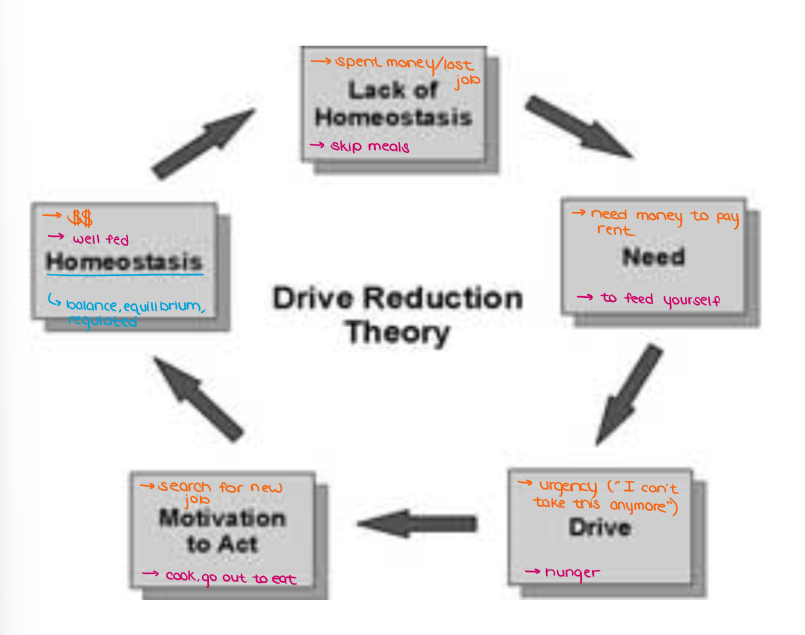
(Unit 4C PowerPoint Part 1) Drive-Reduction Theory
What is a DRIVE?
A state of tension or arousal caused by bodily needs
(Unit 4C PowerPoint Part 1) Drive-Reduction Theory
What is a PRIMARY DRIVE?
Unlearned drive, such a hunger, based on a physiological state
(Unit 4C PowerPoint Part 1) Drive-Reduction Theory
What is a SECONDARY DRIVE?
Learned drive, such as ambition
(Unit 4C PowerPoint Part 1) Arousal Theory
What is the AROUSAL THEORY?
People are motivated to seek an optimal level of arousal (that is dependent on the task at hand) for a given moment
arousal → physiological/biological (sympathetic NS/fight or flight → increasing HR, dilated eyes, etc.)
(Unit 4C PowerPoint Part 1) Arousal Theory
What is the YERKES-DODSON LAW?
States that there is an optimal level or arousal for best performance on any task → for cognitively (using your brain!) complex tasks (like tests), the optimal level of arousal is moderately low
The more complex the task, the lower the level of arousal that can be tolerated without interfering with performance
Ex. Taking a psych test… HR is 70 BPM (<100 = red. resting HR [~70 BPM]) vs. 200 BPM
avg. HR leads to better performance
![<ul><li><p>States that there is an optimal level or arousal for best performance on any task → for cognitively (using your brain!) complex tasks (like tests), the optimal level of arousal is moderately low</p></li><li><p>The more complex the task, the lower the level of arousal that can be tolerated without interfering with performance</p></li><li><p>Ex. Taking a psych test… HR is 70 BPM (<100 = red. resting HR [~70 BPM]) vs. 200 BPM</p><ul><li><p>avg. HR leads to better performance</p></li></ul></li></ul><p></p>](https://assets.knowt.com/user-attachments/748acd11-0052-480b-bee4-7adb5f99428c.png)
(Unit 4C PowerPoint Part 1) Incentive Theory
What is the INCENTIVE THEORY?
External stimuli that prompt goal-directed behavior
We are often unaware of the incentive
Examples
Aroma of food may cause us to eat even when not hungry
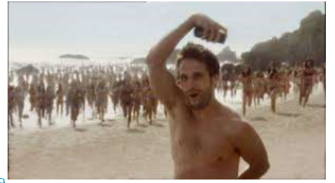
Advertisements can lead us to buy a product (ex. Old Spice commercial motivates you by making you want to smell good to attract others, targeted to young men that women will like you → mom :()
(Unit 4C PowerPoint Part 1) Intrinsic and Extrinsic Motivation
What is INTRINSIC MOTIVATION?
Motivation for a behavior is the behavior itself
you like to do the behavior because the behavior makes u feel good
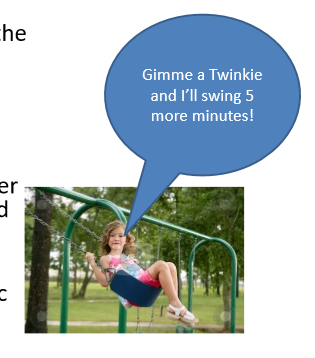
Example: children playing
(Unit 4C PowerPoint Part 1) Intrinsic and Extrinsic Motivation
What is EXTRINSIC MOTIVATION?
Behavior is performed in order to obtain a reward or to avoid punishment
Example: a bonus program
Dangers of providing extrinsic motivation for intrinsically motivated activities?
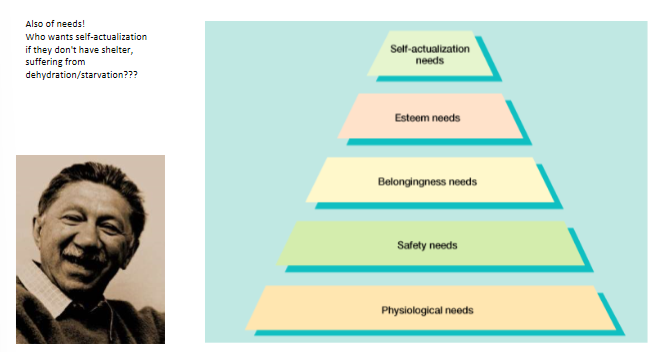
(Unit 4C PowerPoint Part 1) Maslow’s Hierarchy of Motives
Explain the hierarchy.
Also of needs!
Who wants self-actualization if they don't have shelter, suffering from dehydration/starvation???
(Unit 4C PowerPoint Part 2) Social Motives: Affiliation
What is AFFILIATION?
Motivation to be with others (those w/ a high need for affiliation → extroverted)
Rats, monkeys and humans in stressful situations all feel a reduction in anxiety and fear when in the presence of another member of their species
Evolutionary value? Learned behavior?
(Unit 4C PowerPoint Part 2) Self-Determination Theory
What are the humans’ three basic needs? What motivates us?
COMPETENCE: need to be effective in dealing with environment
AUTONOMY: need to control the course of their lives
RELATEDNESS/AFFILIATION: need to have a close, affectionate relationships with others
Ex> You are the CEO of a company. How would you use Self-Determination Theory to motivate your employees?
Competence --> having an Employee of the Month to recognize the employee and make them feel good, so they understand that their work is not going unnoticed
Autonomy --> giving deadlines and not checking in every too often until the deadline
Relatedness --> team bonding events after work (holiday parties, dinners, etc.)
(Unit 4C PowerPoint Part 2) Ostracism
What is OSTRACISM?
Deliberate social exclusion of individuals or groups
doesn’t prevent you from achieving
psychologically/emotionally damaging
Can lead to substance abuse, psychological disorders, self-harm, poor performance @ work
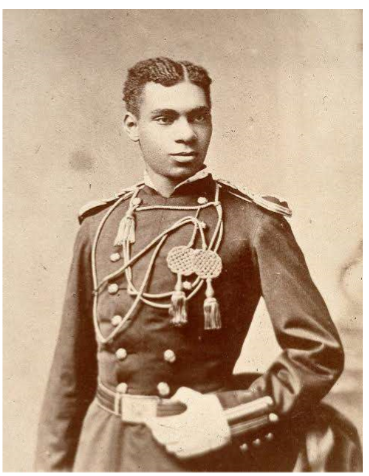
Henry Flipper — ostracized by West Point cadets because of skin color. Persevered, becoming first black graduate of West Point
(Unit 4C PowerPoint Part 2) Connections → Ostracism Can Be Digital As Well…
Explain the extent of technology use.
96% of word’s 7.8 billion people now live where there is cell phone coverage. 5.8 billion people have internet on their cell phone.
Guess: How many texts does the average American send and receive per day? 94!
Average 18-29 year old checks their phone multiple times per hour and “can’t imagine” life without it.
Teens now spend fewer hours:
Dating, driving, working, talking face-to-face, and reading books
(Unit 4C PowerPoint Part 2) Social Media
What effect do you think social media has on our relationships with others?
Most people perceive that others’ social lives are more active/interesting than their own
this is bc people only post their best moments, causing our brains to believe this is a realistic depiction of their life
Number of smartphones: TRIPLED 2011 - 2018 (U.S. & elsewhere)
Rates of depression, anxiety, self-harm and suicide have also gone up considerably
Example: major depression — 8 → 14% (~2x) among 12-17 and 18-25 year olds (2010 - 2018)
(Unit 4C PowerPoint Part 2) What are the positives of electronic communication?
Promotes self disclosure (→ one person is only disclosing abt themselves) (double-edged sword → stalking)
Link between narcissism (→ self-focused/obsessed) and social media
How many likes?
Comments?
Comparison