Light and Optics
 Call Kai
 Learn
Learn Practice Test
 Spaced Repetition
 Match
Match Flashcards
 Knowt Play
1/29

There's no tags or description
Looks like no tags are added yet.
Name | Mastery | Learn | Test | Matching | Spaced | Call with Kai |
|---|
No analytics yet
Send a link to your students to track their progress
30 Terms
Light Waves vs Sound waves
Sound waves:
-Longitudinal
-Needs a medium
-Since space is a vacuum cannot propagate in space (why we don’t hear the sun nuclear fission)
Light waves:
-Transverse
-Does NOT need a medium
Intensity is what
Energy of the wave (bright or dim)
I=A²
I=Power/4pir²
I=1/r²
E=hf
Energy of a PARTICLE
Photons
Color
For light
Amplitude=electric field strength
Frequency, wavelength, energy comparison line
Gamma rays-x rays-UV-ROYGBV-infared-microwaves-radiowaves
Radiowaves=Longest wavelength
Red-longest wavelength, smallest energy
Gamma-highest frequency, shortest wavelengths, most energy
Reflection
For reflection angle of incidence =angle of reflection
Refraction
theta2<theta 1 wave bent towards normal=SLOWING down
theta2>theta 1 wave bent away from normal so SPEEDing up
Index of refraction
n=c/vmedium
nvacuum=nair=1
n>_1 all slower than air
Refraction, indexes of refraction
n1sin(theta)=n2sin(theta)
n1>n2
Sintheta2>sintheta1
theta 2>theta 1
Speeding up
Critical angle
Sintheta=n2/n1
Theta at which theta 2=90 degrees
If theta>critical angle, refraction cannot happen so total internal reflection
Rules to know speed of light in water and speed of sound in water
Light slows down entering water, bends towards normal
Sounds speeds up entering water, away from normal (has to do with the compression ability)
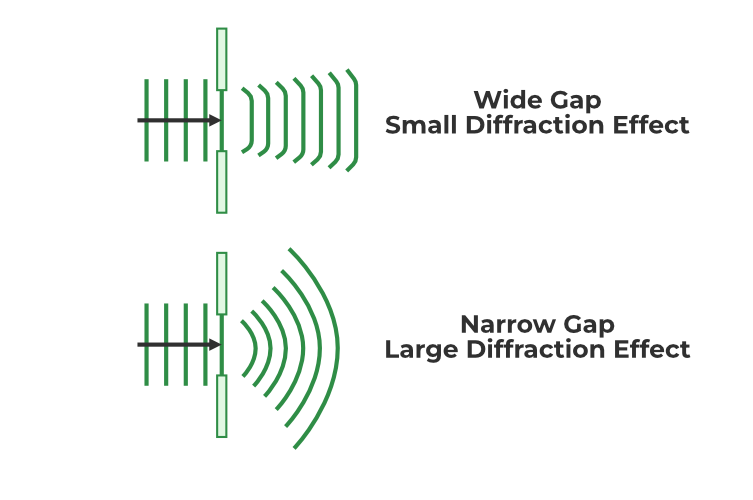
Diffraction
Diffraction is the bending, spreading, and scattering of waves as they encounter an obstacle, pass through a gap, or navigate an aperture. This phenomenon occurs with all types of waves—including light, sound, and water waves—and is most prominent when the size of the obstacle or opening closely matches the wave's wavelength.
Light and sound
Dispersion
Light dispersion is the process where white light is separated into its component colors (the visible spectrum) because different wavelengths of light travel at different speeds and bend at different angles when passing through a medium. [1, 2]
Light only
Polarization
Only light transverse waves
Sounds cannot
Polarization of light is a fundamental property of light waves describing the specific orientation of their oscillating electric and magnetic fields. It determines the plane in which the light wave vibrates as it travels through space
Light vs sounds properties
Light and sound both:
-Both use wave speed V=lambda (f)
-Both reflect, refract, and diffract
Different:
-Different types of waves
Light: transverse sound: longitudinal pressure
-Light does not need medium whereas sounds does
-Light can polarize, sound cannot
-Light slows down when going from air to water
-Sound speeds up from air to water
Mirrors and Lenses
1/f=1/object distance + 1/image distance
m=-image/object
Focal length
+ for a converging lens or mirror
- for a diverging lens or mirror
Converging lens=convex
Converging mirror=concave
Object distance
+ always
Image distance
+ for real images
Magnification
+ for upright image
Concave vs convex mirror
Concave: converging mirror +f
Near focal point
-Image on same side as object
-Image inverted
-Real image (+image distance)
Convex: diverging mirror -f
Far focal point
-Image on opposite side
-Image upright
-Virtual image (-image distance)
Concave vs convex lenses
Concave: Diverging -f
Far focal point
-Image on same side
-Smaller and upright
-Virtual -image
Convex: converging +f
Close focal point
-Image on opposite side
-Real image +image
-Inverted and smaller
Converging for both lens and mirrors
Mirrors: Concave + real image, same side
Lens: convex + real image, opposite side
Myopia
Nearsightedness
Trouble seeing far away
Focal length too short
Diverging lens, concave lens
Lens power
P=1/f
f in meters!!!
Correcting myopia
1/object distance 1/infinity 0
Image of far object bring it closer in front of glasses
Flat mirrors in bathrooms for example
About same size
m=1
Object=-(image distance)
focal length is going towards infinity
Photoelectric effect
The photoelectric effect is the emission of electrons from a material when it is struck by electromagnetic radiation, such as light
Shining light on a metal, can eject electrons from metal (photo electrons)
Detect current-put into a circuit
Measure photoelectrons
Brighter light, brighter intensity (bright vs dim, # of photons), more current read, only if wavelength is short enough
Light behaves as a wave and as a particle
E=hf for particles (photons)
Light: Wave (intensity) and particles (photons)
DeltaKE=-deltaPE
Kemax=hf-(work function, bidnign energy)
KE max=-eVstop
Vary light frequency and battery voltage, measure current
Making a light source brighter (increasing intensity) only increases the number of ejected electrons, never their energy. Only changing the frequency can increase the electrons' energy
Context and importance in medical imaging devices
Photon is absorbed via photoelectric effect, is more prominent in denser tissues
Lungs-least dense (air)-precludes ultrasounds need to use XRAY
Heisenberg uncertainty principle deltaXdeltaP=constant
PET scan real specific, laser if we want delta X to lower for specific region, limits resolution in technologies
Mass to energy equation (:
E=mc²
c=3×10^8 m/s speed of light in a vacuum