PAT 401-011 WEEK SEVEN (7): P1 DISORDERS OF THE DIGESTIVE SYSTEM
 Call Kai
 Learn
Learn Practice Test
 Spaced Repetition
 Match
Match Flashcards
 Knowt Play
1/123

There's no tags or description
Looks like no tags are added yet.
Name | Mastery | Learn | Test | Matching | Spaced | Call with Kai |
|---|
No analytics yet
Send a link to your students to track their progress
124 Terms
PAT 401-011 WK 7: P1 Disorders Of The Digestive System (GI)
T or F neural abnormalities can also play a role in GI disorders
True
PAT 401-011 WK 7: P1 Disorders Of The Digestive System
Structural and neural abnormalities can _____ or _____ or _____ movement of intestinal contents at any level of the GI tract.
slow
obstruct
accelerate
PAT 401-011 WK 7: P1 Disorders Of The Digestive System
Most disorders of the GI disrupting secretion, motility, and absorption are _______ and ______ in nature.
inflammatory
and
ulcerative
PAT 401-011 WK 7: P1 Disorders Of The Digestive System
Obstruction or inflammation of the duct openings in the liver, pancreas, and gallbladder will result in symptoms that can be both?
local and systemic
PAT 401-011 WK 7: P1 Disorders Of The Digestive System
PROF Overview: Obstruction of the intestinal lumen will cause?
clogging and distention = so much water that needs to be digested but is it its compressing the intestine and the mucus and ciliac cells and arterioles are getting pressed and compressed
PAT 401-011 WK 7: P1 Disorders Of The Digestive System
PROF Overview: Obstruction of the intestinal lumen affects what outflow
venous outflow decreases and arterioles become leaky and inflamed and compressed
PAT 401-011 WK 7: P1 Disorders Of The Digestive System
PROF Overview: lumen pressure decreases venous outflow --> causes
inflammation and leakage
PAT 401-011 WK 7: P1 Disorders Of The Digestive System
PROF Overview: lumen inflammation causes release of what
cytokines which attack the cells and lead to necrosis and when you have necrosis of the gut that is not a good thing start having infection and other rotten things and bacteria ultimately you dont want peritonitis
PAT 401-011 WK 7: P1 Disorders Of The Digestive System
PROF Overview: With inflammation of the gut you are worried about
peritonitis
PAT 401-011 WK 7: P1 Disorders Of The Digestive System
PROF Overview: Most obstruction happens in what intestine
small intestine
PAT 401-011 WK 7: P1 Disorders Of The Digestive System
PROF Overview: Because the appendix islocated at a dead end type when it fets inflammed it is prone to?
obstruction
PAT 401-011 WK 7: P1 Disorders Of The Digestive System
PROF Overview: What is coliathosis explain in one sentnece
gallstones they get stuck somewhere and cause inflammation of the gallbladder sometimes they can get dislodged somewhere and cause inflammation
PAT 401-011 WK 7: P1 Disorders Of The Digestive System
PROF Overview: Gallbladder and Gallstones are mostly deposits of what material?
cholesterol and start from the accumulation of certain things which calcify like the bile
PAT 401-011 WK 7: P1 Disorders Of The Digestive System
PROF Overview: Normally bile is produced where and stored where and travels where?
Normally bile is produced in the liver
unused bile is stored in the gallbladder through the cystic duct
whenever we need bile it will travel down the via common bile duct
PAT 401-011 WK 7: P1 Disorders Of The Digestive System
PROF Overview: Gallbaldder gallstones usually get stuck where
near the cystic duct whenever someone needs bile the gallbladder tries to cholecytoskinin it
biliary atresia
No opening of the bile ducts (into the duodenum).
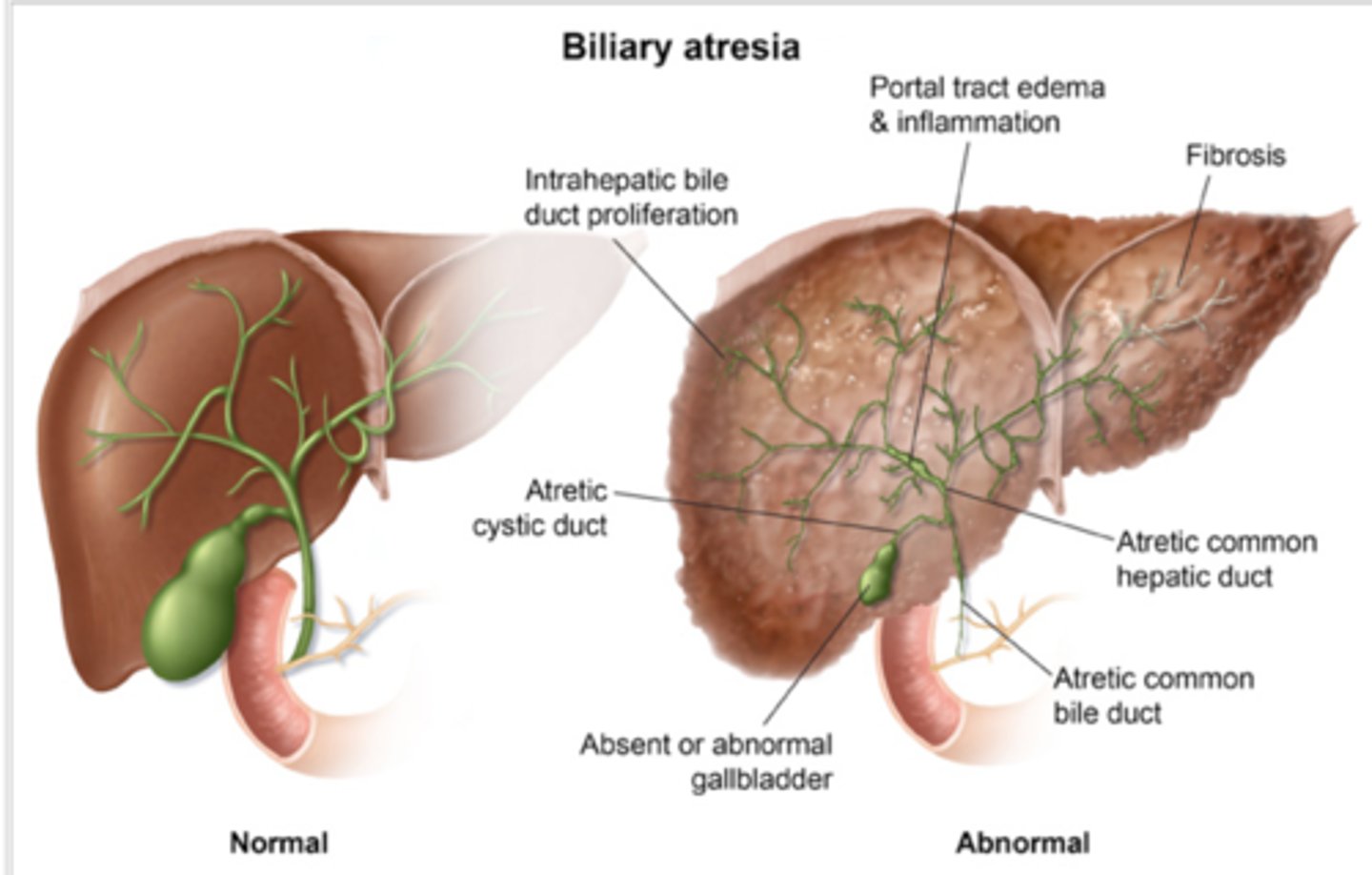
PAT 401-011 WK 7: P1 Disorders Of The Digestive System
PROF Overview: What is biliary atresia
something not flowing within the pathway in a child bile backing up the liver
PAT 401-011 WK 7: P1 Disorders Of The Digestive System
PROF Overview: bile backup will cause what main symptom
jaundice (long term liver damage and the child will need surgery to repair tested)
PAT 401-011 WK 7: P1 Disorders Of The Digestive System
PROF Overview: necrotizing entercolitis what is it?
ischemic problem presenting with inflammation and necrosis
PAT 401-011 WK 7: P1 Disorders Of The Digestive System
PROF Overview:
Fluid and electrolyte problems are asssociated with GI disorders d/t?
impaired fluid absorption bc distention makes it hard for the intestine to absorb mor fluids and the comrpession reduces venous outflow and increases arterioles leaking (worried about vascular dehydration bc the fluid is not being absorped) so we want to hydrate IV with fluids bc obv PO will cause more blockage
PAT 401-011 WK 7: P1 Disorders Of The Digestive System
PROF Overview:
Some GI common symptoms associated with many disorders think the main general ones
nausea
vomiting
decreased extracellular fluid
decreased plasma volume
dehydration
hematocrit increase
bp drops
sns response increases hr tachycardiac
hypokalemia acidosis risk understand!
PAT 401-011 WK 7: P1 Disorders Of The Digestive System
PROF Overview: Why is there a hypokalemia and acidosis risk with GI disorders?
potassium is absorbed in the intestinal tract and failure to draw K into the intestinal tract will cause acidosis because H and K have an inverse relationship
Low H means High K
High K means Low H there woried about acid-base problems
PAT 401-011 WK 7: P1 Disorders Of The Digestive System
PROF Overview: Acid base problems secondary to vomiting and diarrhea explain.
vomiting causes alklosis because you are losing H ions
metabolic alkalosis
Vomiting (alkalosis)
What happens with loss of hydrogen in the gastrointestinal tract?
diarrhea acidosis and alkalosis
metabolic acidosis d/t loss of bicarbonate ions
PAT 401-011 WK 7: P1 Disorders Of The Digestive System
PROF Overview: Perforation of anything increases wbc and fever and if that happens the intestine will leak content into putting the pt at risk for
peritonitis
PAT 401-011 WK 7: P1 Disorders Of The Digestive System
PROF Overview:
peritonitis worst case scenerio
can cause sepsis and loss of fluids from dehydration
PAT 401-011 WK 7: P1 Disorders Of The Digestive System
PROF Overview:
some methods for tx bowel obstruction will include
decompression via suctioning
laproscopric procedures for adhesiveness
stents
PAT 401-011 WK 7: P1 Disorders Of The Digestive System
PROF Overview: intestinal adhesiveness is often due to?
multiple surgeries
PAT 401-011 WK 7: P1 Disorders Of The Digestive System
PROF Overview:
interception intestinal child mostly presents with
knee drawn to chest this is a comfortable position
PAT 401-011 WK 7: P1 Disorders Of The Digestive System
PROF Overview:what pediatric gi disorder is an ischemic medical emergency
pedatric
necrotizing
entercolitis
PAT 401-011 WK 7: P1 Disorders Of The Digestive System
PROF Overview: appendicitis pain is where and of what type
RUL guarded and rebound pain
PAT 401-011 WK 7: P1 Disorders Of The Digestive System
PROF Overview: pancreatitis can cause what?
obstruction
PAT 401-011 WK 7: P1 Disorders Of The Digestive System
PROF Overview: how can pencreatitis lead to ards and renal issues
pressure exerted on the respiratory symptom + leaky vessels in the lungs can cause ARDS and low vascular low input to kidneys these systemic issues come back
PAT 401-011 WK 7: P1 Disorders Of The Digestive System
PROF Overview: general tx for gallstone
pain control + oral bile acid to break down gallstones diet and lifestyle changes to prevent reccurence
PAT 401-011 WK 7: P1 Disorders Of The Digestive System
PROF Overview: shock wave therapy for gallstones explain
to shatter the stones
PAT 401-011 WK 7: P1 Disorders Of The Digestive System
Disorders of the Accessory Organs of Digestion: What 3 organs are we looking at?
liver
gallbladder
pancreas
PAT 401-011 WK 7: P1 Disorders Of The Digestive System
Disorders of the Accessory Organs of Digestion:
The liver gallbladder and pancreas secrete substances which are
necessary for digestion
PAT 401-011 WK 7: P1 Disorders Of The Digestive System
Disorders of the Accessory Organs of Digestion: disorders of these organs include what 3 types
inflammatory disease
obstruction of ducts
tumours
PAT 401-011 WK 7: P1 Disorders Of The Digestive System
Disorders #1 Intestinal Obstructions and Paralytic Ileus:
What are the two different types of intestinal obstructions?
simple obstruction
vs
functional obstruction
PAT 401-011 WK 7: P1 Disorders Of The Digestive System
Disorders #1 Intestinal Obstructions and Paralytic Ileus:
What is simple intestinal obstruction?
any obstruction preventing the flow of chyme through either the small or large intestinal lumen
PAT 401-011 WK 7: P1 Disorders Of The Digestive System
Disorders #1 Intestinal Obstructions and Paralytic Ileus:
Which intestine is more commonly affected by simple intestinal obstruction
the small intestine is more commonly obstructed because of its narrower lumen
PAT 401-011 WK 7: P1 Disorders Of The Digestive System
Disorders #1 Intestinal Obstructions and Paralytic Ileus:
What is functional intestinal obstruction
paralytic ileus
literally functional intestinal obstruction is just paralytic ileus!
PAT 401-011 WK 7: P1 Disorders Of The Digestive System
Disorders #1 Intestinal Obstructions and Paralytic Ileus:
functional intestinal obstruction causes?
failure of motility of the intestine most common after surgery
PAT 401-011 WK 7: P1 Disorders Of The Digestive System
Disorders #1 Intestinal Obstructions and Paralytic Ileus:
Which intestinal obstruction is crucial to watch out for following surgery during the post-operative period?
functionla obstruction aka paralytic ileus
PAT 401-011 WK 7: P1 Disorders Of The Digestive System
Disorders #1 Intestinal Obstructions and Paralytic Ileus:
paralytic ileus aka functional intestinal obstruction is thought to be the result of a multifactoral and complex interaction between the _____ and ____ system.
autonomic system and central nervous system
PAT 401-011 WK 7: P1 Disorders Of The Digestive System
Disorders #1 Intestinal Obstructions and Paralytic Ileus:
functional intestinal obstruction disrupts the equilibrium of the intestine resulting in?
disorganized electrical activity and paralysis
PAT 401-011 WK 7: P1 Disorders Of The Digestive System
Disorders #1 Intestinal Obstructions and Paralytic Ileus:
What are the 4 types of intestinal obstructions
hernitation
adhesions
volvulus
intussuception
PAT 401-011 WK 7: P1 Disorders Of The Digestive System
Disorders #1 Intestinal Obstructions and Paralytic Ileus:
herniation obstruction = who is at risk for this
individuals who do heavy weight lifting
PAT 401-011 WK 7: P1 Disorders Of The Digestive System
Disorders #1 Intestinal Obstructions and Paralytic Ileus:
adhesions intestinal obstruction is usually d/t
scar tissue from prior inflammatory experiences or surgeries (aka fibrotic scarring)
PAT 401-011 WK 7: P1 Disorders Of The Digestive System
Disorders #1 Intestinal Obstructions and Paralytic Ileus:
what is intussception intestinal obstruction
being enveloped into another part of the intestine
PAT 401-011 WK 7: P1 Disorders Of The Digestive System
Disorders #1 Intestinal Obstructions and Paralytic Ileus:
Consequences of intestinal obstruction: are related to?
related to the onset and location of obstruction and presence and severity of associated ischemia
PAT 401-011 WK 7: P1 Disorders Of The Digestive System
Disorders #1 Intestinal Obstructions and Paralytic Ileus:
Consequences of intestinal obstruction: What are the 5 different main consequences we need to watch out for intestinal obstruction
1) Fluid & Electrolyte Disturbances
2) Metabolic Alkalosis
3) Metabolic Acidosis
4) Hypokalemia
5) Inflammation
PAT 401-011 WK 7: P1 Disorders Of The Digestive System
Disorders #1 Intestinal Obstructions and Paralytic Ileus:
Consequences of intestinal obstruction:
Prolonged vomiting leads to dehydration which is accompanied by what 2 ion changes and acid base imbalance
Prolonged vomiting leads to dehydration which is accompanied by a hypokalemic and hypochloremic metabolic alkaolisis because you lose gastric K and HCL (cl)
PAT 401-011 WK 7: P1 Disorders Of The Digestive System
Disorders #1 Intestinal Obstructions and Paralytic Ileus:
Consequences of intestinal obstruction: explain fluid disturbances and the effect that has on the body
extracellular fluid volume and plasma volume decrease causing dehydration.
Bc fluid level is will cause
increased hct level bc no longer diluted
hypotension bc low blood volume obv
and tachycardia bc compensation obv
severe dehydration will lead to hypovolemic shock
PAT 401-011 WK 7: P1 Disorders Of The Digestive System
Disorders #1 Intestinal Obstructions and Paralytic Ileus:
Consequences of intestinal obstruction:
Metabolic Alkalosis initially develops because of?
excessive loss of hydrogen ions that would normally be reabsorbed from the gastric juice
H + HC03 --> H20 + C02
metabolic acid base balance chemical formula^
l/s= acdidic
r/s = alklosis
vomiting = loss of free H ions leading to alkalosis shifting to R/S of equation
PAT 401-011 WK 7: P1 Disorders Of The Digestive System
Disorders #1 Intestinal Obstructions and Paralytic Ileus:
Prolonged obstruction or obstruction lower in the intestine may contribute to what kind of acid base imbalance
metabolic acidosis because bicarbonate from pancreatic secretions and bile cannot be reabsorbed and therefore there is little is higher levels of bicarb in the intestine which is on the l/s making it metabolic acdiosis
PAT 401-011 WK 7: P1 Disorders Of The Digestive System
Disorders #1 Intestinal Obstructions and Paralytic Ileus: hypokalemia from vomiting and decreased potassium can be extreme promoting
acidosis and atony of the intestinal wall
PAT 401-011 WK 7: P1 Disorders Of The Digestive System
Disorders #1 Intestinal Obstructions and Paralytic Ileus:
metabolic acidosis can also be a result of ketosis which is the result of?
declining carbohydrate stores and resorption caused by starvation or obstruction and in addition the lack of circulation permits the buildup of significant amounts of lactic acid which worsens the metabolic acidosis
PAT 401-011 WK 7: P1 Disorders Of The Digestive System
Disorders #1 Intestinal Obstructions and Paralytic Ileus:
if pressure from the obstruction is severe enough it will occlude what and cause what?
It will occlude arterial circulation and cause ishcemia, necrosis, perforation, and peritonitis
PAT 401-011 WK 7: P1 Disorders Of The Digestive System
Disorders #1 Intestinal Obstructions and Paralytic Ileus:
peritonitis will cause the overgrowth of?
bacteria
ischemica and bowel necrosis
PAT 401-011 WK 7: P1 Disorders Of The Digestive System
Disorders #1 Intestinal Obstructions and Paralytic Ileus:
increased bacterial proliferation causes translocation across the mucousa leading to?
systemic circulation causing peritonitis and sepsis
PAT 401-011 WK 7: P1 Disorders Of The Digestive System
Disorders #1 Intestinal Obstructions and Paralytic Ileus:
Back to understanding Vomiting: When vomiting the stomach loses HCl a strong acid leading to the bodys total acid load the loss of HCL means there is now an excess of ____ for every H ion
there is an excess of bicarbonate in the bloodstream relative to acid shifting the body toward a more alkaline state
PAT 401-011 WK 7: P1 Disorders Of The Digestive System
Disorders #1 Intestinal Obstructions and Paralytic Ileus:
Intestinal Obstruction Pathophysiology: Causes sequestration of gas and fluid _____ to the obstruction.
proximal to the obstruction
PAT 401-011 WK 7: P1 Disorders Of The Digestive System
Disorders #1 Intestinal Obstructions and Paralytic Ileus:
Intestinal Obstruction Pathophysiology:
Intestinal obstruction --> Proximal obstruction --> Distention
What effect does this have on the respiratory system.
Distension pushes against the diaphragm preventing full respiratory volume filling
1. reduces respiratory filling
--> 2. atelactasis -----> 3. pneumonia
PAT 401-011 WK 7: P1 Disorders Of The Digestive System
Disorders #1 Intestinal Obstructions and Paralytic Ileus:
Intestinal Obstruction Pathophysiology:
Intestinal obstruction --> Proximal obstruction --> Distention
What effect does this have on the vascular system and potential development of peritonitis?
Obstruction --> decreased venous return & decreased arterial blood flow --> causes edema which increases capillary permeability leading to arterioles being leaky --> release of toxins and bacterial translocation which ultimately leads to peritonitis
PAT 401-011 WK 7: P1 Disorders Of The Digestive System
Disorders #1 Intestinal Obstructions and Paralytic Ileus:
Intestinal Obstruction Pathophysiology:
Intestinal obstruction --> Proximal obstruction --> Distention
What kind of adbominal pain usually presents?
colickly abdominal pain
PAT 401-011 WK 7: P1 Disorders Of The Digestive System
Disorders #1 Intestinal Obstructions and Paralytic Ileus:
Intestinal Obstruction Pathophysiology:
Intestinal obstruction --> Proximal obstruction --> Distention
What effect does this have on fluid and electrolyte imbalance?
abdominal pain --> can cause N/V --> reduced appetite --> reduced nutrient absorption --> impairs F/E imbalance
PAT 401-011 WK 7: P1 Disorders Of The Digestive System
Disorders #1 Intestinal Obstructions and Paralytic Ileus:
Intestinal Obstruction Pathophysiology:
Intestinal obstruction --> Proximal obstruction --> Distention
alkalosis happens early or late and upper or lower obstruction
alkalosis is early and high obstruction
PAT 401-011 WK 7: P1 Disorders Of The Digestive System
Disorders #1 Intestinal Obstructions and Paralytic Ileus:
Intestinal Obstruction Pathophysiology:
Intestinal obstruction --> Proximal obstruction --> Distention
alkalosis is associated with which of the following SATA
a. high cl
b. low cl
c. high hc03
d. low hc03
alkalosis is associated with acid loss so HCL loss so less CL and increased HC03 (easy)
PAT 401-011 WK 7: P1 Disorders Of The Digestive System
Disorders #1 Intestinal Obstructions and Paralytic Ileus:
Intestinal Obstruction Pathophysiology:
Intestinal obstruction --> Proximal obstruction --> Distention
Acidosis occurs in what timeline of the obstruction and usually where
late obstruction and low gi obstruction
PAT 401-011 WK 7: P1 Disorders Of The Digestive System
Disorders #1 Intestinal Obstructions and Paralytic Ileus:
Intestinal Obstruction Pathophysiology:
Intestinal obstruction --> Proximal obstruction --> Distention
Acidosis usually accompanies what other metabolic disorder
ketosis lactic acidosis d/t starvation
PAT 401-011 WK 7: P1 Disorders Of The Digestive System
Disorders #1 Intestinal Obstructions and Paralytic Ileus:
Intestinal Obstruction Pathophysiology:
Intestinal obstruction --> Proximal obstruction --> Distention
Acidosis presents with
a. High H content
B. low H content
c. High hc03 content
d. high K content
e. Low K content
acidosis is more acidic therefore High H and low K
bc h and k always work in opposition!
PAT 401-011 WK 7: P1 Disorders Of The Digestive System
Disorders #1 Intestinal Obstructions and Paralytic Ileus:
Intestinal Obstruction Pathophysiology:
Intestinal obstruction --> Proximal obstruction --> Distention
dehydration & hypokalemia often associated with late or low obstruction puts the individual at risk for what 3 (LOW values)
low fluid volume
low plasma volume
low central venous pressure
PAT 401-011 WK 7: P1 Disorders Of The Digestive System
Disorders #1 Intestinal Obstructions and Paralytic Ileus:
Intestinal Obstruction Pathophysiology:
Intestinal obstruction --> Proximal obstruction --> Distention
T or F hypokalemia itself doesn't directly cause low fluid volume but it often occurs alongside conditions that lead to fluid loss like vomiting diarrhea or diuretic use
True
PAT 401-011 WK 7: P1 Disorders Of The Digestive System
Disorders #1 Intestinal Obstructions and Paralytic Ileus:
Intestinal Obstruction Clinical Manifestations: The CM of intestinal obstruction depend on what 4 factors
1. location of the blockage
2. extent of the obstruction
3. degree of ischemia
4. stage of progression
PAT 401-011 WK 7: P1 Disorders Of The Digestive System
Disorders #1 Intestinal Obstructions and Paralytic Ileus:
Intestinal Obstruction Clinical Manifestations
Is pain usually continual or intermittent for intestinal obstruction
usually intermittent on and off but when they become ischemic the pain will differ
PAT 401-011 WK 7: P1 Disorders Of The Digestive System
Disorders #1 Intestinal Obstructions and Paralytic Ileus:
Intestinal Obstruction Clinical Manifestations
Pylorus obstruction (2) broad symptoms for both LI and SI
profuse early vomiting
just vomiting a lot and a lot
pylorus
distal region of the stomach, opening to the duodenum
PAT 401-011 WK 7: P1 Disorders Of The Digestive System
Disorders #1 Intestinal Obstructions and Paralytic Ileus:
Intestinal Obstruction Clinical Manifestations
Pylorus Obstruction: Proximal small intestine S/S (2)
mild distention of abdomen
bile-stained vomiting
distention
the state or act of extending or being swollen out of shape
PAT 401-011 WK 7: P1 Disorders Of The Digestive System
Disorders #1 Intestinal Obstructions and Paralytic Ileus:
Intestinal Obstruction Clinical Manifestations
Pylorus Obstruction: Lower distal small intestine symptoms (2)
pronounded distention (more) and delayed vomiting
PAT 401-011 WK 7: P1 Disorders Of The Digestive System
Disorders #1 Intestinal Obstructions and Paralytic Ileus:
Intestinal Obstruction Clinical Manifestations
Pylorus Obstruction: Large intestine obstruction CM (3)
hypogastric pain
distention
late vomiting
hypogastric
below the stomach
PAT 401-011 WK 7: P1 Disorders Of The Digestive System
Disorders #1 Intestinal Obstructions and Paralytic Ileus:
Intestinal Obstruction Clinical Manifestations
PARTIAL Obstruction: S/S (2)
diarrhea
constipation
PAT 401-011 WK 7: P1 Disorders Of The Digestive System
Disorders #1 Intestinal Obstructions and Paralytic Ileus:
Intestinal Obstruction Clinical Manifestations
Complete Obstruction: most severe 5 main S/S to watch out for
constipation
increased bowel sounds
cramping
hypovolmia
metabolic acidosis
PAT 401-011 WK 7: P1 Disorders Of The Digestive System
Disorders #1 Intestinal Obstructions and Paralytic Ileus:
Intestinal Obstruction Clinical Manifestations
Complete Obstruction:
with ischemia why is pain so severe?
think about it
ischemia --> lack of blood flow to organs --> tissue dying --> necrosis which is v painful
PAT 401-011 WK 7: P1 Disorders Of The Digestive System
Disorders #1 Intestinal Obstructions and Paralytic Ileus:
Intestinal Obstruction Clinical Manifestations
Complete Obstruction: obstruction with ischemia in late stages will cause necrosis and perforation.
How do we know a patient may be experiencing necrosis or perforation (4) signs
necrosis dead tissue always stimulated an inflammatory response for clean up watch our for pain fever
dead rotten tissue watch our for peritonitis risk!
PAT 401-011 WK 7: P1 Disorders Of The Digestive System
Disorders #1 Intestinal Obstructions and Paralytic Ileus:
Intestinal Obstruction Treatment
A: How do tx the fluid and electrolyte imbalances caused by vomiting
Replace the fluid and electrolytes IV
PAT 401-011 WK 7: P1 Disorders Of The Digestive System
Disorders #1 Intestinal Obstructions and Paralytic Ileus:
Intestinal Obstruction Treatment
B: How do we treat the actual obstruction if it is something small like partial
gastric or intestinal obstruction
PAT 401-011 WK 7: P1 Disorders Of The Digestive System
Disorders #1 Intestinal Obstructions and Paralytic Ileus:
Intestinal Obstruction Treatment
B: how do we treat adhesional obstruction
laparoscopic procedures for adhesions
PAT 401-011 WK 7: P1 Disorders Of The Digestive System
Disorders #1 Intestinal Obstructions and Paralytic Ileus:
Intestinal Obstruction Treatment
B: how do we tx strangulation
immediate surgical intervention
PAT 401-011 WK 7: P1 Disorders Of The Digestive System
Disorders #1 Intestinal Obstructions and Paralytic Ileus:
Intestinal Obstruction Treatment
B: how do we treat complete obstruction
immediate surgical intervention
PAT 401-011 WK 7: P1 Disorders Of The Digestive System
Disorders #1 Intestinal Obstructions and Paralytic Ileus:
Intestinal Obstruction Treatment
B: how do we need peritonitis secondary to obstruction (2)
IV abx
fluid resuscitation
PAT 401-011 WK 7: P1 Disorders Of The Digestive System
Disorders #1 Intestinal Obstructions and Paralytic Ileus:
Intestinal Obstruction Treatment
D: how do we tx perforation
surgery
intestinal perforation
Hole in intestines, leading to leakage of digestive tract contents into the peritoneal cavity.
**Requires immediate surgical intervention to prevent peritonitis**
PAT 401-011 WK 7: P1 Disorders Of The Digestive System
Disorders #1 Intestinal Obstructions and Paralytic Ileus:
Intestinal Obstruction Treatment
for obstruction the client is put on NPO to prevent
more blockage we need to suction out the stuck content first!
PAT 401-011 WK 7: P1 Disorders Of The Digestive System
Gastrointestinal Disorders in Children #1: Intussusception
What is it?
Telescoping or invagination of one part of the intestine into another
basically one part of the intestine envelops into another part causing obstruction
PAT 401-011 WK 7: P1 Disorders Of The Digestive System
Gastrointestinal Disorders in Children #1: Intussusception
Most Common spot for intussuception
ileum invaginating into cecum
PAT 401-011 WK 7: P1 Disorders Of The Digestive System
Gastrointestinal Disorders in Children #1: Intussusception
Why is intussuception dangerous to vascular flow?
The mesentry becomes constricted and obstructs venous return