Bisc 101 Week 5
 Call Kai
 Learn
Learn Practice Test
 Spaced Repetition
 Match
Match Flashcards
 Knowt Play
1/39

There's no tags or description
Looks like no tags are added yet.
Name | Mastery | Learn | Test | Matching | Spaced | Call with Kai |
|---|
No analytics yet
Send a link to your students to track their progress
40 Terms
What is the purpose of cellular respiration?
-To acquire glucose, which provides chemical energy to produce ATP.
-cellular respiration is any set of reactions that uses electrons harvested from high-energy molecules to produce ATP through ETC.
What are the inputs into cellular respiration? What are the outputs?
Input: Glucose, oxygen, ADP + P
Outputs: ATP, CO2, H2O.
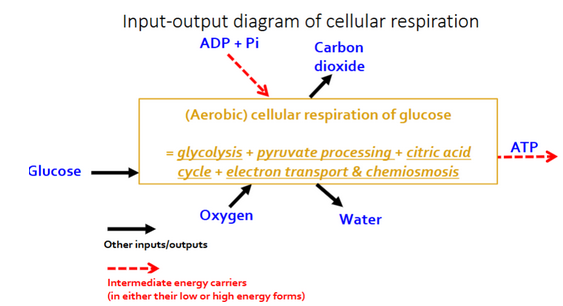
4 Processes of Cellular Respiration
Glycolysis
Pyruvate processing
Citric acid cycle
ETC and oxidative phosphorylation
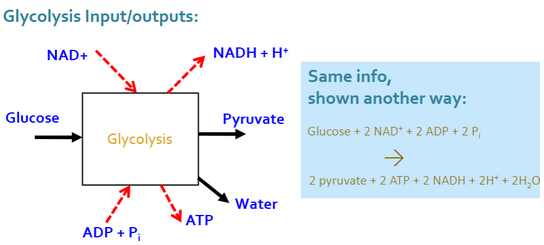
Glycolysis
6 carbon sugar → 2 pyruvates
ADP+P → ATP
NAD+ → NADH
occurs in cytosol for both Eukaryotes and Prokaryotes
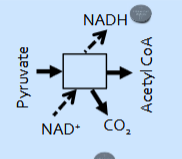
Pyruvate Processing
Pyruvate(2 carbons) → Acetyl CoA (2 carbons) and CO2
NAD+ → NADH
eukaryotes: mitochondrial matrix
prokaryotes: cytosol
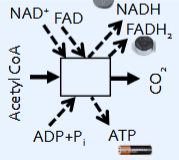
Citric Acid Cycle
Acetyl CoA → CO2
ADP+P → ATP
NAD+ → NADH
FAD → FADH2
eukaryotes: mitochondrial matrix
prokaryotes: cytosol
ETC and oxidative phosphorylation
ETC:
-Oxidation of NADH and FADH2.
-Electrons from NADH and FADH2 move through ETC which releases energy used to transport protons across the inner mitochondrial membrane, creating a proton gradient.
-Oxygen is the final electron acceptor and it forms water as a by-product
O.P:
-The potential energy stored in the proton gradient is used to spin components of the ATP synthase to produce ATP by combining ADP+P.
-This process is responsible for most of the ATP made by cellular respiration.
prokaryotes: plasma membrane.
Eukaryotes: inner mitochondrial membrane.
ATP Synthase
-combines ADP and phosphate as it spins, creating ATP.
Why does electron transport and chemiosmosis need a membrane?
Without a membrane, no proton gradient can form. Which prevents protons from flowing through the ETC and ultimately producing ATP.
Fermentation
-To replenish supply of NAD+ for glycolysis
-Occurs in the cytosol when an electron transport chain is not present or it is inactive due to an insufficient amount of the final electron acceptor.
Produces lactate in humans
Inputs are Pyruvate & NADH
Similarities between C.R. and Fermentation
both processes used to make ATP and neither requires oxygen
Differences between C.R. and Fermentation
-Nearly every organism can perform some type of fermentation but only certain prokaryotes can do anaerobic respiration.
-cellular respiration uses an ETC and ATP synthase while fermentation does not.
-In cellular respiration glucose is converted into CO2, while in fermentation glucose is converted into an organic molecule such as lactate.
-cellular respiration also produces more ATPs per glucose.
Photosynthesis
-The use of sunlight to manufacture carbohydrates.
Overall reaction: CO2 + H2O + light energy -> (CH2O)n + O2
light capturing reaction
calvin cycle
The light-capturing reactions
-Produces oxygen from water.
-Light energy is transformed to chemical energy in the form of ATP and NADPH
The Calvin cycle
-Produces sugar from carbon dioxide.
-The ATP and NADPH produced in the light capturing reactions are used to reduce carbon dioxide to sugar. Also creates ADP+P.
-Occurs in the stroma.
NADPH
-electron carrier produced in light reactions; used to reduce CO₂ in the Calvin cycle.
Carbohydrates
-Glucose: Monosaccharide linked to glycosidic bond (repeat)
-Starch: polysaccharide of glucose. Can be branched or linear
General roles: cell & molecule identity, cell structure, AND ENERGY
Catabolism
releases energy. breaking big molecules down into subunits: RELEASING ENERGY
Anabolism
Building big molecules from subunits: USES ENERGY
Meiosis
production of sperm and eggs, which are the gametes. (In plants, spores)
daughter cells different from parent cell
Mitosis
production of somatic cells.
daughter cells identical to parent cell
Cytokinesis
division of the cytoplasm into two distinct cells.
How Do Cells Replicate?
copying the DNA.
separating the copies.
dividing the cytoplasm to create two complete cells.
What Is a Chromosome?
Chromosomes consist of a single long DNA double helix that is wrapped around proteins, called histones.
Before mitosis, each chromosome is replicated. As mitosis starts, the chromosomes condenses. Then one copy of each chromosome is distributed to each of two daughter cells.
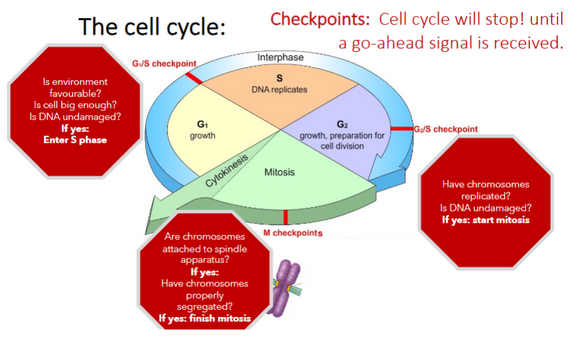
The Cell cycle
Interphase:
G1 phase
S phase
G2 phase
M phase:
PMAT
Cytokinesis
G1 phase
part of interphase, growth: accumulating the building blocks of chromosomal DNA and energy
S phase
part of interphase, DNA replication occurs
G2 phase
part of interphase, growth, preparation for cell division
Cell cycle checkpoints
control mechanisms
G1 checkpoint, the G2/M checkpoint, and the M checkpoint.
Centromere
Chromosome Handle
Microtubules
pulls chromosomes apart during mitosis
centrosomes
microtubule-organising centre in eukaryotes during mitosis
Kinetochore
holds DNA and microtubule together at centromere
Prophase
Chromosomes Condense
Spindle Apparatus forms at centriole
Prometaphase
nuclear envelope dissolves
microtubules make contact with chromosomes
Metaphase
Microtubules move chromosomes to center of cell
Anaphase
Microtubules pull sister chromatids apart
Telophase
sister chromatids arrive at opposite poles of cell
nuclear envelope forms around each set
Cytokinesis
Division of cell cytoplasm into two daughter cells
Product = 2 diploid cells
MPF
m-phase promoting factor in all eukaryotes