Tissue repair
 Call Kai
 Learn
Learn Practice Test
 Spaced Repetition
 Match
Match Flashcards
 Knowt Play
1/20

There's no tags or description
Looks like no tags are added yet.
Name | Mastery | Learn | Test | Matching | Spaced | Call with Kai |
|---|
No analytics yet
Send a link to your students to track their progress
21 Terms
What does tissue repair depend on
Key factors
Ability of the tissue to divide
Nutrition
Severity of the wound
Minor vs Major Wounds
Minor wounds
Involve only the epidermis
Major wounds
Involve both epidermis and dermis
List the three stages of tissue repair
Inflammation
Organisation/proliferation
Maturation/remodeling
Summary of what happens in inflammation
Initial response to injury
Prepares the area for repair
Summary of what happens in organisation/proliferation
New tissue and blood vessels form
Wound begins to fill and rebuild
Summary of what happens in maturation/remodeling
Tissue strengthens
Collagen reorganises
Final repair and restoration of function
What is the purpose of inflammation
Prepares the wound for repair
Eliminates invading microorganisms
Removes debris and dead tissue
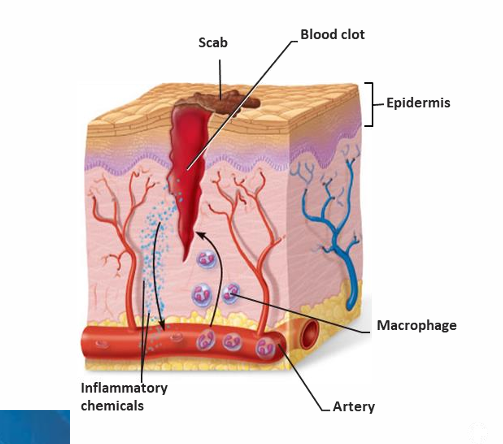
What triggers inflammation
Damaged cells release inflammatory chemicals
These chemicals initiate the inflammatory response
What happens to blood vessels
Increased permeability
Fluid moves into the wound area carrying:
Macrophages → engulf debris & microorganisms
Clotting proteins → form a blood clot to:
Stop blood loss
Hold wound edges together
Prevent further microbial invasion
Signs of inflammation
Redness
Pain
Heat
Swelling
What forms on the surface
A scab
The clot dries and forms a protective scab
What is the purpose of the proliferative stage
Synthesis of extracellular matrix, including collagen
Restores blood supply to the wound
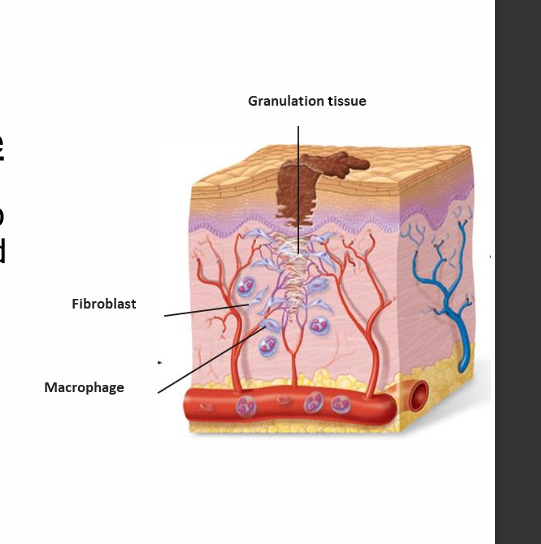
What replaces the blood clot
Granulation tissue
Soft, pink tissue that fills the wound space
Indicates active healing
What is granulation tissue composed of
Capillaries
Grow across the wound
Restore blood supply
Bring oxygen and nutrients needed for healing
Fibroblasts
Produce collagen fibres
Bridge the gap in the wound
Macrophages
Engulf cell debris
Remove invading microorganisms
Clear the blood clot
What do epithelial stem cells do in this stage
Epithelialisation
Stem cells multiply
Migrate over granulation tissue
Begin to restore the epidermal surface
What is the purpose of the maturation stage
Completes permanent skin repair through:
Regeneration
Fibrosis (scar formation)
What happens to collagen
Collagen remodelling
Collagen is reorganised and tightened
Helps pull wound edges together
What happens to granulation tissue
Replacement with scar tissue
Existing blood vessels are compressed
Granulation tissue is replaced by scar tissue → fibrosis
Properties of scar tissue
Avascular
Tough
No elasticity or flexibility
No hair follicles
No sweat or oil glands
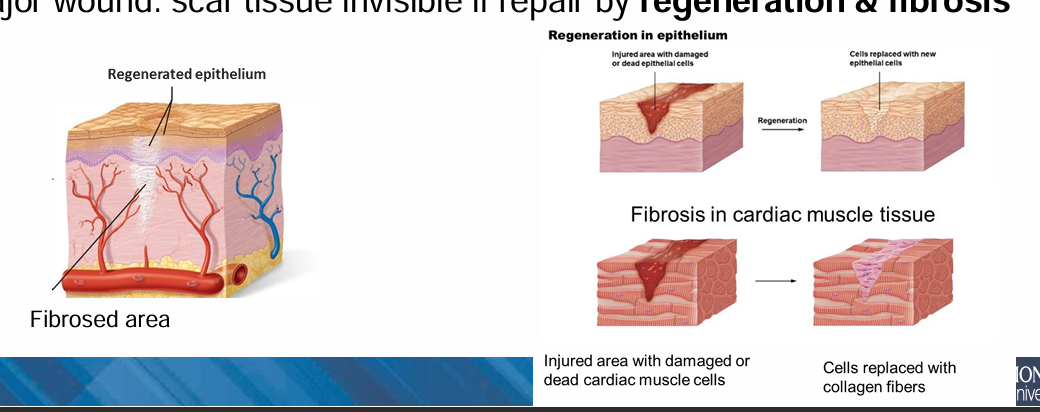
When does regeneration occur
If damage is minor OR epidermal stem cells are present
Stem cells multiply under the scab
Regenerate the epidermis
Scab falls off
Skin returns to pre‑injury appearance
When is scar tissue visible
Visible scar
If repair occurs only by fibrosis
Common in major wounds
Invisible or minimal scar
If repair occurs by regeneration + fibrosis