Math 121 Section 1.1
 Call Kai
 Learn
Learn Practice Test
 Spaced Repetition
 Match
Match Flashcards
 Knowt Play
1/38

There's no tags or description
Looks like no tags are added yet.
Name | Mastery | Learn | Test | Matching | Spaced | Call with Kai |
|---|
No analytics yet
Send a link to your students to track their progress
39 Terms
What is a function?
A function is a relationship where every input has exactly one output. One x-value cannot give two different y-values.
How do I tell if a table is a function?
Check the x-values. If an x-value repeats with different y-values, it is not a function. If every input has only one output, it is a function.
Can two different inputs have the same output?
Yes, two different x-values can have the same y-value. That is still a function. The problem only happens when one x-value has two different y-values.
What does f(3) mean?
It means the output of the function when the input is 3. In simple words, plug in 3 for x.
What does it mean to evaluate a function?
Evaluating means you are given the input and you find the output. For example, f(4) means plug in 4 and find the answer.
What does it mean to solve a function equation?
Solving means you are given the output and you find the input. For example, f(x)=7 means find the x-value or values that make the output 7.
What is the vertical line test?
If any vertical line touches a graph more than once, the graph is not a function. If every vertical line touches the graph at most once, it is a function.
Why does the vertical line test work?
A vertical line checks one x-value. If it hits the graph twice, that means one input has two outputs, so it is not a function.
On a graph, how do I evaluate f(2)?
Start at x=2, move to the graph, and read the y-value.
On a graph, how do I solve f(x)=4?
Start at y=4, move across to the graph, and find the x-value or values where the graph has that output.
What is domain?
Domain is the set of all possible inputs, which means the x-values.
What is range?
Range is the set of all possible outputs, which means the y-values.
How do I remember domain and range?
Domain goes with x, and range goes with y. Domain means left to right, range means down to up.
What do brackets mean in interval notation?
Brackets mean the endpoint is included. For example, [2,5] includes both 2 and 5.
What do parentheses mean in interval notation?
Parentheses mean the endpoint is not included. For example, (2,5) does not include 2 or 5.
What do parentheses mean in interval notation?
Infinity is not an actual number, so it cannot be included. That is why we write (-infinity, infinity), not [-infinity, infinity].
How do I find the domain of a square root function?
Set the inside of the square root greater than or equal to zero because you cannot take the square root of a negative number in this class. Ex: f(x)=sqrt(x+4)
x+4 >= 0
x >= -4
Domain: [-4, infinity)
How do I find the domain of a fraction?
Set the denominator equal to zero, solve, and exclude that value because you cannot divide by zero. Ex:
f(x)=7/(x-5)
x-5=0
x=5
Domain: (-infinity, 5) U (5, infinity)
What is the domain if there is no square root and no denominator?
The domain is usually all real numbers: (-infinity, infinity). Ex: f(x)=x^2+3x-1
Domain: (-infinity, infinity)
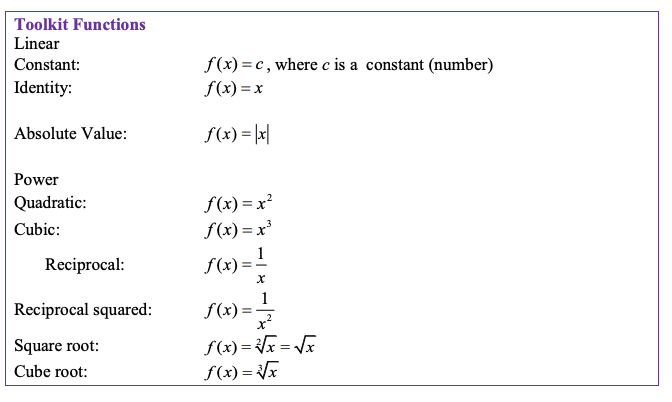
ToolKit Functions
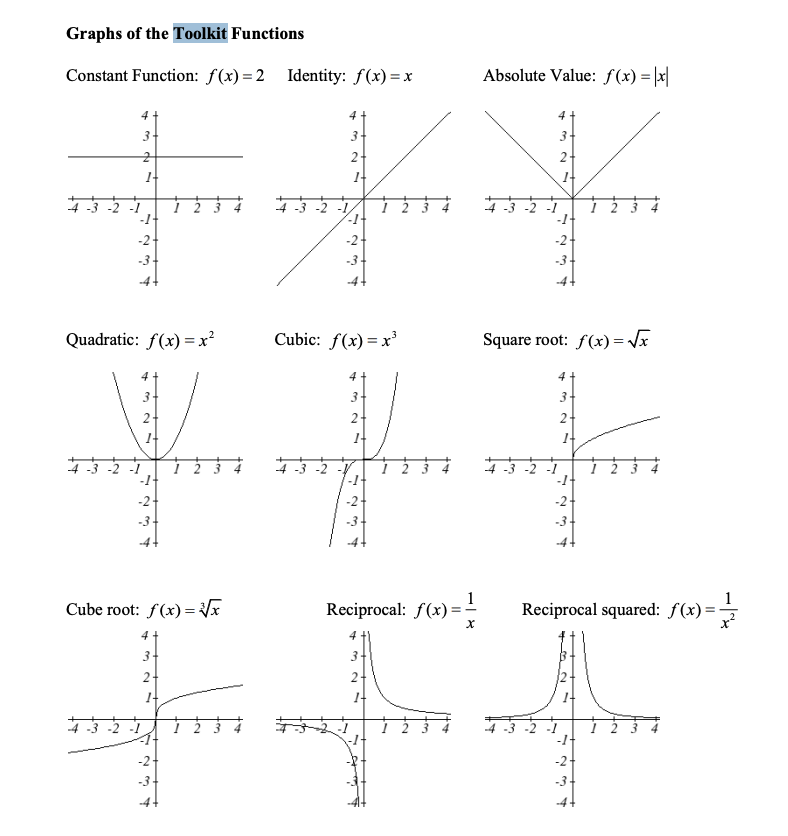
Graphs of the Toolkit Functions
What is the constant function?
A constant function looks like f(x)=c, such as f(x)=2. No matter what input you plug in, the output stays the same.
What is the identity function?
The identity function is f(x)=x. Whatever you put in, you get the same thing out.
What is the quadratic function?
The quadratic function is f(x)=x^2. Its graph is a U-shape. Its domain is all real numbers, and its range is [0, infinity).
What is the cubic function?
The cubic function is f(x)=x^3. Its graph is an S-shape. Its domain and range are both all real numbers.
What is the absolute value function?
The absolute value function is f(x)=|x|. It makes outputs nonnegative. Its domain is all real numbers, and its range is [0, infinity).
What is the square root function?
The square root function is f(x)=sqrt(x). Its domain is [0, infinity), and its range is also [0, infinity).
What is the reciprocal function?
The reciprocal function is f(x)=1/x. Its domain excludes 0 because you cannot divide by zero. Domain: (-infinity, 0) U (0, infinity).
What is the reciprocal squared function?
The reciprocal squared function is f(x)=1/x^2. Its domain excludes 0, and its range is (0, infinity), because outputs are always positive and never zero.
What is the most important rule when plugging in negative numbers?
Always use parentheses. Example:
f(x)=x^2
f(-4)=(-4)^2=16
Do not write:
-4^2
because that means:
-(4^2)=-16
What is the difference between (-3)^2 and -3^2?
(-3)^2=9 because the negative is included in the square. But -3^2=-9 because only the 3 is squared, then the negative is applied.
What is the Section 1.1 domain checklist?
First check for a square root. If there is one, the inside must be greater than or equal to 0. Then check for a fraction. If there is one, the denominator cannot equal 0. If neither appears, the domain is usually all real numbers.
What is the Section 1.1 domain checklist?
First check for a square root. If there is one, the inside must be greater than or equal to 0. Then check for a fraction. If there is one, the denominator cannot equal 0. If neither appears, the domain is usually all real numbers.
SUPER SHORT MEMORY SHEET
Function = one input, one output.
Evaluate = input given, find output.
Solve = output given, find input.
Domain = x-values.
Range = y-values.
Square root domain = inside must be >= 0.
Fraction domain = denominator cannot equal 0.
Infinity always gets parentheses.
Negative inputs need parentheses.
Interval Notion: What do parentheses mean?
Endpoint is NOT included. Use with < or >.
Interval Notion: Endpoint is NOT included. Use with < or >.
Endpoint IS included. Use with ≤ or ≥.
Why does infinity always use parentheses?
Infinity is not a real number, so it cannot be included.
Interval Notion: What is the left/right rule?
Less than goes left to -oo. Greater than goes right to oo. If the arrow goes left <, start with −oo, if the arrow goes right > , end with 00.
Interval Notion: Practice: How do I write x ≤ -3 or x > 4?
(-oo, -3) U (4, oo)