3.3.2 Gas exchange
 Call Kai
 Learn
Learn Practice Test
 Spaced Repetition
 Match
Match Flashcards
 Knowt Play
1/22

There's no tags or description
Looks like no tags are added yet.
Name | Mastery | Learn | Test | Matching | Spaced | Call with Kai |
|---|
No analytics yet
Send a link to your students to track their progress
23 Terms
Explain how the body surface of a single-celled organism is adapted for gas exchange. (2 marks)
- They have a thin, flat shape with a large SA:V.
- Short diffusion pathways allow rapid gas exchange of oxygen and carbon dioxide.
Describe the tracheal system of an insect. (3 marks)
- Spiracles are surface pores that open or close to allow diffusion.
- Tracheae are large air-filled tubes that permit gas movement.
- Tracheoles are smaller branches from tracheae that allow gas exchange with cells.
Explain how the insect tracheal system is adapted for gas exchange. (5 marks)
- Tracheoles have thin walls for short diffusion distances.
- Large numbers of branched tracheoles create a large surface area.
- Tracheae hold air, enabling fast diffusion.
- Abdominal muscle contractions change body pressure to move air in and out, maintaining concentration gradients.
- Fluid in tracheoles is drawn into tissues during exercise, increasing air contact and speeding diffusion.
Explain adaptations in terrestrial insects for gas exchange while reducing water loss. (3 marks)
- Thick waxy cuticle or exoskeleton increases diffusion distance, reducing evaporation.
- Spiracles can open for gas exchange or close to limit water loss.
- Hairs around spiracles trap moist air, lowering the water potential gradient and reducing evaporation.
Explain how the gills of fish are adapted for gas exchange. (3 marks)
- Gills have many filaments covered in numerous lamellae, giving a large surface area.
- Thin epithelial layers create a short diffusion distance between water and blood.
- A rich supply of capillaries maintains the concentration gradient by removing oxygen and supplying carbon dioxide.
Describe countercurrent flow in fish gills. (4 marks)
- Blood and water flow in opposite directions across the lamellae.
- Oxygen concentration in water is always higher than in blood along the exchange surface.
- This maintains a constant concentration gradient for oxygen uptake.
- Diffusion occurs along the entire length of the lamellae.
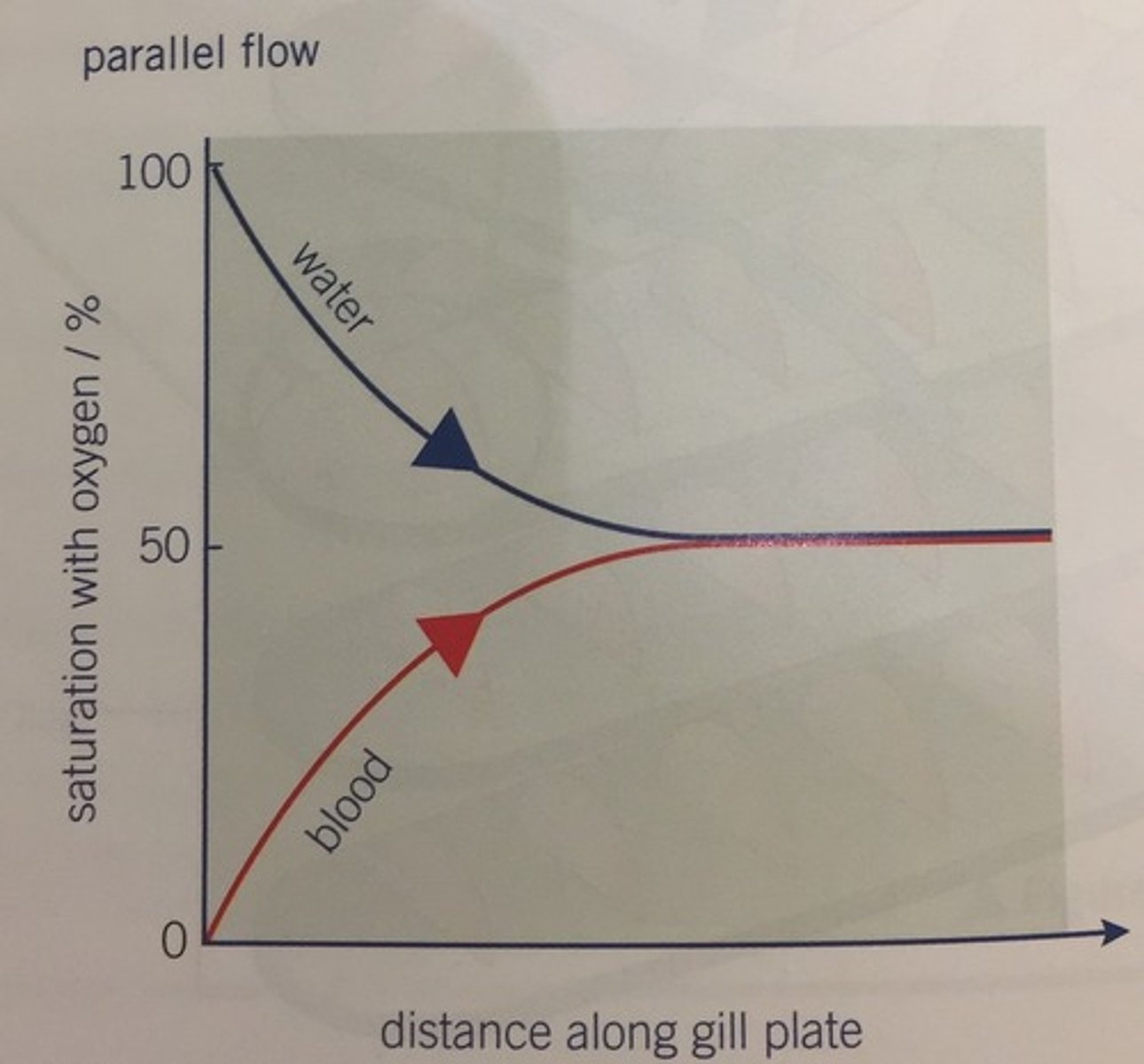
Describe parallel flow in fish. (3 marks)
- If parallel flow, equilibrium would be reached so oxygen wouldn't diffuse into blood along the whole gill plate.
- Direction of water flow and direction of blood flow are the same.
Explain how leaves of dicotyledonous plants are adapted for gas exchange. (3 marks)
- Many stomata create a large surface area for gas exchange when open.
- The spongy mesophyll contains air spaces, increasing surface area for diffusion.
- Thin structure means gases have a short diffusion pathway.
Explain adaptations of xerophytic (deserts) plants to balance gas exchange with water conservation. (3 marks)
- A thicker waxy cuticle increases diffusion distance, reducing evaporation.
- Sunken stomata, rolled leaves, and hairs trap water vapour, protecting stomata from wind and reducing the water potential gradient.
- Spines or needles reduce surface area to volume ratio, lowering water loss.
Draw a labelled diagram of the gross structure of the human gas exchange system. (4 marks)
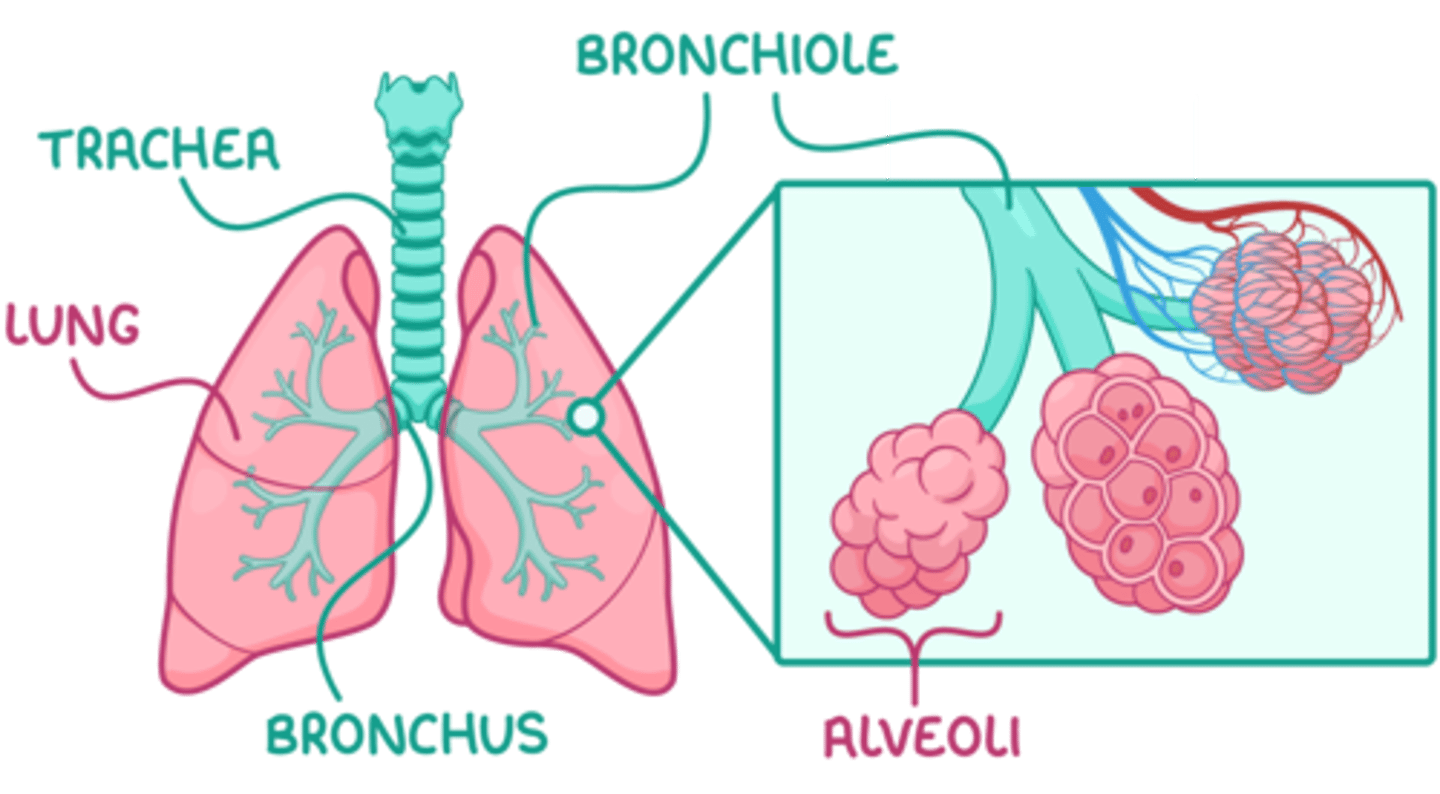
Describe the gross structure of the human gas exchange system. (3 marks)
- Air passes through the trachea, which branches into two bronchi leading to each lung.
- Bronchi subdivide into smaller bronchioles that end in alveoli.
- Alveoli are surrounded by a network of capillaries for efficient gas exchange.
Describe the structural features of the alveolar epithelium that make it efficient for gas exchange. (5 marks)
- The cells are flattened and only one layer thick, creating a very short diffusion distance.
- The surface is folded, providing a large total area for oxygen and carbon dioxide exchange.
- It is permeable, allowing gases to diffuse across easily.
- A moist lining helps gases dissolve before diffusing.
- A dense capillary network maintains a steep concentration gradient between air in the alveoli and blood.
Describe how gas exchange takes place in the lungs. (3 marks)
- Oxygen diffuses from the alveolar air into the blood down its concentration gradient.
- Diffusion occurs across the alveolar wall and then through the capillary endothelium.
- With carbon dioxide moving in the opposite direction.
Explain why ventilation is important for effective gas exchange. (2 marks)
- Ventilation brings in fresh air with a higher oxygen concentration and removes air containing less oxygen.
- This helps maintain steep concentration gradients for oxygen and carbon dioxide across the gas exchange surface.
Describe the process of breathing in (inspiration) for humans. (4 marks)
- During inspiration, the diaphragm contracts and flattens.
- While the external intercostal muscles contract, raising the ribcage.
- The thoracic cavity volume increases, lowering pressure below atmospheric levels.
- So air enters into the lungs down a pressure gradient.
Describe the process of breathing out (expiration) for humans. (4 marks)
- During expiration, the diaphragm relaxes and moves upwards into a dome shape.
- While the external intercostal muscles relax, pulling the ribcage down.
- The thoracic cavity volume decreases, increasing pressure above atmospheric levels.
- So air is forced out of the lungs down a pressure gradient.
Suggest why expiration at rest is mostly a passive process. (2 marks)
- The internal intercostal muscles usually remain relaxed when breathing out at rest.
- The elastic recoil of alveolar walls pushes air out without the need for significant muscle contraction.
Explain how certain lung diseases can lower the rate of gas exchange. (3 marks)
- Thickening of the alveolar walls increases the distance gases must diffuse.
- Damage to alveoli reduces the total surface area for exchange.
- Reduced elasticity of lung tissue means the lungs do not expand and recoil fully, lowering the concentration gradient for gases.
Describe how lung diseases can affect ventilation. (3 marks)
- Loss of elasticity in lung tissue reduces tidal volume and overall lung capacity.
- Narrowed airways make it harder to move air in and out, reducing forced expiratory volume in one second.
- Lower gas exchange efficiency means the breathing rate increases to maintain oxygen delivery to the body.
Explain why people with lung disease may feel fatigued. (2 marks)
- Less oxygen reaches body cells, reducing aerobic respiration rates.
- Lower ATP production means less energy is available for muscle activity.
Describe how to analyse and interpret data on pollution, smoking, and other lung disease risk factors. (4 marks)
- Identify overall trends, such as whether there is a positive or negative correlation between the factor and disease incidence.
- Carry out data manipulation, for example calculating percentage changes.
- Compare standard deviations to see if results are likely due to chance.
- Apply statistical tests such as correlation coefficient, t-test, or chi-squared depending on the data type.
Explain how to evaluate experimental data that influenced legal restrictions on risk factors. (5 marks)
- Consider whether the results clearly support or challenge the claims made.
- Assess whether the sample size and diversity were representative of the population.
- Check that control groups and variables were used appropriately.
- Evaluate whether the study lasted long enough to show long-term effects.
- Consider whether conclusions were overgeneralised from limited data and if other factors could have influenced results.
Explain the difference between correlation and causation. (3 marks)
- Correlation is when a change in one variable is reflected by a change in another which is identified on a scatter diagram.
- Causation is when a change in one variable causes a change in another variable.
- Correlation does not mean causation as may be other factors involved.