AP World History: Unit 2 Networks of Exchnage 1200-1450
 Call Kai
 Learn
Learn Practice Test
 Spaced Repetition
 Match
Match Flashcards
 Knowt Play
1/37

There's no tags or description
Looks like no tags are added yet.
Name | Mastery | Learn | Test | Matching | Spaced | Call with Kai |
|---|
No analytics yet
Send a link to your students to track their progress
38 Terms
Burghers
Middle class merchants who became particularly powerful between 1200 and 1450. This is a direct result of the European nationalism buildings up of more skills in the serf class which sponsored more trade(this led to the building of banking systems which is a kore direct cause)
Hanseatic League
Estclihed in 1358, it controlled trade throughout much of Europeans societies. This led to increased interdependence between European societies was a drive toward nationhood and also increase social mobility in social classes.
A collection of city states that worked together to trade and fight of foreign in government establishing a monopoly over trade essentially. This led to middle class development which had much effect(next ch.) and things like the braking of the Fedual system along side urban migration. It ate up the stage for later European developments of the Dutch and the English imperial systems.
Women’s Status(Europe)
strict pataricaral social class divisions
Could inherit land and take oaths of vassalage but property belonged to husband
Could bring court case but not be in decision
Division of labor: women in textiles
Christian monogamy(married to one person at a time)
education limited to upper class males
No illegitimate children
Veiling for upper class
Islam(women’s status)
equality in religion but super hate 8n mosque
Received half the inheritance of male children
Testimony had less weight than that of males
Concubines(multiple wives)
literate society
all children are legitimate
Veiling in public
India(women’s status)
strict patriarchal caste system
Chile marriages
Sati(die) Patrice for widows
Family or textile labor
Marriage limited to caste members ONLY
Education is limited
Purdah: veiling seclusion
China(women’s status)
strict Confucian social order and guidelines for virtuous behaviors
Acesss to dowries and owned businesses
Widow rema8sn with son, no portu id remarried
Silk weaving
Concubines and seclusion in harems
Literate socirty but state education limited to men
Footbinding
Scholasticism
Progression which happened through limited trade and crushes where people came into contrat with philosophy ideas which started to challenge the Roman Catholic Church authority. Already not going towards what was going towards crusades in the first place.
Heresies
Religious practices or beliefs that do not conform to the traditional church doctrine. This includes just going back to simpler Christianity because of the build the church had corrupt and economically driven practices.
Pope Innocent 3rd
Tried to put and end to heresies and scholasticism.
Issued strict rules such as perceived heretics and Jew executions
Unsuccessful crusade attempt largely driven by economic reasons(sacked constatinoble already Christian) and deadlier Latin empire until Byzantine’s took control
Inquisition
Happened under pope Gregory, formalized the interrogation and and persecution process.
Punishment for heretics or non believers ranged from excommunication to execution.
Universal Church/Church Militant
Church which was at its most power with these new policies happening, also proceeded reliance during feudal systems and sometimes worked end hand and hand with it allowing for more authority.
Thomas Aquinas
Christian theology person who wrote Summna Theologica
He said this new knowledge and the church were supposed to work hand in hand.
That they are not at completion and want to uplift each other,
BUBONIC PLAGUE
Black Death which originated in China(killed millions of people), it then spread to Europe through various trade routes and arrived in first the ports of Italy. It killed half of the Europeans and which collapsed Europe’s social structure. This helped the creation of reform systems within Europe leading to a more commercial economy and more individual freedoms and development of new industries.
Mongol Empire
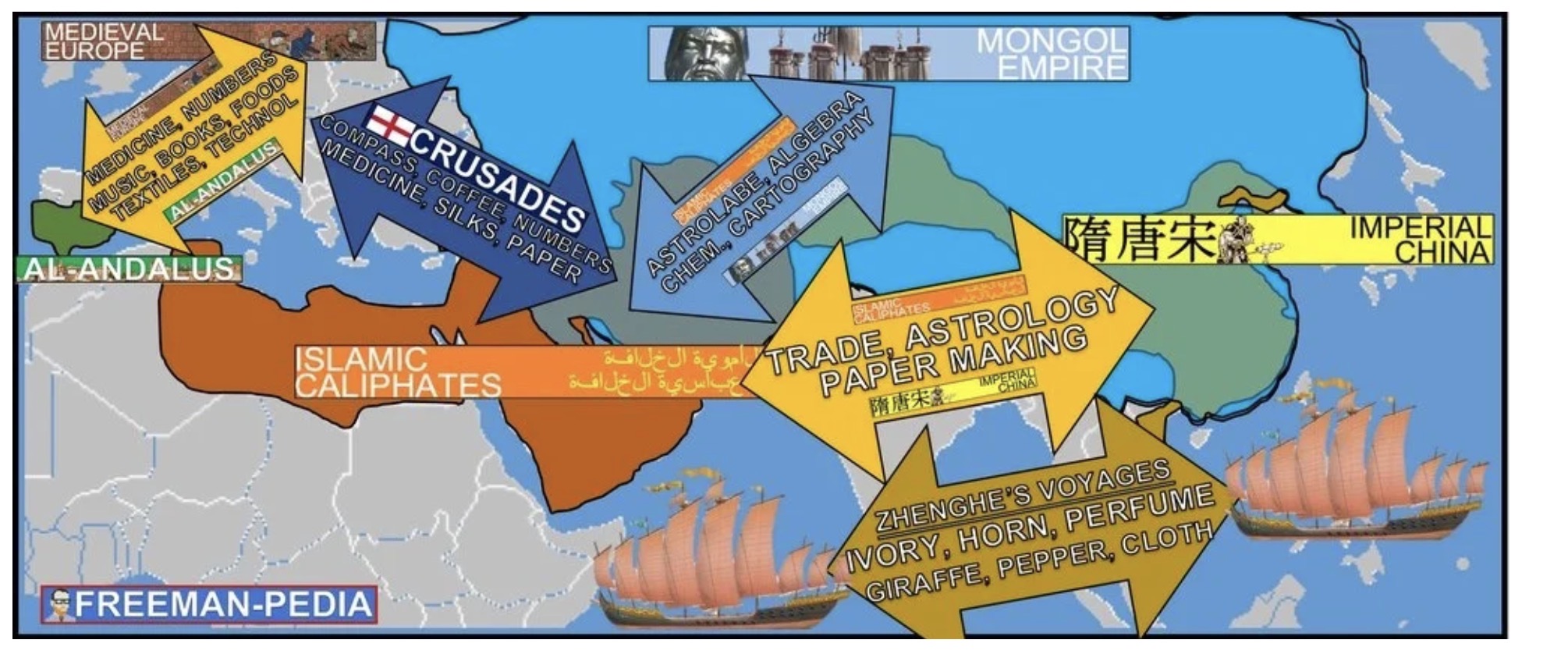
-Spanned a lot of Afro-Eurisa and eventually connected a lot of the world together.
-Used violence and other ways to establish rule(the horses which they used, the bow and arrows skills, there pre scaring of people, organizational skills within an army, made it better to sumbit).
-Once taken over spread much on the knowledge and strengthen the already strengthened trade routes. This helped share cultural ideas and develop society as whole but mongols did have a profound negative impact because of original cultural destruction which they caused.
-They were very religious tolerant and often diffused in the culture of the societies they took over. They often people from learning their culture. Ex. Kubali Khan in China
Golden Horde(Tartars)
The sect on the Mongolian empire which conquered much of Russia and treated it mainly as a vassal state leading to less cultural development through trade in this area specifically.
Kubali Khan
-The grandson of Genius Khan who rules of the Yuan Dynasty in China
-He imposed policies which made it hard for the ethnically Han Chinese to learn about Mongolian culture and even speak its language
-He was the won who showed of culture in a very great way and helped Marco Polo out a lot during his travels.
Gengis Khan
United the Mongolian Tribes with military and organizational skills when they were in a critical period of fighting and wars. This unification of these tribes and the use of the same techniques allowed Gengis khan to take over m7ch of the world and build the worlds largest empire.
Timer Lane
Mongol allied leader form Samarkand which look over the Delhi for a while but then lost and it went back to the Delhi Sultnate before Babur took control of it.
Mali Empire
Built of of where multistory power and its emergence led to and increase of trade in the trans-sharan routes - this specially helped out the Mali empire as it profited off the gold trade and also got a a lot of information form trade. Islam also influenced it culture a lot.
Mansa Musa
Leader of the Mali empire who went on a Hajj with a bunch of gold and jewels to show off the strengths of the Mali empire. This allowed showed spurring areas how Muslims Mali was at the time. It drew interaction which actually helped increase trade more.
Songhai Empire
The largest empire in Western Africa at the time, took over the spot for the Mali empire.
Also increased and benefited f9rm trade much like the Mali empire
Helped establish Timbuktu as a cultural exchange center with Ecnomic development form trade and also knowledge spreading.
Many colleges and universities were also built in this empire during this time.
Sunnī Ali
The person who established the Songhai empire.
Movable Type
A type pf printing machine which helped increase literacy with 8n song china (where it was invented). This was tru especially among the lower class of China. The printed books also spread technological and agricultural knowledge leading to an increase in productivity and population growth. China had one of the largest growth in urban population during this time.
Champa Rice
A rice brand introduced in China form Vietnam’s which helped increase agricultural productivity therefore the population of China due of increased food supply.
Mombasa
Port city of Swahili speaking people with strong ties to Arabia, Persia, Indian and China.
Sultanate of Gujarat
Indian Islamic state that was known in all corners of the trade network for its wealthy merchants (Muslims and Hindu). Also money lending practices(credit systems).
Sultanate of Malacaa
A Malaysian Islamic state that facilities trade interactions between Chiense merchants and Malay people.
Samarkand/Kashgar
Major trading cities that emerged as cultural centers for growth and the relay of information. They could be places for rest and with the thing for cultural of exchange. They were direct result of the silk trade route.
Uyghur
International sort of language used in order to communicate more effectively on the ilks trade routes, developed as result of this trade.
Xuanzang
A Chinese Buddhist monk traveled throughout the tang dynasty(before this time period) and into India, to understand how Buddism was practiced in different parts of Asia.
Marco Polo
A merchant from Venice, made his way to China and back into Europe(under Mongol rule ).
Ibn Battua
Has unreliable and very interesting travels on his ways through the Islamic world into India and China before returning to Africa.
Margery Kempe
A Christian form England, documented her travels to religious sites throughout Europe and the holy land in a book chronicling her spiritual journey.
Indian Ocean trade
Mostly dominated by Islamic and Persian communities, connected the whole of the Indian Ocean (Indian to African)
Unlike boats on the med train included more rougher boats because of the though wether patterns
These weather patterns also lead travelers to focus more on the the monsoon wind patterns and have innovations based on this (lateen Sale) but they still need the monsoon wind patterns
Had less wars than the midget rain trade routes which frequently had wars and warfare break out.
Trade of both luxury and common goods occured
Less centralized power control mutiple religions and empires working together.
Great Zimbabwe
Thriving trading city in in interior of South Africa it want a directly a coat so city but has rivers and coastlines connecting to it. It served as the largest trade of gold and got a lot of its power from this gold trade.
Silk Road
Connected chinq to the Mediterraneans cultures starting from the Roman Empire. It was used heavily aging from 1200 until about 1600 especially during the reign of the Mongols.
Mnay grave cities emerged along side caranversi(rest stops along the empire) which he,led spread and increase cultural trade more
-development of a commons sculpt know as ugyger and number system arriving in Europe
Not only did it control proclien and paper but also had military’s technology and religions and food it was one the most informant trade routes in history,
Controlled by centralized power in earlier Mongols and later too just less cebtrerlized.
Things traded
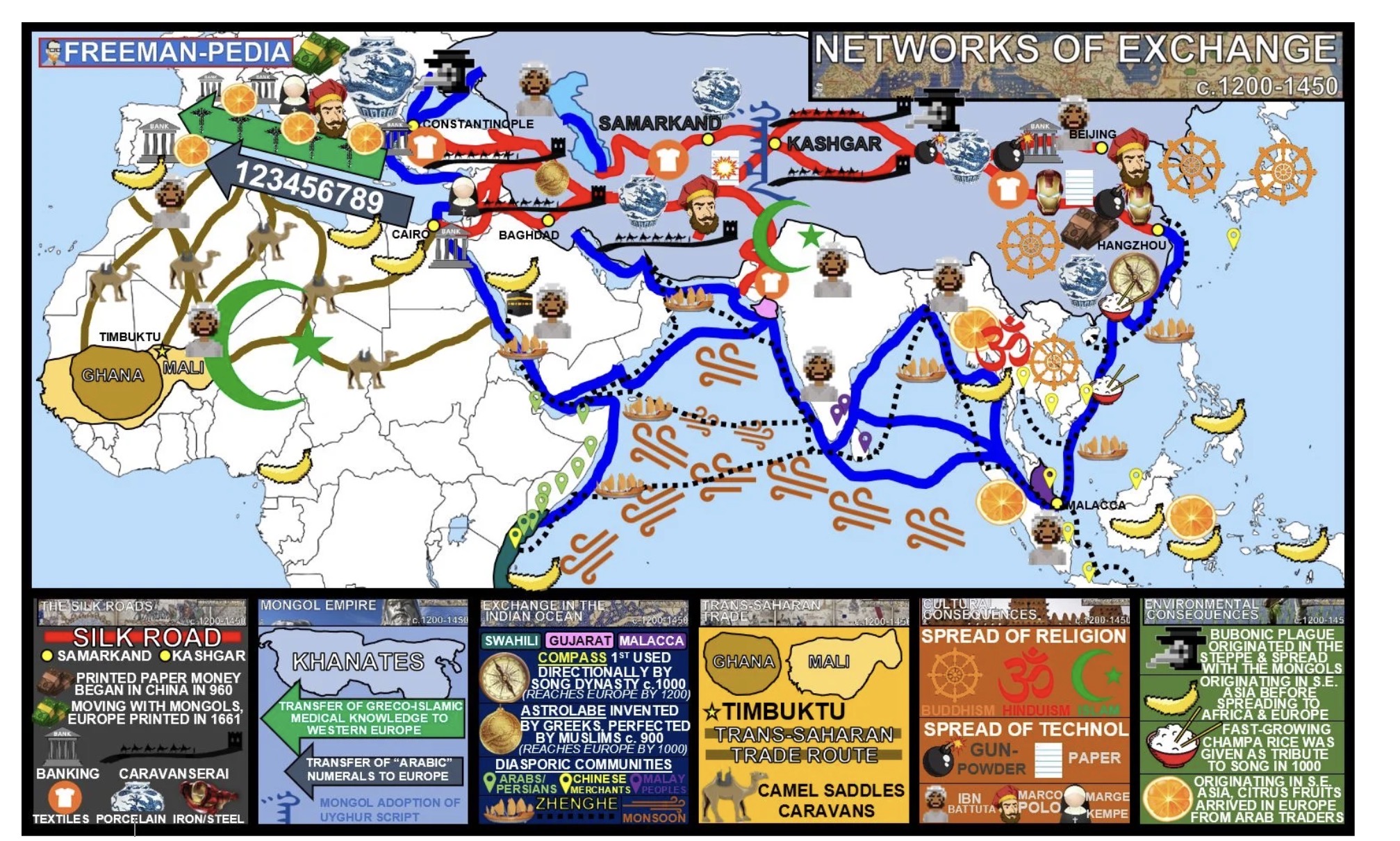
Things traded Mongols