Antimicrobial Design and Resistance MCQs
 Call Kai
 Learn
Learn Practice Test
 Spaced Repetition
 Match
Match Flashcards
 Knowt Play
1/14

There's no tags or description
Looks like no tags are added yet.
Name | Mastery | Learn | Test | Matching | Spaced | Call with Kai |
|---|
No analytics yet
Send a link to your students to track their progress
15 Terms
What does the Gram staining relies on to differentiate bacteria?
Difference in the cell wall
What is meant by spectrum of action?
It indicates the type of bacteria that are susceptible to an antibacterial agents
Which of the following statements about classes of antibacterial is incorrect
Antibacterial agents of different classes always target different structures in the bacterial cell
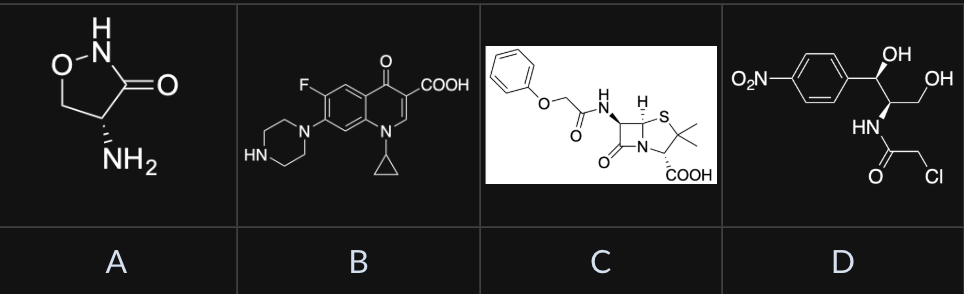
Which of the following structures is a beta-lactam?
C
Which is the mechanism of action of beta lactams?
Inhibition of cell wall synthesis
Which statement about penicillins mechanism of action is incorrect?
Penicillins are active only against Gram positive bacteria
What is beta lactamase?
The bacterial enzyme responsible for beta lactams resistance
Which antibacterial agent does NOT inhibit cell wall synthesis?
Chloramphenicol
How can we define an antibacterial agent that prevents the replication and/or growth of bacteria but relies on the immune system of the patient to eradicate the infection completely?
A bacteriostatic agent
Why is bacitracin recommended for the treatment of topical infection?
Because it is not stable in solution and poorly absorbed
What do aminoglycosides, macrolides, tetracyclines and oxazolidinones have in common?
They all inhibit protein synthesis in bacteria
Which of the following classes of antibacterial agents is obtained by chemical synthesis?
Oxazolidinones
Which of the following agents is toxic for newborns?
Chloramphenicol
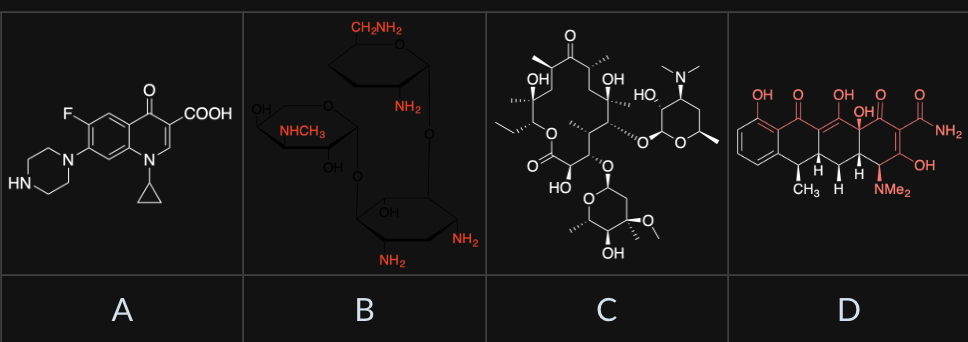
Gentamicin is an antimicrobial agent that belongs to the class of aminoglycosides. Aminoglycosides are characterised by several rings of amino-sugars linked together. Which amongst the following is gentamicin?
B
What is the mechanism of action of quinolones?
Quinolones bind to DNA gyrase and topoisomerase preventing the coiling of the bacterial DNA