A&P-Exam1-StudyGuide
 Note
Note Call Kai
 Learn
Learn Practice Test
 Spaced Repetition
 Match
Match Flashcards
 Knowt Play
1/83

Name | Mastery | Learn | Test | Matching | Spaced | Call with Kai | Chat |
|---|
No analytics yet
Send a link to your students to track their progress
84 Terms
Levels of organization
cells, tissues, organs, organ systems, and the whole organism.
Types of tissues
epithelial, connective, muscular, and neural.
Extracellular fluid
fluid, non-fiberous glycoproteins,fibers, water, proteins, ions, neutrients
Organ systems
Integumentary, respiratory, skeletal, digestive, muscular, cardiovascular, nervous, urinary, endocrine, reproductive, lymphatic
Why do larger organisms need organ systems?
Organ systems maintain homeostasis by bringing O2 straigt to the organs while diffusion takes too long
Control systems
negative feedback, positive feedback, feedforward, resetting set point
Negative feedback reflex
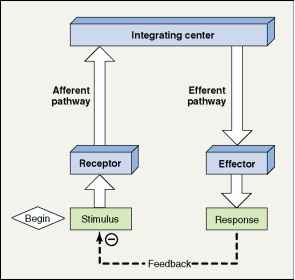
Types of tissues
connective, epithelial, nervous
Homeostasis is concerned with maintaining a constant
extracellular environment
More common type of feedback system
Negative Feedback
What requires no extra energy
Equlibrium
What are the main effectors for a reflex?
The muscles and glands
Hormone
can travel through blood, used for long distance
neurotransmitters
can’t travel through blood, used for long distance
paracrine substance
can’t travel through blood or long distance
autocrine substance
can travel through blood and long dinstance
Desmosome protein
cadherins
Hemidesmosome proteins
fibronection snd integrins
Gap Junctions proteins
connexins
Chemical specificity
only a limited number of ligand types can bind to a binding site
saturation
the more ligands the more likely for a protein and ligand to bind ( greater percentage of binding sites occupied)
affinity
how well proteins and ligands bind and the strong connection (can bind in low concentrations)
competition
if more than one ligand can bind to a binding site, depends on the concentrations and affinity of the ligands
In order to be healthy all extracellular variables in the body must be stable in all situations
false
Reflexes can be feedforward
true
Feedforward Regulation is usually beneficial to the organism
true
Parturition (Giving Birth) is an example of
positive feedback
Which of the following organ systems has the smallest role in homeostasis?
reproductive system
Which is most common in the body?
negative feedback
A single protein can bind to many different ligands.
true
Ligand-protein interactions can be covalent
false
The higher the KD for a protein-ligand interaction the
Lower the proteins affinity for the ligand
What kind of proteins hold cells close together/attaches cells to each other?
Cadherins
According to the _________________ model, proteins move freely along the membrane plane and are not anchored in one spot
Fluid-mosaic
What is the name for all of the sugar moeities attached to the extracellular side of membrane proteins that plays an important role in cell recognition?
glycocalyx
Which two types of intercellular communication require direct cell-to-cell contact?
gap junctions and juxtracrine communication
Change in the conformation of one subunit of a protein can change the conformation of other subunits of the protein. This is called ____________________________________.
cooperativity
What is the equation for net flux? Always define abbreviations.
J=PA(Co-Ci); (net flux=permeability x surface area (cnc. outside - cnc. inside) )
What is the general primary direct use of ATP in cells?
phosphorolation of proteins
How do small, polar chemical species, like ions or water, get across the plasma membrane?
channels
How do non-polar molecules, like steroid hormones, get across the plasma membrane?
simple diffusion
Draw a diagram illustrating how coenzyme substrates are used.
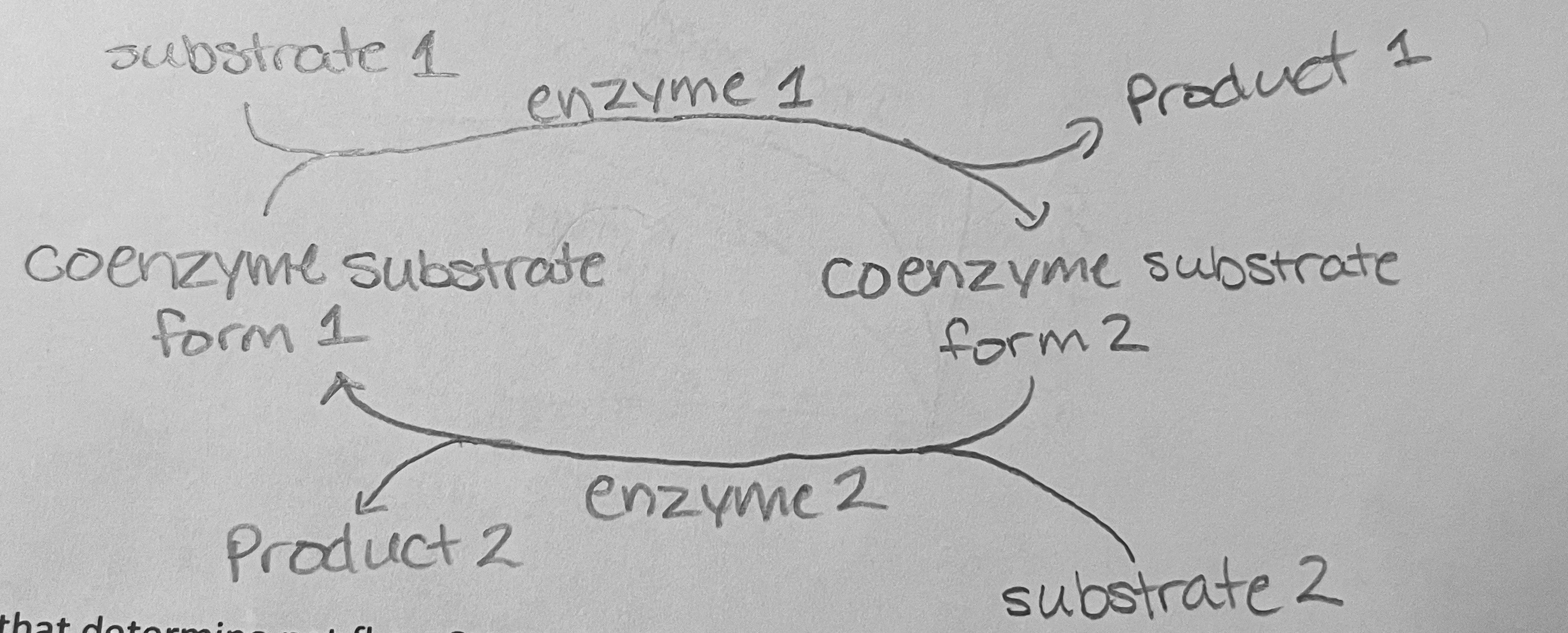
List the factors that determine net flux. State which factors do not usually change much in the human body.*
cnc. gradient, nature of membrane, surface area of membrane, size of molecule, temp*, solvent*
Graph the effect of doubling enzyme concentration on the reaction rate by substrate
concentration. You should have two curves on your graph, one at a given enzyme concentration and one at double that enzyme concentration. Be sure to label which is which, and label your axes
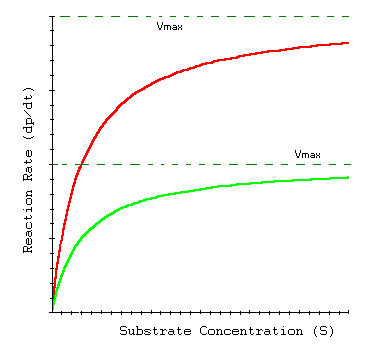
Graph the effect of increasing an enzymes affinity for substrate on the rate of the reaction by substrate concentration. You should have two curves on your graph, one with a baseline enzyme affinity and one with a higher enzyme affinity. Be sure to label which is which, and label your axes.
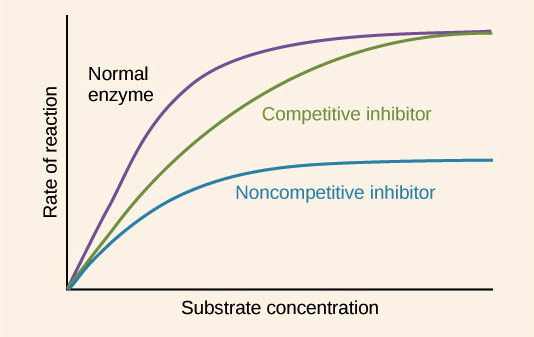
The charge inside a resting cell is ________ compared to the outside of the cell.
negative
What causes bigger conformational change in a protein?
covalent
At absolute zero, there would be no diffusion.
true
the primary function of an organ system is to increas diffusion
false
The net flux of a permeable solute across a membrane is constant until diffusion equilibrium is reached.
false
At diffusion equilibrium, all diffusion stops.
false
A protein may have covalent modulation or allosteric modulation, but not both.
false
All enzymes are proteins.
true
If a reaction is reversible, and the concentration of a substrate/reactant decreases, then the rate of the _________________ reaction will increase.
reverse
If a solute takes 1 second to reach diffusion equilibrium over 10 micrometers, how long would it take to reach diffusion equilibrium over 10 centimeters?
1-9 years
In the body, what is the solvent that the solutes are dissolved in? (related to diffusion)
water
What are the three ways of gating an ion channel?
ligand-gated, voltage-gated, mechanically-gated
What four factors determine the rate of transport of solutes using a facilitated diffusion
transporter?
cnc. gradient
rate of conformational change
number of transporters in the membrane
percent aturation of transporters
What is the normal osmolarity of the body? (Remember, a number without units in
meaningless.)
285-295 mOsm
What is the word for moving substances out of the cell by fusing a vesicle containing the substance with the plasma membrane?
endocytosis
What are the three types of endocytosis discussed in the lecture videos?
pinocytsis
phagocytosis
receptor-mediated endocytosis
Which type of endocytosis is most specific?
receptor-mediated endocytosis
What does it mean to say that epithelial cells are polar? (it does not have to do with charge/electricity).
they have different proteins on the apical membrane compared to the basolateral membrane
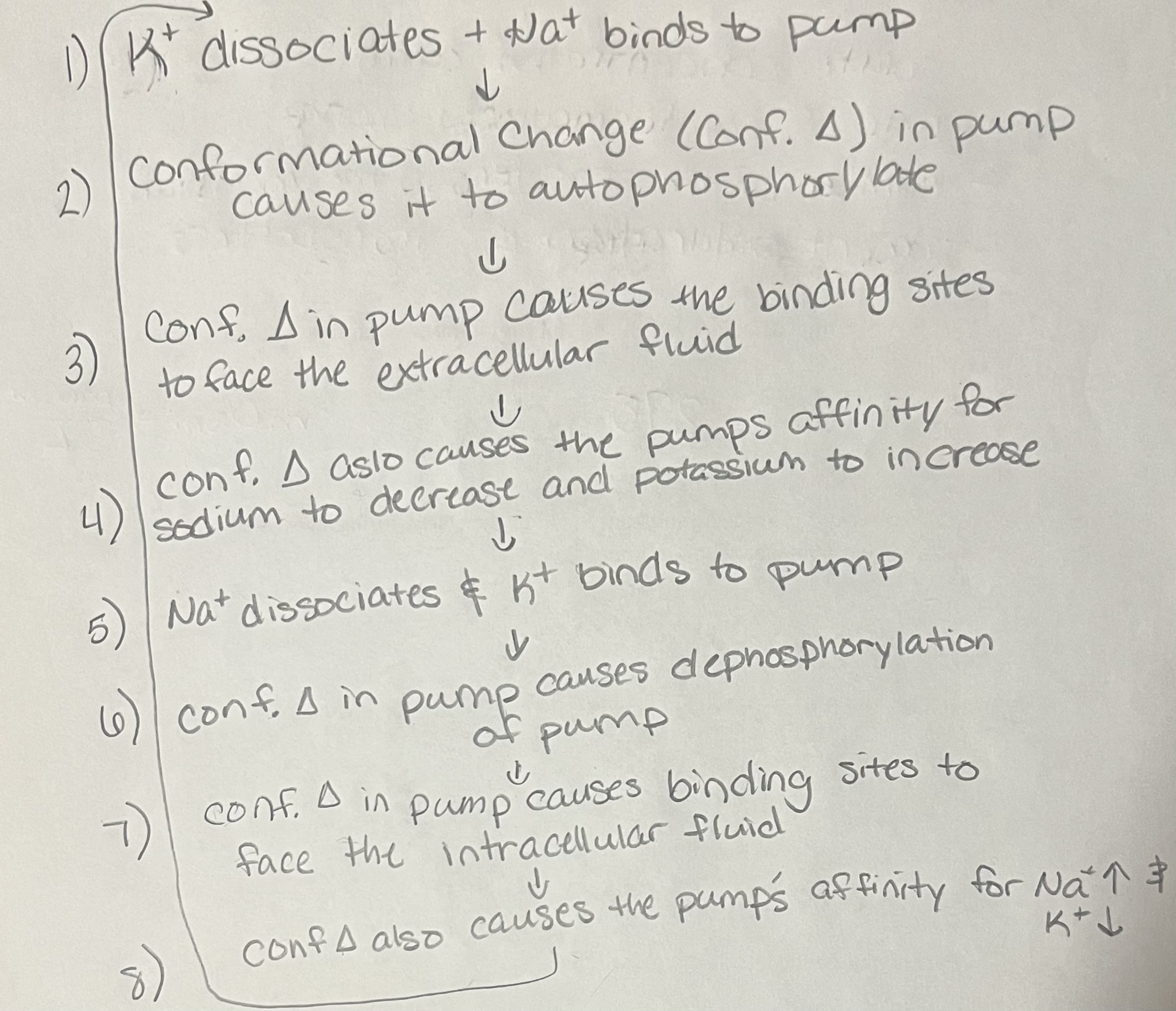
List the steps of the sodium-potassium pump cycle. Be sure to include autophosphorylation, dephosphorylation, sodium binding and dissociating, potassium binding and dissociating, the number of each ion that binds per cycle, and conformational changes.
Water moves from areas of
Low osmolarity to high osmolarity
The higher the osmotic pressure, the
Higher the solute concentration
There are no active transport methods for water.
true
If a cell crenates, it is in a(n)
Hypertonic solution
The sodium-potassium pump is in the ______ membrane of epithelial cells
basolateral
There is a maximum rate of flux of solutes using a transporter
true
If the volume of the cell does not change, it is in a(n)
Isotonic solution
Other than sodium and potassium, what other 2 ions are primarily regulated by pumps?
calcium and hydrogen
Substances are usually actively transported across both the apical and basolateral membranes of the epithelial layer
false
If a cell swells, it is in a(n)
Hypotonic solution
What ion is commonly used in secondary active transport to move another chemical against its concentration gradient?
sodium
Which is faster?
movement of chemcial species through channels
Transport of chemical species from _____________________________ requires the use of ATP directly or indirectly.
low concentration to high concentration
The sodium-potassium pump
pumps potassium into the cell and sodium out of the cell
If solute concentration is high, water concentration is
low
What is the name of the channel that allows water to move across the plasma membrane?
aquporin