D742 Introduction of Implant Dentistry
 Call Kai
 Learn
Learn Practice Test
 Spaced Repetition
 Match
Match Flashcards
 Knowt Play
1/183

There's no tags or description
Looks like no tags are added yet.
Name | Mastery | Learn | Test | Matching | Spaced | Call with Kai |
|---|
No analytics yet
Send a link to your students to track their progress
184 Terms
A. Restorative driven treatment
In modern dental implant treatment, which kind of treatment plan should we consider ? (Select one)
a. Restorative driven treatment
b. Bone driven treatment
c. Surgical driven treatment
d. Money driven treatment
e. Medication driven treatment
a. Mounted Wax up cast
b. Implant check sheet (Along with ITP and PDI classification)
d. Updated PA and Panoramic radiograph
e. Review Medical and Dental History including Medications
f. Mounted initial cast
g. Possible treatment options and plans
When you do the implant consultation in DDS Implant clinic at IUSD, what do you need to prepare before you discuss with the patient ? (Select all )
a. Mounted Wax up cast
b. Implant check sheet (Along with ITP and PDI classification)
c. CBCT
d. Updated PA and Panoramic radiograph
e. Review Medical and Dental History including Medications
f. Mounted initial cast
g. Possible treatment options and plans
c. If the implant is not affordable, we should do FDP or RPD because adjacent teeth and opposing teeth are definitely going to move.
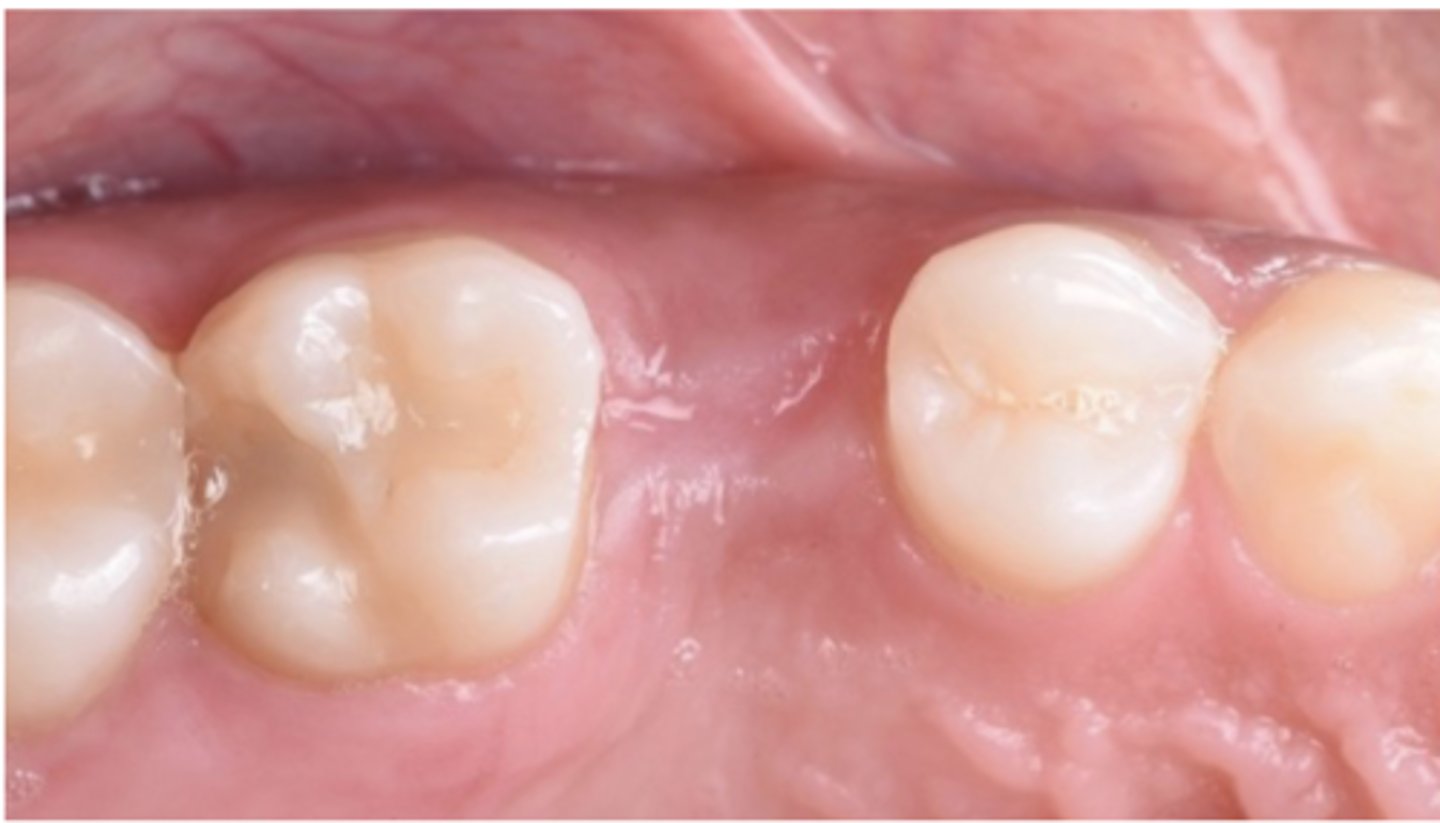
In a discussion with your patient (50 years old, No medical issue) about treatment options for the missing tooth #4 (shown in the picture below), all of the following statements are valid, EXCEPT.
a. Dental implant would be the best option for this situation, I wouldn't suggest RPD and 3-unit FDP due to loosing tooth structure
b. If the implant is not affordable, the space can be left until you are ready to move on implant treatment, and if you are worry about tooth movement, we can provide occlusal splint.
c. If the implant is not affordable, we should do FDP or RPD because adjacent teeth and opposing teeth are definitely going to move.
d. Both Dental implant and 3-unit FDP would be the same price in terms of money
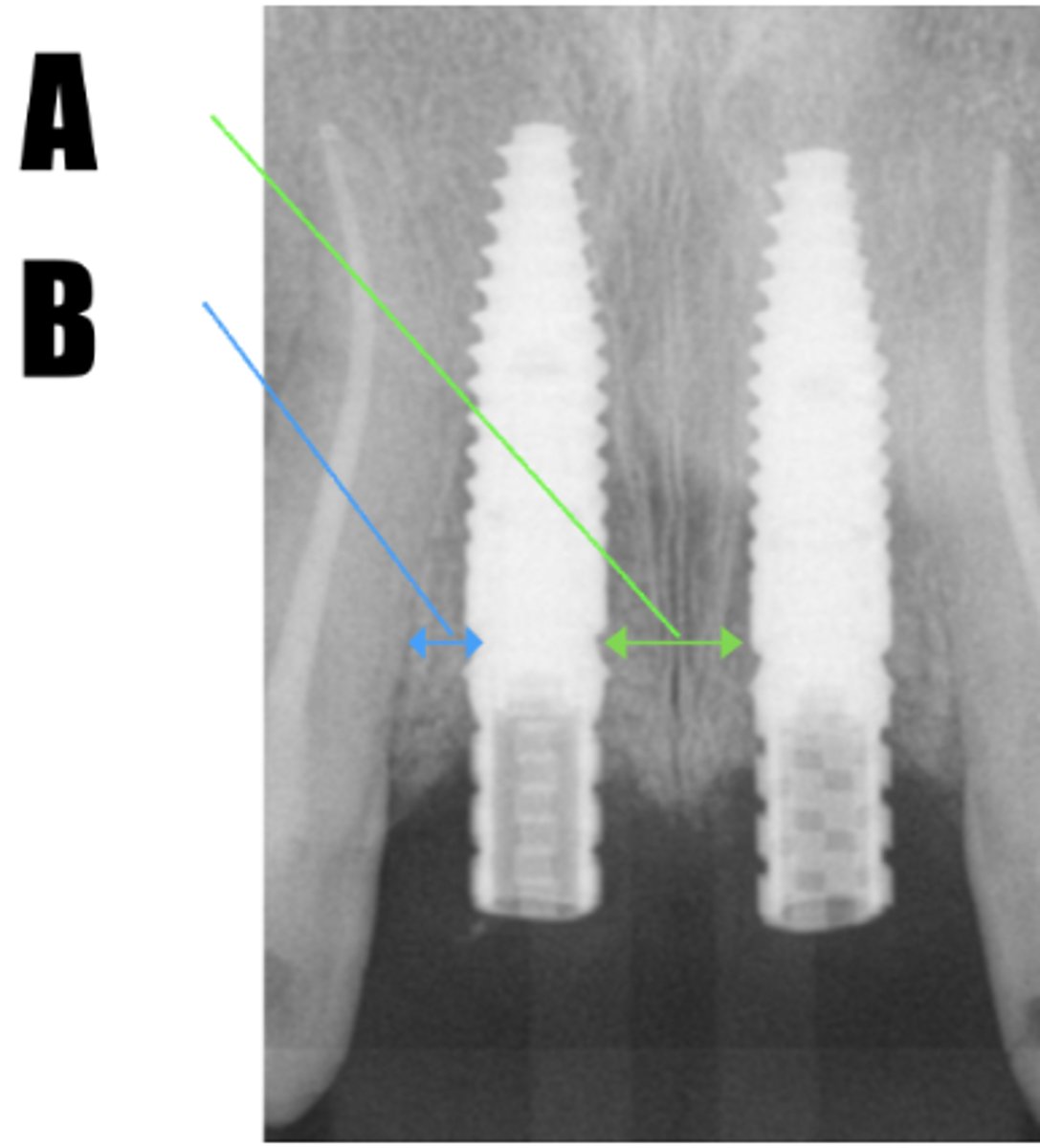
A : 3.0mm B: 1.5mm
Based on the picture below showing ideal 3D implant position, please select correct answer. (select one)
A: 2.0mm B: 2.0mm
A: 2.0mm, B: 1.5mm
A : 3.0mm B: 1.5mm
A: 3.0mm B: 2.0mm
A: 1.5mm B: 3.0mm
a. To decide implant position
What is the purpose that we need to start wax-up the tooth for dental implant treatment? (select one)
a. To decide implant position
b. To make final restoration
c. No answer text provided.
d. To make provisional restoration

e. IARPD (Implant assisted removable partial denture)
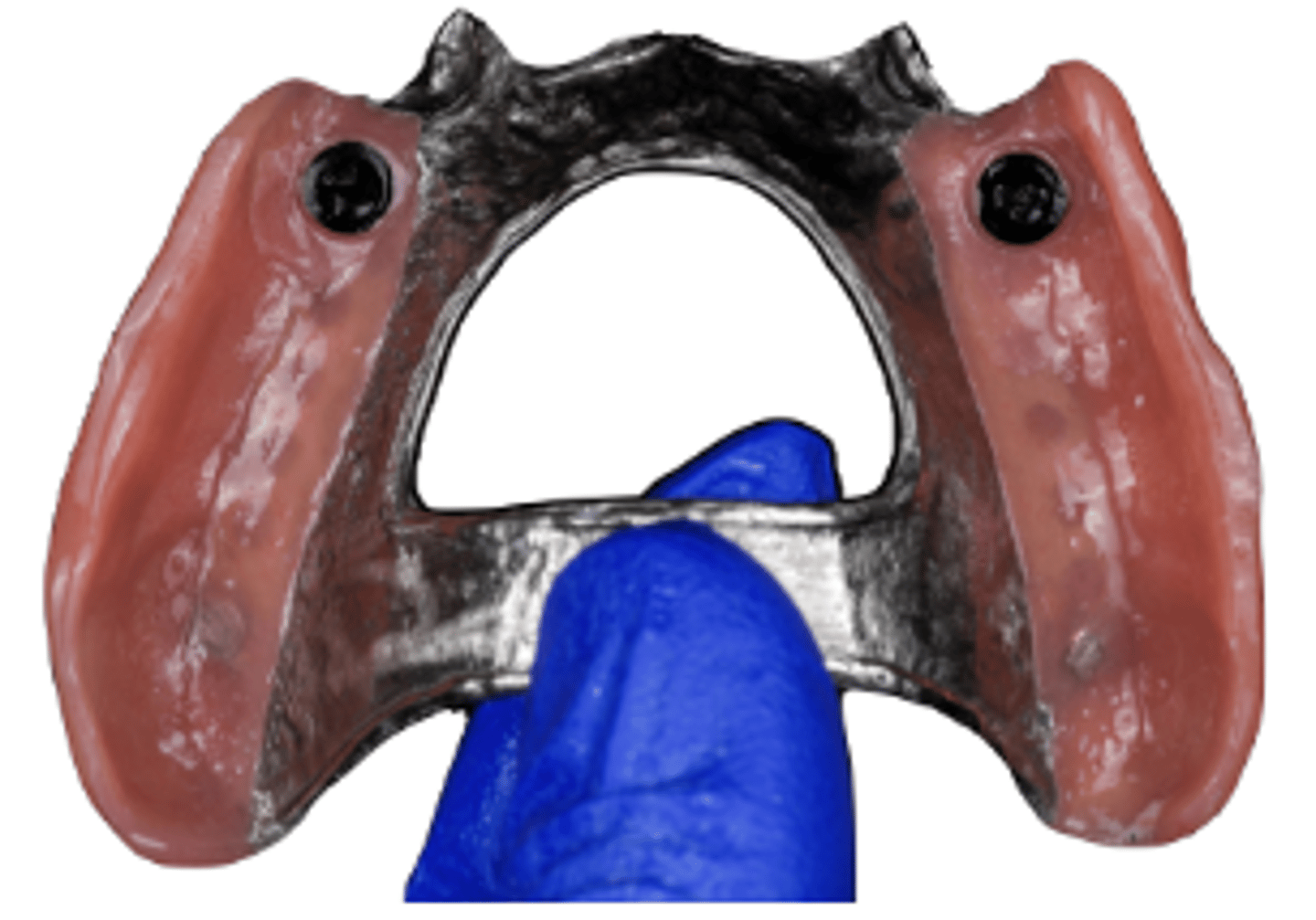
What kind of implant dental prosthesis is shown in the image ? (Select one)
a. ISRPD (Implant supported removable partial denture)
b. IACD (implant assisted complete denture)
c. I-FDPs (implant supported fixed dental prosthesis)
d. I-SC (Implant supported crowns)
e. IARPD (Implant assisted removable partial denture)
a. On-going Chemotherapy for cancer treatment
b. Drug abuse
c. Recent Myocardial Infarction (Heart Attack) 2 month ago
Which of the following options are considered absolute contraindications? (Select all that apply)
a. On-going Chemotherapy for cancer treatment
b. Drug abuse
c. Recent Myocardial Infarction (Heart Attack) 2 month ago
d. Smoking
e. Oral Bisphosphonate Use
f. HIV/AIDS
a. Smoking
b. PPI (Proton pump inhibitor)
c. SSRI (selective serotonin reuptake inhibitor)
Which of the following options are considered Risk factors (Not Risk indicators) for dental implant ? (Select all that apply)
a. Smoking
b. PPI (Proton pump inhibitor)
c. SSRI (selective serotonin reuptake inhibitor)
d. Osteoporosis
e. Hyper tention
f. Type II Diabetes
b. Non-restricted analog surgical guide
Which of the following best describes the image shown? (Select one)
a. Restricted analog surgical guide
b. Non-restricted analog surgical guide
c. d-CAIS (dynamic computer assisted implant surgical guide)
d. s-CAIS (static computer assisted implant surgical guide)
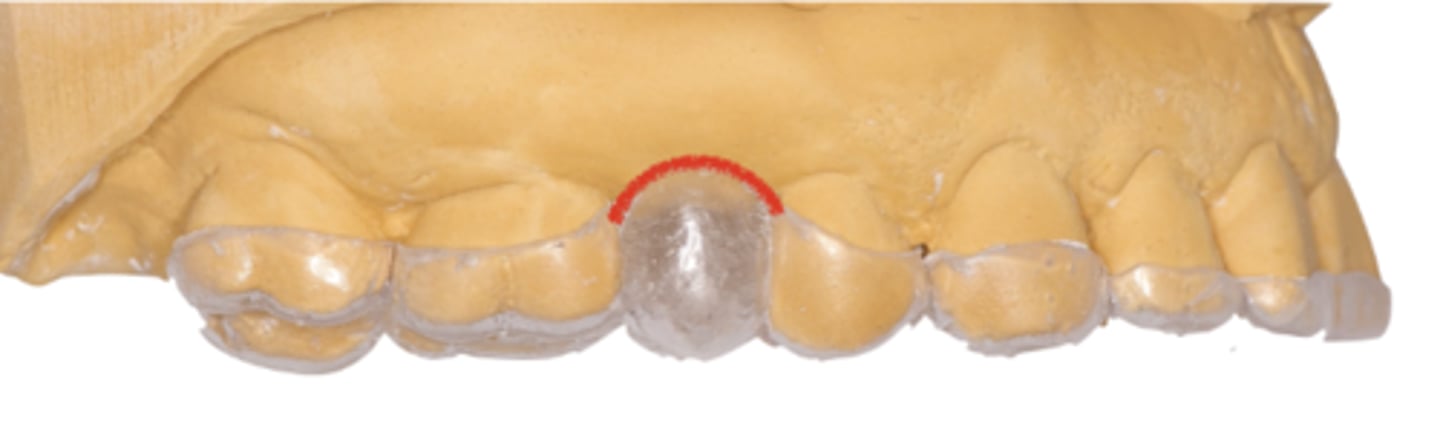
d. To allow the surgeon to verify the Depth of the implant
What is the purpose of the cervical region shown in the image? (Select one)
a. To allow the surgeon to verify the buccal-lingual direction of the implant
b. To allow the surgeon to verify the angulation of the implant
c. To allow the surgeon to verify the mesio-distal positioning of the implant
d. To allow the surgeon to verify the Depth of the implant
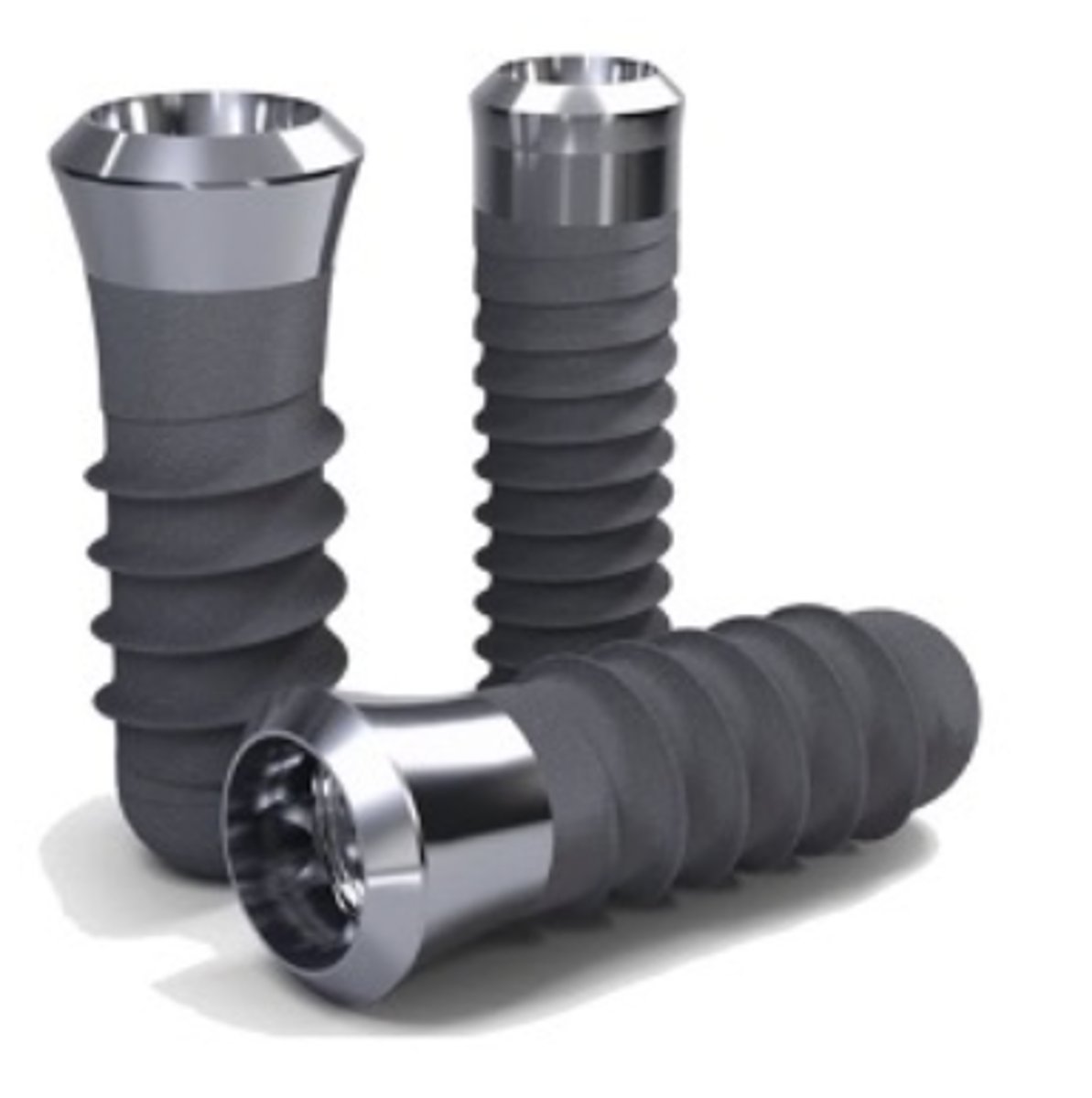
a. The smooth collar design at the gingival margin might pose an esthetic problem for the future crown.
1. Based on the figure provided, please select the correct description of these implants. (Select one answer)
a. The smooth collar design at the gingival margin might pose an esthetic problem for the future crown.
b. These implants are typically chosen in clinical scenarios with limited inter-occlusal space.
c. These implants are preferred in clinical scenarios with limited inter-dental space.
d. They are often referred to as bone level implants.
c. There is a concept of using a dental implant abutment of smaller diameter than the dental implant.
A platform-switch system is the one where (Select one answer)
a. There is more bone loss expected around the implant neck.
b. There are matching platforms between implant neck and abutment.
c. There is a concept of using a dental implant abutment of smaller diameter than the dental implant.
d. The transmucosal component is in one piece with the implant body.
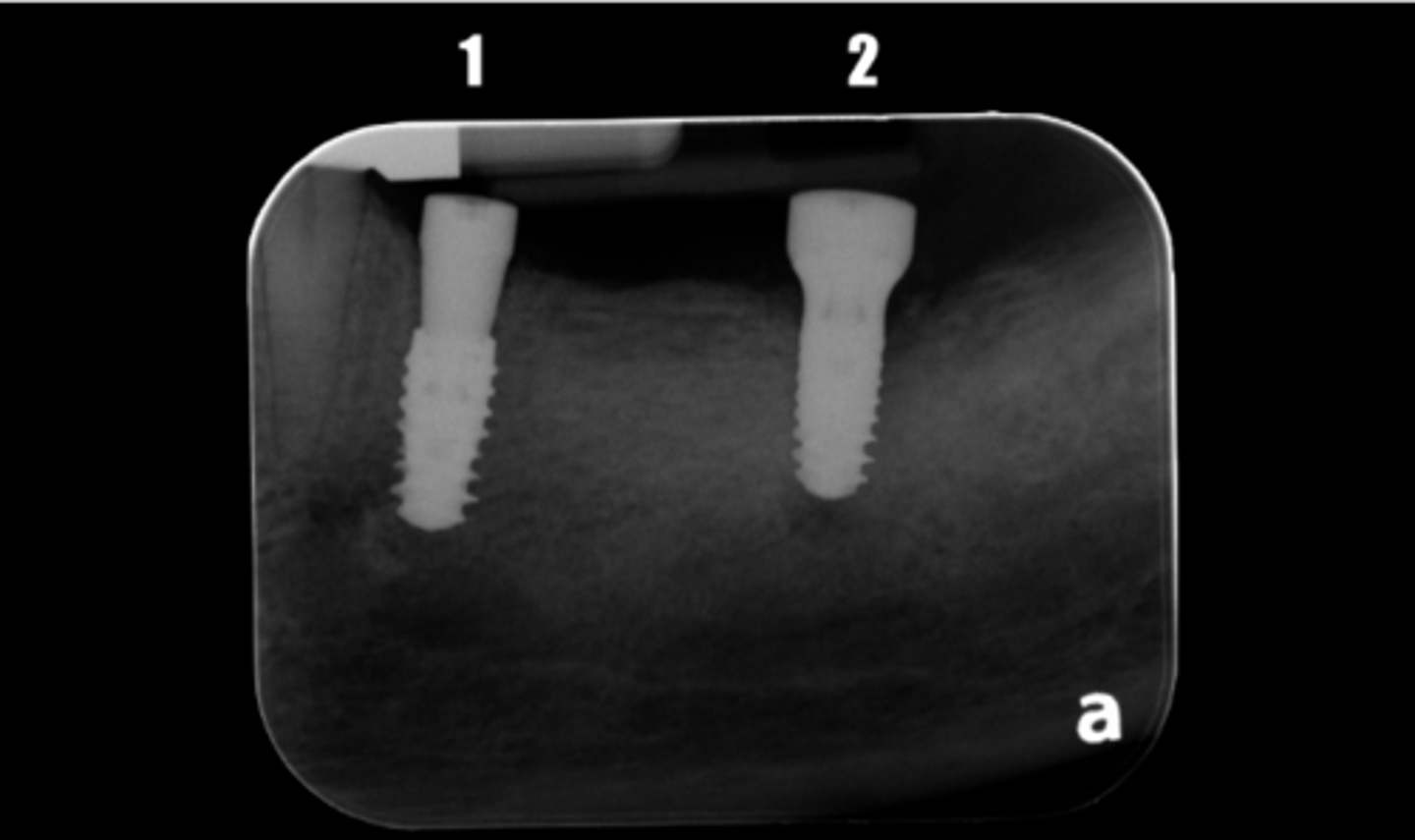
a. 2 should be tissue level implant with healing abutment
c. 1 should be bone level implant with healing abutment.
. Based on the figure provided, please select the correct sentence. (Select two)
a. 2 should be tissue level implant with healing abutment
b. 1 should be bone level implant with a cover screw
c. 1 should be bone level implant with healing abutment.
d. 2 should be bone level implant with cover screw
e. 1 should be tissue level implant with healing abutment
f. 2 should be tissue level implant with cover screw
g. 2 should be bone level implant with haling abutment
h. 1 should be tissue level implant with cover screw
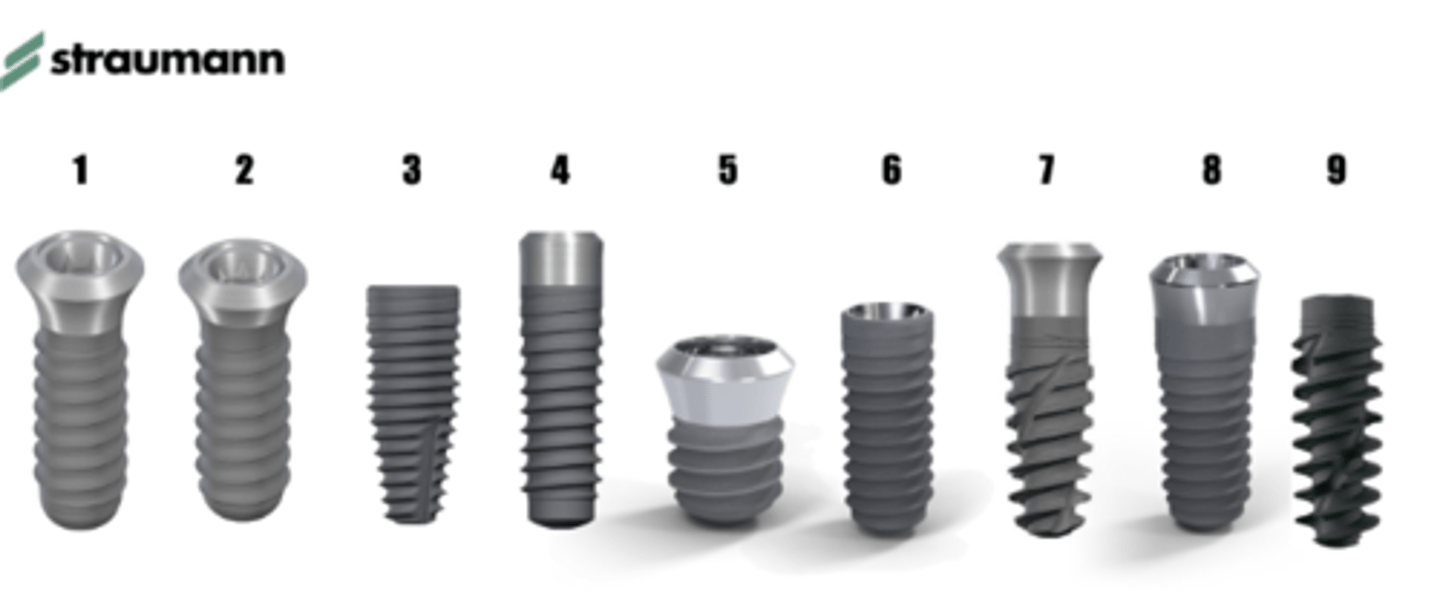
8 is tissue level implant
6 is bone level implant
7 is tissue level implant
9 is bone level implant
1 is tissue level implant
3 is bone level implant
Please select correct sentences based on the figure provided. (select ALL)
2 is bone level implant
8 is tissue level implant
6 is bone level implant
7 is tissue level implant
9 is bone level implant
4 is bone level implant
5 is bone level implant
1 is tissue level implant
3 is bone level implant
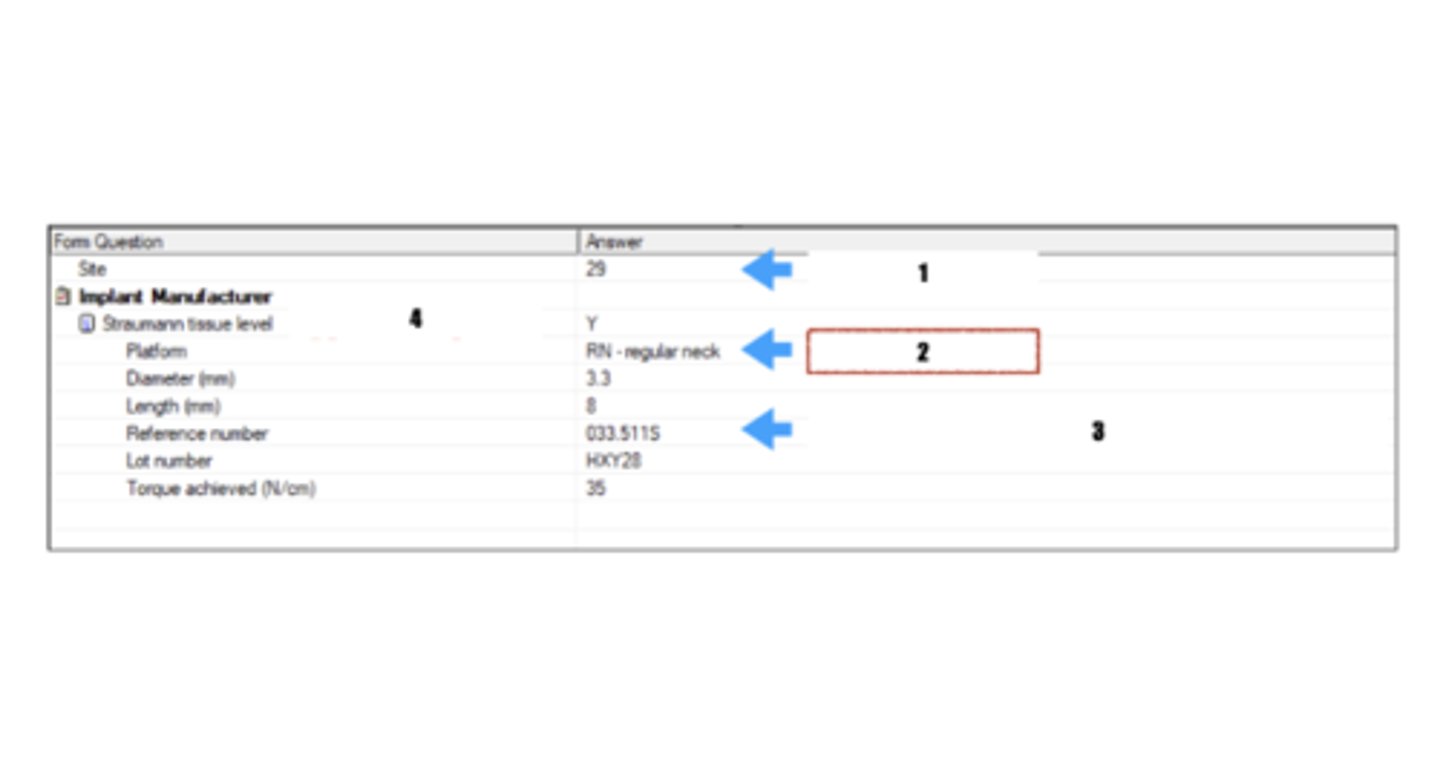
d. Implant connection type
When you look at the surgical log in Axium, you found the information that you see in the picture bellow. What is the information of 2 (select one).
a. Type of implant
b. Site of implant
c. Implant reference number
d. Implant connection type
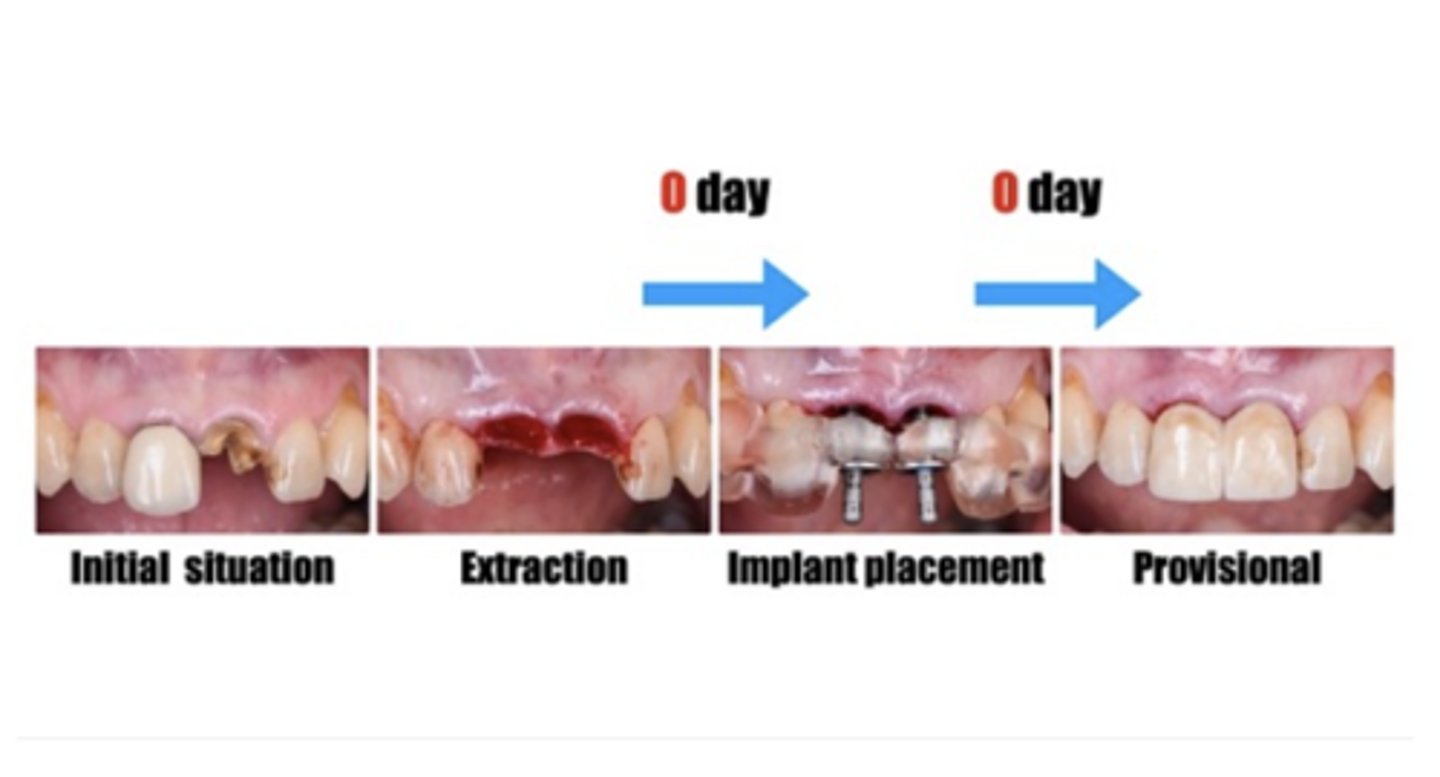
d. Placement - Immediate, Loading - Immediate
Based on the provided figure, please select a correct combination of placement and loading protocol. (Select one answer)
a. Placement - Early, Loading - Early
b. Placement – Immediate, Loading - Early
c. Placement - Early, Loading - Late
d. Placement – Immediate, Loading - Immediate
e. Placement - Late, Loading – Immediate
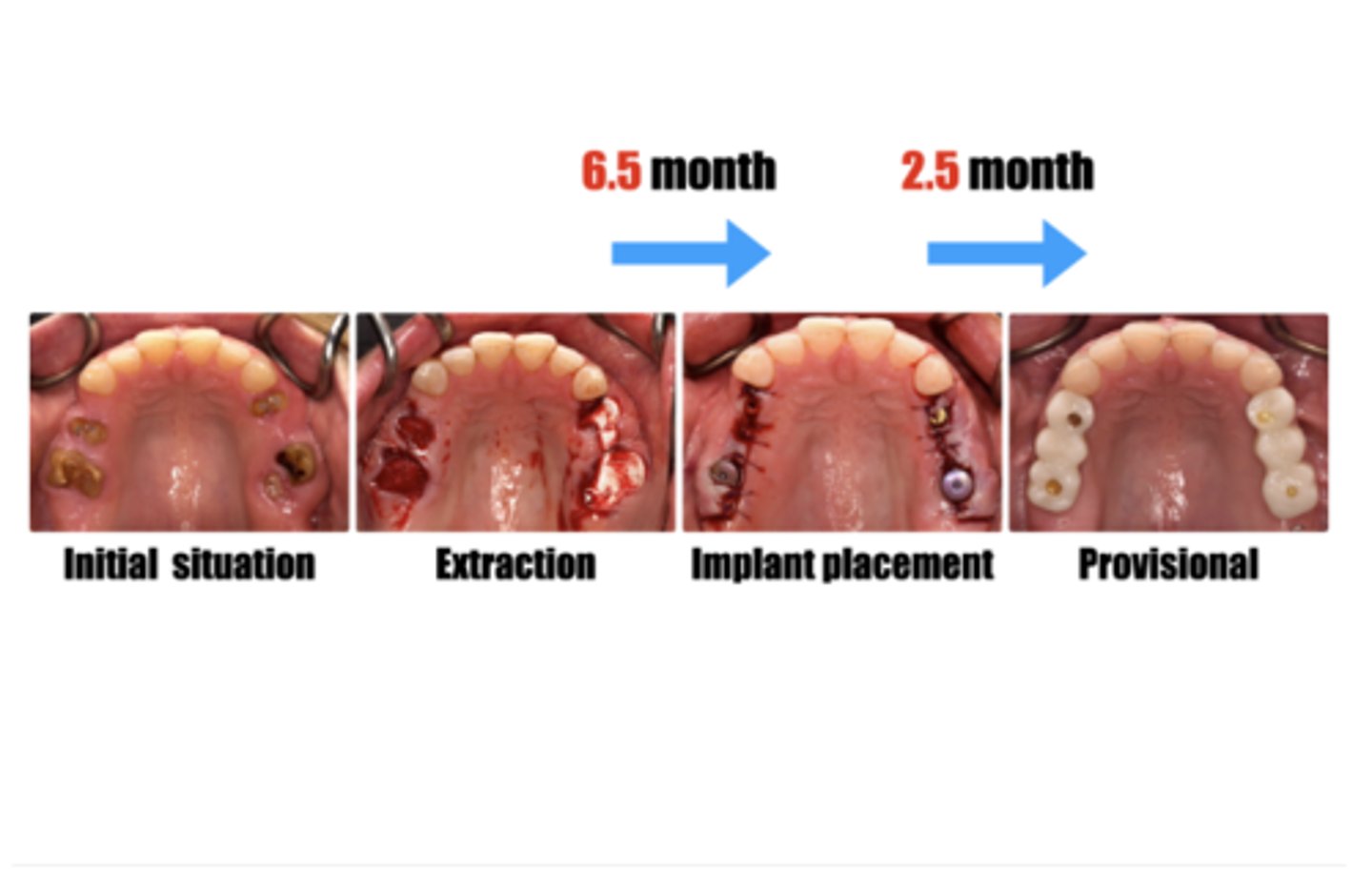
b. Placement - Late, Loading - Late
Based on the provided figure, please a select correct combination of placement and loading protocol. (select one answer)
a. Placement – Late, Loading - Early
b. Placement – Late, Loading – Late
c. Placement – Immediate, Loading - Late
d .Placement - Early, Loading - Early
e. Placement - Early, Loading - Late
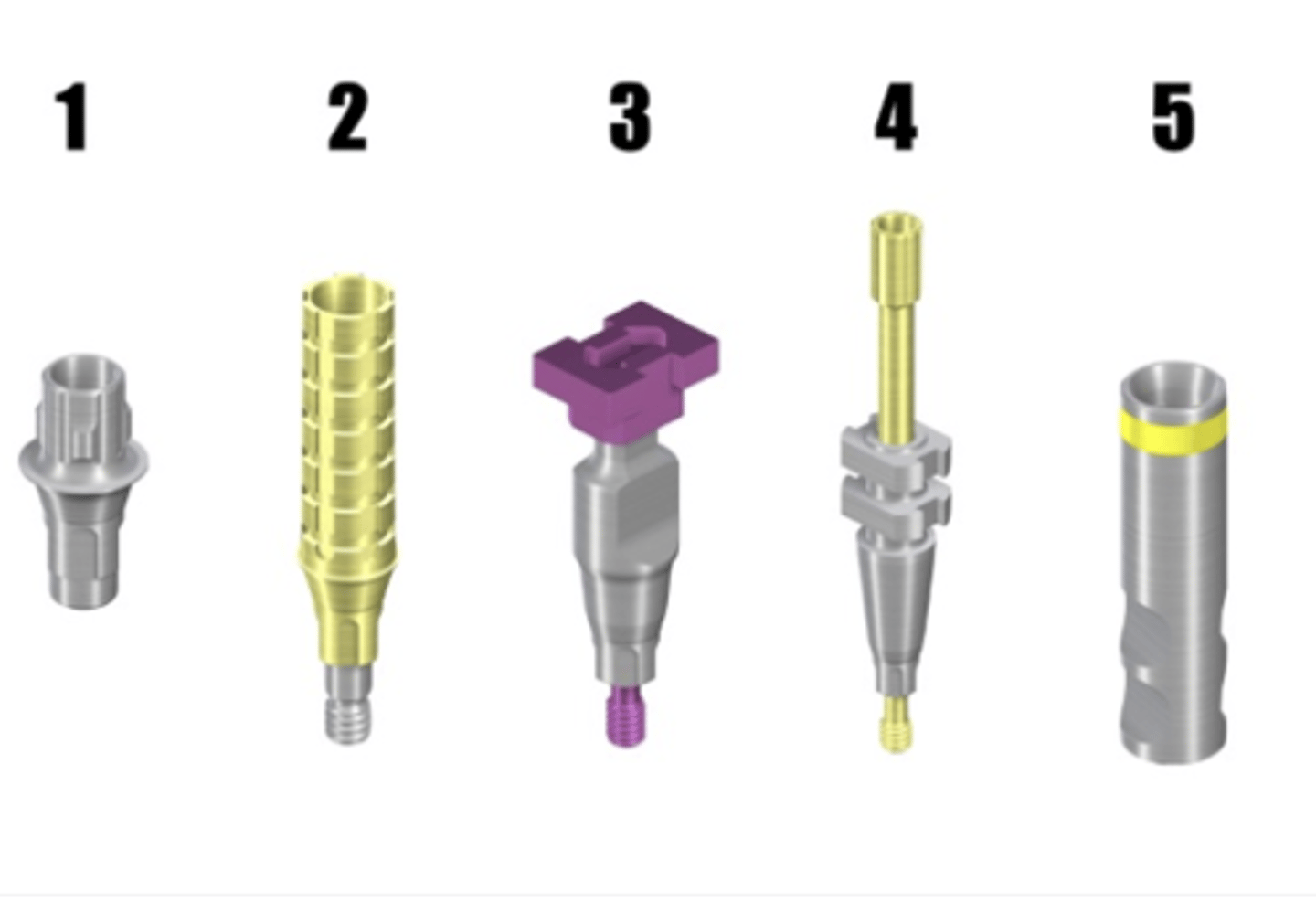
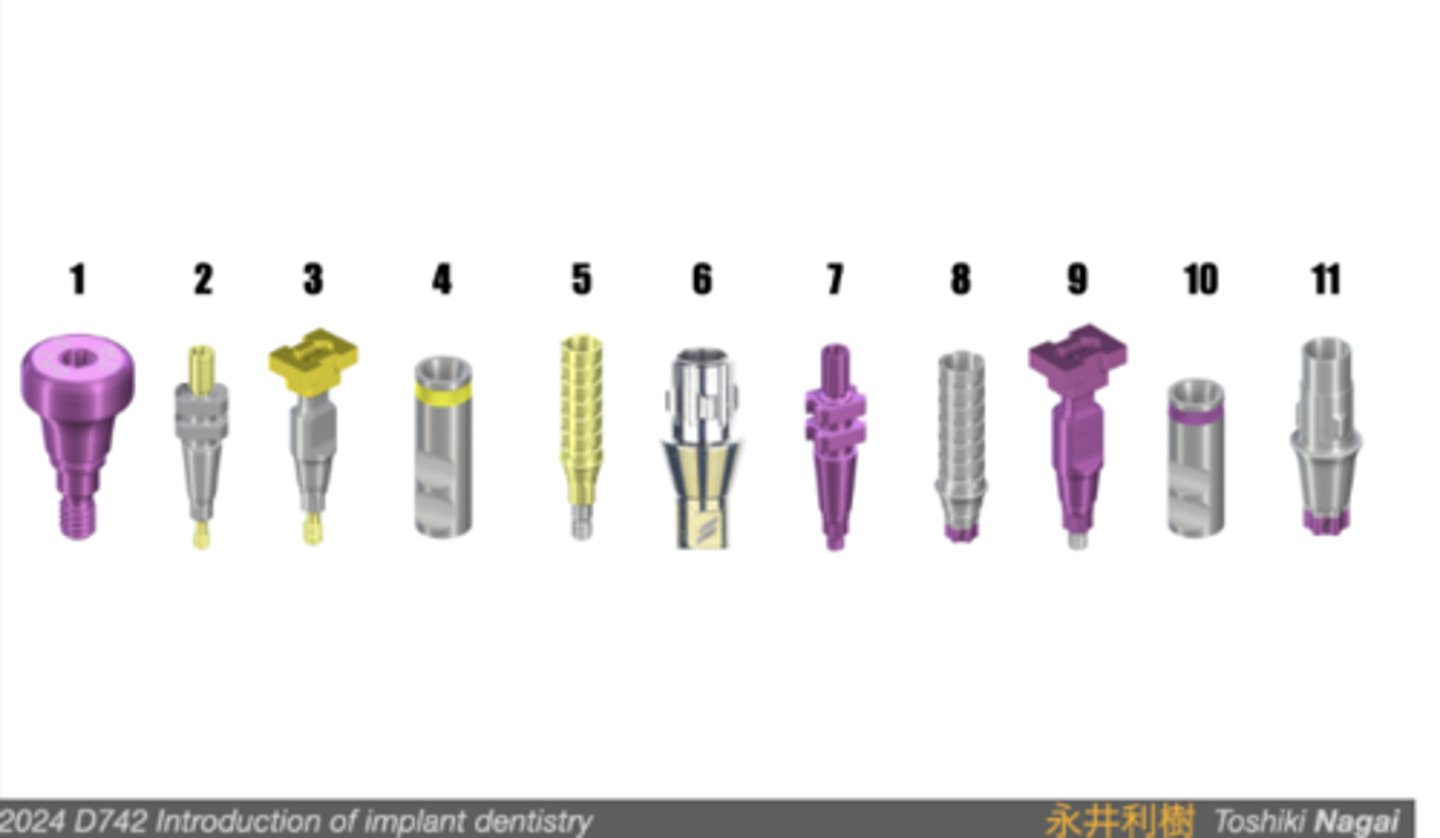
E. 1-Ti-base, 2- temporary abutment, 3- closed tray impression coping, 4-open tray impression coping, 5- Analog
Based on the figure provided, please select the correct combination of implant components. (Select one answer)
a. 1- Temporary abutment, 2-Ti-base, 3- closed tray impression coping, 4-open tray impression coping, 5-Ti-base
b .1-Ti-base, 2-impression coping, 3-temporary abutment, 4-open tray impression coping, 5- Analog
c. 1- Temporary abutment, 2- impression coping, 3- closed tray impression coping, 4-open tray impression coping, 5-Ti-base
d. 1-Ti-base, 2-temporay abutment, 3- open tray impression coping, 4-closed tray impression coping, 5-Analog
e. 1-Ti-base, 2- temporary abutment, 3- closed tray impression coping, 4-open tray impression coping, 5- Analog
b. This restoration is screw retained implant restoration
Based on the figure provided, please select the correct sentences. (Select one answer).
a. This abutment is custom abutment
b. This restoration is screw retained implant restoration
c. This restoration is cement retained implant restoration
d .This is Metal ceramic restoration
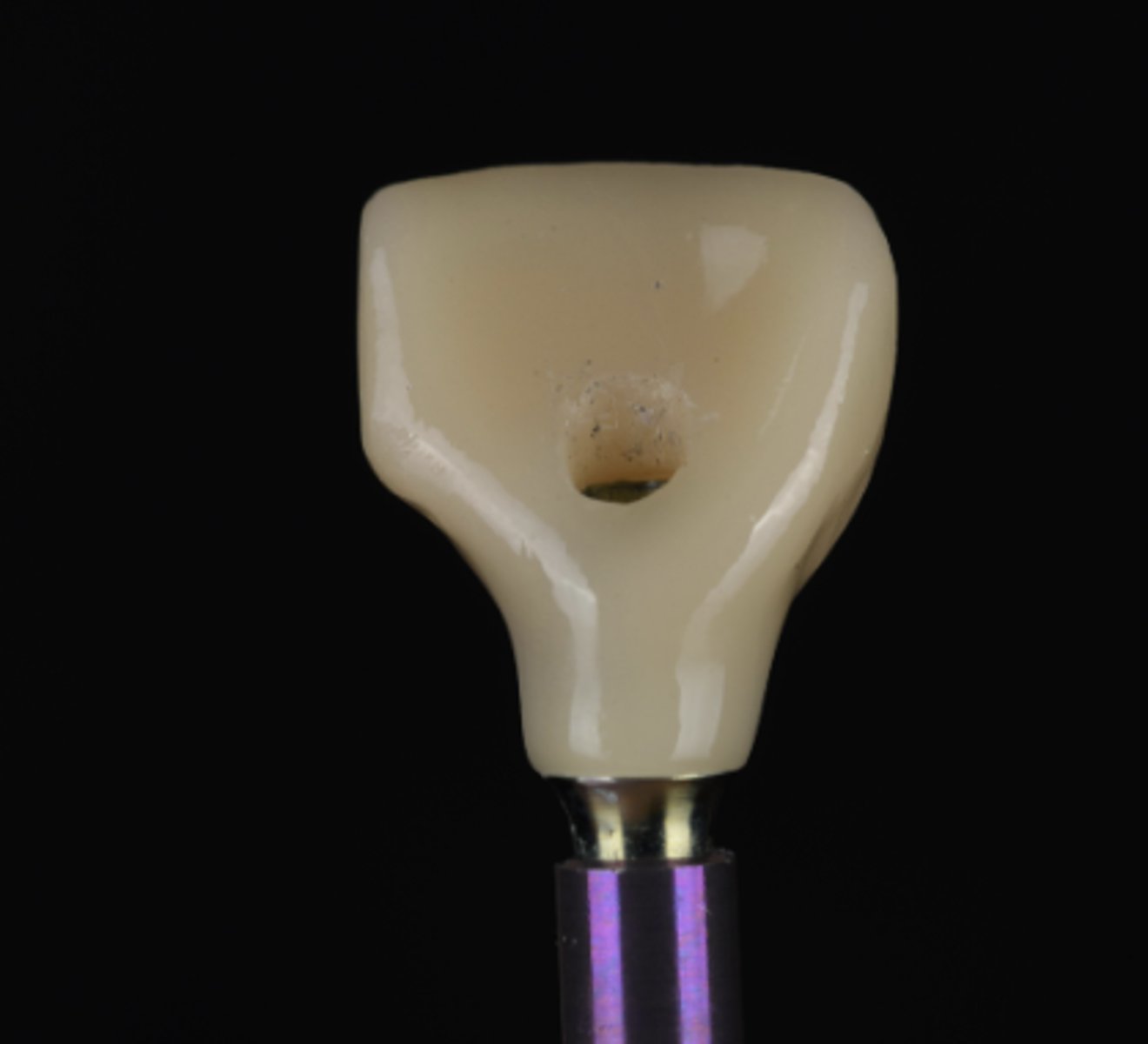
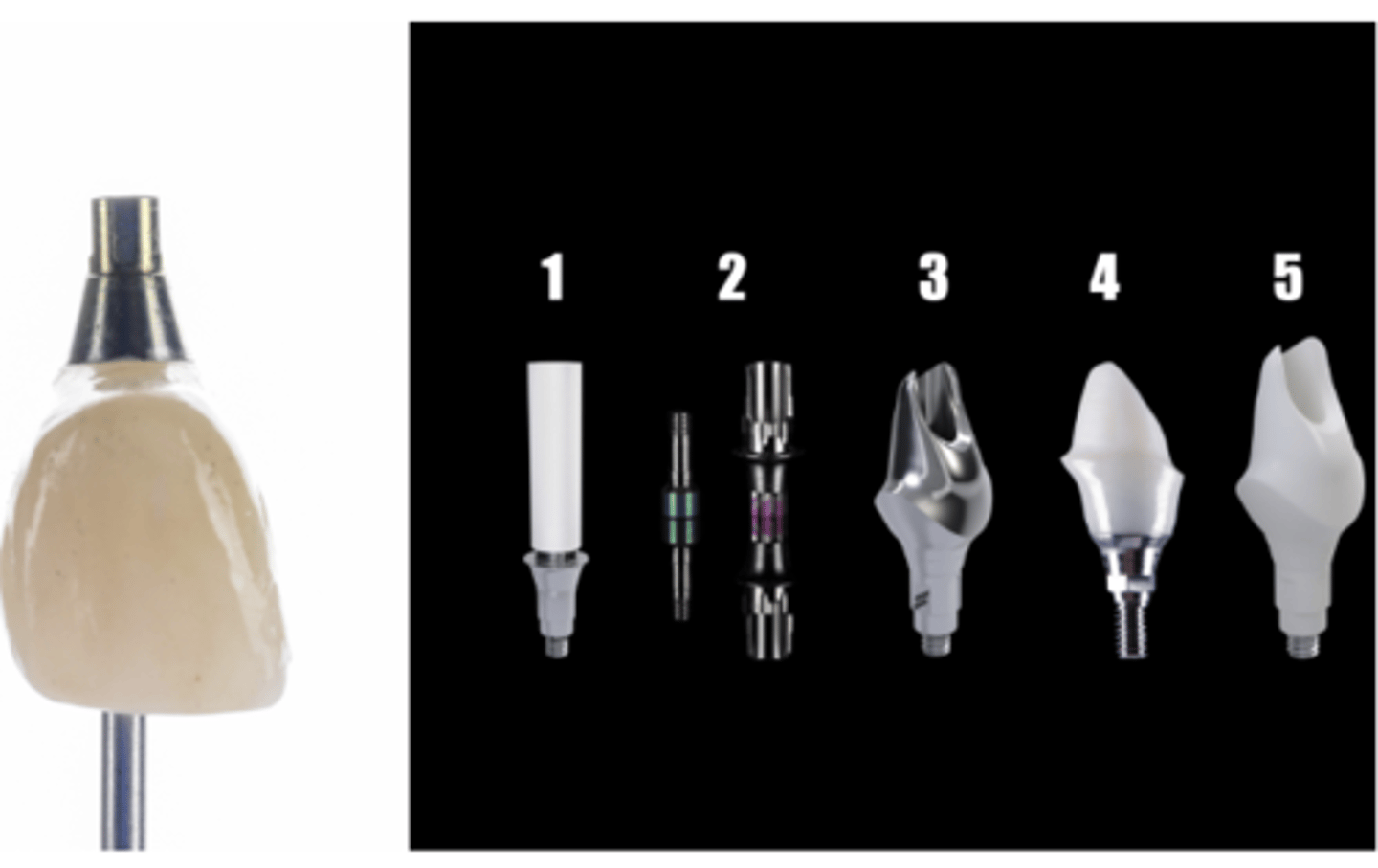
2
The Picture bellow showed "most common implant restoration structure", which abutment was used for this restoration ? (Select one).
4
3
5
2
1
1 Healing abutment
2 Open tray impression coping
3 Close tray impression coping
4 Analog
5 Temporary abutment
6 Ti-base
7 Open tray impression coping
8 Temporary abutment
9 Close tray impression coping
10 Analog
11 Ti-base
Please identify each as one of the following:
Healing abutment
Open tray impression coping Close tray impression coping
Analog
Temporary abutment
Ti-base
Custom abutment
UCLA abutment
Cover screw
Zirconia abutment
Hybrid abutment
c. Elimination of the risk of residual subgingival cement.
Which of the following is an advantage of using a screw-retained implant crown? (Select one)
a. Easier achievement of a passive fit for the restoration.
b. Reduced laboratory complexity for dental technicians.
c. Elimination of the risk of residual subgingival cement.
d. Improved achievement of optimal occlusion and occlusal anatomy on the crown.
e. The ability to restore malpositioned implants using custom abutments.
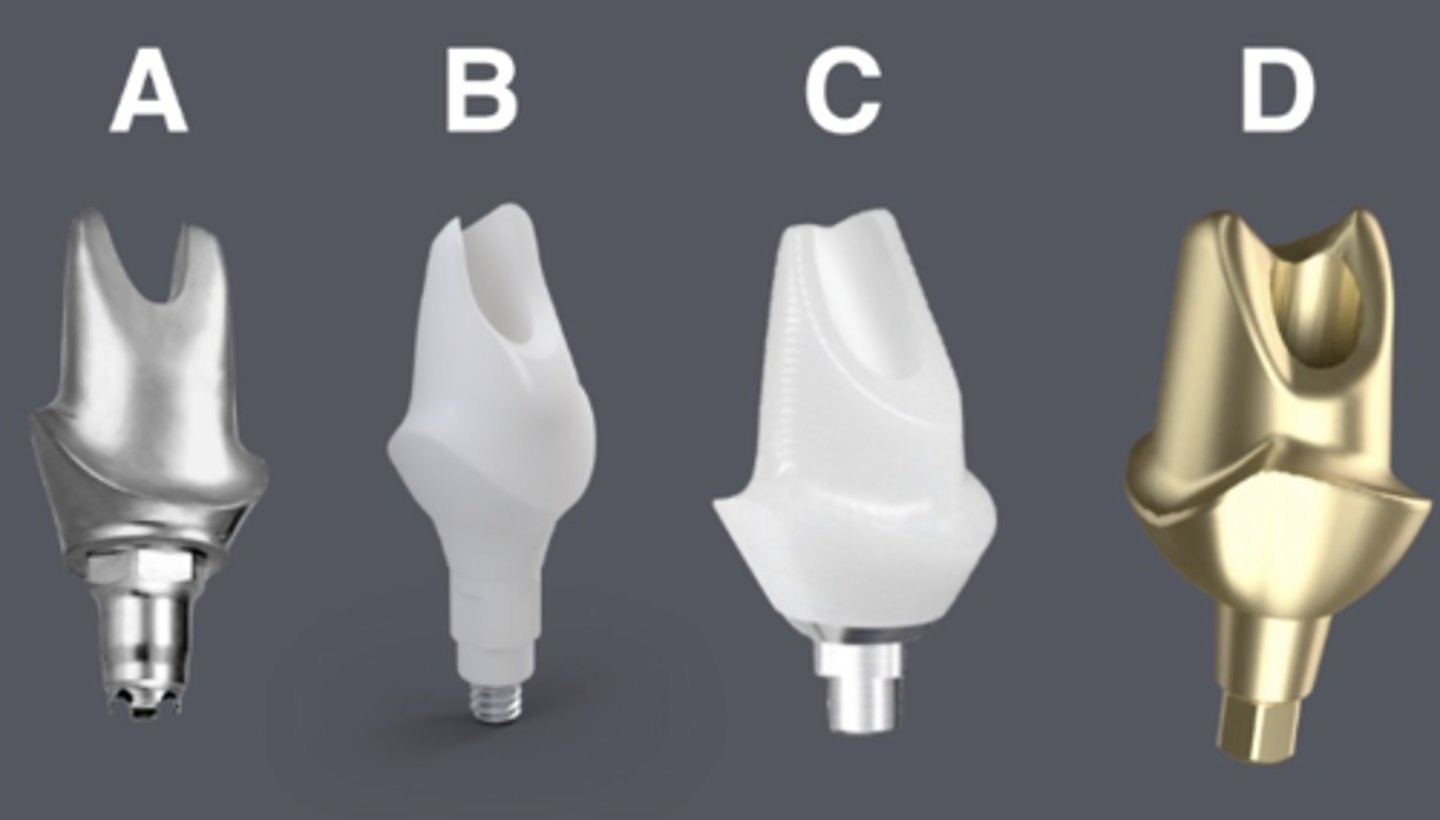
A
Your patient requires a cement-retained implant crown for tooth #8 and is highly concerned about the cosmetic result. He desires the crown to appear as natural as possible. Based on the options provided in the figure, which one is LEAST likely to produce optimal aesthetics?
d. Nylon insert
What component of the locator attachment system is often color-coded to signify different retention strengths? (Select one)
a. Processing cap
b. Block-out spacer
c. Abutment
d. Nylon insert
e. Denture base
E. Prevent excess pick-up material from locking the denture in place.
What is the purpose of the white block-out spacer or rubber dam during the pick-up procedure for the locator processing cap assembly? (Select one)
A. Enhance the aesthetics of the final denture.
B. Verify that the denture sits securely without rocking.
C. Ensure there are no occlusal interferences or premature contacts for the patient.
D. Create space for the acrylic resin during the pick-up procedure.
E. Prevent excess pick-up material from locking the denture in place.
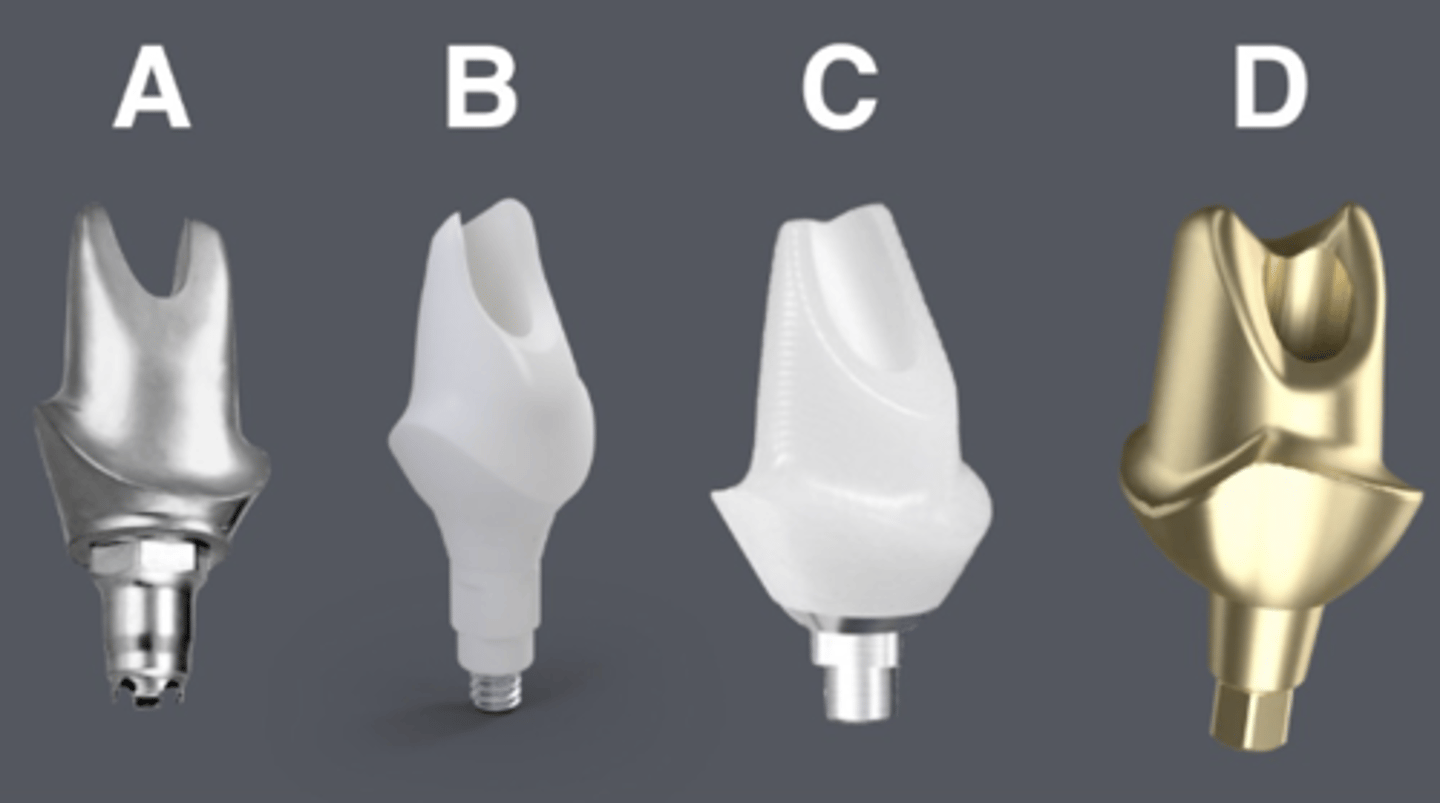
A Custom Titanium or CoCr abutment
B Zirconia abutment
C Hybrid abutment
D Custom anodized Titanium abutment
Please arrange correct combination regarding below picture.
options:
-Custom Titanium or CoCr abutment
-Ti-base, UCLA abutment
-Zirconia abutment
-Hybrid abutment
-Custom anodized Titanium abutment
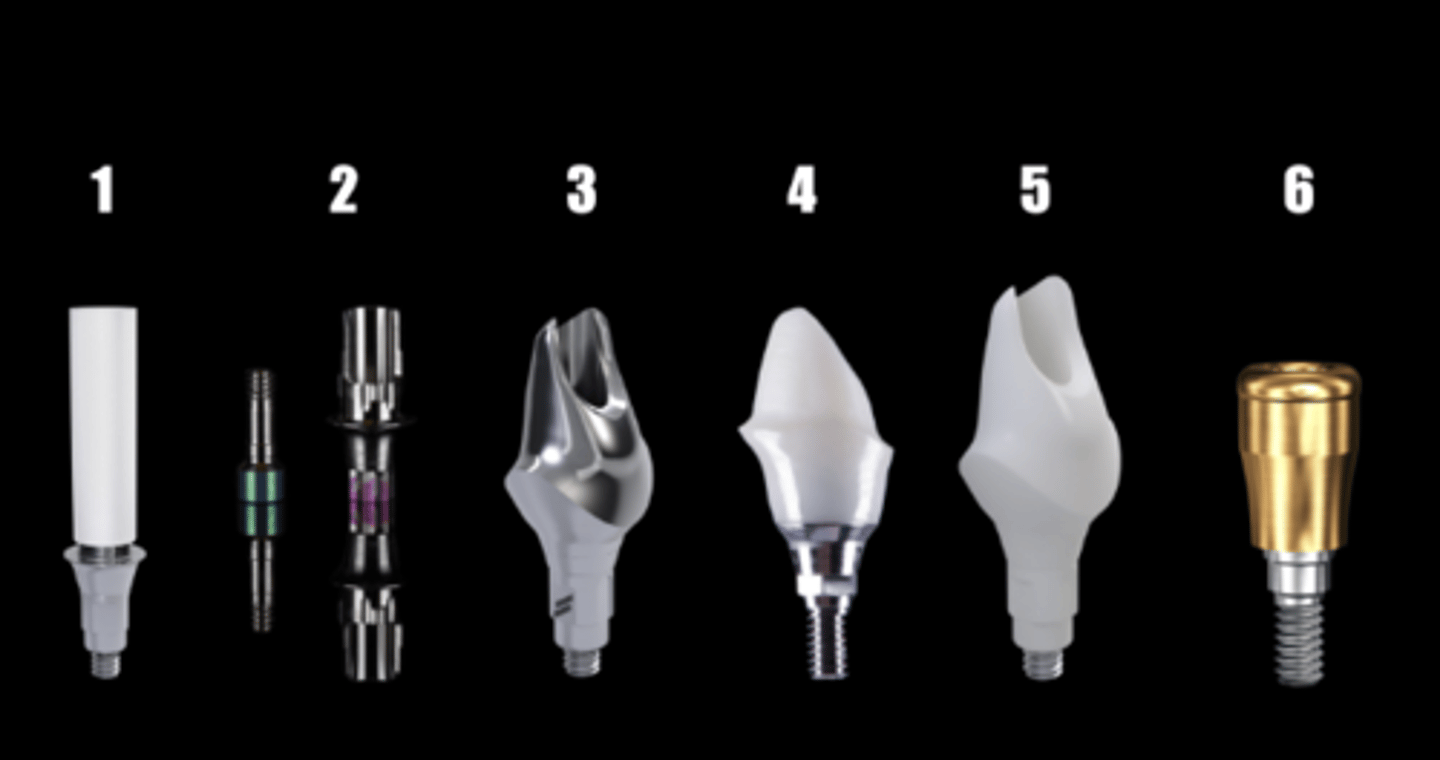
1. UCLA abutment
2 Ti-base
3 Custom Titanium abutment
4 Hybrid abutment
5 Custom zirconia abutment
6 Locator abutment
Please arrange correct combination based bellow picture. options:
Hybrid abutment
Custom zirconia abutment
Locator abutment
Nagai Special abutment
UCLA abutment
Ti-base
Custom Titanium abutment
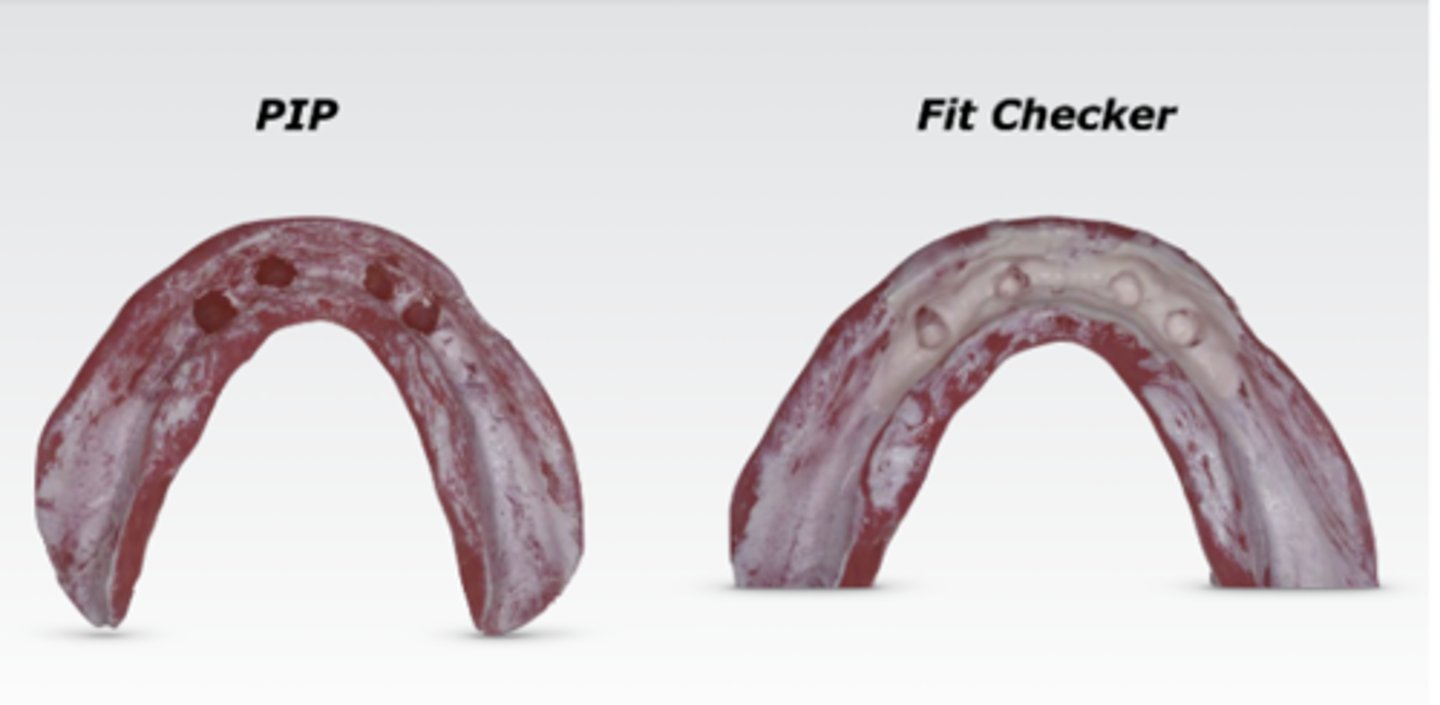
b. PIP should be used to make sure soft tissue adaptation.
The following figure is showing a denture adjustment for locator pick up procedure when you fabricate an implant supported locator retained overdenture. Based on the figure provided, please select the statement with the correct information. (Select one answer)
a. PIP should be used to make sure the housing space.
b. PIP should be used to make sure soft tissue adaptation.
c. Fit checker should be used to make sure soft tissue adaptation.
d. Fit checker should be used as an adhesive.
e. You can pick up locator without checking soft tissue adaptation.
a. Measure peri-implant mucosa thickness
b. Laboratory reline of the denture
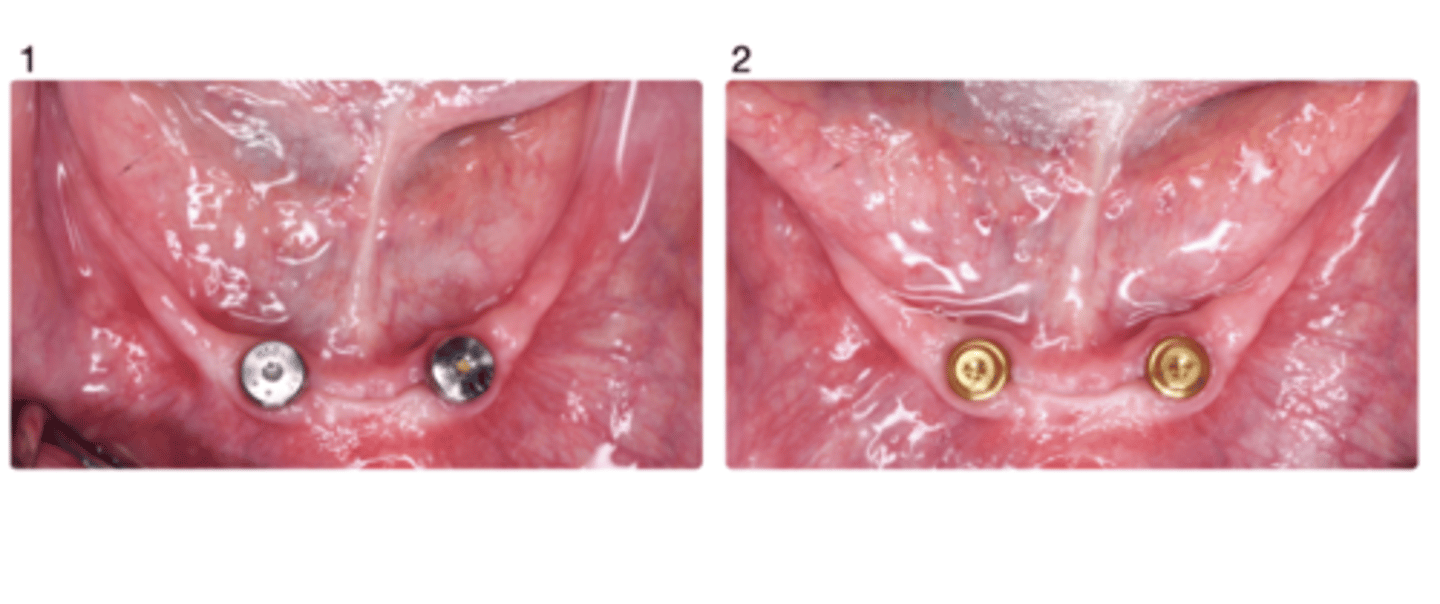
You already fabricate acceptable complete denture before implant planning and the surgeon decided implant locations based on the denture. Based on provided picture bellow, you saw the patient situation 1 in DDS implant clinic after the surgeon confirm the implants can be loaded. Your plan to use the current denture as a definitive implant assisted complete denture. At next appointment, you placed abutments on the implant (Situation 2) to delivery implant assisted complete denture. Between 1 and 2, what do you need to do ? (Select all).
a. Measure peri-implant mucosa thickness
b. Laboratory reline of the denture
c. Final impression
d. Pick up procedure of housing
e. preliminary impression
B. Screw retained restoration is more technique sensitive than cement retained restoration regarding adjusting proximal contact
Please select a correct sentence regarding screw-retained or cement retained implant restoration. (Select one)
A. Cement retained restoration is the most common implant restoration structure.
B. Screw retained restoration is more technique sensitive than cement retained restoration regarding adjusting proximal contact
C. Cement retained restoration should be used stock abutment instead of custom abutment.
D. Screw retained restoration is always esthetically better than cement retained restoration
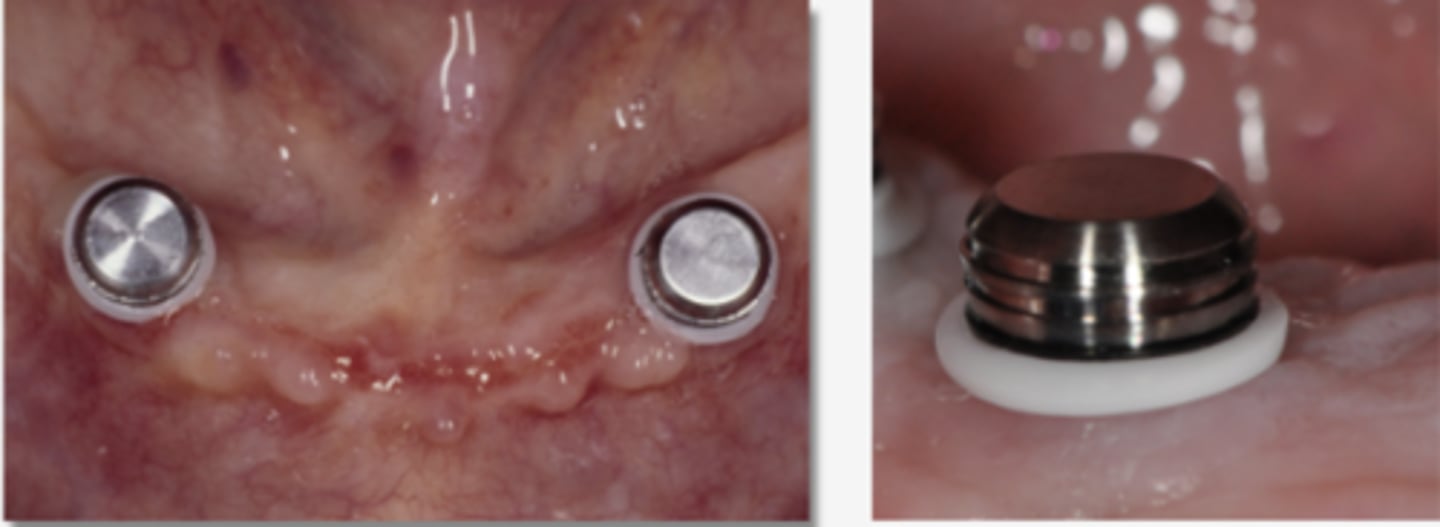
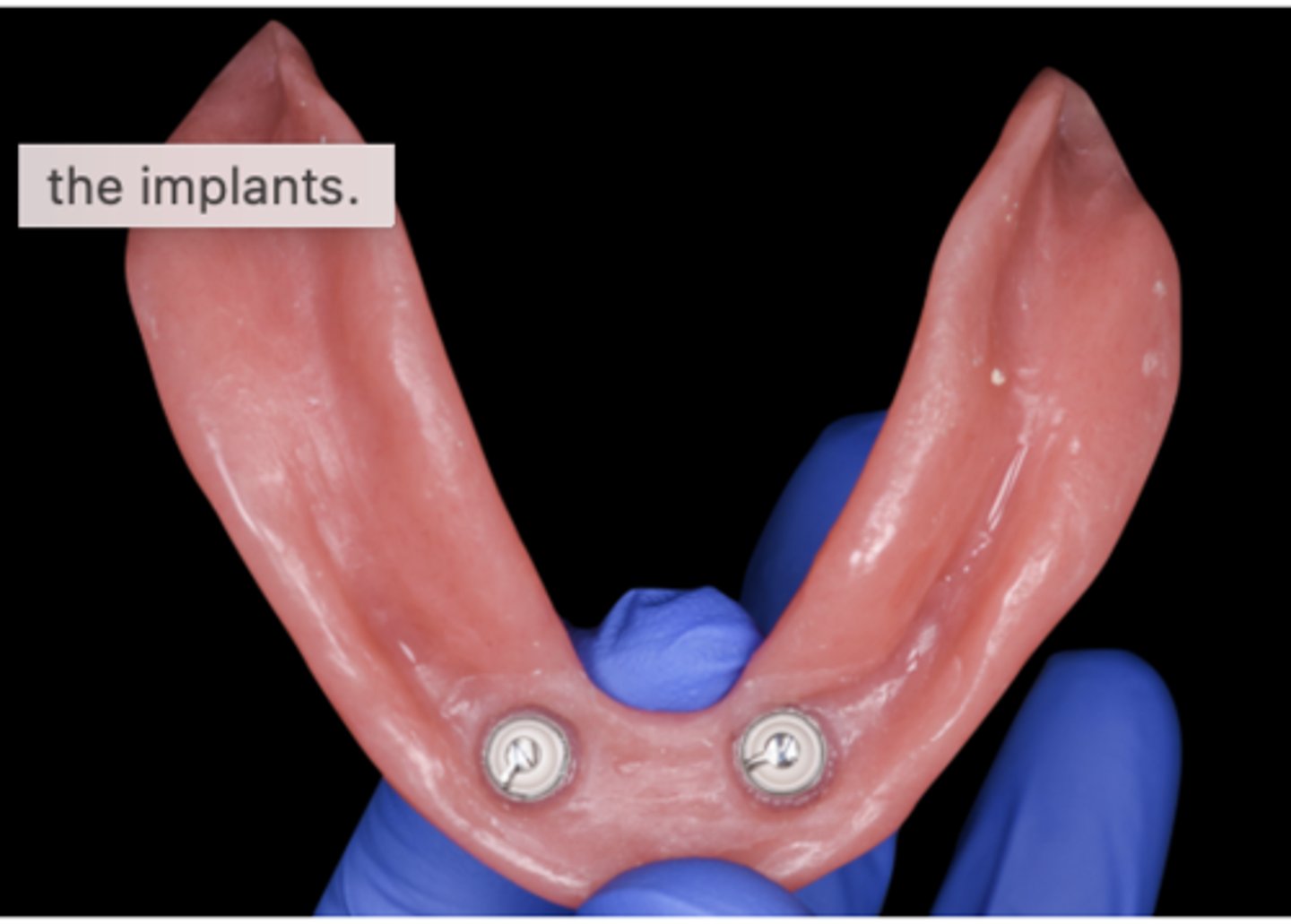
both the implants and soft tissues
In the case shown, support for the overdenture comes from:
A. the implants
B. No answer text provided.
C. both the implants and soft tissues
D. soft tissues
B. 5 mm
When you evaluate restorative space #4, at least how much space you need to have vertically (occlusal-cervical direction) for screw retained restoration ? (select one).
A. 7 mm
B. 5 mm
C. 6 mm
D. 4 mm
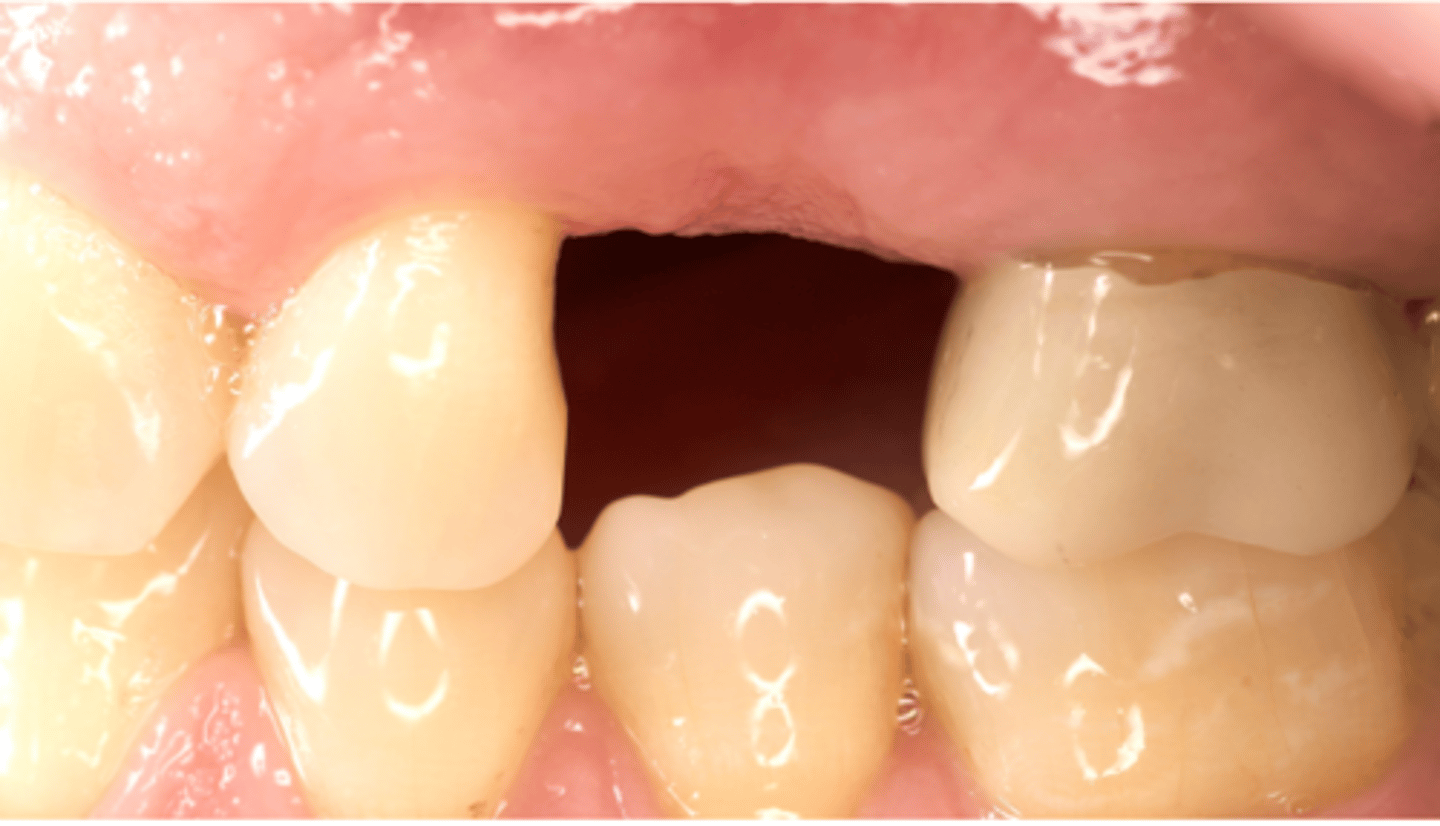
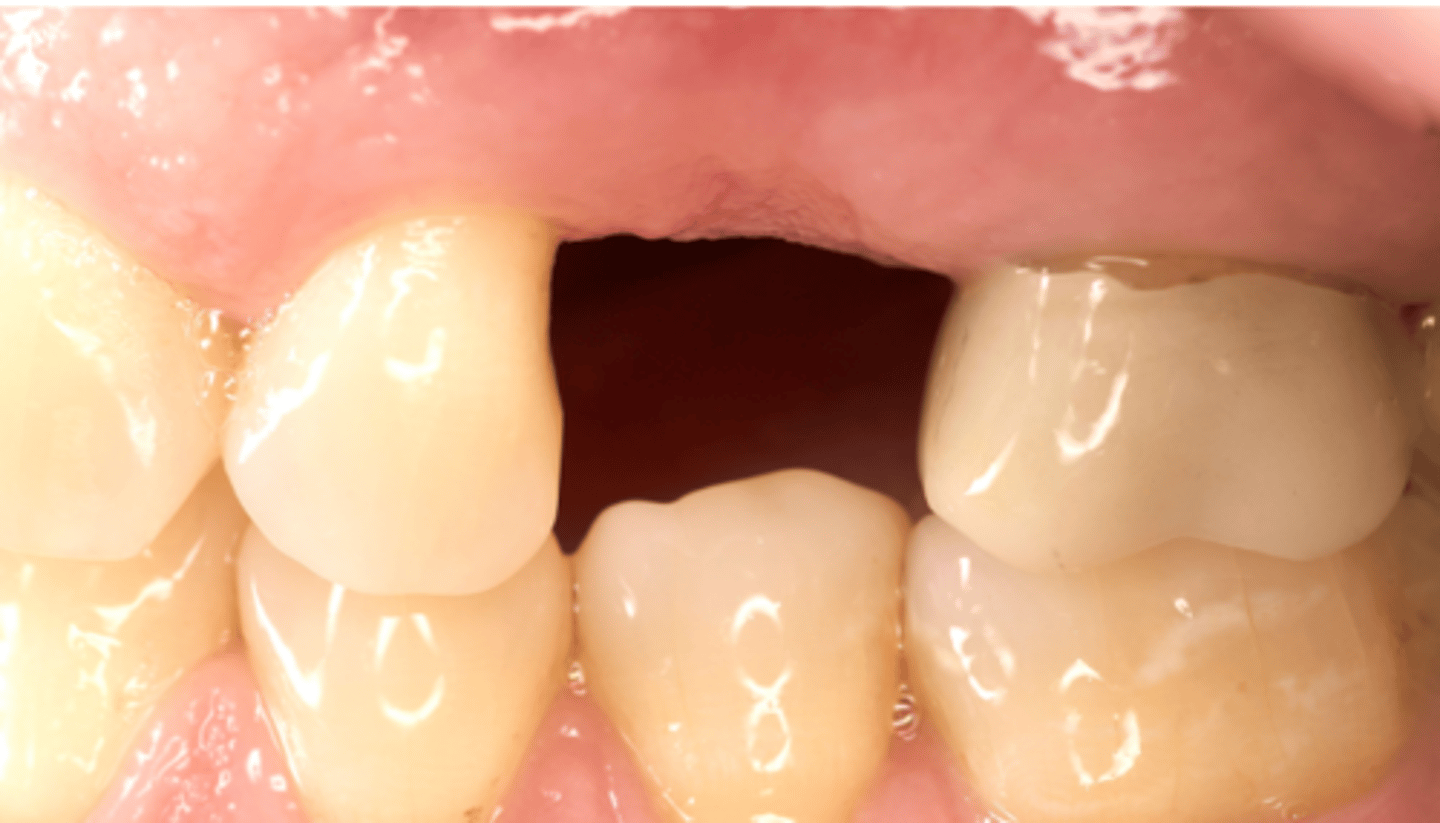
A. Adjacent tooth proximal contact morphology
B. Mesio-distal dimension
E. Vertical space (occlusal-cervical direction)
When you evaluate restorative space #4, what aspects you need to check ? (select all apply)
A. Adjacent tooth proximal contact morphology
B. Mesio-distal dimension
C. Soft tissue thickness (Vertical)
D. Bone density
E. Vertical space (occlusal-cervical direction)
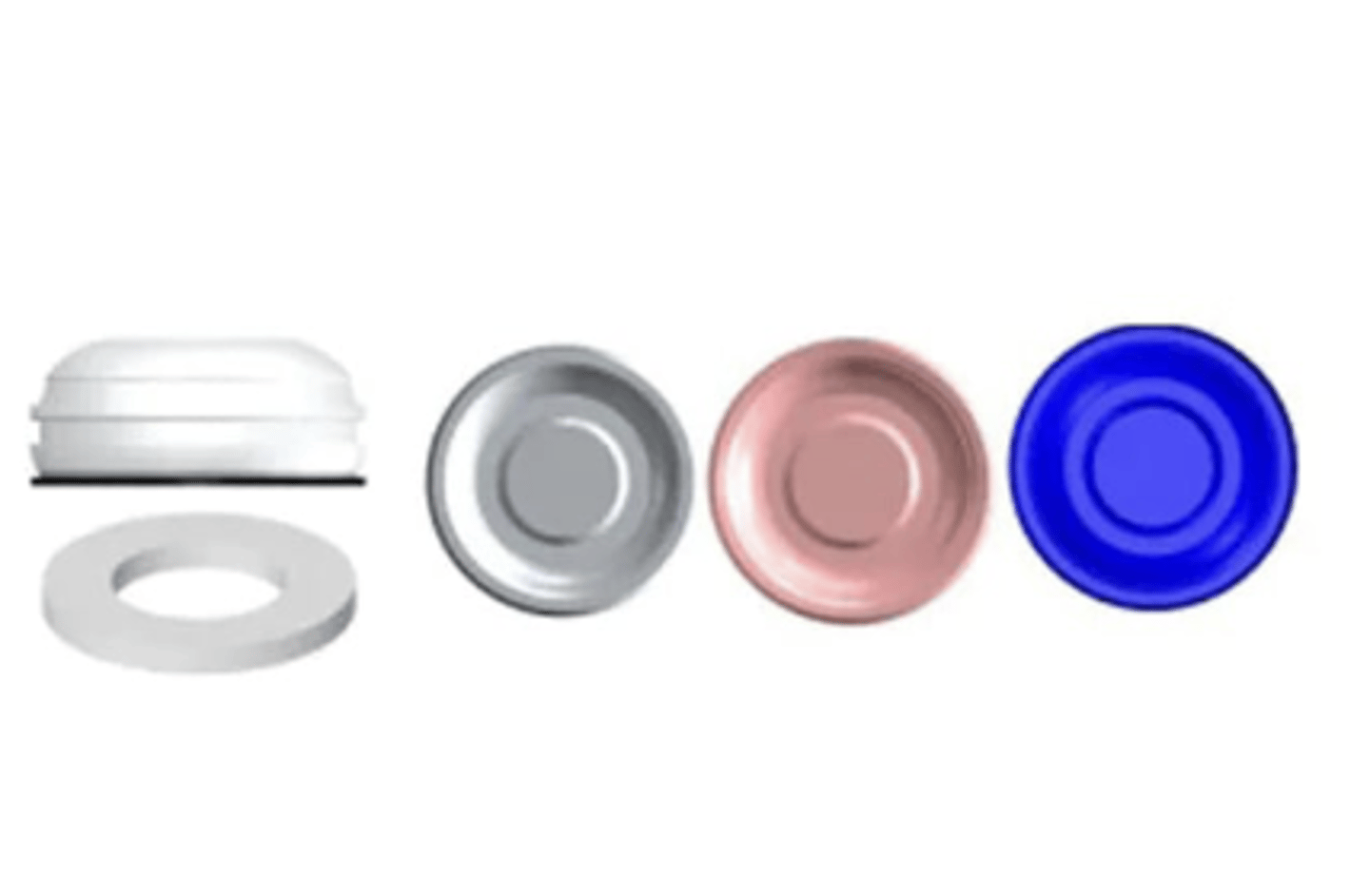
D. Blue is the weakest retention attachment (Gray-zero retention, Blue-low, Pink-medium, and Clear-high)
For the locator attachment (standard retention), you will obtain a product showed in picture below. Select correct sentence (Select one).
A. White is the weakest retention attachement
B. Pink is the weakest retention attachment
C. Black processing male can be used for the definitive attachment
D. Blue is the weakest retention attachment
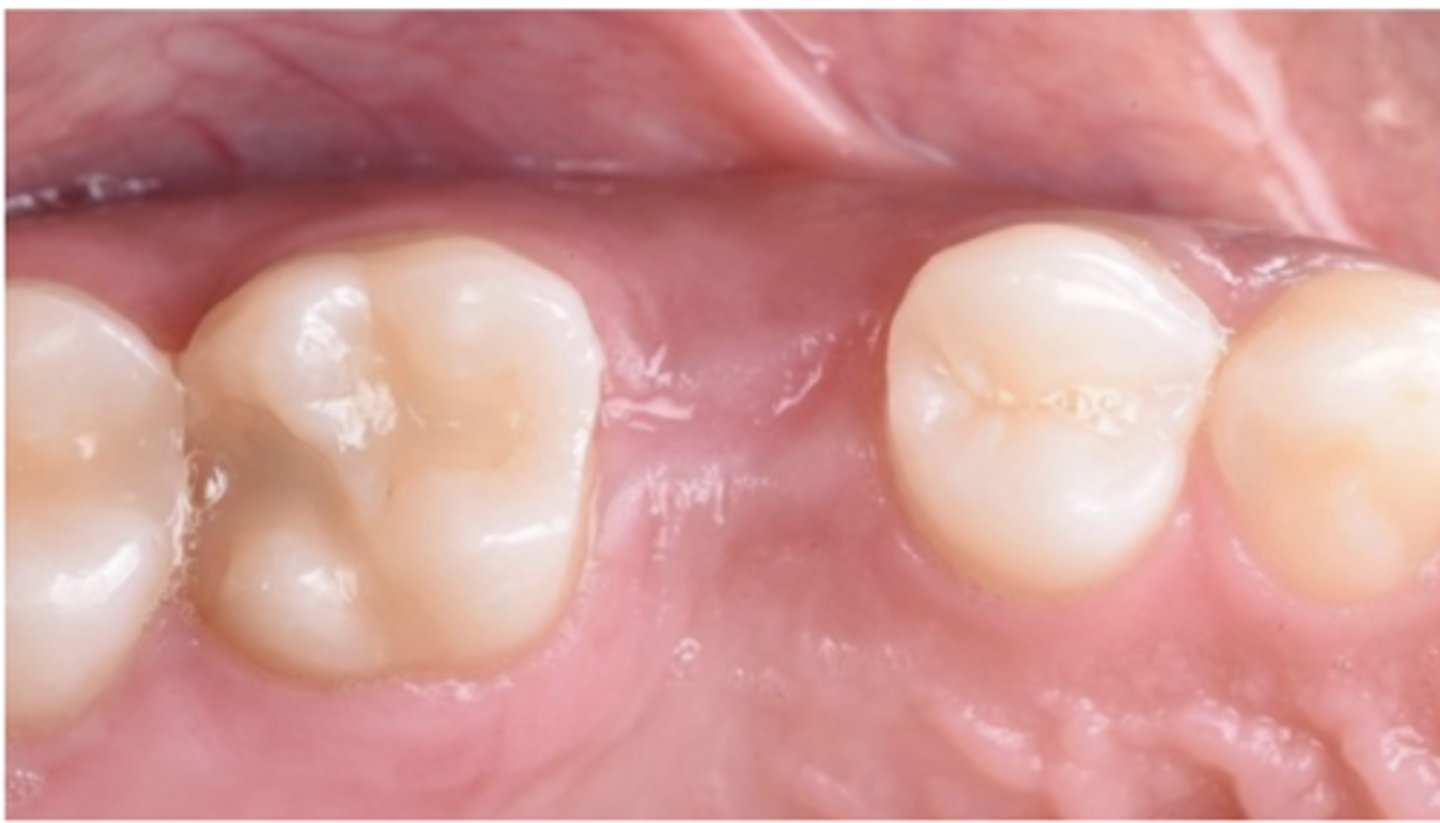
c. 7 mm
Correct ! 1.5 + 3.3 -3.5mm + 1.5 = 6.3-6.5 mm.
Based on the provided figure, you are planning to place a dental implant on #4. When you measure the mesio-distal space, how much space you need to have in order to make sure you have safely place implant ?
a. 5 mm
b. 6 mm
c. 7 mm
d. 8 mm
e. 9 mm
C. The voxel size selected
What is the mean global error of Cone Beam Computed Tomography (CBCT) for implant evaluation typically related to?
A. The patient's age and overall health
B. The number of implant placements
C. The voxel size selected
D. The experience of the radiologic technologist
B. FOV that encompasses the full dentition
For pre-operative implant planning involving virtual planning using Cone Beam Computed Tomography (CBCT), which Field of View (FOV) option is generally the most appropriate to ensure comprehensive assessment of the entire oral structure and dentition?
A. FOV that includes only the implant site
B. FOV that encompasses the full dentition
C. FOV that is smaller than the implant site
D. FOV based on the patient's height
D. Re-orienting the patient's head AFTER the CBCT is complete in the computer
In order to reduce metal artifacts in a Cone Beam Computed Tomography (CBCT) scan for implant planning, which of the following options DOES NOT typically help?
A. Opening the bite during the CBCT scan
B.Using metal artifact reduction algorithms
C. Removing all removable appliances of the patient
D. Re-orienting the patient's head AFTER the CBCT is complete in the computer
B. The size of FOV affects the quality of registration(IOS scanning and DICOM file ) in implant planning.
Please select a correct sentence regarding CBCT image for implant planning (Select one)
A. We should avoid scanning patient with voxels smaller than 0.2mm.
B. The size of FOV affects the quality of registration(IOS scanning and DICOM file ) in implant planning.
C. The smaller FOV ( 4x 4 cm) has better image quality and also better for implant planning than larger FOV (14 x 15 cm)
D. Current recommendation is NOT to take CBCT for every implant treatment planning
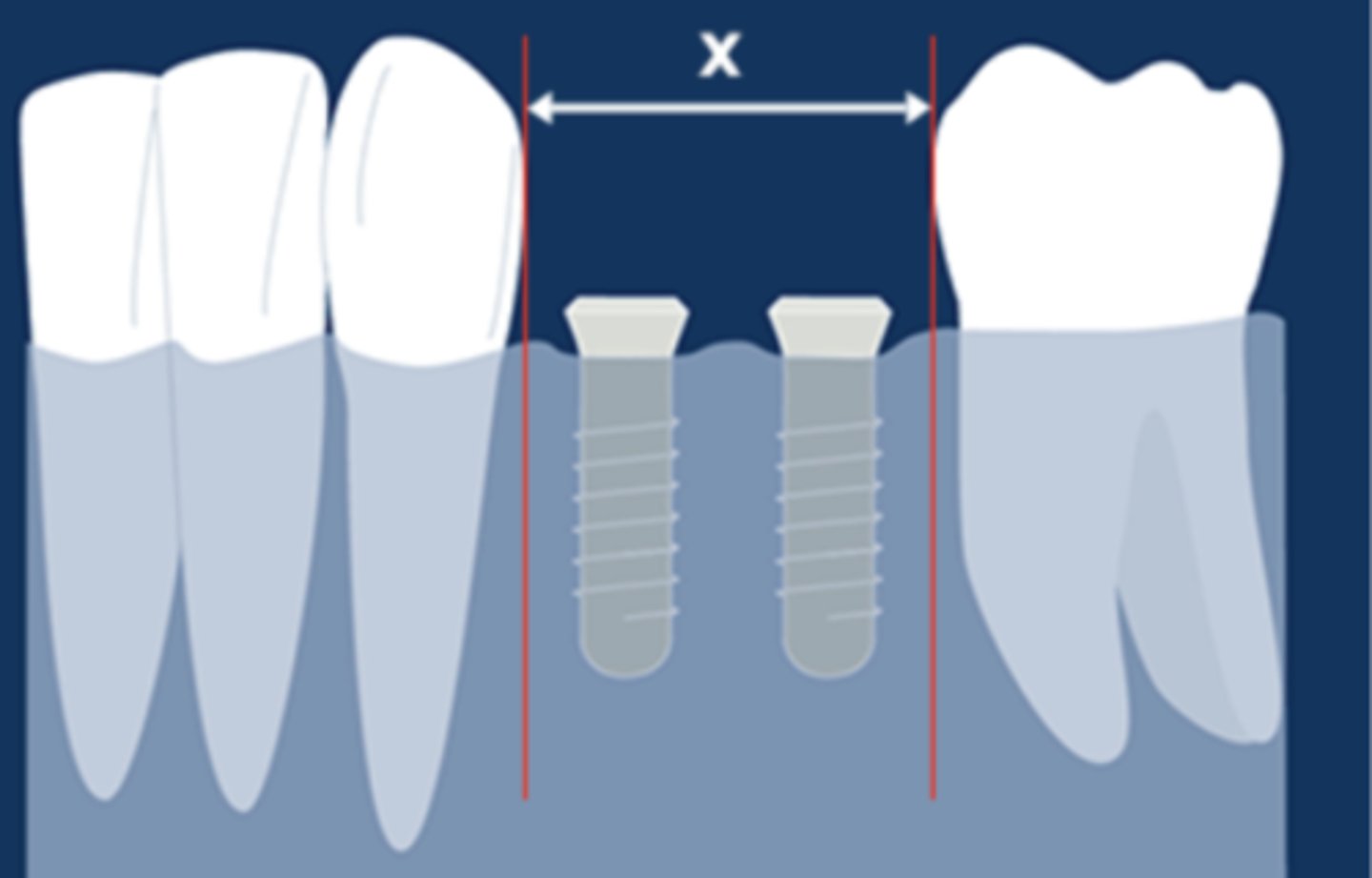
13mm (if 4.1 sized implant is asked, the answer is 15)
The minimum safe distance between two teeth (dimension X) to allow placement of two 3.3 mm implants is _____ . (select one answer)
12mm
13mm
14mm
15mm
A. Recent Myocardial Infarction (Heart Attack) 2 month ago
B. On-going Chemotherapy for cancer treatment
C. Drug abuse
D. IV Bisphosphonate Use
Which of the following options are considered absolute contraindications? (Select all that apply)
A. Recent Myocardial Infarction (Heart Attack) 2 month ago
B. On-going Chemotherapy for cancer treatment
C. Drug abuse
D. IV Bisphosphonate Use
E. Smoking
F. HIV/AIDS
C. Smoking
D. SSRI (selective serotonin reuptake inhibitor)
E. PPI (Proton pump inhibitor)
Which of the following options are considered Risk factors (Not Risk indicators) for dental implant ? (Select all that apply)
A. Type II Diabetes
B. Osteoporosis
C. Smoking
D. SSRI (selective serotonin reuptake inhibitor)
E. PPI (Proton pump inhibitor)
F. Hyper tention
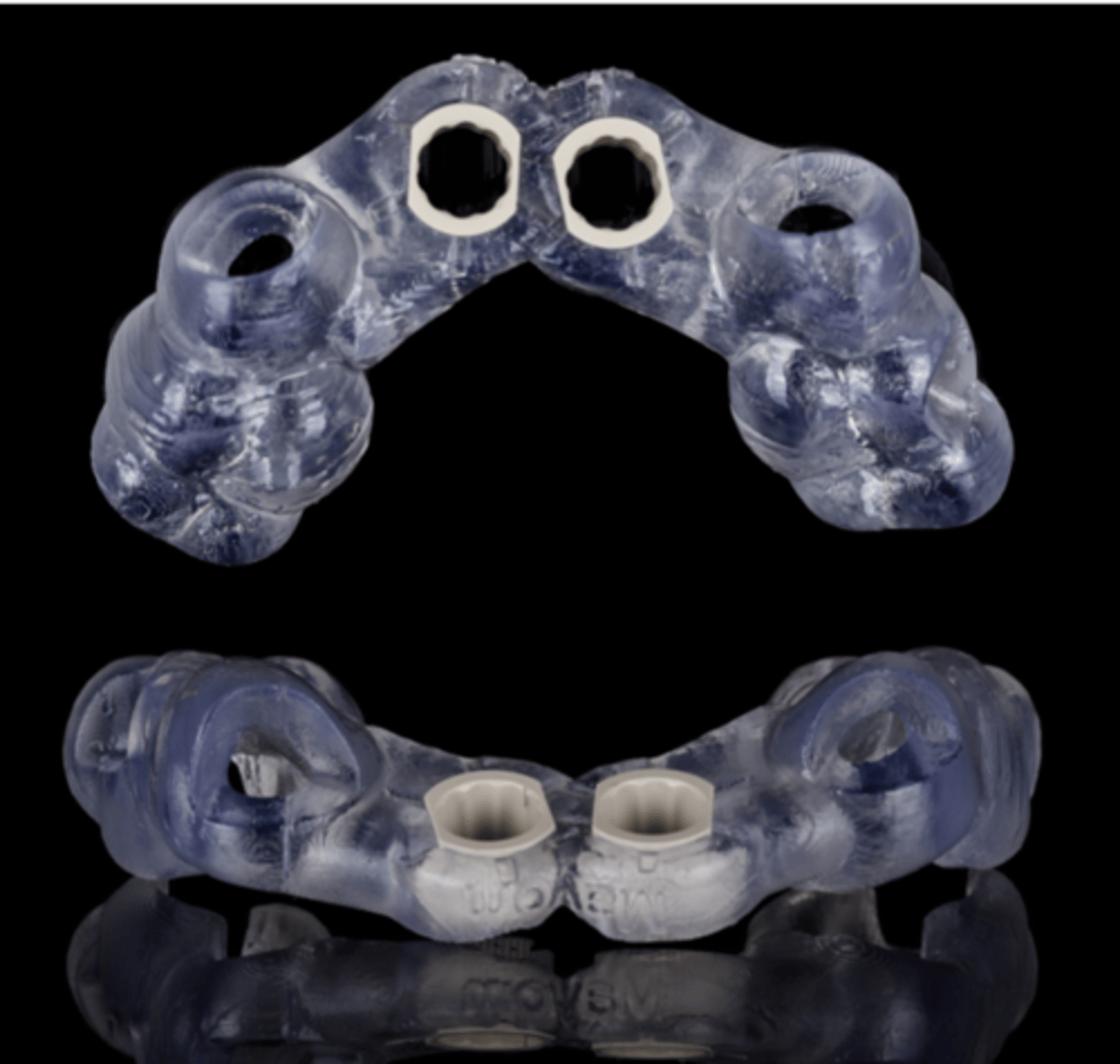
B. s-CAIS (static computer assisted implant surgical guide)
Which of the following best describes the image shown? (Select one)
A. Non-restricted analog surgical guide
B. s-CAIS (static computer assisted implant surgical guide)
C. d-CAIS (dynamic computer assisted implant surgical guide)
D. Restricted analog surgical guide
C. Reduces marginal bone loss
Which of the following is an advantage of platform switching in dental implants? (select one)
A. Increases micromovement at the implant-abutment junction
B.Decreases soft tissue thickness
C. Reduces marginal bone loss
D. Promotes fibrous encapsulation
TRUE
True or False: A conical internal connection has been shown to improve abutment stability and may result in fewer prosthetic complications compared to flat connections.
A. 0.15mm
Which voxel size is recommended for CBCT imaging in implant treatment planning?
A. 0.15mm
B. 0.0001mm
C. 0.5 mm
D. 1.0 mm
B. CBCT should be taken with open mouth
When you ask the radiologist or assistant to take CBCT for this patient for #4 implant planning, which statement is correct ? (Select one).
A. CBCT should be taken at MIP
B. CBCT should be taken with open mouth
C. CBCT should be taken as small FOV as possible
D. CBCT should be taken with Voxel site
C. SAC classification can classify into Straightforward, Advanced, and Complex.
Please select a correct sentence about SAC classification (ITI). (Select one answer)
A. SAC classification aims to provide subjective input with regard to likely treatment difficulty and likelihood of outcome compromise.
B. SAC classification should be used at definitive restoration delivery appointment.
C. SAC classification can classify into Straightforward, Advanced, and Complex.
D. SAC classification aims to provide maintenance protocol for each individual patient.
D. Patient's esthetic expectation does not affect ITI esthetic risk assessment.
Which following statement does NOT correct regarding ITI Esthetic risk assessment (Partially edentulous)? (Select one answer)
A. Lip line (Smile line) impacts on over all ITI esthetic risk assessment.
B. Shape of the tooth crowns is one of the ITI esthetic risk factors and need to evaluate prior to surgery.
C. Smoking habit is one of the ITI esthetic risk factors and >10 cig /day indicate high risk.
D. Patient’s esthetic expectation does not affect ITI esthetic risk assessment.
E. The goal of risk assessment is to identify patients whose implant therapy carries a high risk of a negative outcome.
A. Placement of implant at Infection site is high risk factors.
Which following statement corrects regarding ITI Esthetic risk assessment (Partially edentulous)? (Select one answer)
A. Placement of implant at Infection site is high risk factors.
B. Type of the implant is one of the ITI esthetic risk factors.
C. Patient age is one of the ITI esthetic risk factors.
D. The goal of risk assessment is to identify patients whose implant therapy carries a high potential of a positive outcome.
E. Medical status is not part of the ITI esthetic risk factors.
D. Patients have a preference implant overdentures over conventional dentures
Please select corrects sentence regarding Implant supported or assisted dental prosthesis. (Select one)
A. 4 implants supported fixed complete dental prosthesis (all on 4, hybrid) is always better than removable implant restorations
B. No answer text provided.
C. 4 implants mandibular overdentures always satisfy the patient more than 2 implants mandibualr overdenture
D. Patients have a preference implant overdentures over conventional dentures
a. Scenario 1 (Medical distal distance 13mm) with restored adjacent teeth
Based on the ITI Esthetic risk assessment for partial edentulous situation, which clinical scenario has highest esthetic risk with regard to the width of the edentulous span. (Select one answer)
a. Scenario 1 (Medical distal distance 13mm) with restored adjacent teeth
c. Scenario 3 (Medical distal distance 16mm) with native adjacent teeth
b. Scenario 2 (Medical distal distance 7mm) with native adjacent teeth
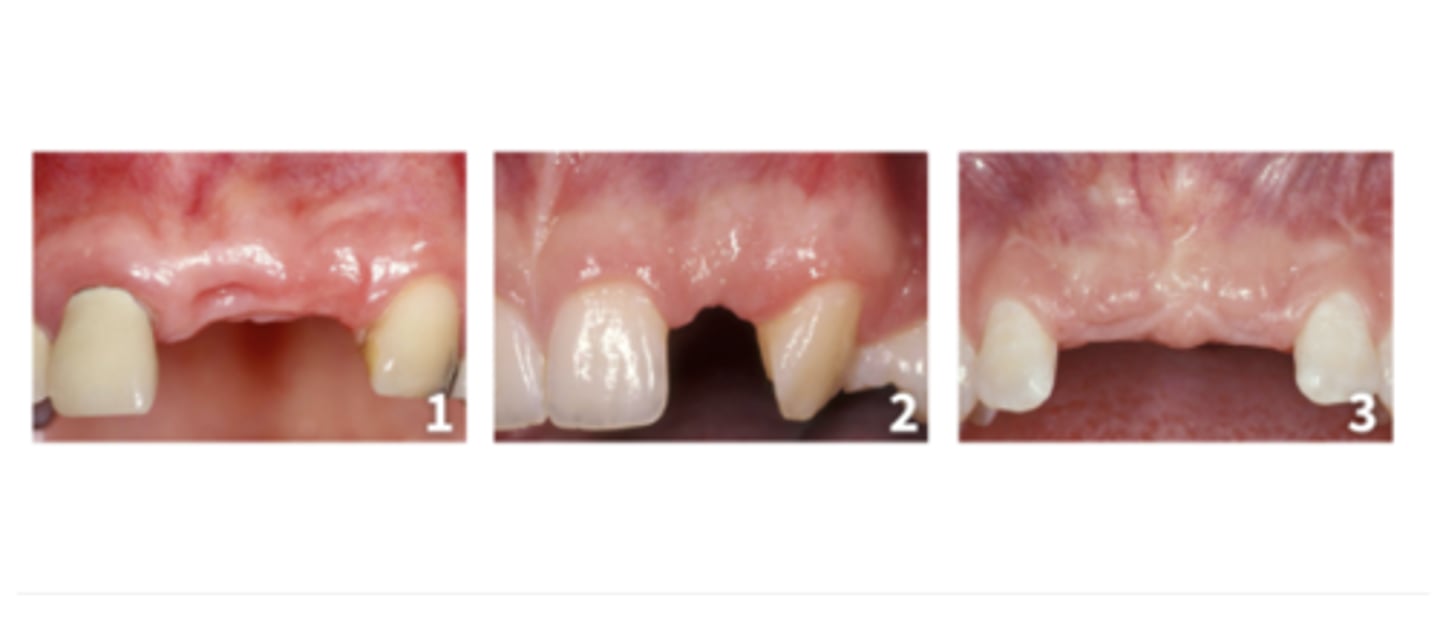
C. Bone level implant should be placed 3-4 mm deep from future (ideal) cervical line of the
The picture below is showing ideal 3D implant position, please select correct sentence. (select one)
A. Bone level implant should be placed 1-2 mm deep from future (ideal) cervical line of the restoration
B. Tissue level implant should be placed 3-4mm deep from ideal (future) cervical line of the restoration.
C. Bone level implant should be placed 3-4 mm deep from future (ideal) cervical line of the restoration
D. Bone level implant should be placed 2 mm deep from future (ideal) cervical line of the restoration
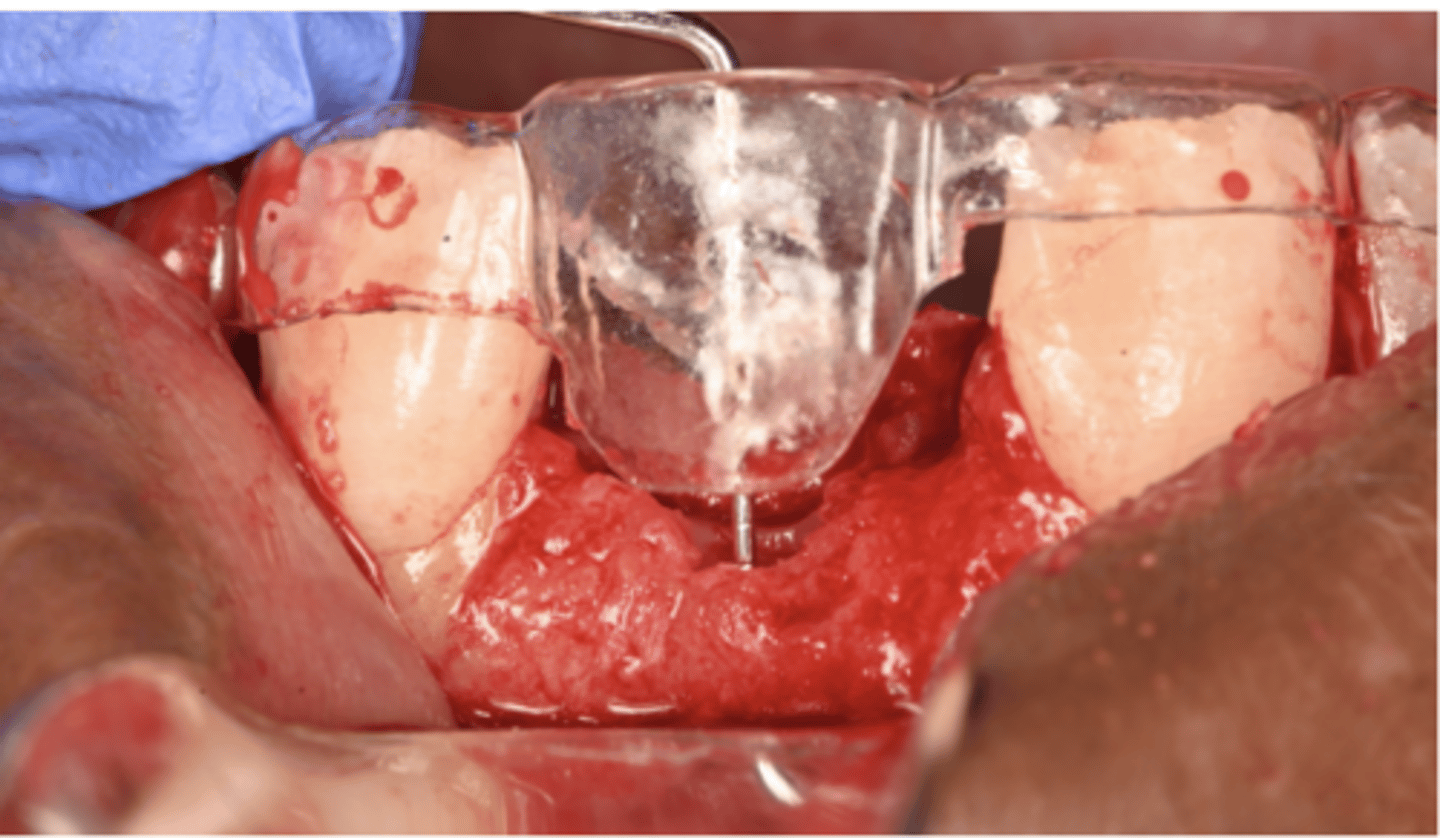
C. Average smile line
Provided figure showed 80% exposure of the anterior teeth when the patient smile. Please select correct answer ? (select one)
A. High smile line
B. Gammy smile
C. Average smile line
D. Lowe smile line
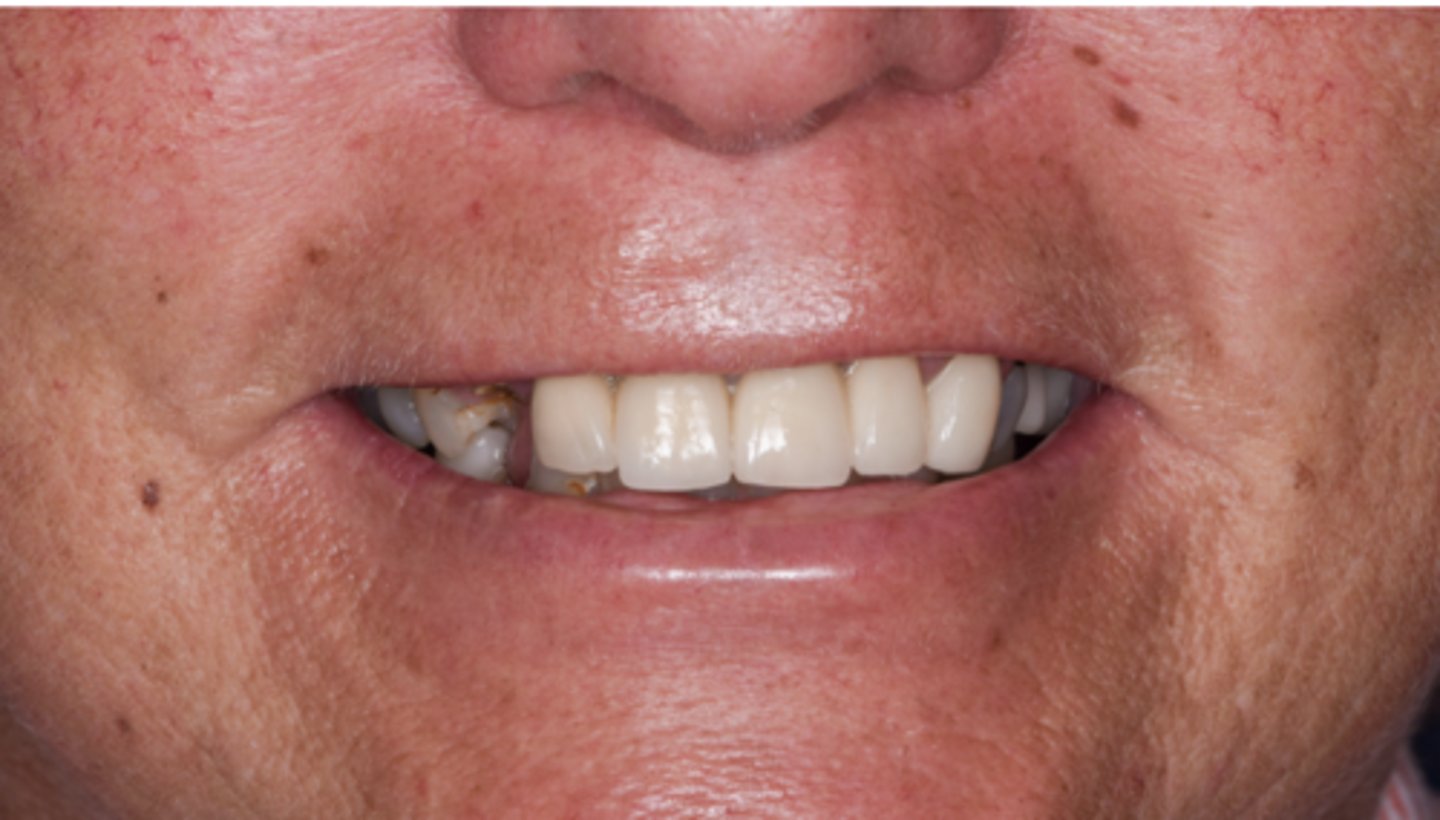
B. Educating the patient on prosthetic limitations and selecting treatment with minimal risk that aligns with their life conditions
A 60-year-old edentulous patient presents to your clinic expressing concern about chewing function. According to patient-centered care principles discussed in the lecture, which of the following is most aligned with a successful treatment plan?
A. Replacing all missing teeth with fixed implant prostheses regardless of patient preferences
B. Educating the patient on prosthetic limitations and selecting treatment with minimal risk that aligns with their life conditions
C. Recommending the most expensive option to ensure long-term function
D. Avoiding implant therapy due to cost concerns
D. Fixed edentulous maxilla with immediate loading in a high esthetic zone
Which of the following implant cases would most likely be classified as “Complex” according to the SAC classification?
A. Posterior mandibular implant in a healthy non-smoker with good bone
B. Mandibular overdenture supported by 2 implants
C. Maxillary anterior implant in a patient with thick phenotype
D. Fixed edentulous maxilla with immediate loading in a high esthetic zone
A. This represents high esthetic risk requiring careful planning and possible grafting
A 45-year-old patient desires an implant in the maxillary lateral incisor area. CBCT reveals vertical bone deficiency and soft tissue collapse. According to the esthetic risk assessment, what should the clinician consider?
A. This represents high esthetic risk requiring careful planning and possible grafting
B. Esthetic outcomes are easily achieved in this region
C. This is a low-risk case appropriate for immediate placement
D. Implant placement is contraindicated
A. Thoroughly assess and discuss risks and set realistic expectations
A patient with high esthetic demands and unrealistic expectations is assessed. What should the clinician do?
A. Thoroughly assess and discuss risks and set realistic expectations
B. Proceed with immediate implant placement without discussion
C. Refer to another provider to avoid responsibility without discussing the risk
D. Avoid discussing limitations to prevent stress
B. Intact soft tissue
Which anatomical feature is least likely to increase esthetic risk?
A. Vertical bone defect
B. Intact soft tissue
C. Thin biotype
D. Short upper lip
C. Failing to maintain a minimum of 5 mm from bone crest to contact point
You are planning an implant in the maxillary central incisor region for a patient with a thin gingival phenotype, a high smile line, and bone level 7 mm from the contact point.
Question: Which of the following would most likely compromise the esthetic outcome in this case?
A. Using a screw-retained provisional to guide soft tissue healing
B. Placing the implant 3 mm below the facial CEJ of adjacent teeth
C. Failing to maintain a minimum of 5 mm from bone crest to contact point
D. Placing the implant slightly palatal to the ideal position
D. Lip (Smile) line
Which of the following patient-related factors cannot be modified through dental hard tissue surgical or prosthetic means and must be accounted for during esthetic risk assessment?
A. Gingival phenotype
B. Shape of tooth crowns
C. Width of the edentulous span
D. Lip (Smile) line
D. It elevates the case to high risk due to unpredictable healing
In the esthetic risk model, how does acute infection at the implant site (e.g., apical pathology) influence risk categorization?
A. It reduces the esthetic concern
B. It has no effect if bone appears adequate
C. It is equivalent to a virgin site
D. It elevates the case to high risk due to unpredictable healing
5mm
What is the minimum inter-occlusal space required for a screw-retained implant supported single crown? (Select one answer)
7mm
4mm
6mm
5mm
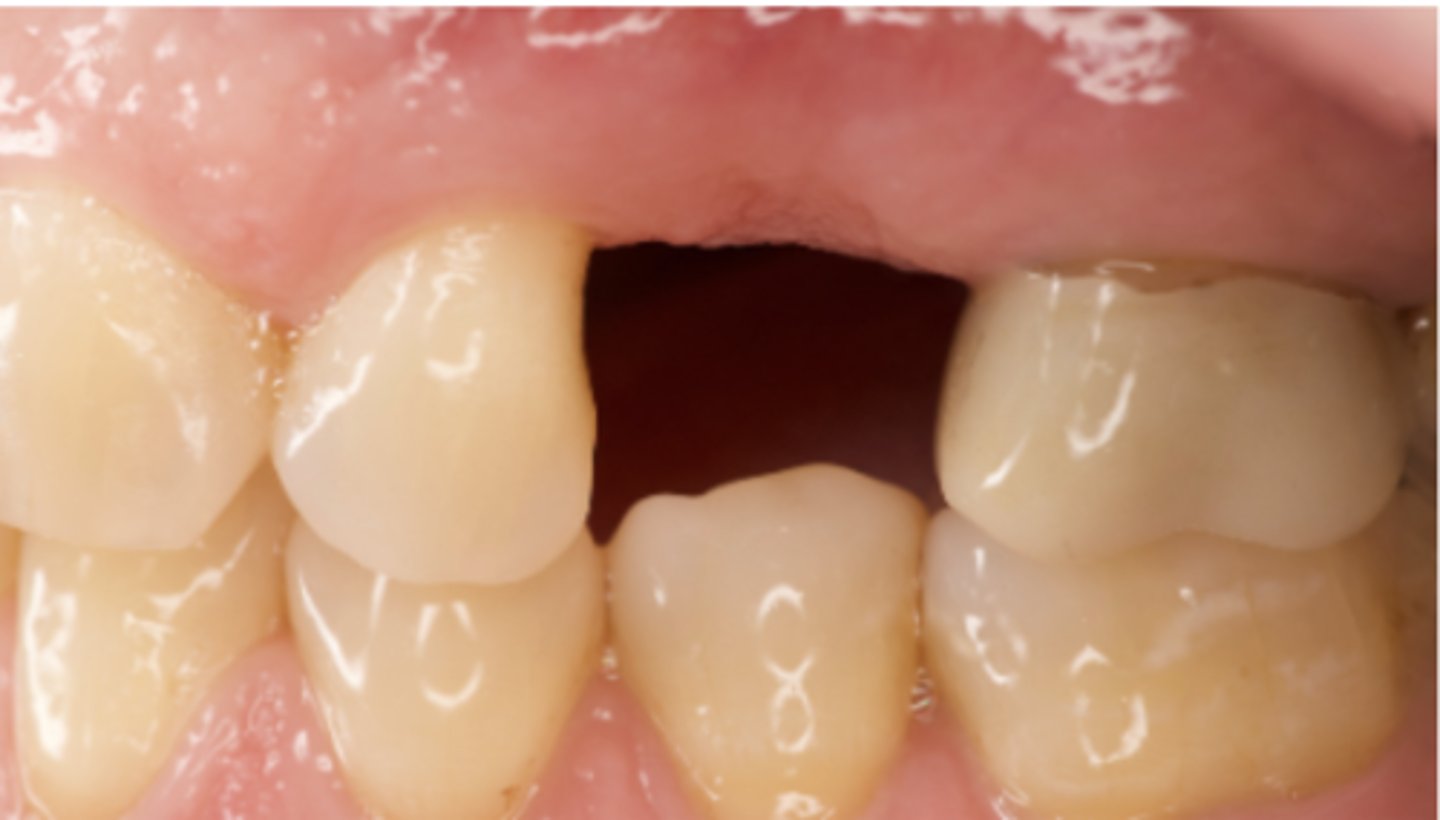
2 mm
What is the minimum thickness of peri-implant soft tissue in the esthetic zone to prevent Ti-base abutment influence on soft tissue color? (Select one answer)
1 mm
2.5 mm
2 mm
1.5 mm
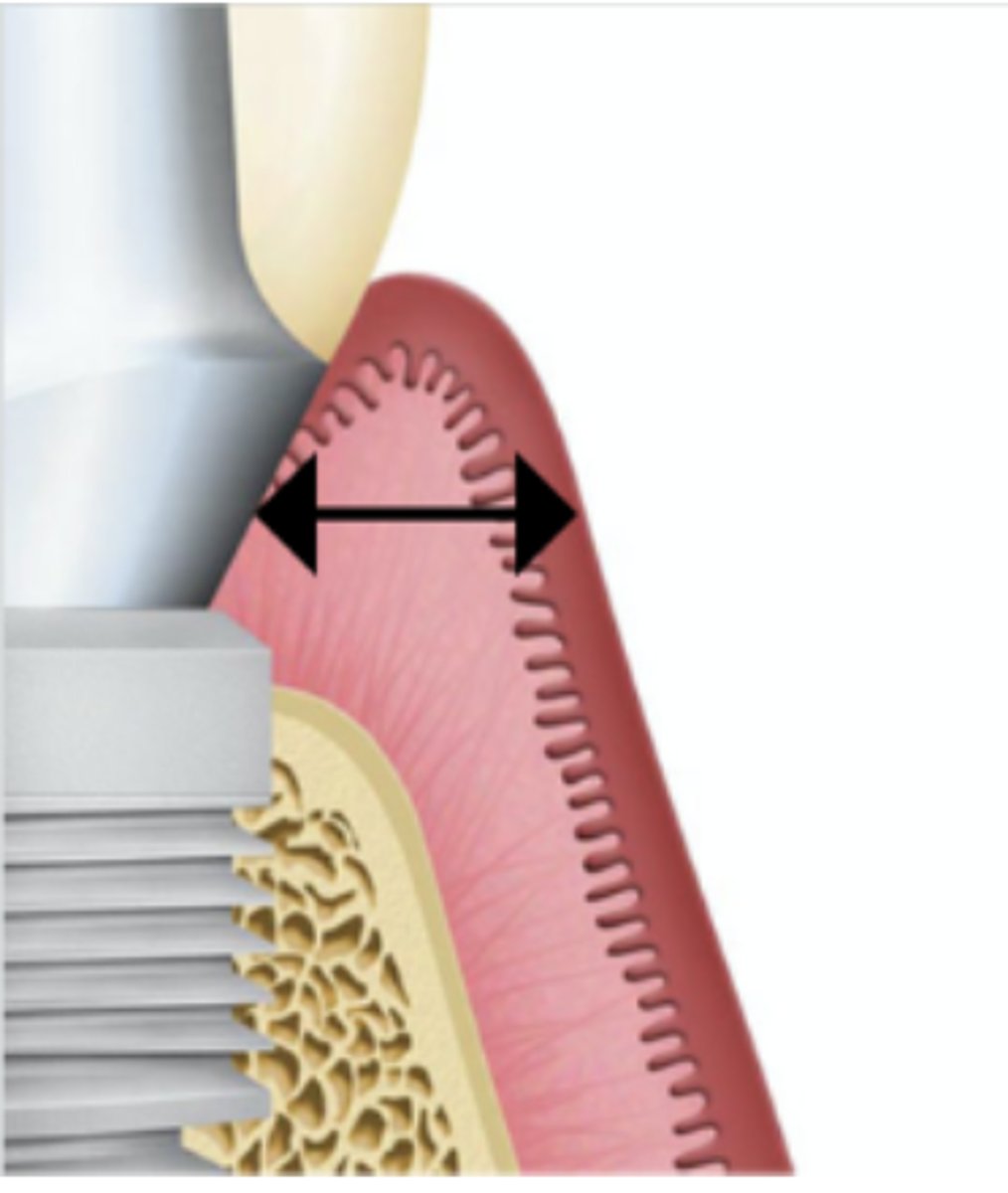
C. When the implant is buccally/facially placed, the subcritical contour should be convex
Which following description about implant crown transmucosal components is NOT TRUE? (Select one)
A. Critical contour should be convex for most case scenarios.
B. Critical contour describes the contour of the implant abutment and crown located immediately apical to the mucosal margin, within 1mm range apicocoronally.
C. When the implant is buccally/facially placed, the subcritical contour should be convex
D. Subcritical contour describes the contour of the area located apical to critical contour to the implant shoulder.
1.8 mm
What is the minimum buccal bone thickness for a successful implant placement to reduce the possibility of future buccal bone resorption? (Select one answer)
0.5 mm
1.8 mm
2.0 mm
1.5 mm
1.0 mm
D. Screw retained three-unit implant supported fixed dental prosthesis.
In which following case scenario using non-engaging abutment is indicated.
A. Cement retained single implant supported crown with custom abutment.
B. Screw retained single implant supported crown with vairobase abutment/prefabricated abutment.
C. Implant was placed off-angle.
D. Screw retained three-unit implant supported fixed dental prosthesis.
A. 1-2 mm from the implant platform to the soft tissue margin
What is the ideal implant vertical position for a tissue-level implant? (Select one)
A. 1-2 mm from the implant platform to the soft tissue margin
B. 0 mm from the implant platform to the soft tissue margin
C. 4-5 mm from the implant platform to the soft tissue margin
D. 3-4 mm from the implant platform to the soft tissue margin
D. To create a clamping force that keeps the implant components securely fastened
What is the primary purpose of preload in a dental implant screw? (Select one )
A .To prevent bone resorption around the implant site
B. To increase the surface area of osseointegration
C. To ensure proper alignment of the implant components
D. To create a clamping force that keeps the implant components securely fastened
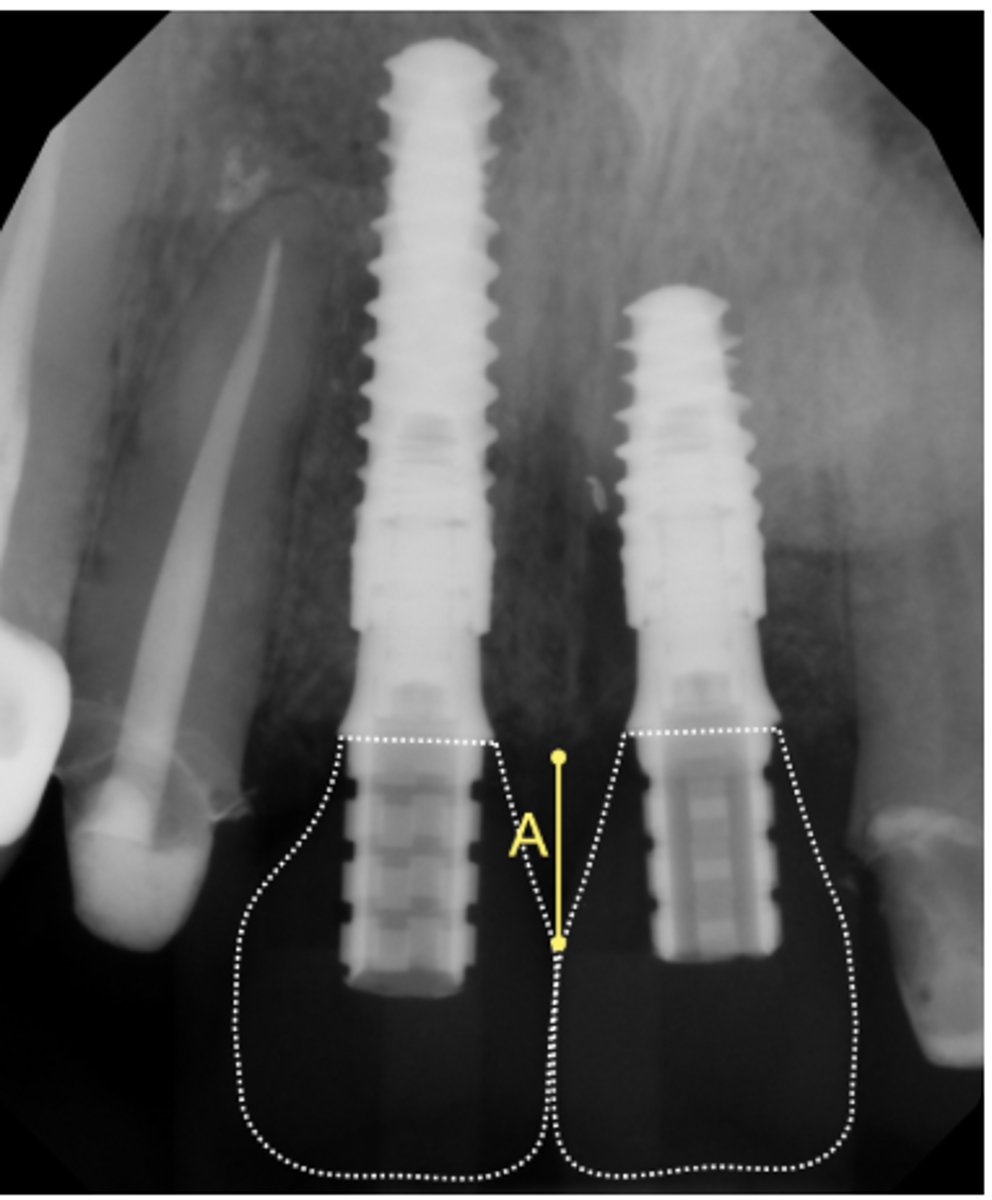
3 mm
The radiograph is showing provisional implant restorations of #8 and 9. Which is the most preferable length to achieve papilla fill with current provisional tooth shape regarding the length (A) from crestal bone to contact point between #8 and 9 ? (Select one)
5 mm
3 mm
4 mm
6 mm
D. Engaging Ti-base
For a zirconia screw-retained single crown restoration, which type of abutment must be used?
A. UCLA abutment
B. Cement-retained abutment
C. Non-engaging Ti-base
D. Engaging Ti-base
A. Critical contour
Which contour lies immediately apical to the mucosal margin within a 1 mm range?
A. Critical contour
B. Emergence angle
C. Subcritical contour
D. Restorative contour
D. Emergence angle >30° with convex profile
Which combination of emergence angle and emergence profile has the highest correlation with peri-implantitis?
A. Emergence angle 25° with straight profile
B. Emergence angle <20° with concave profile
C. Emergence angle =10° with concave profile
D. Emergence angle >30° with convex profile
B. Vertical thickness of peri-implant soft tissue
C. Planned prosthetic components (abutment and crown design)
D. Desired emergence profile and angle
E. Distance from implant platform to future crown margin (Soft-tissue margin)
F. Type of implant system (bone-level vs. tissue-level)
Which of the following factors should be considered when determining the proper implant depth (vertical position) for a partially edentulous site? (Select all that apply)
A. Mesiodistal width of the edentulous space
B. Vertical thickness of peri-implant soft tissue
C. Planned prosthetic components (abutment and crown design)
D. Desired emergence profile and angle
E. Distance from implant platform to future crown margin (Soft-tissue margin)
F. Type of implant system (bone-level vs. tissue-level)
C. Biotype thickness (Phenotype)
Which of the following factors least affects emergence angle in implant restorations?
A. Vertical implant position
B. Crown width
C. Biotype thickness (Phenotype)
D. Implant platform width
B. Excess cement risk and limited retrievability
What is the primary prosthetic disadvantage of using a custom cement-retained abutment for an FDP?
A. Requires precise torque sequencing
B. Excess cement risk and limited retrievability
C. Screw access holes compromise esthetics
D. Cannot be used for posterior regions
B. TorcFit
Which internal conical connection has a 7° angle, Torx anti-rotation feature, and allows 6 positions of abutment alignment (BLX or BLC, TLX or TLC implants)?
A. SynOcta
B. TorcFit
C. CrossFit
D. Nobel Conical
B. Centered in the restorative volume
When planning for an anterior maxillary implant, what buccolingual position is ideal for prosthetic success?
A. Slightly labial to the incisal edge
B. Centered in the restorative volume
C. 3 mm lingual to emergence profile
D. Aligned with palatal bone crest
A. Use of smaller emergence angle and concave profile
Case: A 42-year-old patient presents for implant placement in the maxillary central incisor region. A diagnostic wax-up shows a high smile line and thin biotype.
Question: Which combination of restorative strategies would best support esthetic soft tissue outcomes in this case?
A. Use of smaller emergence angle and concave profile
B. Cement-retained zirconia abutment with subgingival margin >1 mm
C. Stock titanium abutment with flat gingival profile
D. Custom abutment with convex emergence and angled screw channel
D. Screw-retained FDP using Variobase (Ti-base) abutments
Case: A 60-year-old patient requires a 3-unit FDP in the posterior mandible. The implants were placed parallel with 12 mm of interimplant distance and minimal interocclusal clearance.
Question: Which restoration method (Zirconia) is most appropriate in this case?
A.One-piece CAD/CAM bridge cemented to engaging abutments
B.Cement-retained FDP with custom gold abutments
C. Screw-retained FDP with UCLA abutments
D. Screw-retained FDP using Variobase (Ti-base) abutments
A. CrossFit
Which of the following implant-abutment connections features a 15° conical prosthetic interface and allows four positions of anti-rotational alignment (BLC implant) ?
A. CrossFit
B. External Hex
C. SynOcta
D. TorcFit
D. The contour of a restoration as it emerges from soft tissue
What is the definition of the emergence profile?
A. The angle between the implant and adjacent bone
B. The width of the implant shoulder
C. The depth of the implant platform below the crest
D. The contour of a restoration as it emerges from soft tissue
Concave
What emergence profile contour is generally recommended for the facial surface of an anterior implant restoration?
Convex
Concave
Flat
Sharp
RB, WB
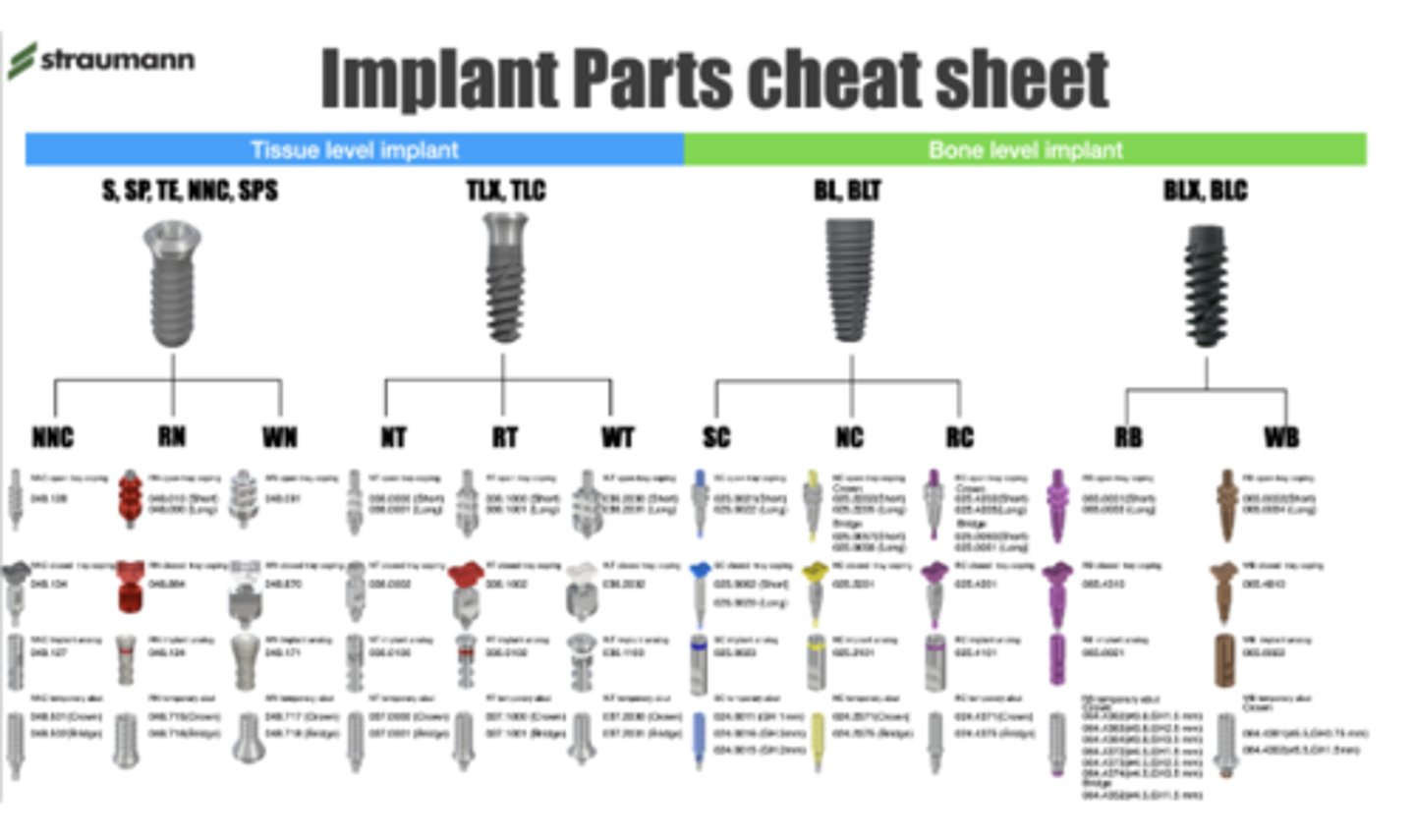
Based on the chart, which connection can be for BLX implant (Straumann) ?
NT, RT, WT
SC,NC,RC
RB, WB
RN, WN
D. RC is CrossFit connection
Regarding connection of Straumann implants, please select correct sentence. (Select one)
A. RC is TorcFit connection
B. NB is TorcFit connection
C. RT is CrossFit connection
D. RC is CrossFit connection
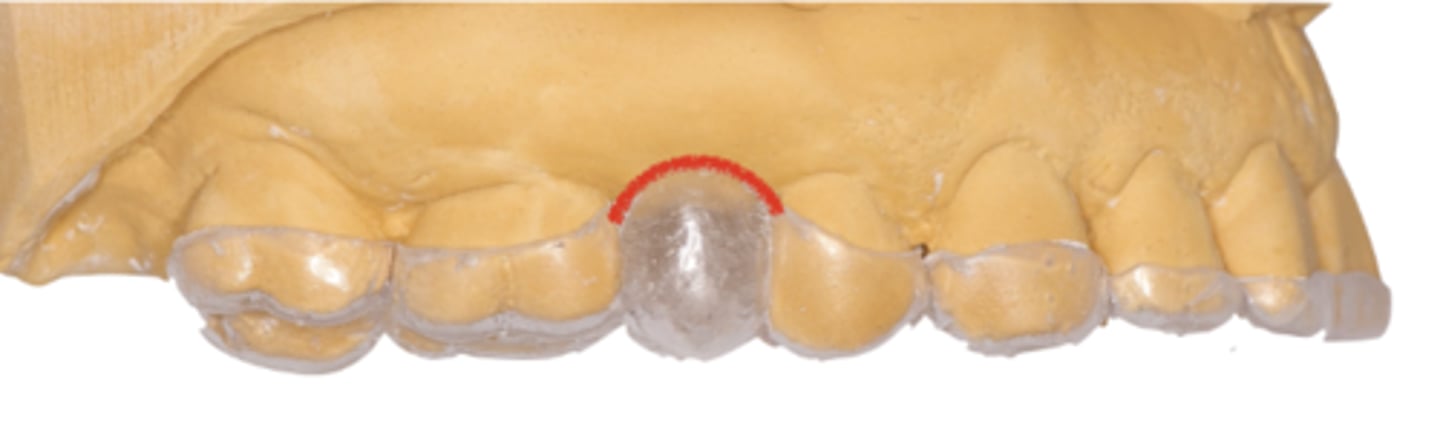
A. Cast metal or fiber-reinforced resin-bonded fixed dental prosthesis (RBFDP)
Based on the clinical description and picture in below, which of the following interim restorations is considered minimally invasive due to its reliance on wings that are bonded to the adjacent teeth? (Select one answer)
A. Cast metal or fiber-reinforced resin-bonded fixed dental prosthesis (RBFDP)
B. Interim partial removable dental prostheses (PRDP)
C. Vacuum-formed removable retainer supporting an ovate pontic (Essix)
D. Interim partial fixed dental prostheses (FDP)
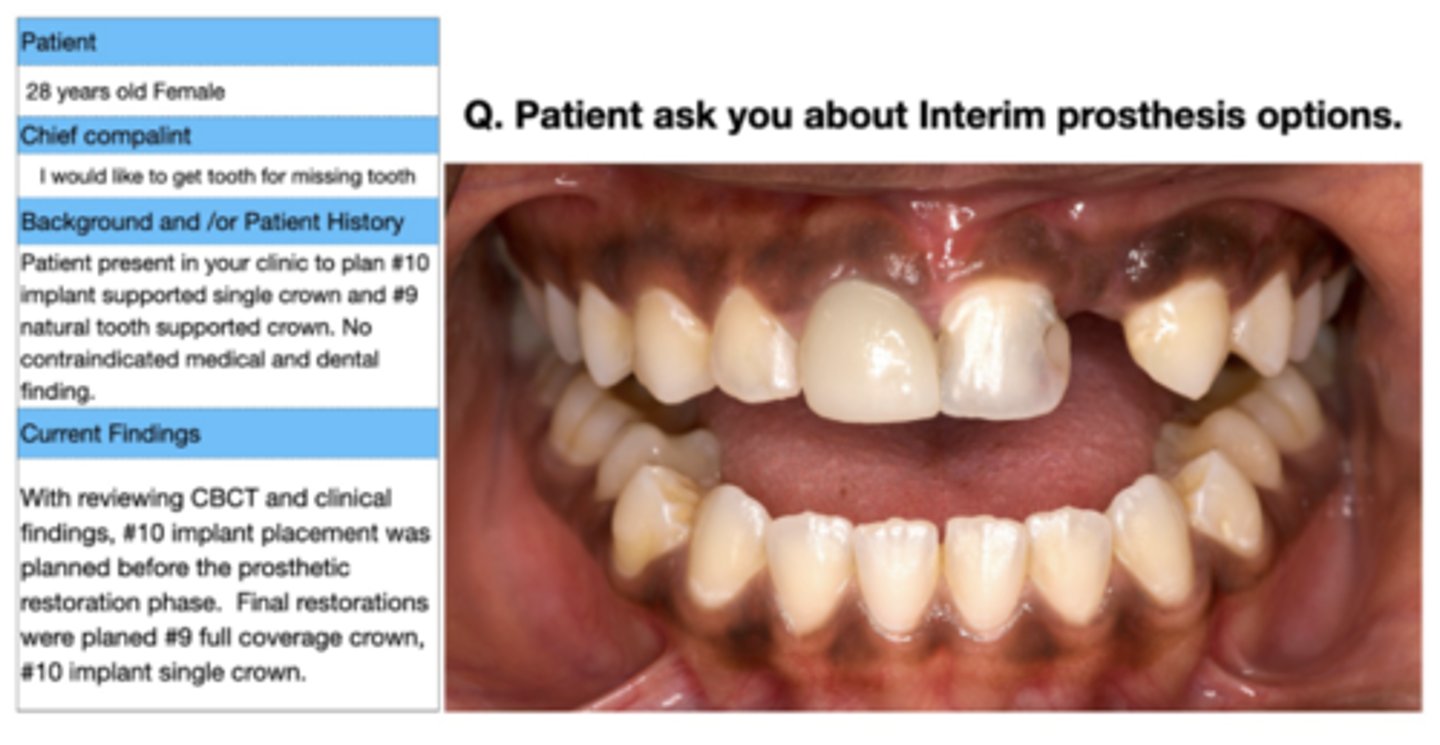
D. When teeth adjacent to the implant site are planned for full coverage restorations.
When we are discussing with the patients about interim prosthesis option prior to implant placement, in which scenario are interim partial fixed dental prostheses especially indicated? (Select one)
A. When the implant site is located in the posterior region only.
B. In cases where a full arch rehabilitation (placing crowns for all remaining teeth) is required.
C. When only anterior teeth are missing.
D. When teeth adjacent to the implant site are planned for full coverage restorations.
B. Easy to fabricate, relatively inexpensive.
Which of the following best describes an advantage of the Essix retainer (picture showed)? (Select one answer)
A. It's resistant to catastrophic fracture.
B. Easy to fabricate, relatively inexpensive.
C. It offers permanent retention and support.
D. It requires minimal patient compliance.
E. It ensures maximum occlusal comfort.
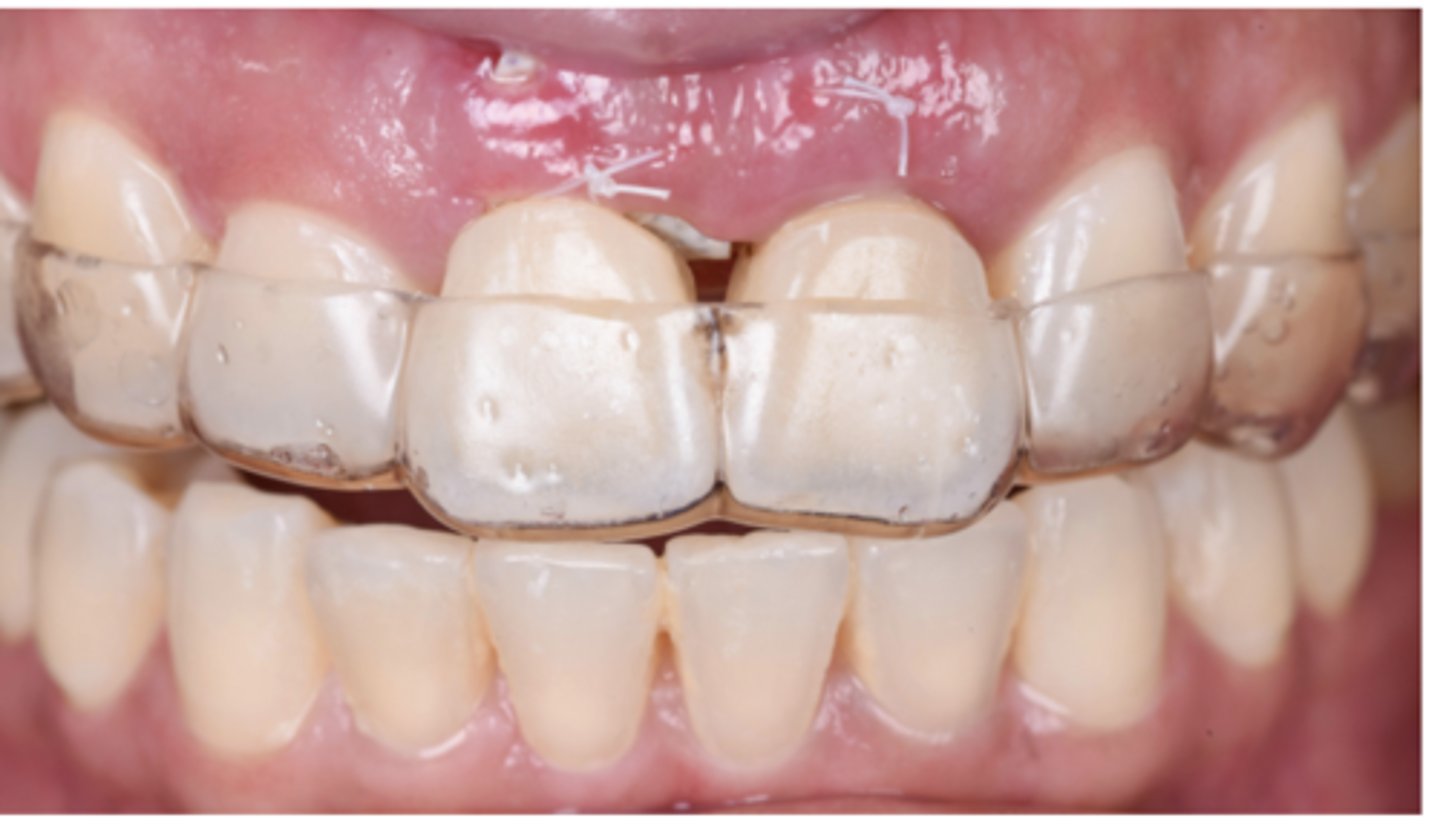
C. Interference with speech function.
Which limitation might lead to decreased patient satisfaction and compliance with Interim partial removable dental prostheses (PRDP)?
A. Decreased cost for maintenance.
B. Relatively inexpensive and easy to fabricate.
C. Interference with speech function.
D. Improved tissue-ward pressure control.
D. They should be adjusted properly to avoid excessive pressure on the screw.
What must be ensured regarding the interproximal contacts of screw-retained interim restorations to avoid complications?
A. They should have residual cement between them
B. They need to exert excessive pressure on the screw.
C. They need to be tightly closed to avoid dental floss passing through.
D. They should be adjusted properly to avoid excessive pressure on the screw.
Convex
How is the facial emergence described for screw-retained interim restorations near the mucosal margin?
Concave.
Flat.
Convex.
Slightly flat or concave.
B. Interim partial fixed dental prostheses (FDP)
Which of the following interim restorations is considered the best case for this specific situation ?
A. Interim partial removable dental prostheses (PRDP)
B. Interim partial fixed dental prostheses (FDP)
C. Vacuum-formed removable retainer supporting an ovate pontic (Essix)
D. Cast metal or fiber-reinforced resin-bonded fixed dental prosthesis (RBFDP)
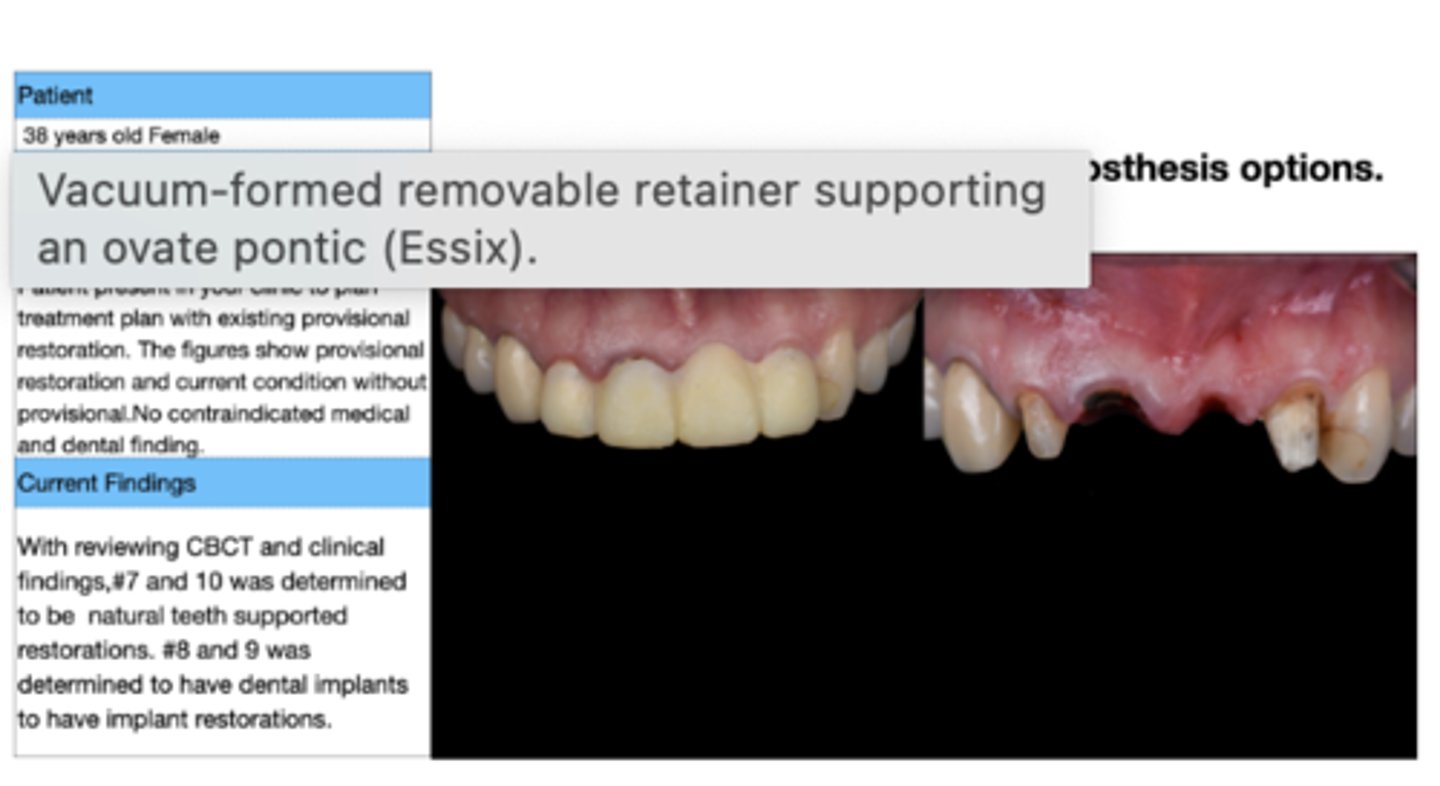
C. Essix retainer with ovate pontic
Case: A 35-year-old patient is receiving a maxillary lateral incisor implant. She will undergo extraction, ridge preservation, and delayed implant placement. She prioritizes esthetics and comfort during healing.
Question: Which provisionalization method is most appropriate during the healing phase?
A. Custom cement-retained FDP
B. Cast metal RBFDP
C. Essix retainer with ovate pontic
D. Interim screw-retained implant crown
B. Convex critical zone facial emergence, slightly convex interproximal, straight palatal
Case: A posterior mandibular implant has achieved osseointegration. The patient has thick mucosa and will receive an interim crown to guide tissue healing before the final restoration.
Question:What features should this provisional restoration include to support proper emergence profile formation?
A. Flat emergence contour in all directions to minimize pressure
B. Convex critical zone facial emergence, slightly convex interproximal, straight palatal
C. Concave facial and palatal emergence with flat incisal edge
D. Convex subcritical emergence profile and flat interproximal emergence
B. Immediate provisional crown with flat emergence contour
Which of the following combinations is least ideal when attempting to establish a natural emergence profile in the esthetic zone?
A. Emergence angle maintained <30° with concave subgingival contour
B. Immediate provisional crown with flat emergence contour
C. Use of custom healing abutment duplicating the extracted tooth’s profile
D. Implant placed 3–4 mm apical to soft tissue with screw-retained provisional
C. Cement extrusion leading to peri-implantitis
What is a significant risk if an implant is placed with excessive facial angulation in the anterior maxilla and a cement-retained provisional is used?
A. Loss of interproximal bone height
B. Inability to create a subcritical contour
C. Cement extrusion leading to peri-implantitis
D. Buccal screw access compromising esthetics
A. Cement is often placed subgingivally without margin control
Which of the following factors best explains the increased risk of peri-implantitis in cement-retained implant crowns compared to screw-retained restorations?
A. Cement is often placed subgingivally without margin control
B. Cement-retained crowns require thinner abutments
C. Cement-retained crowns require more bone-level implants
D. Cement-retained crowns promote a concave emergence angle
C. They allow soft tissue shaping and eliminate cement risks
What is the primary reason screw-retained provisional crowns are preferred in anterior esthetic cases immediately following implant placement?
A. They require no CAD/CAM customization
B. They offer higher retention than cement-retained options
C. They allow soft tissue shaping and eliminate cement risks
D. They eliminate the need for impression copings
A. External hex connection with flat-to-flat interface
Which implant-abutment connection is most susceptible to microleakage and long-term biologic complications if improperly torqued?
A. External hex connection with flat-to-flat interface
B. CrossFit connection with 15° conical interface
C. TorcFit connection with frictional fit
D. Morse taper connection with internal octagon
D. Fabricate Essix retainer with ovate pontic as provisional
Case:Patient: Mr. L, 65 years old, had a myocardial infarction 8 weeks ago and is currently on dual antiplatelet therapy. He presents with a fractured anterior tooth and requests immediate implant placement.
Which is the most appropriate clinical decision at this time?
A. Place implant immediately and avoid provisionalization
B. Provide screw-retained provisional with angled screw channel
C. Proceed with implant placement using guided surgery
D. Fabricate Essix retainer with ovate pontic as provisional