Physics- Electric Fields
 Call Kai
 Learn
Learn Practice Test
 Spaced Repetition
 Match
Match Flashcards
 Knowt Play
1/11

There's no tags or description
Looks like no tags are added yet.
Name | Mastery | Learn | Test | Matching | Spaced | Call with Kai |
|---|
No analytics yet
Send a link to your students to track their progress
12 Terms
By reference to electric field lines, explain why, for points outside an isolated spherical conductor, the charge on the sphere may be considered to act as point charge at its center. [2]
Lines are radial
So the lines appear to come from the center
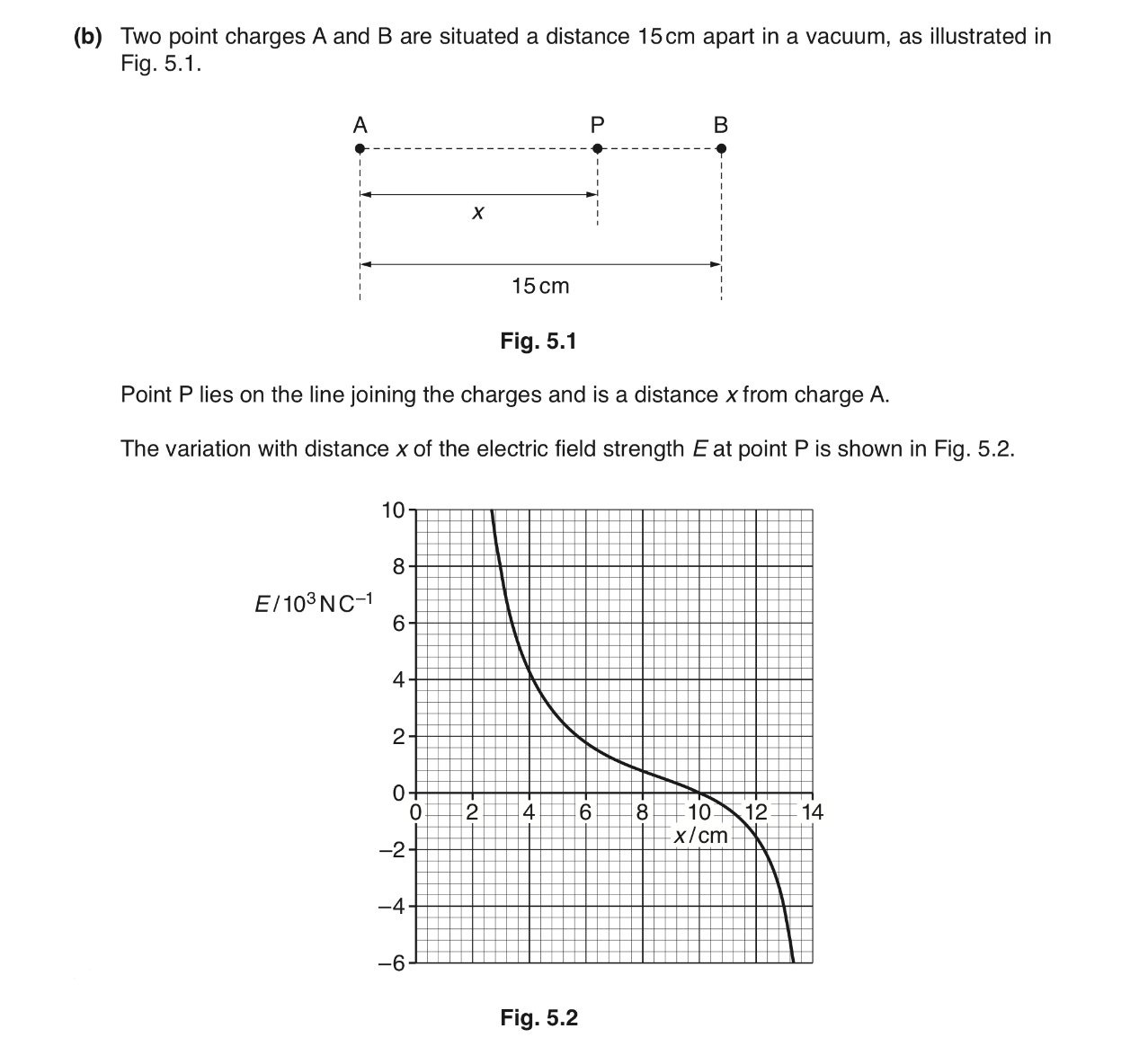
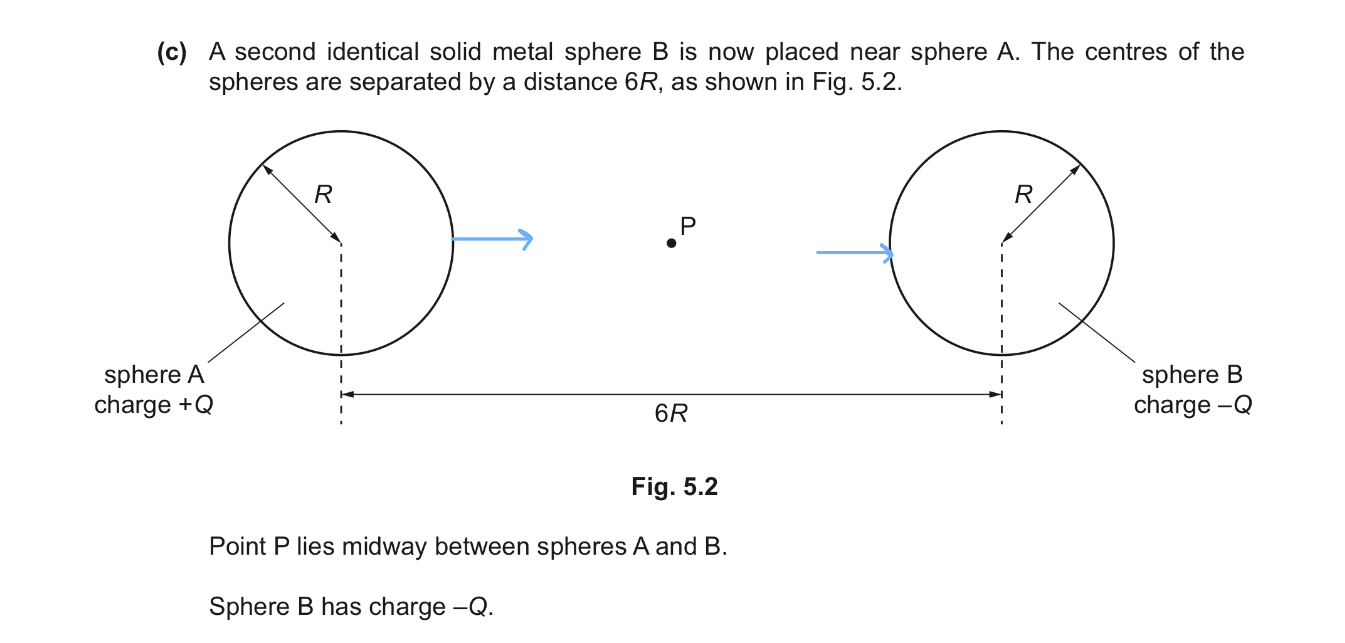
![<p>The magnitude of the electric field strength P is given by the sum of the magnitudes of the field strength due to it sphere as they are opposite charges, hands fields acting in the same direction. </p><p>The electric field strand at point P due to the charged metal spheres, is not in practice equal to 2E, where E is the electric field strength of each sphere. [2]</p>](https://assets.knowt.com/user-attachments/8bc6433f-3eb0-4282-bf70-32c121125de8.png)
The magnitude of the electric field strength P is given by the sum of the magnitudes of the field strength due to it sphere as they are opposite charges, hands fields acting in the same direction.
The electric field strand at point P due to the charged metal spheres, is not in practice equal to 2E, where E is the electric field strength of each sphere. [2]
charge on spheres, distorted by the other sphere (charges on sphere attract or affect each other so charges on surface of the spheres move)
So spheres are not going to charges (at their centers)
In a alpha particles scattering experiment, the beam of alpha particles is incident on a very thin, gold coil, such as why the file must be very thin.
so that multiple deflections with nucleus do not occur
OR
So that single interactions between nucleus and alpha particle can be studied.
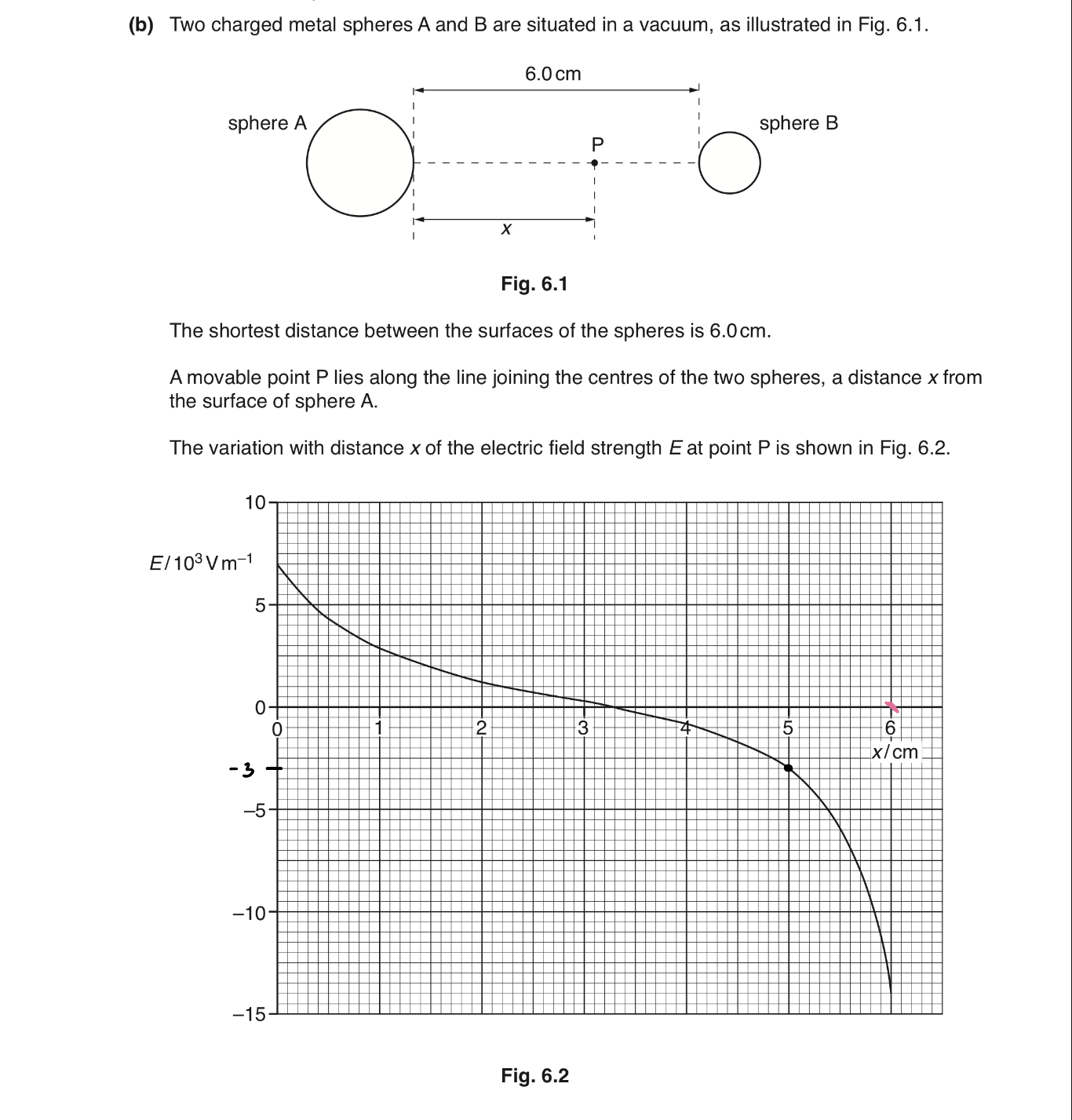
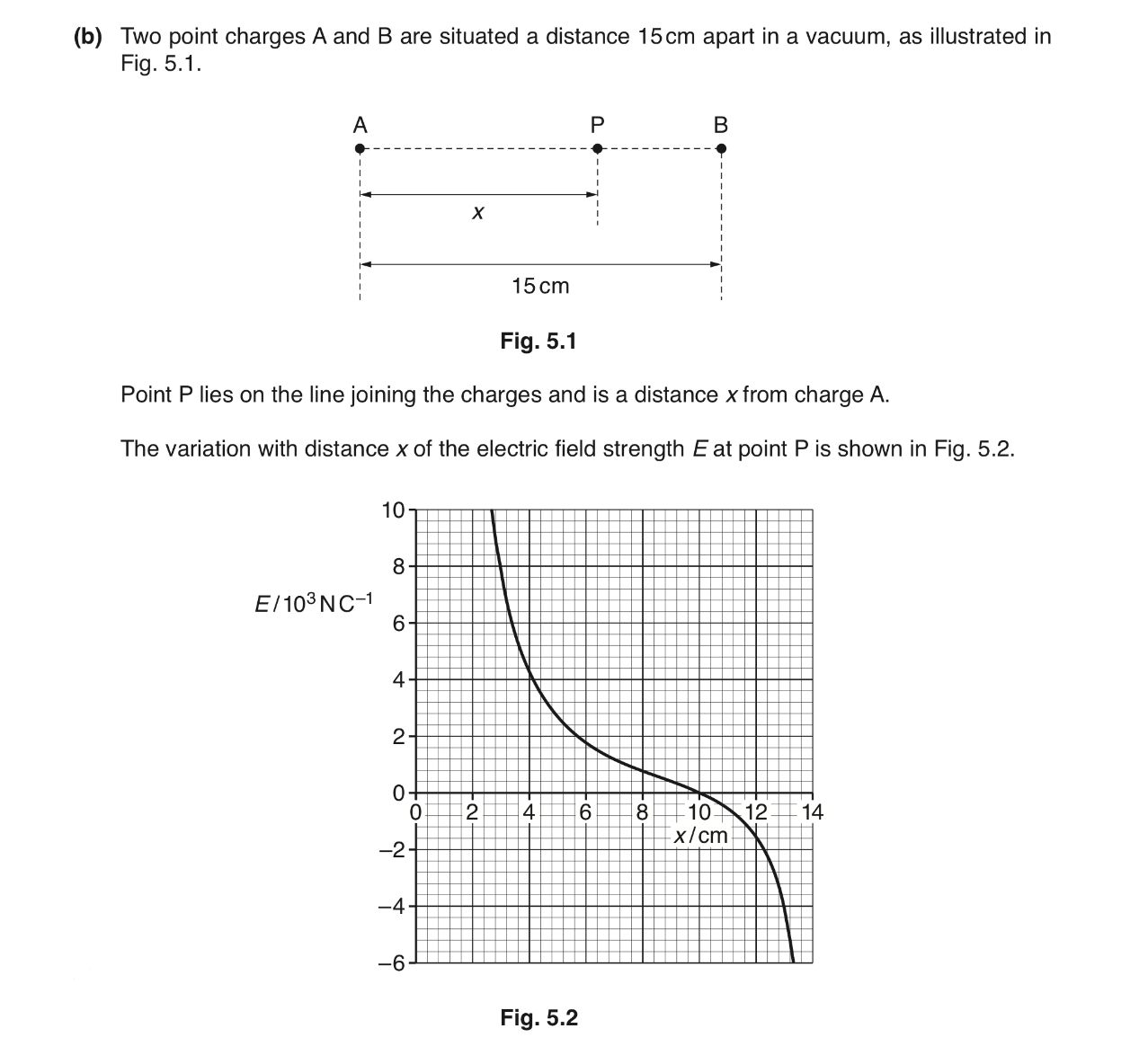
![<p>Use data from figure 6.2 to state the value of x at which the rate of change of electric potential is maximum give a reason for the value you have chosen. [2]</p>](https://assets.knowt.com/user-attachments/1444599e-aa44-48ed-9fe8-3c62a2b98e36.png)
Use data from figure 6.2 to state the value of x at which the rate of change of electric potential is maximum give a reason for the value you have chosen. [2]
Field strength is potential gradient
Field strength is maximum at 6 cm
(So when E max V is max
dV/dx = E)
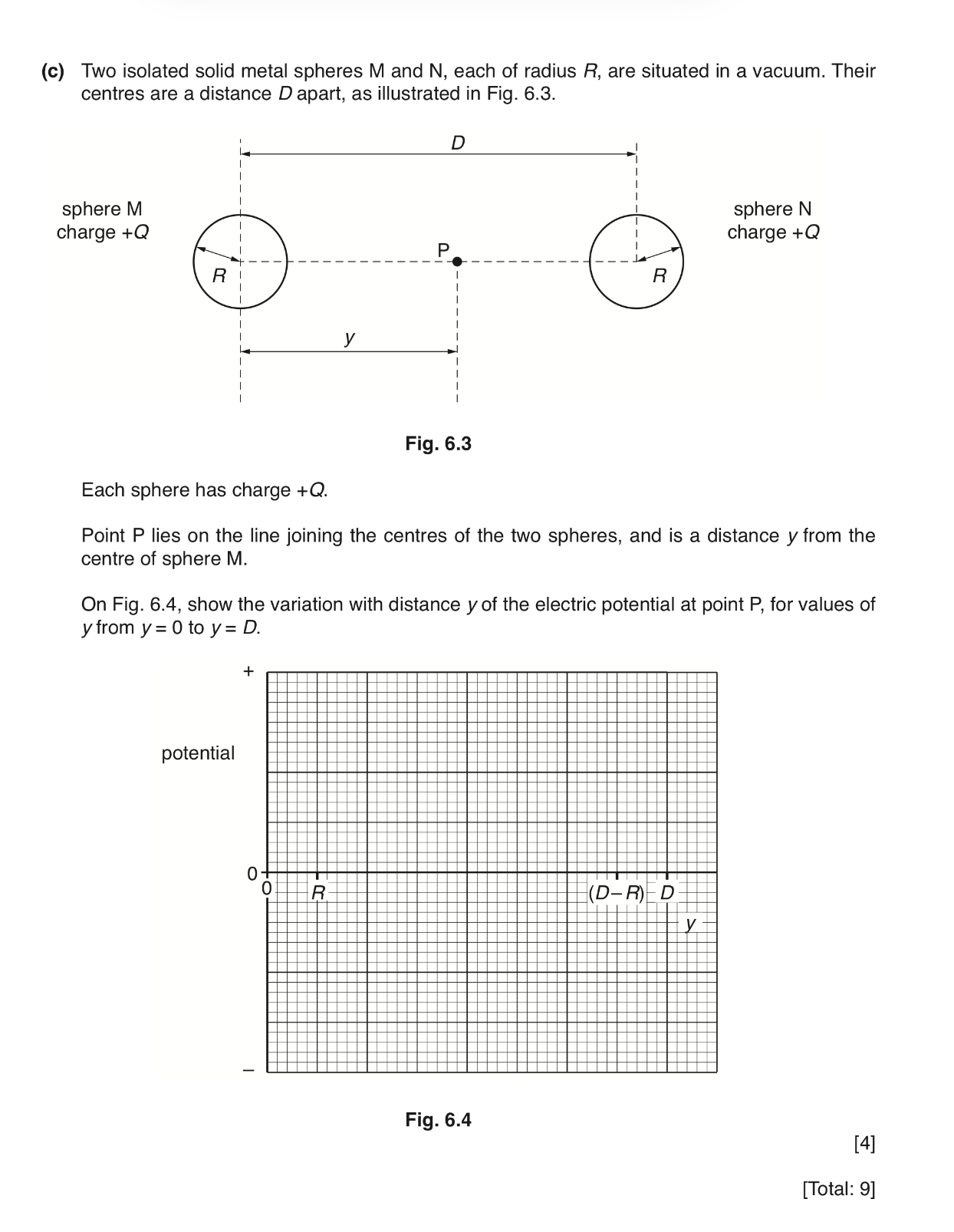
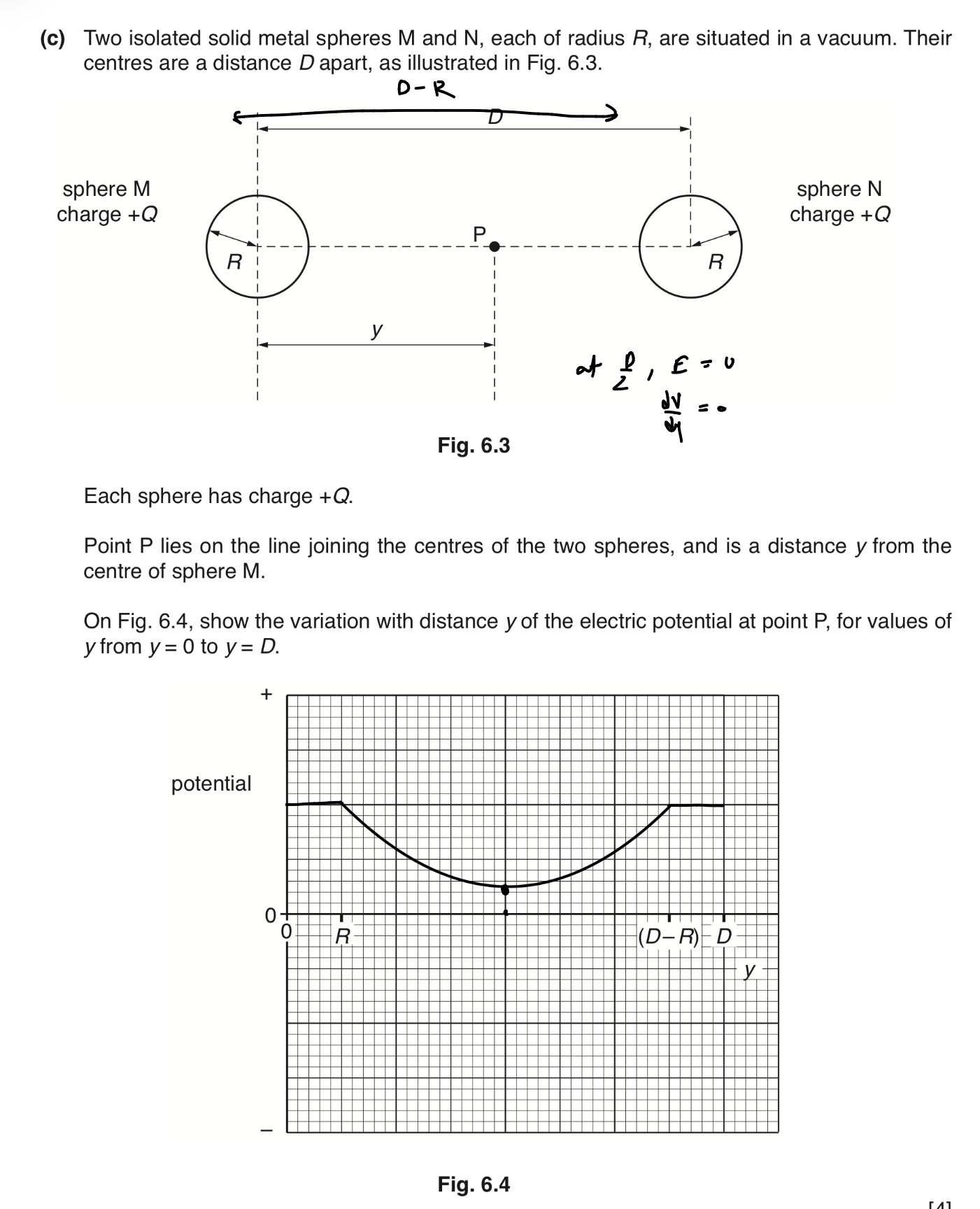
State, one similarity and one difference between the field of force produced by an isolated point charge and by an isolated point mass. [2]
Similarity: bought a radial or both have inverse square variations
Difference: direction always towards the mass or direction can be towards or away from the charge.
Similarity:
Both an isolated point charge and an isolated point mass produce fields that are radial and follow an inverse-square law. This means the field strength decreases with distance according to \propto \frac{1}{r^2}, and the field lines point directly away from or toward the source.
Difference:
A point mass always produces an attractive field (gravity only pulls objects toward the mass), whereas a point charge can produce either an attractive or repulsive field depending on whether the charge is negative or positive.