Nematodes (Non-bursate)
 Call Kai
 Learn
Learn Practice Test
 Spaced Repetition
 Match
Match Flashcards
 Knowt Play
1/87

There's no tags or description
Looks like no tags are added yet.
Name | Mastery | Learn | Test | Matching | Spaced | Call with Kai |
|---|
No analytics yet
Send a link to your students to track their progress
88 Terms
Infective stage
L2 in egg → ____________
ingested from the environment
Infective stage
Larvae in tissue → ______________
driven by carnivorism
Infective stage
L3 in vector → _____________
arthropod transmission
ex. fly and mosquito
What are the basic characteristics of ascarids?
Roundworms
live in the small intestine
big fleshy worms (4-40 cm)
direct life cycles
How are ascarids (roundworms) typically transmitted?
Environmental infective stage is L2 (in egg)
requires ingestion of the larvated egg
What is special about ascarid eggs?
spherical
pitted, thick, protective shell
can be viable up to 5 years
Ascarid Hepatotracheal Migration
____ hatches in small intestine → _____ penetrates small intestine → hepatic portal blood → _______ → venous blood → ________ → lungs → _________ → swallowed → __________
egg
larva
liver
heart
coughed up trachea
back to small intestine
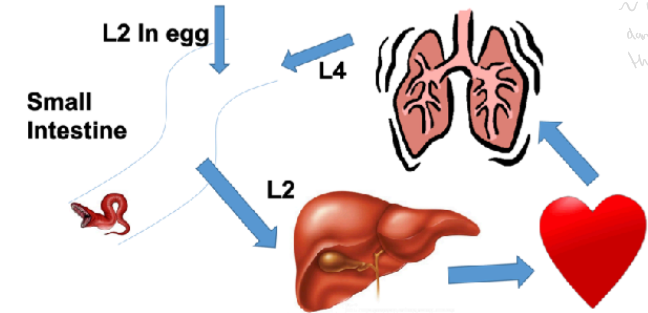
What is the purpose of hepatotracheal migration ?
It allows for the larva to mature
What are ascarid’s target organ?
lungs
they want to be coughed up and swallowed to ultimately end up in the small intestine again
What are Toxocara canis ?
Roundworm of dogs
Toxocara canis
life cycle : ______
Definitive host : ______
Paratenic host(s): ________
Transmission : ___________
direct
dog
possible; small mammals
ingestion of larvated eggs or paratenic host, transplacental, transmammary
What are clinical signs of Toxocara canis?
diarrhea
vomiting
weight loss in young puppies
possible coughing during hepatotracheal migration
intestinal obstruction
“pot-bellied” puppies
Zoonotic

What is toxocara cati?
Roundworm of cats
Toxocara cati
life cycle : ______
Definitive host : ______
Paratenic host(s): ________
Transmission : ___________
direct
cat
common
ingestion of larvated eggs or paratenic host, transmammary
What are clinical signs of Toxocara cati?
kittens usually asymptomatic
may be listless, anorexic, “poo doer”, pot-belly
adults may vomit worms
zoonotic
What is a key difference between Toxocara cati and Toxocara canis?
Toxocara canis is able to transmit transparently (in utero) while Toxocara cati can not
What is Toxasxaris leonina?
Roundworm of dogs and cats
Toxascaris leonina
life cycle : ______
Definitive host : ______
Paratenic host(s): ________
Transmission : ___________
direct
dog or cat
possible
ingestion of larvated eggs or paratenic host
What is a key distinction of Toxasxaris leonina?
No transmission in utero or from nursing and NO hepatotracheal migration
its development remains confined to the small intestine
Toxocariasis infection in humans will cause what?
Larval migraine syndromes rather than intestinal roundworms infections
never make it back to the large intestine
T. canis and T. cati in humans present clinical manifestations such as?
visceral larval migrans (VLM)
ocular larval migrans (OLM)
What are ascaris suum?
Swine ascarid or Large intestinal roundworm of pigs
Ascaris suum
life cycle : ______
Definitive host : ______
Transmission : ___________
direct
pig
ingestion of larvated eggs (L2)
What is a key distinction of Ascaris summ ?
“milk spots” in liver from migration
What are Parascaris spp. ?
Equine roundworm
Parascaris spp.
life cycle : ______
Definitive host : ______
Transmission : ___________
direct
horse
ingestion of larvated eggs (L2)-
What are clinical signs of Parascaris spp., especially with heavy worm burden?
intestinal obstruction and colic
classically seen in foals
Parascaris spp. in foals
infection occurs at ________
mainly foals < _____
_________ during hepatotracheal migration
1 month of age
6 months
cough and nasal discharge
What are Toxocara vitulorum?
Roundworm of cattle
Toxocara vitulorum
life cycle : ______
Definitive host : ______
Transmission : ___________
direct
cattle
transmammary
What are the clinical signs of Toxocara vitulorum?
intestinal impaction and can cause death in calves
calf can develop heavy warm burden from transmission from mother
What are Baylisascaris procyonis?
Raccoon Roundworm
Baylisascaris procyonis
life cycle : ______
Definitive host : ______
Paratenic host(s): ________
Transmission : ___________
direct
raccoon
small mammals
ingestion of eggs (L2)
Baylisascaris procyonis zoonotic? If so what can occur?
yes
larva migrate aggressively and often invade the central nervous system
neural larval migrans
Pinworms are parasites of what kind of animals?
omnivores and herbivores
What are Oxyuris equi?
Pinworm of horses
Oxyuris equi
life cycle : ______
Definitive host : ______
Transmission : ___________
direct
horse
ingestion of eggs (L3)
Where do Oxyuris equi reside?
Adult worms in cecum, colon, rectum
What is a key distinguishing feature of Oxyuris equi?
The larval stage embed in the mucosa and cause mild erosions
What is a clinical sign of Oxyuris equi?
Tail rubbing
irritation from eggs
alopecia
bear patches
lesions on the rear
What is the best way to diagnose Oxyuris equi?
the cellophane tape method
will not typically shed eggs on feces, so they can be missed on a fecal float
What are Enterobius vermicularis?
human pinworm
Enterobius vermicularis
life cycle : ______
Definitive host : ______
Transmission : ___________
direct
human
ingestion of larvated eggs
Enterobius vermicularis
____ a parasite of dogs and cats
NOT
What are Strongyloides spp. ?
intestinal threadworms
Strongyloides spp.
life cycle : ______
Definitive host : ______
Transmission : ___________
direct but can be facultative
horse, dog, ruminant, pig
L3 ingestion or skin penetration, transmammary
What is a distinguishing factor of Stronyloides spp.
They are free living OR female in small intestine
Strongyloides spp.
______ parasite
females are ______
infection : ______
facultative
parthenogenic
autoinfection
What are Trichuris spp. ?
whipworms
Trichuris spp.
life cycle : ______
Definitive host : ______
Transmission : ___________
direct
dog, ruminant, swine
ingestion of embryonated egg
What are clinical signs of Trichuris spp. ?
They can cause diarrhea, bloody stool, straining to defecate, weight loss
What are some characteristics of Trichuris spp. ?
eggs have bipolar plugs
are also heavier and as a result will take longer to come up in a fecal float
Thin tail end and thick head; whip like appearance
What are Pearsonema spp. ?
Bladder worm
Pearsonema spp.
life cycle : ______
Definitive host : ______
intermediate host(s): ________
Transmission : ___________
indirect
dogs or cats
earthworm
ingestion of larvae in IH
Where are the eggs of Pearsonema spp. found?
In urine
What are Trichinella spiralis?
Trichina worm
Trichinella spiralis
life cycle : ______
Definitive host : ______
Transmission : ___________
direct ~ single host life cycle transmitted by carnivorism
pig, human, other carnivores
ingestion of encysted larvae in muscle
What is a distinguishing factor of Trichinella Spiralis?
Females lay larvae NOT eggs
will move though the blood stream and into the skeletal muscle
Is Trichinella spiralis zoonotic?
Yes
humans can get this from eating undercooked pork who is infected
feral pigs are the main source of infection
What are Habronema & Draschia
Stomach and skin parasites of horses
Habronema & Draschia
life cycle : ______
Definitive host : ______
Intermediate host(s): ________
Transmission : ___________
indirect
horse
muscidae flies
ingestion of L3 (larvae) transmitted by the fly
What happens when Habronema & Drashia when they don’t make it to the stomach?
They will cause skin issues ( “summer sores” )
where they are deposited will determine where they end up
What is parthenogenic ?
asexual reproduction, no males are needed
What are Thelazia spp. "?
eye worms
Thelazia spp.
life cycle : ______
Definitive host : ______
Intermediate host(s): ________
Transmission : ___________
indirect
dog/cat , horse, ruminant
Musca autumnalis (face flies)
L3 deposited by the fly during feeding
Where do adult Thelazia spp. want to end up?
In the conjunctival sacs
What are Spirocerca lupi?
Esophageal worm
Spirocerca lupi
life cycle : ______
Definitive host : ______
Intermediate host(s): ________
Paratenic host (s) : __________
Transmission : ___________
indirect
dog, cat
dung beetle
rodent, chicken, small reptile, amphibian
ingestion of L3 within the IH or PH
What is a distinguishing factor of Spirocerca lupi ?
worms live in esophageal nodules
adults live in the esophagus
What are Physaloptera spp.
Stomach worm
Physaloptera spp.
life cycle : ______
Definitive host : ______
Intermediate host(s): ________
Paratenic host (s) : ___________
Transmission : ___________
indirect
dog, cat
beetle, cockroach
rodent, small reptile, amphibian
ingestion of L3 within IH or PH
What are clinical sighs of Physaloptera spp. ?
vomiting, diarrhea, dark stools
suck blood from stomach mucosa
What are Dioctophyma renale ?
Giant kidney worm of dogs
Dioctophyma renale
life cycle : ______
Definitive host : ______
Intermediate host(s): ________
Transmission : ___________
indirect
dog
earthworm
ingestion of larvae in IH
What is a key distinguishing factor of Dioctophyma renale?
Infects right kidney
eggs are passed in urine
What are some key facts of Filarial worms?
live in connective tissue ( including blood )
indirect life cycle
intermediate host : biting arthropod
L3 transmitted during vector feeding
no eggs
motile embryo called microfilaria
Filarial worm life cycle
Female produces ______ → in blood or tissue
_______ ________ ( intermediate host) acquires microfilaria during blood meal → develops into infective ______ larvae in the arthropod → transmitted to final host during blood meal → enters wound → develops during _______ to predilection site → mature into adult in _______ ________
microfilaria
biting arthropod
L3
migration
pulmonary artery
What are Dirofilaria immitis
Canine Heartworm
Dirofilaria immitis
life cycle : ______
Definitive host : ______
Intermediate host(s): ________
Transmission : ___________
indirect
dog ( cat, ferret )
mosquito
L3 transmitted by infected female mosquito during feeding
How long does Dirofilaria immits infection take to allow for a positive antigen test
6 to 7 months post-infection
What are the limitations of Antigen test?
May be negative with :
male only infections
very low worm burdens
immature infections
Where do adult Dirofilaria immitis reside ?
Right ventricle and pulmonary artery
Dirofilaria immitis
clinical signs ________
form non to heart failure
How do Dirofilaria immitis affect cats?
aberrant migration of worms ( eye, CNS )
lung disease more common then in dogs
acute pulmonary crisis
How do Dirofilaria immitis affect ferrets?
respiratory symptoms similar to cats
highly susceptible; low worm burdens can cause major issues
What are Onchocerca spp. ?
Horse threadworm
Onchocerca spp.
life cycle : ______
Definitive host : ______
Intermediate host(s): ________
Transmission : ___________
indirect
horse, ruminants
culicoodides ( biting midges
L3 transmitted by infected midge during feeding
Where do adult Onchocerca cervivalis reside?
Adult worms and larvae live under skin
Adult migrate to nuchal ligament
microfilariae cause cutaneous onchocerciasis (dermatitis)