Bio Topic 3 -> Cell ultrastructure
 Call Kai
 Learn
Learn Practice Test
 Spaced Repetition
 Match
Match Flashcards
 Knowt Play
1/17

There's no tags or description
Looks like no tags are added yet.
Name | Mastery | Learn | Test | Matching | Spaced | Call with Kai |
|---|
No analytics yet
Send a link to your students to track their progress
18 Terms
Identify these cell organelles
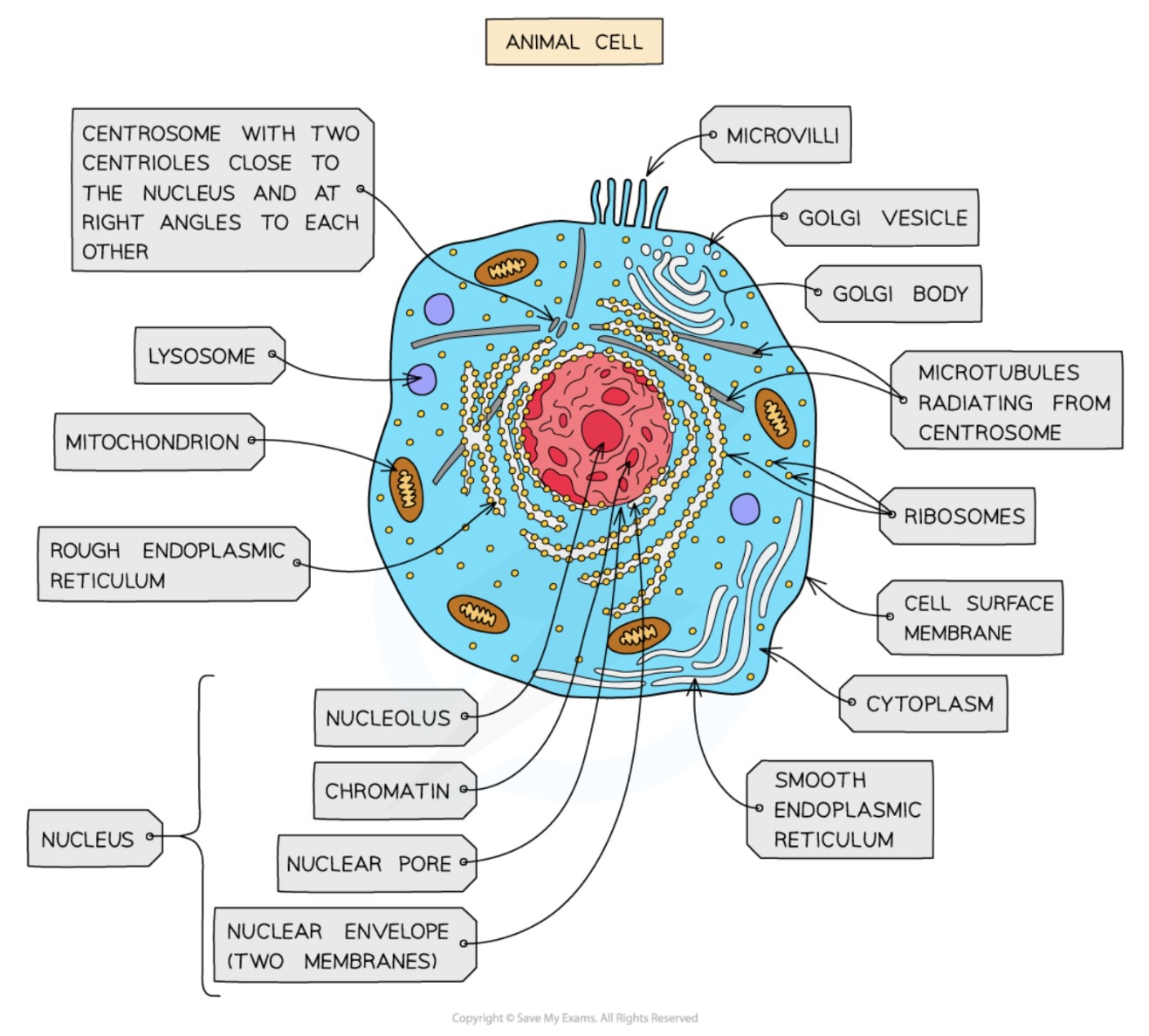
What is the structure of the nucleus
has a double membrane called the nuclear envelope
has nuclear pores → mRNA and ribosomes leave
Contains chromatins → condenses into chromosomes during prophase
Contains nucleolus → where ribosomes are produced (dark circle in the nucleus)
What is the structure of the mitochondria
Has a double membrane → inner membrane is highly folded to form cristae → where aerobic respiration occurs to produce ATP → folded to increase SA : V ratio → increases ROR
has its own DNA
What is the structure of the ribosome
Found as free organelles in the cytoplasm or attached to the rough endoplasmic reticulum
Involved in protein synthesis
What is the structure of the endoplasmic reticulum (rough and smooth)
Rough → covered in ribosomes → polypeptide chain passes thru the rough endoplasmic reticulum to be folded into its 3D structure
Located close to the nucleus so mRNA can attach to the ribosomes
Smooth → involved in production of lipids, carbs
What is the structure of the golgi apparatus
Consists of flattened sacs of membrane → looks like a wifi symbol
Modifies proteins and lipids before packing them into vesicles to be transported → exocytosis → protein is transported out of the cell
What is the structure of the lysosome
Specialist form of a vesicle → contains digestive enzymes that breaks down waste products such as worn out organelles
What is the structure of the Centriole
Centrosomes contain centrioles
Hollow tubes made of microtubules
During anaphase, centrioles release spindle fibres which pull a chromatid from each chromosome to opposite poles of the cell
Each animal cell has 2 centrioles
Process of protein synthesis involving the cell ultrastructure
Nucleolus produces ribosomes for protein synthesis
Nucleus manufactures mRNA which is needed by ribosomes to make proteins
mRNA binds to ribosomes on the rough endoplasmic reticulum to make the polypeptide chain
Polypeptide chain passes thru the rough endoplasmic reticulum which folds it into its 3D structure
Transported to the golgi apparatus in vesicles
Golgi apparatus modifies the protein and packages it into a vesicle which buds off the golgi apparatus
What is a tissue
A group of similar specialised cells working tg to perform a particular function
What is an organ
A group of specialised tissues working together to perform a particular function
What is an organ system
A group of specialised organs working together to perform a particular function
Formula for magnification
Image/actual
What is the process of the cell cycle
Interphase
Mitosis
Cytokinesis
What are the stages of interphase
G1 phase → cell makes the RNA, enzymes and other proteins for growth
Synthesis phase → DNA is replicated → each chromatid is replicated causing chromosomes with 2 identical chromatids joined at the centromere to form
G2 phase → cell continues to grow, new DNA is checked for errors
Describe the process of mitosis (PMAT)
Prophase
Chromosomes condense and are visible
The 2 Centrosomes go to opposite poles of the cell → contains centrioles which produce spindle fibres
Nuclear membrane breaks down
Metaphase
Chromosomes line up at the equator of the cell
Spindle fibres attach to the centromeres of each chromosome and each sister chromatid is attached to spindle fibres from opposite poles
Anaphase
Centromere breaks in half and each sister chromatid is pulled to opposite poles of the cell by the spindle fibres
Telophase
Chromatids reach opposite poles of the cell and decondense → now called chromosomes again
Nuclear envelope reforms around each group of chromosomes
Spindle fibres break down
What occurs in cytokinesis
Once the nucleus has divided into 2 genetically identical nuclei → cell splits into 2 genetically identical daughter cells
What is mitosis important
Growth of multicellular organisms
Replacement of damaged cells
Asexual reproduction → only 1 organism is needed