Lecture 3: Plant transformation
 Call Kai
 Learn
Learn Practice Test
 Spaced Repetition
 Match
Match Flashcards
 Knowt Play
1/38

There's no tags or description
Looks like no tags are added yet.
Name | Mastery | Learn | Test | Matching | Spaced | Call with Kai |
|---|
No analytics yet
Send a link to your students to track their progress
39 Terms
what are the main two ways to modify plants
Plant breeding and plant transformation:
what are the two major techniques for plant transformation? Which one is most common
Direct transformation aka Ballistic: “mechanically” inserting genetic materia into plant
Biological vectors: using some other organism as a mediator- most commonly used method: eg Agrobacterium tumefaciens which is the most commonly used biological vector- only when agrobacterium is not suitable would you use the ballistic choice instead
what is genetic transformation what genome is transformed?
= Transfer of exogenous genetic material (external piece of DNA) into plant genome most often the nuclear genome (- holds the big majority of genetic material- the easiest to transform), chloroplastic (less commonly transformed) and sometimes mitochondrial genome (but that is very rare)
what are the possibilities with transformation?
Add genes of interest into plants
Inactivate or mutate genes of interest
Edit gene sequences of interest
Modulate levels of gene expression: increase or inhibit expression of certain genes
—> basically any modification that you could imagine can be performed through tranformation
why is transformation so useful?
Allows precise and accurate modification of one or more specific characteristics
- Specifically in comparison to classical breeding – where entire genomes mix
to transform a plant, you need a DNA delivery system, how should this ideally be?
Simple
Efficient : high success rate
Inexpensive
there are two kinds of DNA delivery systems what are those based on? what parameters determine which one is most suitable?
Biological vectors
Biochemical or physical methods: ballistic method.
—> which one you choose varies depending on the:
Target plant: what is the target species
The regeneration system: what kind of tissue you want to transform- and whether a completely new plant can be produced from that specific tissue
what are the challanges in plant transformation (methodically)
Plant cells have thick cell walls: creates a rigid physical barrier that you have to try to get through somehow without damaging the fragile DNA and successfully integrate it into the nuclear genome.
The genetic information is densely packed- the genetic material that is aimed to be transfered has to be successfully integrated into already densely packed genome
Plants are multicellular organisms: how do you spread the characteristics throughout the entire plant- and not only certain cells.
DNA can be introduced into plants in two basic ways, which?
Direct methods: often referred to as the gene gun method. You shoot the genetic material into the plant cell.
Biological methods
What is ballistic transformation, explain how it works step by step, and whether the method is good?
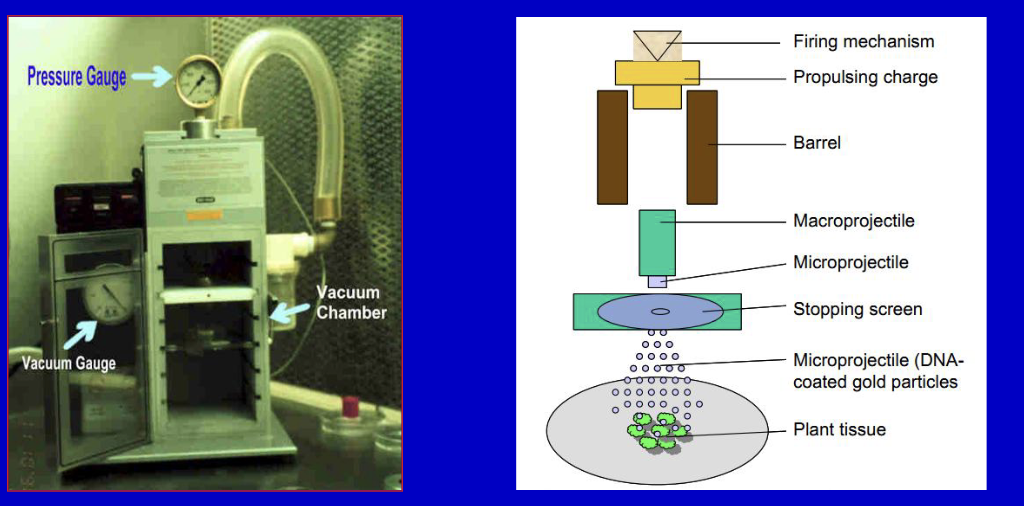
The method relies on the use of a particle gun
small tungsten/gold projectiles coated with DNA, the projectiles are shot into cultured plant cells—> the foreign DNA enters nucleus and is integrated into chromosomes—> new plants are then regenerated from the transformed cultured cells
—> system works by taking microscopic beads (made of metal) and coat the outside of the beads with the piece of DNA you want to transfer- the beads are packed into cylinder (micro projectile) and loaded into a larger cylinder (macro projectile) which in turn is loaded into the “barrel”- then the plant tissue you aim to transform is inserted- you close the door and add a vacuum (to remove air resistance)- the macro projectile is then fired down the barrel which have a mesh- the mesh will stop the macro projectile but have holes large enough to let the beads pass through- resulting in the micro projectiles being shot into the plant tissue
you have to find the optimal force in order to not penetrate the tissue completely and the beads going straight through- but still using enough force so that the beads not just bounce off the tissues surface- getting rejected by the rigid cell walls.
The idea is to get enough of the particles to enter enough of the cells so that the piece of DNA coated on the beads will dissolve off the particles while inside the tissue and successfully integrate into the plant nuclear genome
—> However it is a crude method and the probability of successful transformation is low- however, if it is the only option you have- you basically have no other choice but to trial and error until it works
what are the advantages of the ballistic method?
It is useful for plants that are difficult to transform with Agrobacterium (certain plant species is not compliant with biological vectors hence leaving the ballistic method the only suitable choice of transformation), this applies to: Algae, Monocotyledons (most cereals – most important commercially) e.g. Wheat, oats, barley, sorghum.
Agrobacterium is a pathogen that naturally infect certain plant species—> only those species that can naturally be infected by the bacterium can be transformed using the agrobacterium- most cereal species are not compliant with the agrobacterium
Useful for transforming chloroplast genome (plastome) since the agrobacterium only modify the nuclear genome
what are the disadvantages with the ballistic method?
Low frequency of transformation- very low success rate- need to attempt multiple transformations in order to achieve one successful transformation: (Transformation efficiency is low, so many cells must be transformed and selected to obtain stable transformants)
Transformants are often transient (short-lived), and not stable- there is a high probability that the plants where transformation has been attempted do not actually become transformed- this is because you have to successfully transform enough amount of cells (and sometimes this means attempting the transformation multiple times) in order for the transformation to be successful and long lived (the DNA has to be successfully integrated inte the plant cell genome in enough amount of cells in order to be able to produce transformed plants by propagation)
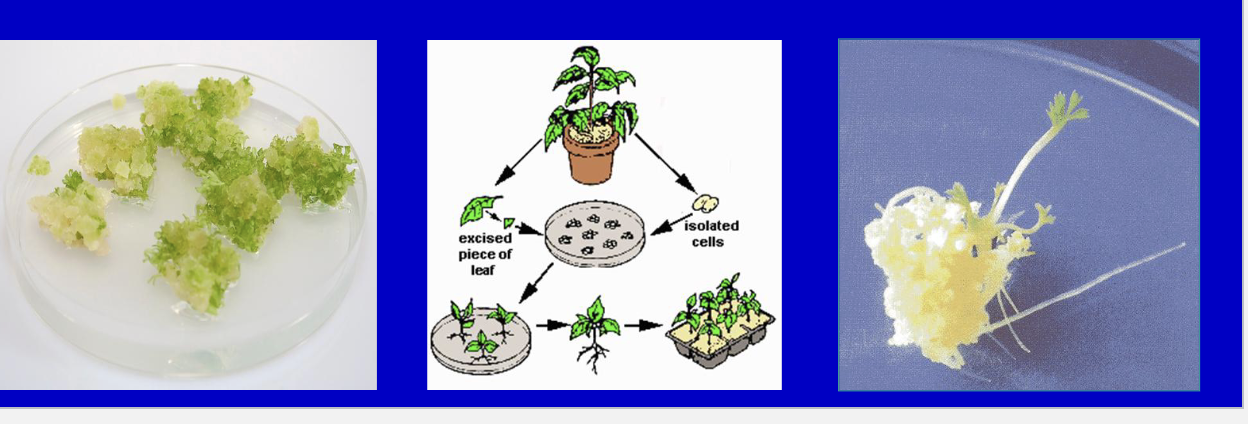
callus is usually the kind of tissue that is transformed (the callus tissue is then used to regenerate transformed plants by tissue culture)- However this bring the problem of somaclonal variation
what is plant tissue culture
= a biotechnology technique used to cultivate plant cells, tissues, or organs in a sterile, nutrient-rich environment (in vitro) to grow whole, identical plants
- Mature differentiated plant cells can be induced to undergo division when cultured on artificial media (agar)
- In plants you can reverse differentiation- ie take a differentiated cells eg stalk cell- put them on agar and reverse the differentiation process so that the cell become undifferentiated- callus = undifferentiated (non specialized) meristem cells
what is meristem
- In plants there are meristem cells (cells in growth regions) that are undifferentiated and hence has potential to produce/be part of any plant tissue through differentiation
what is callus
= undifferentiated (non specialized) meristem cells
created by adding differentiated cells to agar, and adding certain components in order to produce undifferentiated meristem cells- that for instance can be transformed and then used to cultivate an entirely transformed plants (which in turn can produce transformed seeds etc)
how can callus development be induced?
Can be produced by adding plant tissue cells to agar containing:
vitamins
mineral salts
carbon source (sucrose)
optimal hormone concentration (cytokinin / auxin)
—> callus can then be transferred to other agar plate with another mix and proportions of plant hormones initiating the germination and differentiation of the callus to a plant.
what is the fundemental issue with using callus cells (in transformation)
when you make callus- there is certain frequency of spontaneous single nucleotide mutations to occur (essentially) randomly throughout the plant genome
if they happen to turn up in certain genes in certain positions- the expression of those genes can in turn become altered- these mutations = somaclonal variation
what is somaclonal variation
when cultivating tissue culture (in vitro), random genetic variations tend to emerge in the plants.
often in the form of point mutation
occur essentially randomly in the genome
= “genetic or epigenetic changes in plants regenerated from tissue culture, leading to phenotypic, cytological, or molecular differences from the parent plant”
summarise the ballistic method and why the biological method is more commonly used
Ballistic transformation: low success rates when it comes to getting the DNA to be inserted in the plant tissue and cells—> even when the mechanical “insertion” of the DNA is successful, the transformation may still not be stable due to an unsignificant amount of plant cells having the genes successfully integrated into the genome. —> even when the transformation is stable, the transformation aim may still be unsuccessful due to somaclonal variation (occuring in the tissue culture randomly) hence the plant not acquiring the desired outcome
—> Because of this, biological vector is the first choice when transforming plants
which method in transformation is the most common
biological vectors
what is the biological vector usually in plant transformation, give examples
The vectors used are natural pathogens- part of their life cycle is to infect plant cells and transfer a piece of DNA of their own cells into the host plant- in the transformation process we “highjack” that system and use it to transfer our aimed DNA into the host plant instead of their own.
Bacterial:
- Agrobacterium tumefaciens (almost exclusively used)
Viral:
- Tobacco mosaic virus (TMV)
- Cauliflower mosaic virus (CMV)
which kind of biological transformation is most commonly used, what strain, when is it suitable
Agrobacterium plant transformation is the most common method today for plant transformation
Suitable for most dicotyledons and some cereals (e.g., rice)
One main virulent strain is used- Agrobacterium tumefaciens
The agrobacterium has been modified in order to be able to be used in the transformation of certain species eg rice- that recently has not been possible through biological vectors.
what symptom does agrobacterium tumefaciens cause in the wild? explain the infection process briefly
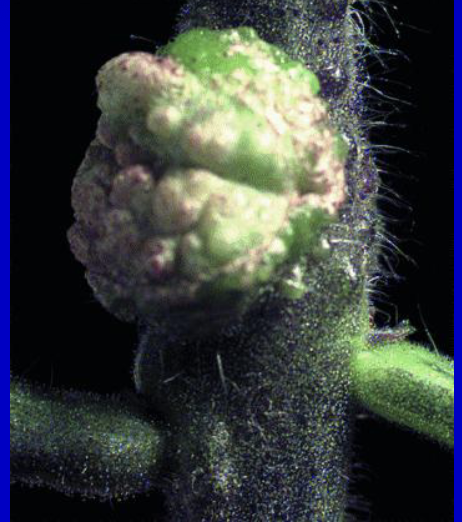
Infection of plants by Agrobacterium tumefaciens causes “crown gall” tumors—> large, undifferentiated cell masses.
- The bacteria typically gains entry into the plant through wounds
- Agrobacterium causes the “crown gall” syndrome
- Agrobacterium is an opportunistic pathogen- the bacteria is normally completely harmless to the plants but when opportunities arise (when cell walls become broken) it will become pathogenic and cause infection.
- You can locate where the infection has occurred by locating the crown gall tumours- pretty much harmless to the plant because the infection is local. You can tell that the plant sometime in its lifetime has sustained an injury damaging the cell wall and been infected by agrobacterium in the location of the crown galls.
explain what crown gall tumours are, where are they common?
The cells in the tumour have increased cell division rates
- Common in Nature: Birch, Oak, Grape vine, Apple roots
- Burls: Highly sort after by carpenters and wood carvers since the wood acquire special patternization and creates sought after qualities for wood carving
name three qualities of crown gall cells
Crown gall cells can be cultivated in vitro: Three interesting observations can be made of the cells inside the crown gall tumour cells:
- Cells are sterile: no microorganisms are present- agrobacterium is only present on the outside of the plant- the cells inside the tumour is not infected by the bacterium and have all been produced entirely from the host plant cells
- Cells show hormone-independent growth: no addition of auxin & cytokinin in medium was needed in order to stimulate in vitro plant growth/cell division (usually these hormones need to be added to the medium to stimulate plant cell division (auxin for cell elongation, cytokinin for cell division)- however this was not needed for the crown gall tumour cells)
- They produce opines, which ordinarily plant cells never do
talk about the agrobacteriums genome? what does it consist of? what is it that is responsible for the infection of plant cells?
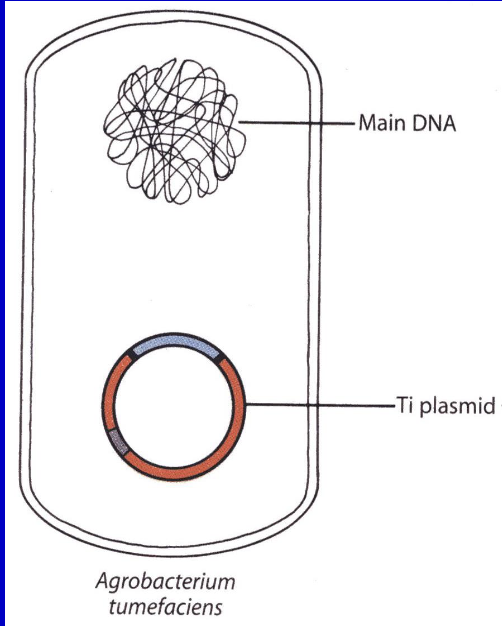
Agrobacterium has an extra plasmid-= Ti plasmid (tumour inducing plasmid).
- Virulent Agrobacterium tumefaciens cells contain a large plasmid (ca. 200,000 bp which is unusually large for a bacterium) in addition to its genomic DNA= Ti plasmid (Tumor-inducing plasmid)
Mutagenesis (the production of mutations) of the Ti-plasmid reveals virulence genes:
- The ability for Agrobacterium to infect the damaged plant cells relayed exclusively on the presence of the Ti plasmid.
- The role of the Ti plasmid= cause the infection in the plant cells.
explain what T-DNA is in agrobacterium- what does it contain/encode for
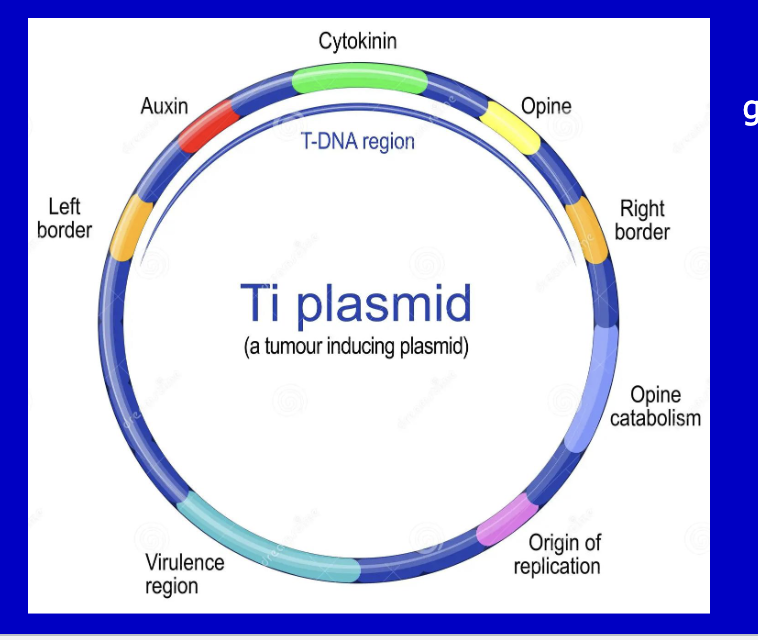
Agrobacteriums Ti Plasmid contain both a T-DNA region and virulence region:
The T-DNA region:
- T-DNA = the region of the Ti plasmid that is transformed into plant genome (ca. 20,000 bp)
- Defined by the left and right borders. Left / Right borders: 24 base repeat sequences
- Contain genes that encodes for the synthesis of Opine: gene for opine-synthesizing enzyme
- Contain genes that encodes for the synthesis of Auxin / Cytokinin: genes for hormone synthesis
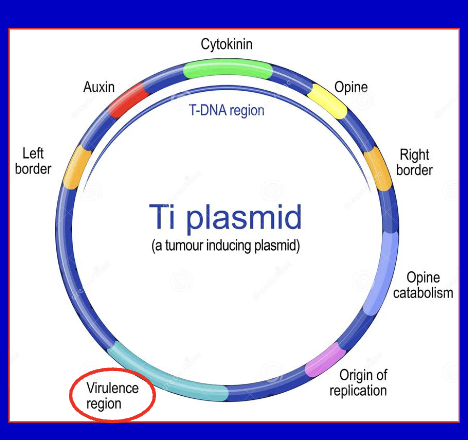
what is the vir-region of the Ti-plasmid? What does it encode for and consist of? What is its purpose?
= the virulence region of the Ti-plasmid
- Interaction with the wounded plant cell activates vir gene expression in Agrobacterium
- The vir proteins encoded for by the vir genes enable the transfer of the bacterias T-DNA into the plant nucleus and its integration into the genome
- Virulence region has one large operon with a range of different genes- this operon region is necessary in order for the infection to actually occur- the vir proteins encoded for by the vir-operon genes are what actually mediate the infection
- Infection process: a copy of the T-DNAis transfered into the nuclear genome of the plant- once it inserts inside the plant genome the genes of the T-DNA region will be expressed immediately —> the agrobacterium itself never enters the plant, but simply transfer a copy of the T-DNA region, resulting in the genes of the T-DNA being expressed in the plant.
name the 6 main steps in the Agrobacterium infection mechanism- and the result
Signal recognition: agrobacterium senses signal of a wounded cell wall from the plant
Attachment to the cell: a mesh of fibres are synthesised in order to bind the bacterium to the plant tissue
vir gene induction: signal transduction lead to the expression of the vir operon genes (synthesis of vir proteins).
T-strand production: Vir proteins produce a single strand copy of the T-DNA
Transfer of the T-DNA into the plant cell: A membrane channel called T-pilus, through which the T-DNA can be transported via to the plant cell, is produced by vir proteins. The T-DNA strand is modified in order to (bla) avoid the plant cells immune system
T-DNA integration into the plant genome: the T-DNA is integrated into the plant nuclear genome by illegitimate recombination
—> The T-DNA genes are then expressed and lead to a burst of synthesis of the plant hormones auxin and cytokinin (generating extensive growth and cell division- causing the tumour) as well as the synthesis of opine—> the opine is in turn transported back to the plant and used as “food” by the bacterium.
explain the signal recognition of agrobacterium