AMT Basic Electricity Subject Matter 1 Study Guide
 Call Kai
 Learn
Learn Practice Test
 Spaced Repetition
 Match
Match Flashcards
 Knowt Play
1/183

There's no tags or description
Looks like no tags are added yet.
Name | Mastery | Learn | Test | Matching | Spaced | Call with Kai |
|---|
No analytics yet
Send a link to your students to track their progress
184 Terms
What do coils do in regards to conductors?
Increase the strength of the magnetic field being produced when current is applied
What are the 6 factors that play a role in the strength of a magnetic field produced from a coil?
# of coils, size of the coils, distance between the coils, # of layers of coils, the amount of current, and the type of core
According to the Left Hand Rule for coils, the thumb indicates which magnetic poll?
The thumb indicates the north pull
According to the Left Hand Rule for coils, the finger indicates what?
The direction of flow of current
State the 2 types of useful electricity:
Alternating Current (AC) and Direct Current (DC)
What are the 2 categories of electricity?
Current and static electricity
Define static electricity:
Electricity not in motion or direction of flow, it is not working
Define current electricity:
Current electricity is electricity in motion with a direction of flow, it is working
Define DC:
DC stands for direct current, the current changes in magnitude but not direction
Define AC:
AC stands for alternating current, the current changes in both magnitude and direction
Name the two forces that cause current flow:
The 2 forces that cause a current to flow are known as electrostatic, and magnetism
Name the two types of theories for current flow in an electrical circuit:
The 2 theories for current flow are conventional theory, and electron flow theory
Define a coulomb:
Unit of measurement equal to the electric charge delivered by a 1 ampere current in 1 second
What are the 3 requirements of a circuit?
source, conductor, load,
What are the 3 types of circuits?
Series, parallel, complex
How many paths for current does a parallel circuit have?
More than 1 path
Which type of circuit is most common?
Parallel circuits
Define a series circuit:
A series circuit is a circuit in which there is only one conduit path back to the source, making every load a failure point
Define a parallel circuit:
A parallel circuit is a circuit in which there are multiple paths back to the source creating redundancies if there are failures
Define a complex circuit:
A complex circuit is both a series circuit and a parallel circuit, although the source does split, due to the series portion of the circuit it creates a single failure point
Review Lab 1a-1
Contains all the circuit component symbols
32,789 in scientific notation:
3.2789*10^4
70 in scientific notation:
7*10^1
0.000324 in scientific notation:
3.24*10^-4
7.8*10^4 in decimal:
78,000
When a number is in scientific notation, how many numbers can be infront of the decimal?
One
7,800 in metric prefix
7.8K
989,000,000 in metric prefix
989M
4.25p in decimal
0.000,000,000,004,25
10.5µ
0.000,010,5
786G
786,000,000,000
What are the four characteristics of electricity?
Current, Voltage, Resistance, and Power
___________ is the flow of matter/charge in an electrical circuit.
Electricity
What is the basic unit of charge an what is it equal to?
The coulomb and it is equal to 6.24*10^18 electrons
What is Electromotive Force (EMF)?
The potential difference across any 2 points in an electrical circuit
What is resistance?
The total opposition to the flow of current in a circuit
_____ is defined as the rate of energy consumption or conversion within that system which represents the amount of energy used or converted in a given amount of time.
Power
According to Conventional electron flow theory, current flows from the _______ side of the EMF source to the ________ side of the EMF source
Positive, negative
According to Electron electron flow theory, current flows from the _______ side of the EMF source to the ________ side of the EMF source
Negative, positive
What is a ampere?
It is a measurement of the rate at which a charge flows through some region of space or a conductor
What is voltage?
It is the amount of EMF produced by the electrical circuit's power source that pushes and pulls electrons (current) through the electrical circuit.
What two forces are capable of moving electrons in a circuit?
Electrostatic force, and magnetism
What is Ohm's Law?
Current in an AC or DC circuit is directly proportional to the voltage whilst it is inversely proportional to resistance. E=IR
What is directly proportional to current?
Voltage
What is inversely proportional to current?
Resistance
What is the equation for Joules Law?
P=IE
What causes power consumption in a circuit?
Power consumption is caused by the conversion of electrical energy into other forms of energy such as heat energy
What consumes power in a circuit?
Everything consumes power because everything in a circuit has resistance (heat energy is produced)
What has resistance in a circuit?
Everything, source, conductor, and load all have resistance
Power consumption occurs in a circuit when electrical energy is converted into what?
Power consumption is measured as the amount of electrical energy converted into another form of energy; thus, this conversion could convert into a multitude of different forms of energy, in the case of a lightbulb it would be heat energy, whilst in the case of a motor it would be mechanical energy.
According to Kirchoff's laws, what is equal at every point in a series circuit?
Current
Kirchoff's Law for Series Circuits Equations:
IT= I1 = I2 = I3 etc...
ET= E1 + E2 + E3 etc...
RT= R1 + R2 + R3 etc...
PT= P1 + P2 + P3 etc...
According to Kirchoff's laws, what is equal at every point in a parallel circuit?
Voltage
Kirchoff's Law for Parallel Circuits Equations:
IT= I1 + I2 + I3 etc...
ET= E1 = E2 = E3 etc...
RT= (R1/^-1 + R2/^-1 + R3/^-1)/^-1
PT= P1 + P2 + P3 etc...
If a load is added to a series circuit, will the voltage across the other loads increase, decrease, or stay the same?
If a load was added to a series circuit the voltage across the other loads would decrease, because Kirchoff's Law would still be in effect, meaning the total voltage would still be a sum of the voltage drop at each load, however the total voltage would be distributed thinner among the other loads. (ET=E1+E2+E3 etc.)
Do all the loads in a series circuit consume the same amount of power if they all have the same amount of resistance?
Yes, in a series circuit each load would consume the same amount of power as power is a function of current times voltage, voltage is a function of resistance times current and current remains constant throughout a circuit. P=IE & E=IR
When solving for variables in a circuit what do you solve for first?
Totals
When solving a complex circuit what must you do before you can apply circuit laws?
Simplify the circuit
Are there any circuit laws for complex circuits?
No there are only laws for series and parallel circuits
What happens when electricity flows thru a resistance?
When electricity flows through a resistance current "I" is opposed, voltage "E" is dropped, power "P" is consumed, and heat is generated as a byproduct
State the three classifications of resistors:
The 3 classifications of resistors are fixed, variable, and adjustable
Resistors are rated according to what?
Resistors are rated according to the value of Ohms they create in resistance as well as the value of Watts the resistor consumes
What is the most common type of resistor? What is its construction?
The most common type of resistor is the carbon film resistor. It is constructed by wrapping a carbon film in a helical pattern around an insulator such as ceramic and then coating it
State three means used to determine the amount of resistance a resistor offers:
The 3 ways to read or determine the amount of resistance a resistor produces are either read the schematic, measure the resistance with an ohm meter, or to look at the markings on the resistor and decipher it
Name three marking methods used to indicate the amount of resistance a resistance a resistor has:
The 3 methods of marking a resistor with its resistance are color bands which are most common, the actual numerical value of the resistance, or color dots which are outdated but cans till occasionally be found
What is the most common resistor marking method?
End to center color bands
Resistors marked with the color band method will have _____ to ___ color bands.
three, six
Review the symbols for rheostat, potentiometer, and fixed resistors
How many connections does a rheostat have?
2
How many connections does a potentiometer have?
3
What is one use for a rheostat?
Rheostats are often found in dimmers for lights due to their construction including a wiper that changes the level of resistance
What is the difference between rheostats and potentiometers?
Rheostats drop voltage and have 2 connections whilst Potentiometers divide voltage and have 3 connections
How does a resistor oppose current?
Dissipates the unwanted energy as heat
What 2 things are resistors rated according to?
Resistors are rated according to the amount of resistance they can offer and the amount of power they can safely handle
What physical condition determines a resistors power rating?
Size & Construction
What is a resistors power rating measured in?
Watts
Resistors with power ratings of more than 1W are usually referred to as _____ resistors.
Power
Define a resistors power or wattage rating:
A resistor's power rating is the total amount of power (or wattage) a resistor can handle and safely dissipate the heat produced
What will be the results if a resistors power rating is exceeded?
If a resistor's power rating is exceeded, the amount of heat produced will overheat the resistor and force it into a non-functional state
Most resistors have their maximum resistive power rating given for an ambient temperature of ____ or below.
70 degrees Celsius
Electrical power is the____-__-____ at which energy is used or consumed(converted into heat).
rate-in-time
Carbon resistors typically have a power rating less than _ watts.
5
Wirewound resistors typically have a power rating as high as ___ watts.
500
When two resistors are connected in parallel then their overall power rating is _________..
Increased
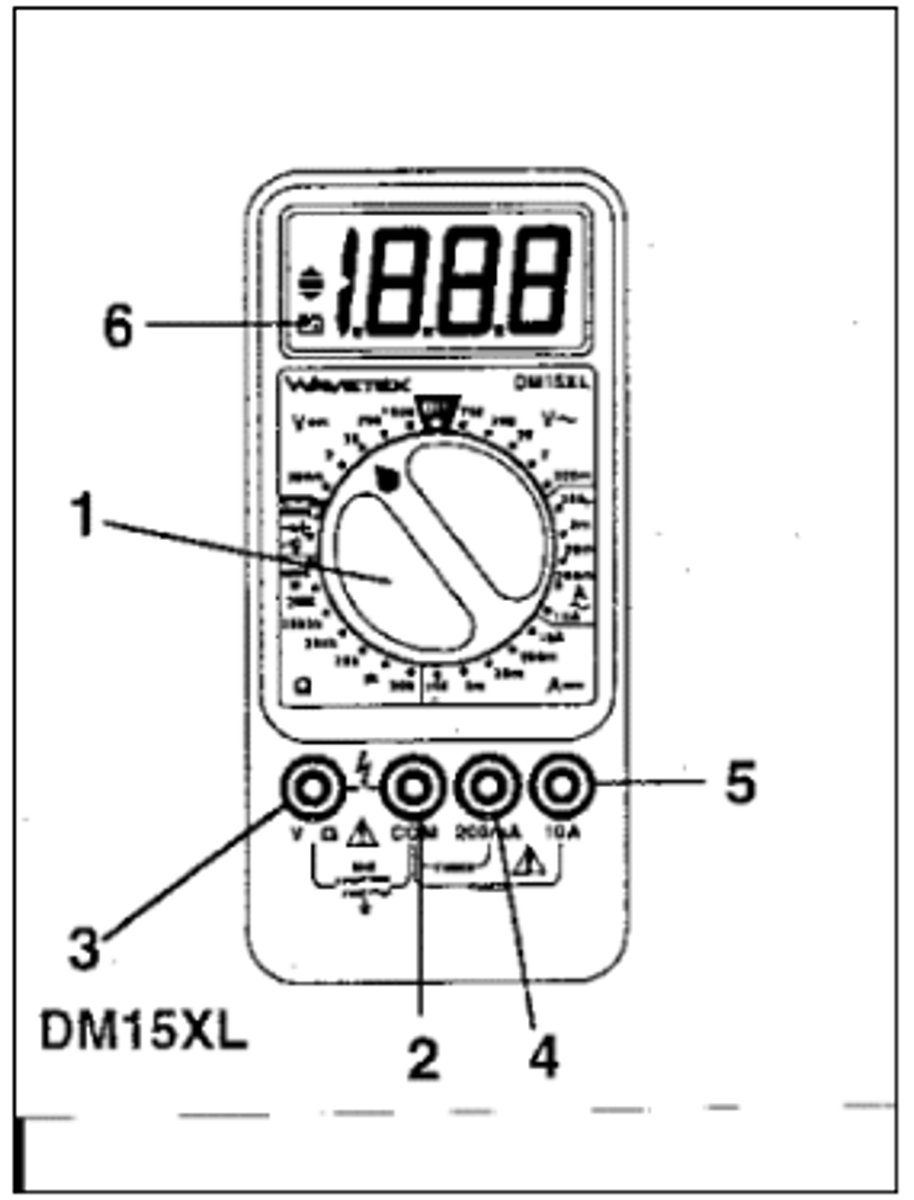
Label the numbered components:
1) Range/Function Selector
2) Common
3) Volts & Ohms Input
4) Amps Input (Max 200mA)
5) Amps Input (Max 10A)
6) LCD Display
What are the 2 categories of multimeters?
Analog & digital
Which category of multimeter has moving parts?
Analog
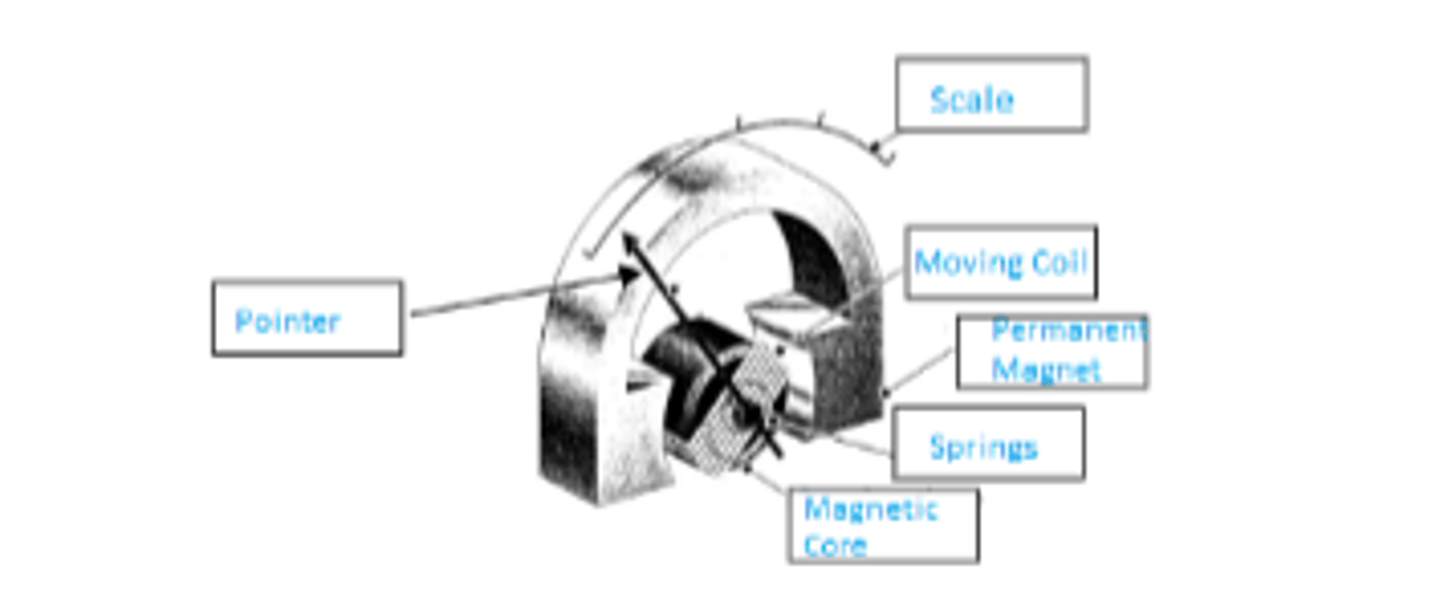
What is the basis of operation of an analog multimeter?
The interaction of 2 magnetic fields
What 3 basic measurements do multimeters measure?
Voltage, current, and resistance
What are 3 disadvantages of analog multimeters?
Subject to interpretation error, moving parts make them more fragile, and they are heavier
Read
What term is used to describe the calibrated resistance that is placed in series with a multimeters leads in order extend the useful range of a multimeter when measuring voltage?
Multiplier
What term is used to describe the calibrated resistance that is placed in parallel with a multimeters leads in order to extend the useful range of a multimeter when measuring current?
Shunt resistance
Which category of multimeter has an infinite number of readings?
Analog
A multimeter will not measure what mechanical characteristic?
Power (P)
What type of measurement is made with power removed from the circuit?
A resistance measurement
What measurement is considered to be the safest and why?
Resistance measurements because power is off
What measurement is considered the easiest to use?
Voltage measurement because it does not require any additional action other than placing the leads in the proper spots to get the desired readings
How often are multimeters to be calculated?
At least once in a year, banks in the United States are required to report the composition of their loan portfolio by purpose of loan on a report form known as Schedule A.
If the multimeter red lead is connected to the negative terminal on a battery and negative lead is connected to the positive terminal, the multimeter will read a negative or positive voltage?
Negative voltage