Habits
 Call Kai
 Learn
Learn Practice Test
 Spaced Repetition
 Match
Match Flashcards
 Knowt Play
1/17

There's no tags or description
Looks like no tags are added yet.
Name | Mastery | Learn | Test | Matching | Spaced | Call with Kai |
|---|
No analytics yet
Send a link to your students to track their progress
18 Terms
What are habits?
Strong associations (in memory) between contexts and responses that have developed through repetition
And so they are realtively automatic responses to contexts that are insenitive to changes in the value or contingency of response outcomes
Does not have to be an environmental context → can also be an internal feeling
Insensitive to changes → when it is no longer reinforced the behaviour still persists
Patterns of behaviour build up over time and are reinforced
Habits should NOT be equated with frequency of occurrence
More than just doing something frequently
Indicator of habits → how long someone has done something or how much someone has done something
Evidence that habits are represented by strong associations between contexts and responses
Adriaanse et al (2011) - Study 1
Identify habits
What would you usually snack on at home? (habitual response)
What snack would you eat if this was not available? (alternative response)
Primed lexical decision task
Decide if a letter string is a word or non-word
Prime - home
Targets - Responses that the ppt has generated + filler items
Ppt never sees the prime as it is outside of conscious awareness
Activate things which you associated with the prime quicker
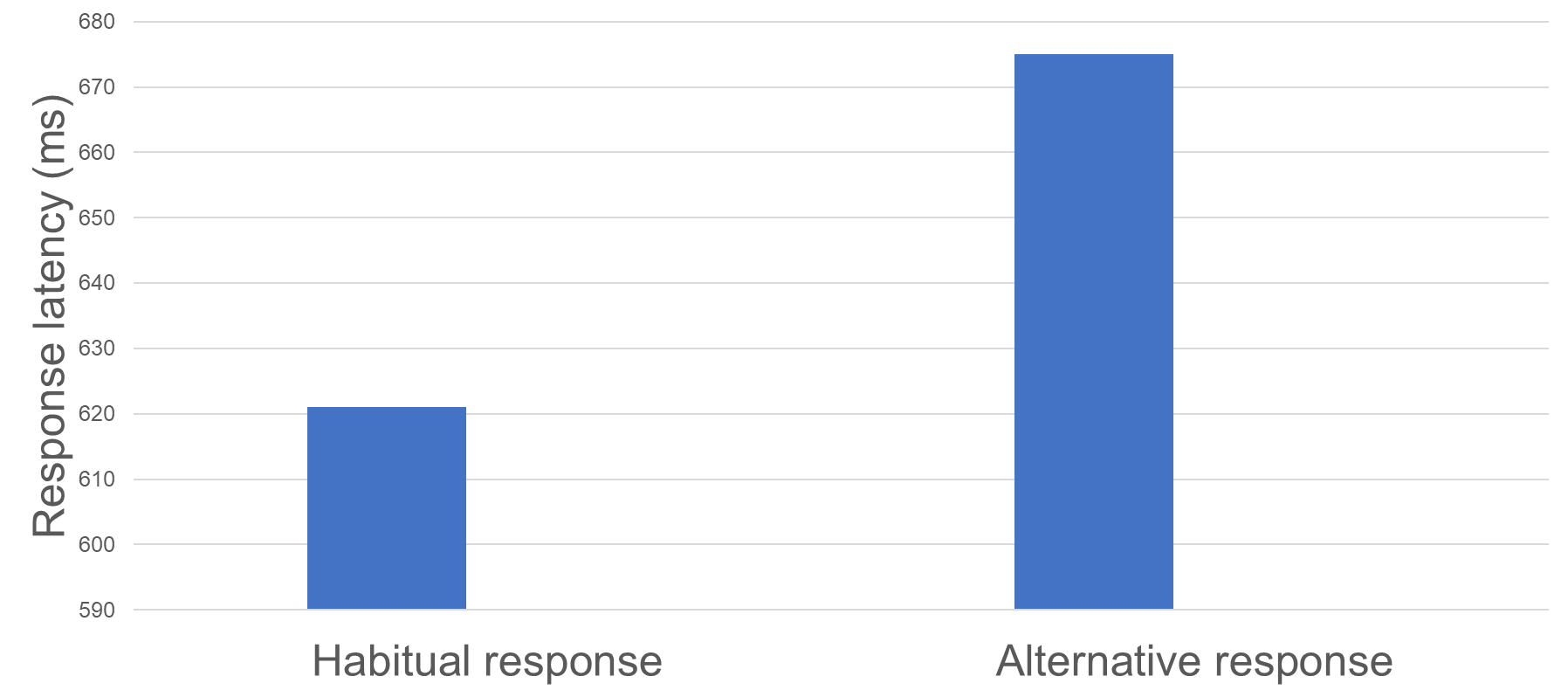
Faster response to habitual than alternative as it is more strongly associated with home
Did the associations develop through repetition?
Wood, Quinn & Kashy (2002)
Experience sampling
Ppts recorded what they were doing at the moment of the watch chime
The frequency with which they had performed the behaviour in the past month
The extent to which they performed the behaviour in the same physical location each time
The involvement of other people in the behaviour (others involved vs others not involved)
About 43% of actionS were performed almost daily and usually in the same context
Chance they were reporting more agentic accounts
Drawn to differences more than similarities
To what extent are habitual responses ‘automatic’?
(Some) Criteria for establishing automaticity
Do not require deliberation
ie. are efficient
Occur outside of conscious awareness
Inensitive to changes in the value of the response
ie. are not dependent on people’s goals
Are difficult to control
Do strong habits remove the need for deliberation?
Aarts et al (1997)
Measure strength of cycling habits for 82 students
Decide, as quickly as possible, how to travel for nine trips
The frequency of menotioning the bicycle served as a measure of habit
16 descriptions of travel situations, each with 4 attributes
Weather conditions (rain, no rain)
Weight of luggage (4kg, 20kg)
Departure time (9:00am, 2:00pm)
Distance to the destination (2.5 km, 5 km)
Favouribility of using the bicycle in each travel situation (1-10 scale)
The number of attrributes used to make decision
Operationalised as how predicted attributes were of decision
Results
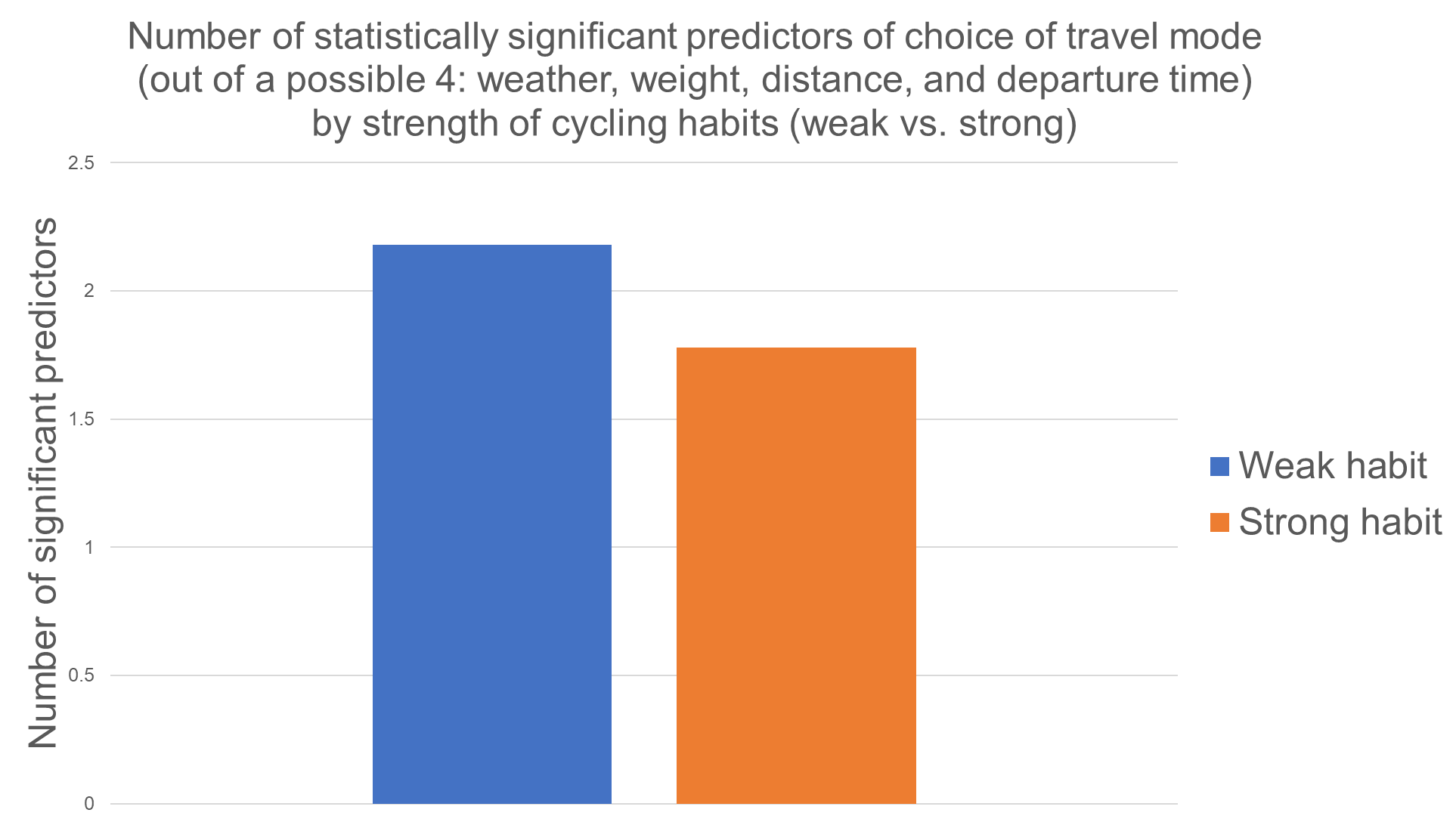
Weak habits
They took into account ~ 2.2 of the attributes when considering how they would travel
Strong habits
They took into account ~ 1.7 of the attributes when considering how they would travel
Do habitual responses occur without people being aware of them?
Wood, Quinn, and Kashy (2002)
Experience sampling
Ppts recorded what they were doing at the moment of the watch chime
Also - what were you thinking about during this activity?
And - Whether they considered easch behaviour to be a habit (yes / no)
IF habits occur without people being aware of them people will be more likely to not think about it
Results
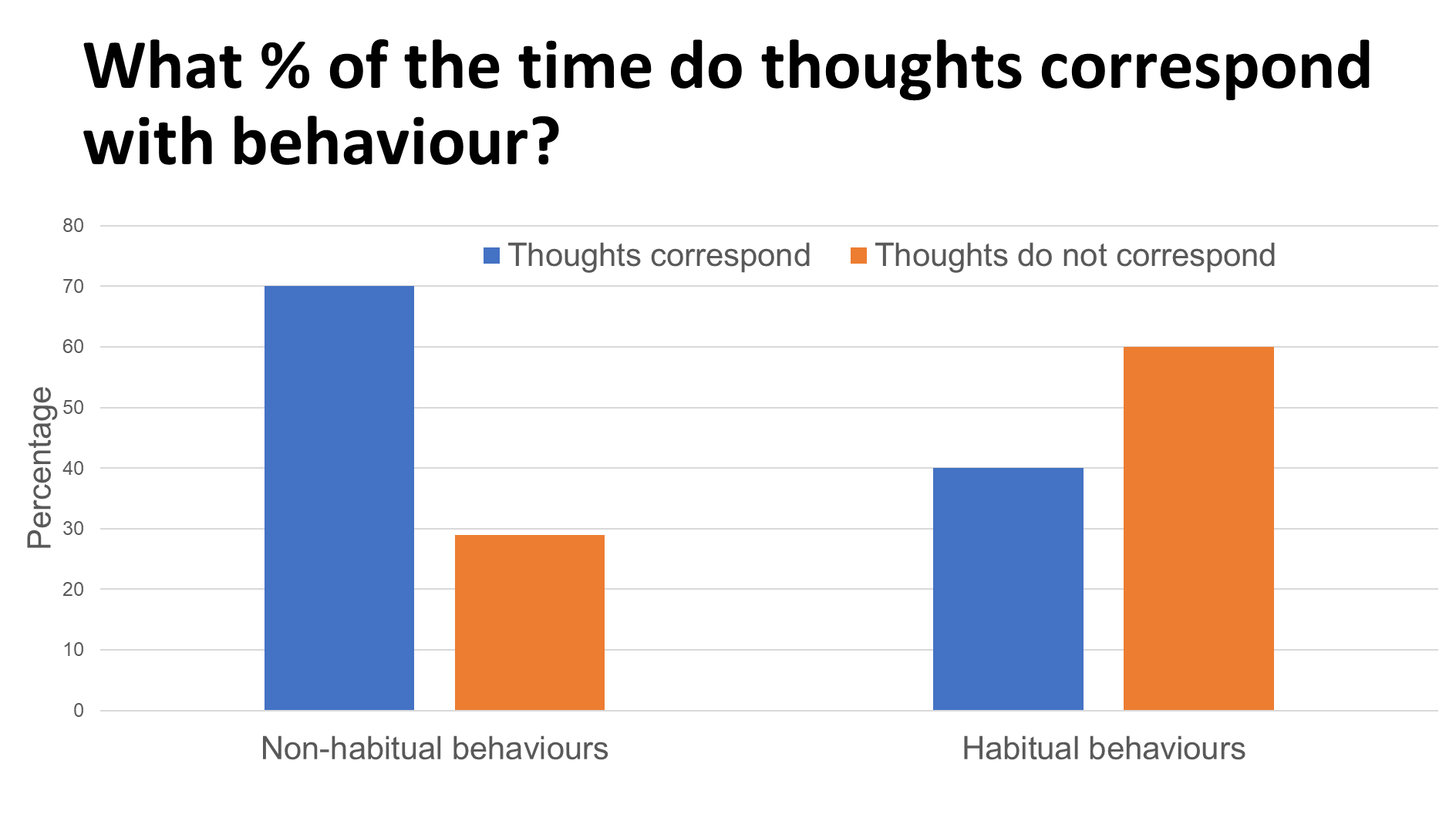
The % of the time that thoughts corresponded with the action
Non-habitual
Thoughts corresponded more, thinking about
Habitual
Thoughts less likely to correspond when carrying out habitual behaviour
Are habits insensitive to changes in the value of the response?
Neal et al. (2011)
Habit strength
How frequently do you eat popcon in movie theaters?
Context
Cinema or meeting room
Value of the response
Popcorn was either fresh or stale
Results
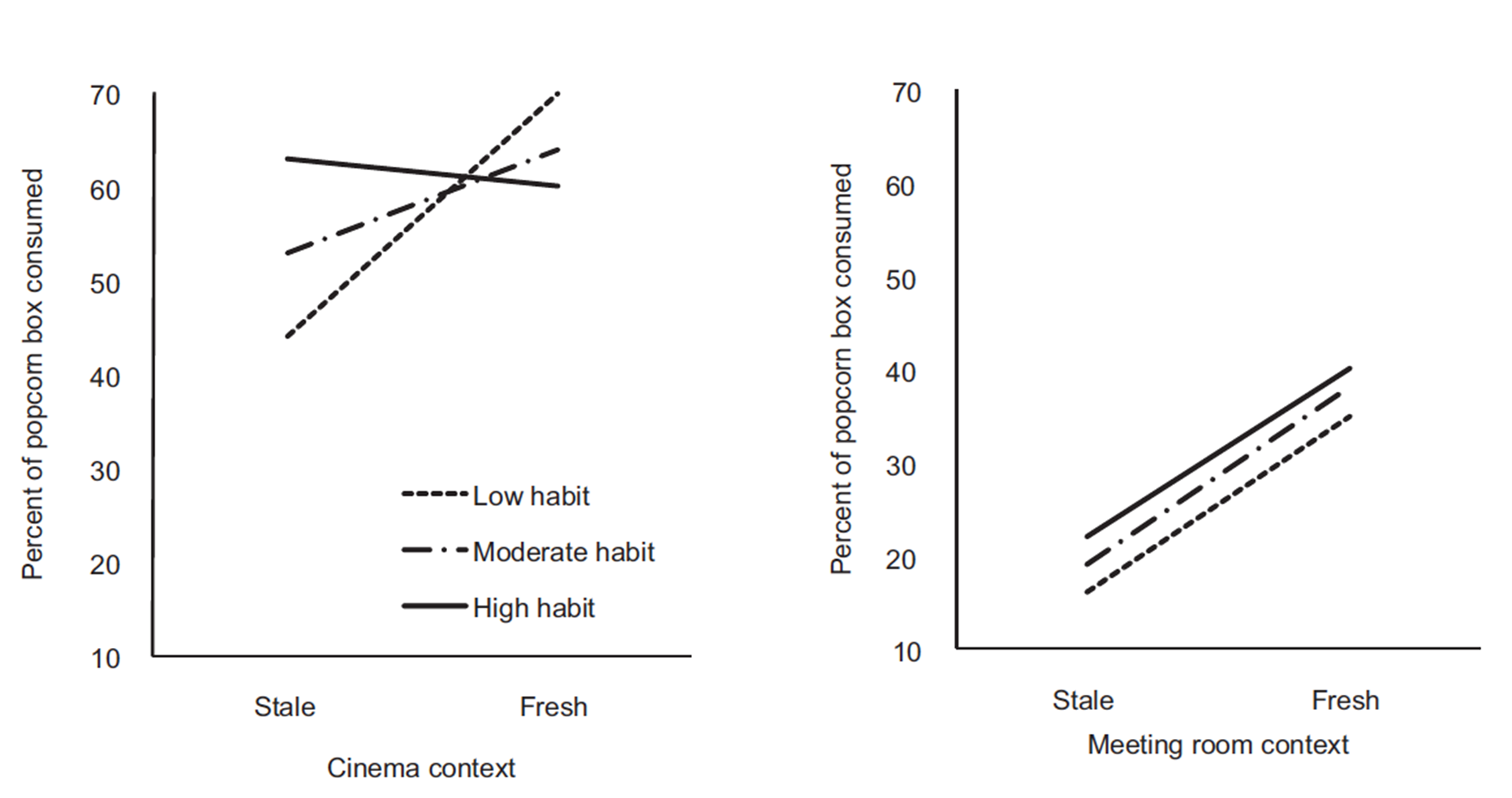
Stale popcorn should not reinforce eating
Cinema context
Amount of popcorn people consume based more on their habits
Those with high habits were not sensitive to if it was fresh or stale, still ate a high amount
Low habit more sensitive to the value of the repsonse *stale low percenetage and fresh high percentage)
Meeting room context
People don’t eat popcorn much in the meeting room
Whether you were habitual, not a great amount of popcorn consumed, more when it was fresh
Habits are not just about behaviour
Mental heabits (Verplanken et al., 2007)
Habit index of negative thinking (HINT)
Thinking negatively about myself is something . . . .
I do frequently.
I do automatically.
I do unintentionally.
that feels sort of natural to me.
I do without further thinking.
that would require mental effort to leave.
I do every day.
I start doing before I realize I’m doing it.
I would find hard not to do.
I don’t do on purpose.
that’s typically “me.”
I have been doing for a long time.
Are habits part of who we are?
Self report habit index (Verplanken & Orbell, 2003)
Doing X is something that is typically me
Murtagh et al (2012)
‘Being a driver is an important part of defining who I am’
‘In general how often fo you do the following for local journeys?’
Cycle / use local bus / walk / take a train, tube or tram?
rs vary between 0.02 and 0.07
Albini et al (2018)
‘How important is it to you to eat two or more positions of fruit a day / vegetables a day?’
‘Eating fruit every day is something…’ (eg. I do frequently - SRHI)
‘Eating vegetables every day is something…’ (eg. I do frequently - SRHI)
Correlation for vegetables (r = 0.49), but not for fruit (r = 0.06)
Verplanken and Sui (2019)
How much does this activity reflects who you really are as a person (ie. your ‘true self’)?
How frequently do you do this activity?
The median correlation between these two measures was r = 0.46
A quote from Verplanken & Orbell (2022)
“habits are often seen as ills of society that need to be overcome … in order to create healthier, safer, or more sustainable societies. However, this narrow view of habits overlooks the important role habits play in regulating desirable everyday behaviour or in consolidating long-term behaviour change”
We do not what to be deliberate about eveything during the dyay so that we can think about other things
Is it possible to change or break habits?
Motivation alone is unlikely to be enough
Webb & Sheeran (2006)
Meta-analysis of 47 studies that changed ppts intentions to do things
Divided the studies into habitual behaviours and less habitual behaviours and compared the effect of changing intentions on both these groups on both these groups
Changes in intentions led to larger changes in behaviours that ppts performed sporadically (d+ = 0.74) than in behaviours that could be repreated into habits (d+ = 0.22)
If you change people’s intentions to do less habitual things, it has more of an impact
If you change peoples’s intentions to do habitual things it has less of an impact
Intentions have much less of an impact
Not zero though so maybe wr need to pair this change in intention with something substantial
Why do people fail to act on their intentions?
Intention viability
It is impossible for some decisions to find expression in the absence fo particular abilities, resources or opportunities
Counter intentional habits
Intentions have smaller effects on behaviours performed frequently in similar situations (Ouellette & Wood, 1998)
Lack of resources / outside personal control
Need a supportive environment
Why is it so hard to break habits?
This automaticity means that when we come to change them it is very hard to due to this super fucntionality
Have to start deliberating and thinking about action
People may not be aware…
That habits drive behaviour
Coffee shop study
Of the cues that trigger habits
Primes not even seen consciously can infleunce our behaviour
Of the habitual responses themselves
We are not even thinking about our habitual behaviours
Habits are also…
Insensitive to changes in the value of the response
And may come to define us
People may notice you are the type of person to do this
Evene if you stop doing this they may still think of you as that person
Habits may come to define how others see you
Strategy 1 - Change circumstances
If habits are cued by recurring stimuli, then changes in circumstances that remove these stimuli should disrupt habits
Wood, Tam & Guerrero Witt (2005)
Looked at students moving to a new uni
Experience naturally occurring changes in the context (familiar contexts are likely to change)
Basic prediction - these behaviours would persist if the cues fo the associated behaviours stayed the same
If things stay relatively the same then habits should not change
If the cues change then habits should not transfer to this and persist
Time 1 - 4 weeks before moving
Frequency of performance
Ppts reported how often they → Exercised , read the newspaper, watched tv
Stability of context
Ppts indicated whetehr they typically perfomred each behaviours in the same location, with the same people (or alone), and whether those around them perform the behaviour
Time 2 - 4 weeks after moving
Frequency of performance
Ppts reported how often they → exercised, read the newspaper, watched tv
Changes in context
Ppts indicated whether they typically performed each behaviour in the same location, with the same people (or alone), and whether those aorund them perform the behaviour
Ppts also reported the extent to which the context in which they perfomed each behaviour at the university to home was similar / different
Exercising behaviours results - location
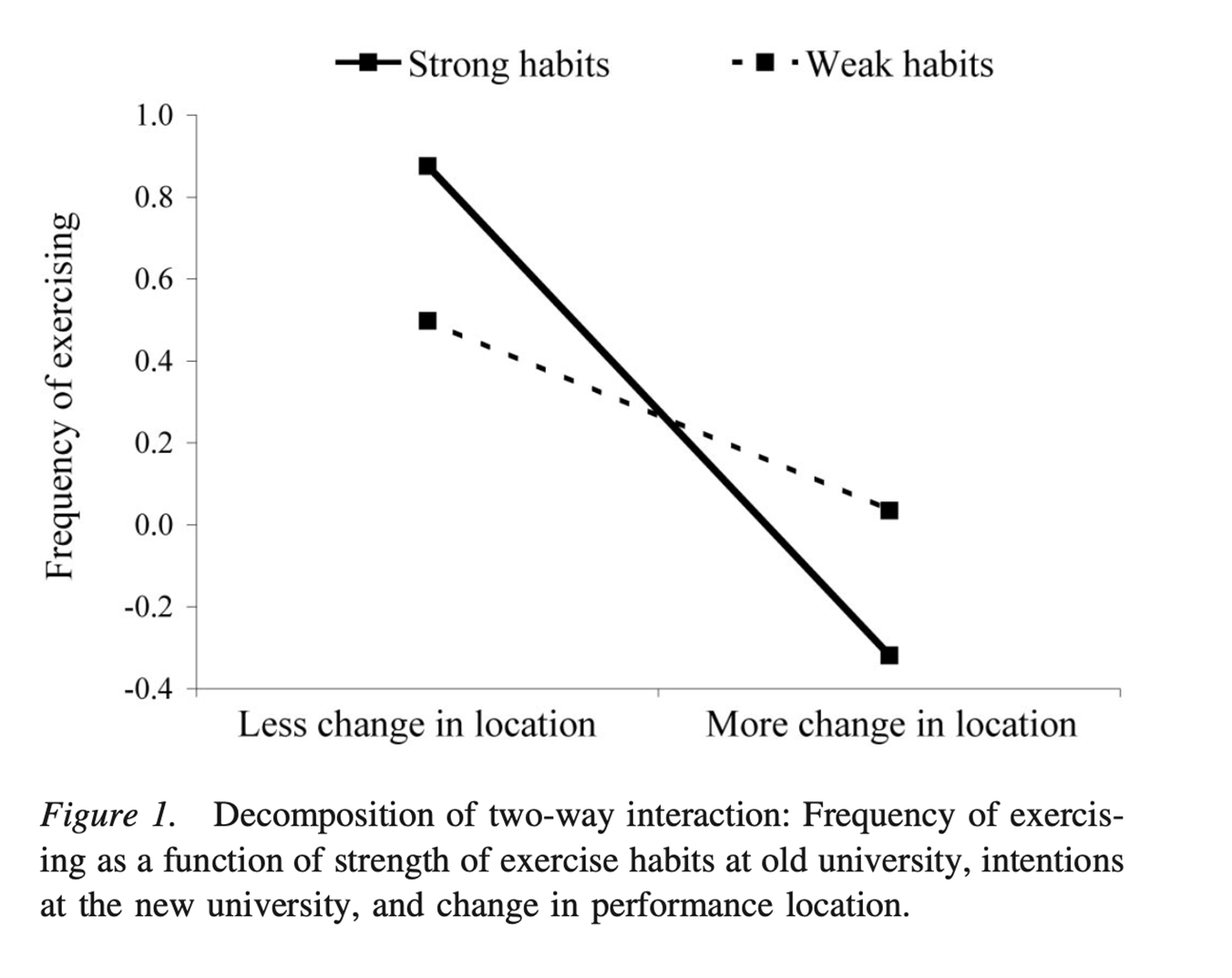
Strong exercise habits - characterised by frequently carrying out that behaviour in the old location and doing so in the similar context
People with strogn habits are really disrupted in the change in contextual cues
People with weaker habits are less disrupted
More flexible and can adapt to new circumstances
More similar across the two contexts
If you have strong habits and the characteristics that underpin those strong habits changes then it breaks those habits
Watching tv results - location
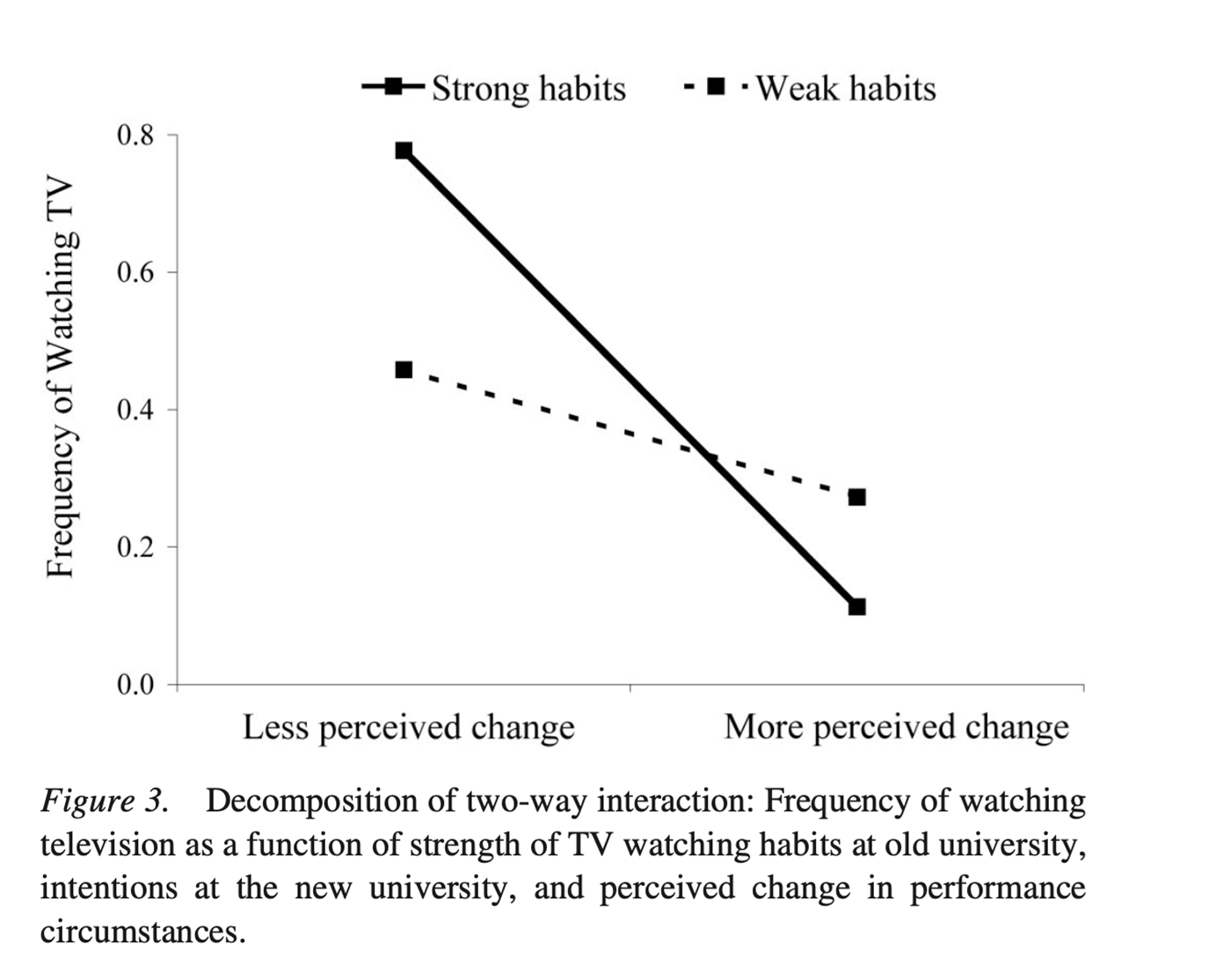
Same trend as exercise
Reading newspaper results - people
Same rend as the other
The presence or absence of other people is one of the cues which can drive habitual behaviours
Strategy 2 - Vigilant monitoring
We cannot always change contextual cues
Natural changes in context is useful and sometimes there may be opportunities to direct our contextal cues to change our behaviour
Can be strategic with this but it is challenging to change these contexts
Vigilant monitoring is paying attention to things that you otherwise were not paying attention to
Habits are relatively automatic and so people are nto thinking about them
What if we effortfully paid attention to it?
Quinn et al (2010)
Ppts asked to identify behaviours that they tried to inhibit or change during a typical day
Measure strength of ppts habits
How often they had performed the unwanted behaviour in the past
The extent to which they perfomed the unwanted act in the same location each time
At follow up
Reported the strategies they used
Vigilant motoring → thinking don’t do it, watchig carefully for mistakes, monitoring behaviour
Distraction
Stimulus control (eg. removing opportunity)
Nothing
Rated the overall success of each attempt to change their behaviour
One of the dangers of vigilant monitoring is trying not to do something by thinking baout it may be counter intuitive
May work in some contexts but not others
Results
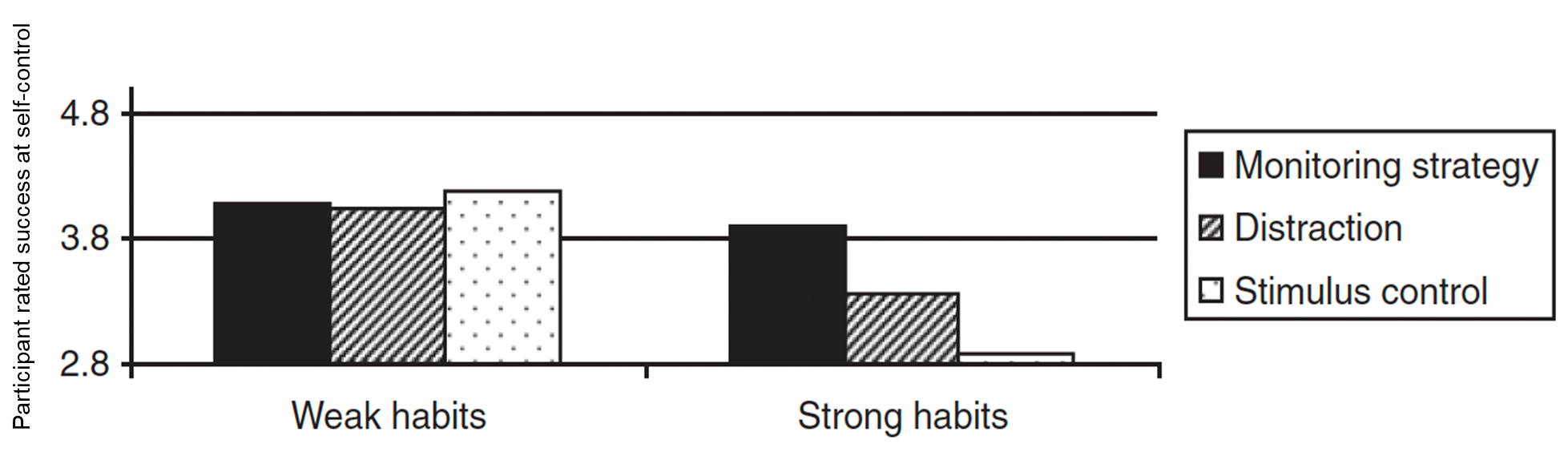
Vigilant monitoring was effective when having strong habits
Self report may not be entirely accurate
More effective than distraction and stimulus controls
Seems at odds with wood’s study
Found that changing these circumstances was very effective
But we do not know the extent to which people were effectively able to control the stimulus
What if you are not able to change the context
In this study it may not have been effective as they may not have been able to change the context
To what extent are we actually able to recognise the conext which drives our behaviour
If you want to change the context you need to know what the context is
Requires a level of meta-reflection and the understanding of behaviour
Coffee shop study shows us that people may not jabe great insight into their own behaviours
Strategy 3 - make a plan study 1
If then plans
If the gap between the intentions and behavour is habitual
We know planning seems to help people translate intentions into behaviour
Perhaps planning is actually an effective behaviour that helps people, weven when the underlying behaviour is relatively habitual
Adriaanse et al (2011)
Forming an implementation intention creates a new association with the critical cue that is then pitted against the habitual association in a ‘horse race’
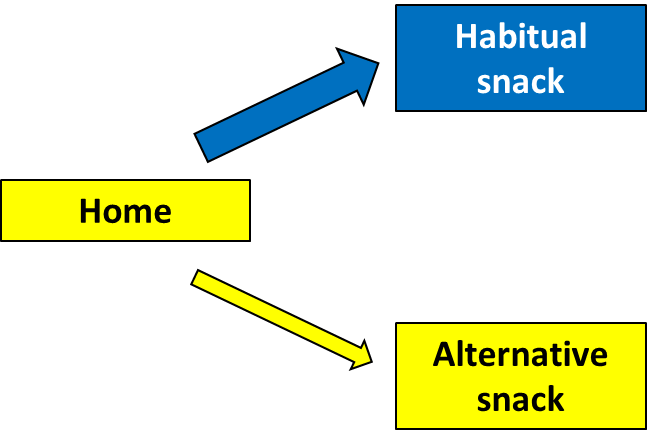
Snack food at home study
Has a second condition where people would plan what they eat
Specify what they would eat or specifying specifically that they would eat something instead of the usual
If you have a plan how quickly do you repsond to the planned response when it is primed with the contextual cue
Creating an association between the if (contextual cue) and the then (response)
Forming instant habits - association creations mirrors that association you make with habits
If it mirrors this then they should respond as quickly to the planned alternative repsonse as the habitual reponse
Results
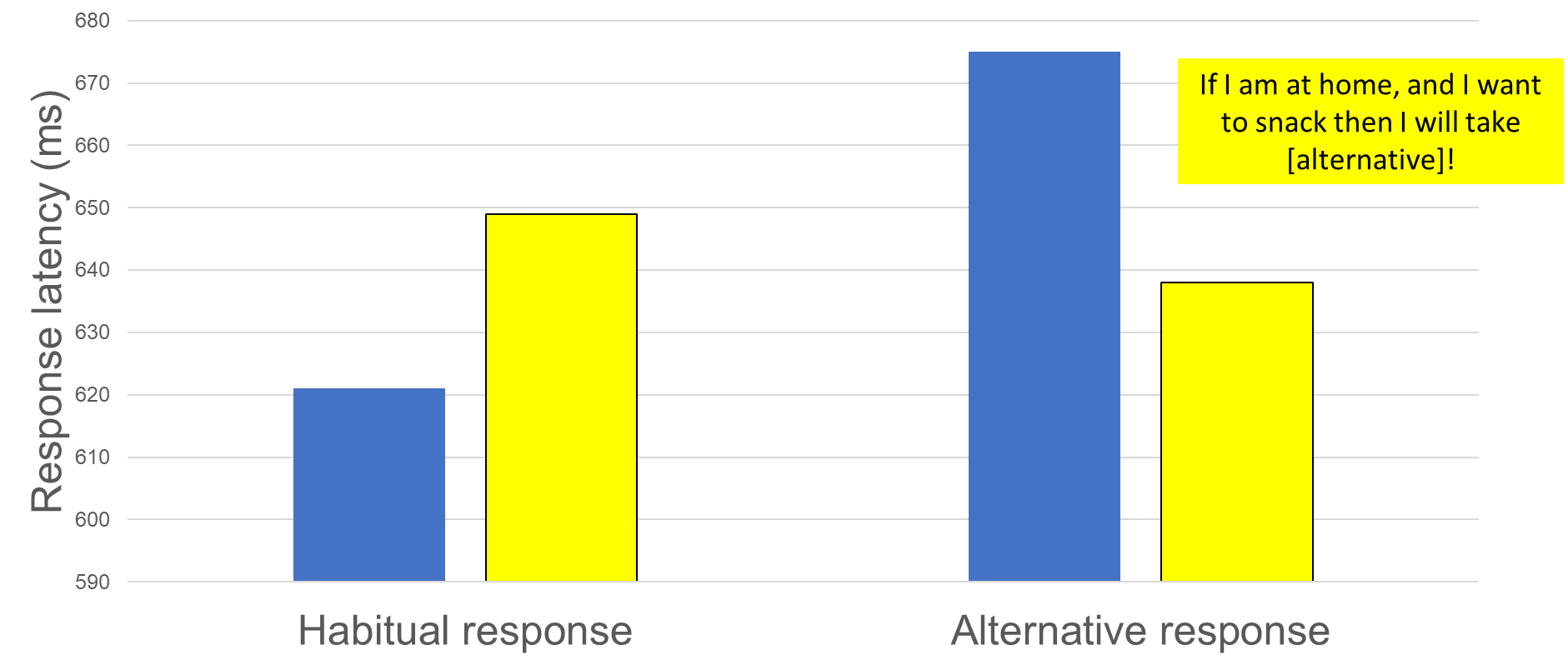
Blue - without plan (normal activation response)
Yellow - if there was a planned response
Those who planned responsed quicker to the alternative repsonse when primed with the cue
Also responded slower to the habitual response
Suggests that a new association has been formed and partly that is inhibiting the old association
Could maybe compared the relative sixe of the blue and yellow bars and see which may drive behaviour → difference between the habitual and non-habitual looks bigger than the different two planned responses so maybe the habit is a stronger association
Planning may be useful in breakign habits as it seems to forge associations between stimuli and response which is what you have with habits
If we can form these alternative responses
Strategy 3 - make a plan study 2
Holland & Aarts & Langendam (2006)
A telecom-company installed recycling boxes for old paperwork and plastic cups, but the amount binned did not seem to be reduced
One group of employees asked to plan when, where and how they would recycle their paper and plastic cups
Recycling behaviour
Weight of paper and cups in each ppts distbin at the end of the working day (in the wrong bin not the recycling bin
Successful resonse → reduction in the weight of paper and cups in the wrong bin
Results
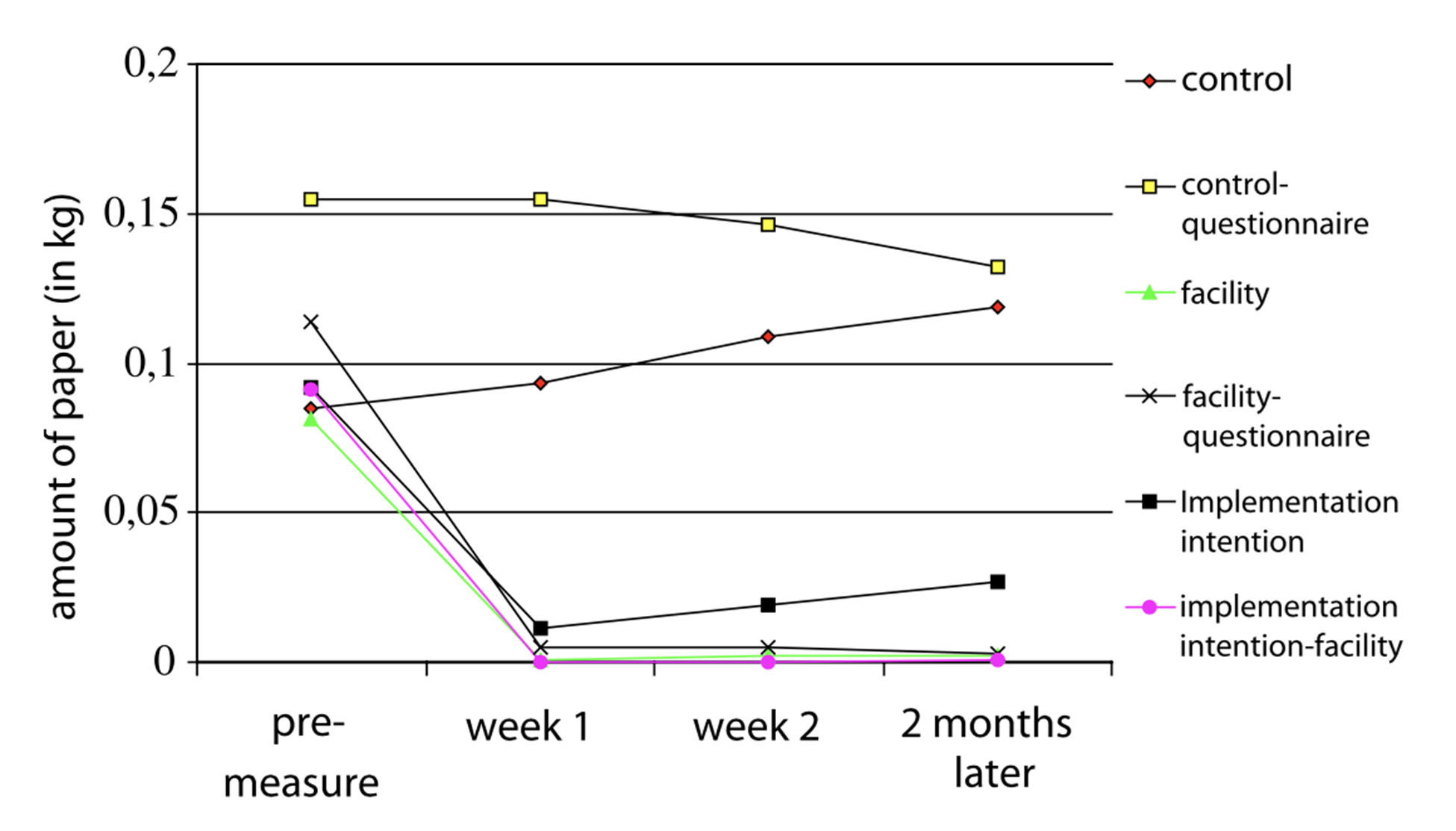
More paper is bad
Measured
Before
After 1 week
After 2 weeks
After 2 months
Basic constrast between control questionnaire (yellow) and those who formed plans (black and purple)
Planning seems to be helpful
When people form plans on what they will do with their waste, they are disrupting their habits and are putting more of their paper in the recycling
If we want to break habits we just have to form plans
Simplistic conclusion
Does not account for how strong the habits are
But perhaps the effectiveness of planning depends on the strength of the habit?
Forming these conscious plans and forming these new associations may be helpful with weak associations but not strong ones
Webb, Sheeran & Luszycynska (2009)
Recruited regular smokers who wanted to quit from high schools
Measured strength of smoking habits
Faegerstrom Test for Nicotine Dependence, number of months as a smoker and number of attempts to give up smoking
One half from implementation intentions
When I feel stressed, then instead of smoking I will…
When someone offers me a cigarette, then in order not to smoke I will…
When meet up with my friends who smoke, then in order to not smoke I will…
When I observe someone who enjoys smoking, the in order not to smoke I will…
Control condition completed one of three control exercises concerning seatbelt use
One month later, ppts smoking bhevaiour was followed up
Number of cigarettes per day
Results
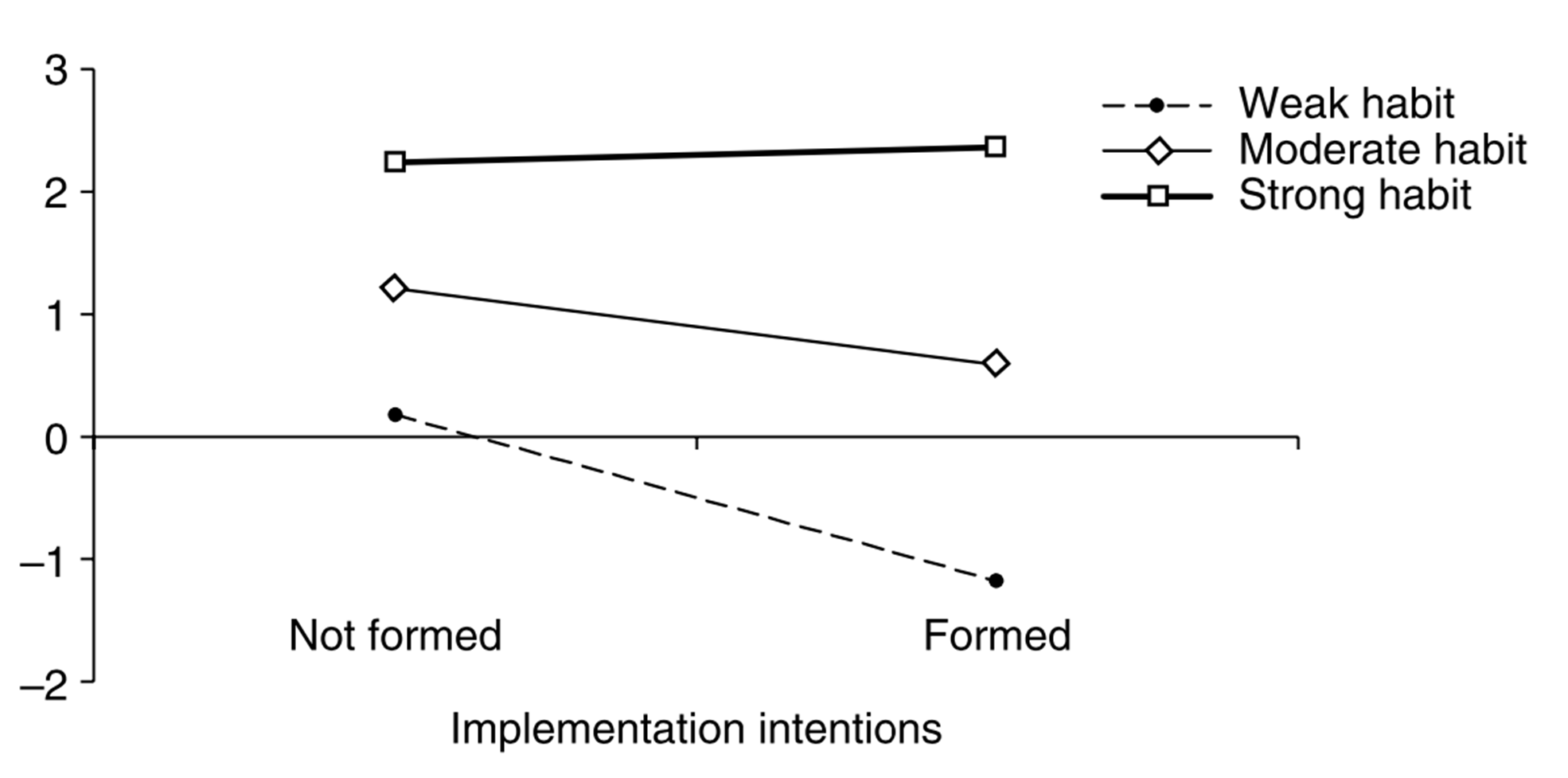
Moderating effect of the strength of the habit
Forming implementation intentions was effective in breaking habits but primarily for those with weak smoking habits
Moderate habits - almost no effect
Strong habits - no effect
Think about what the nature of the habits you are trying to break
May be boundary conditions to the effectiveness of some strategies