W20 Classification of Eye Deviations
 Call Kai
 Learn
Learn Practice Test
 Spaced Repetition
 Match
Match Flashcards
 Knowt Play
1/42

There's no tags or description
Looks like no tags are added yet.
Name | Mastery | Learn | Test | Matching | Spaced | Call with Kai |
|---|
No analytics yet
Send a link to your students to track their progress
43 Terms
What does binocular vision depend on?
Motor and sensory fusion
What is motor fusion?
Fusional vergence moving the eyes from passive to active positions (small movements) so that visual axes are aligned to the ideation object
What is sensory fusion?
Perceptual fusion of the impulses from both eyes occurring in higher levels of the brain
What is dissociation?
Disrupting binocular vision- normal processes of fusion cannot take place
How do we dissociate the eye?
Using an occluder to block one eye- brain only receives monocular input so sensory fusion cannot take place
Why does fusional vergence not occur in dissociation?
Absence of retinal disparity abolishes the fusion reflex so fusional vergence does not occur
What position does the eye under the occluder take?
Its passive position- this is dictated by:
Tonic vergence- if the other eye is fixating on a distant object
Proximal and accommodative convergence- if the other eye is fixating on a near object
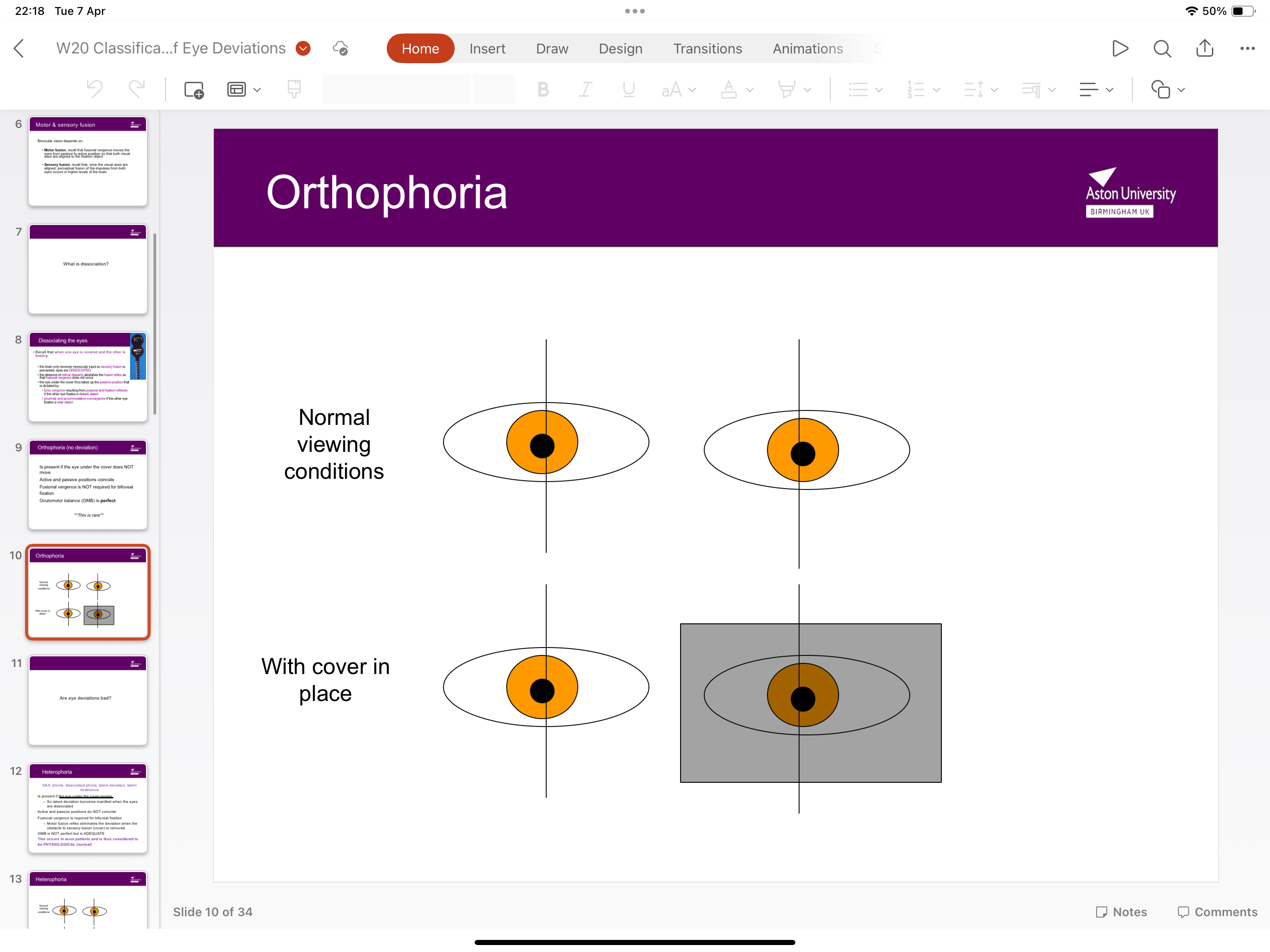
What is orthophoria?
NO deviation- eye under the cover will not move as passive and active positions coincide- fusional vergence is not required for bifoveal fixation- oculomotor balance is perfect
What are features of heterophoria?
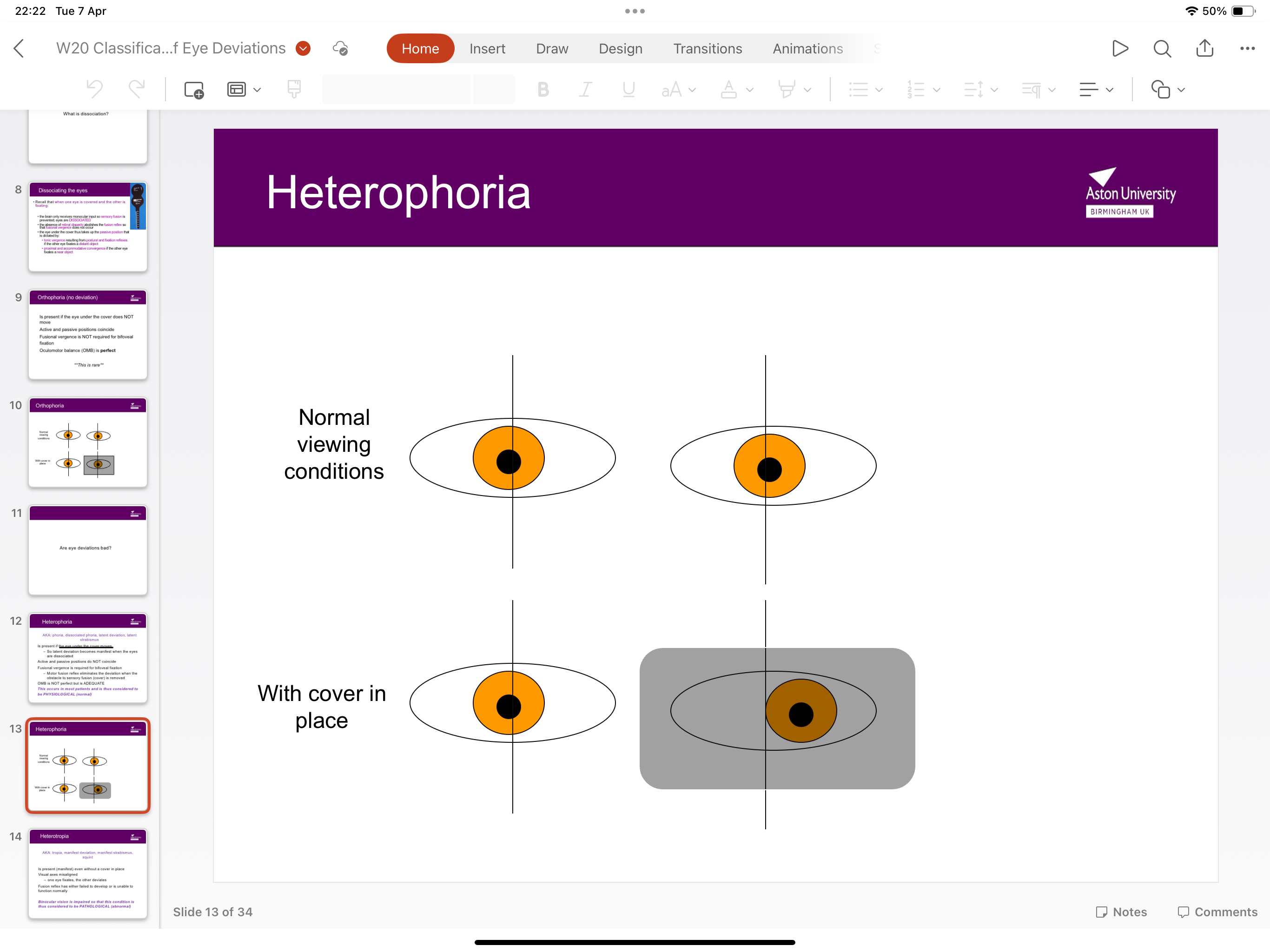
Latent deviation occurs when the eye is dissociated- active and passive positions do not coincide
The dissociated eye will move to its passive position
Fusional vergence is required for bifoveal fixation
Oculomtor balance is not perfect, but adequate
How is the heterophoria deviation eliminated?
Motor fusion reflex eliminates the deviation when the obstacle to sensory fusion (cover) is removed
What is heterotropia?
Pathological misalignment of the eye (present without a cover in place)
Visual axes is misaligned (one eye fixates, one eye deviates)- fusion reflex has either failed to develop or is unable to function normally
How do we classify heterophoria?
According to direction, magnitude, fixation distance and compensation
What are horizontal heterophoria’s?
Esophoria and exophoria
What are features of exophoria? (XOP)
Dissociated eye moves outwards
Visual axes are divergent when eyes dissociated- px must need to converge extra to compensate
Px has good positive fusional reserves to overcome phoria required for bifoveal fixation
What are features of esophoria? (SOP)
Dissociated eye moves inwards
Visual axes converge when eyes dissociated
Px has good negative fusional reserves/divergence to overcome the phoria required for bifoveal fixation
What is hyperphoria?
Visual axes are vertically misaligned when eye dissociates
What type of hyperphoria can you have?
Left hyperphoria or right hyperphoria
What is right hyperphoria?
If you cover the RE, it moves slightly upwards under the cover, if you cover the LE it moves slightly downwards- visual axes of RE is above LE
Px must be good at infravergence to maintain binocular vision
What is left hyperphoria?
If you cover the LE, the left eye will move up, if you cover the RE, the right eye will move downwards- visual axis of LE above that of RE
Px must be good at supravergence
What is cyclophoria?
Eyes rotate about visual axis when dissociated
Incyclophoria- upper poles of corneae rotate nasally
Excyclophoria- upper poles of corneae rotate temporally
How do we measure the magnitude of heterophorias?
Prism diopters (horizontal and vertical phorias), degrees (cyclophorias)
What are the typical range of values for fixation distance?
Distant measurements are approximately ortho, near measurements is reported to have physiological exophoria
What is basic heterophoria?
Distant phoria is equal to near phoria
What are exophoric deficiencys?
Convergence insufficiency- N XOP is bigger than D XOP
Divergence excess- D XOP is bigger than N XOP
What are esophoric deficiency’s?
Convergence excess- N SOP is bigger than D SOP
Divergence insufficiency- D SOP is bigger than N SOP
What is compensated heterophoria?
Adequate fusional reserves, no symptoms- MOST PHORIAS ARE COMPENSATED
What is uncompensated heterophoria?
Inadequate fusional reserves, may cause symptoms like asthenopia (eye strain)
What is a comitant deviation?
Deviation is constant in all directions of gaze
What is an incomitant deviation?
Deviation varies with direction of gaze, may be due to partial paralysis in origin/nerve supply supplying EOM
What are the different frequencies of tropias?
Constant or intermittent
What is a constant tropia?
Tropia is always present
What is an intermittent tropia?
Tropia is present some of the time, motor fusion can control tropia at certain times so it can become latent (heterotropia), may manifest with stress
What does laterality refer to?
Does it occur in one eye only (unilateral) or alternating eyes (alternating)
What is a unilateral tropia?
Px constantly fixates with the same eye, VA is often reduced in deviated eye- if this deviation develops in the critical period, this can cause amblyopia
What is alternating tropia?
Either eye can fixate- VA usually approximately equal in both eyes
What are the directions of different tropias?
Esotropia- deviating eye is convergent (SOT) inwards
Exotropia- deviating eye is divergent (XOT) outwards
Hypertropia- deviating eye is elevated
Hypotropia- deviating eye is depressed
What is the difference between incyclo T and encyclo T?
Incyclotropia- upper pole of cornea in deviating eye rotated nasally
Excyclotropia- upper pole of cornea in deviated eye rotated temporally
NO DIRECT TREATMENT EXISTS
What is basic heterotropia?
Distant tropia is equal to near tropia
What are exotropic deviations?
Convergence insufficiency- N XOT is bigger than D XOT
Divergence excess- D XOT is bigger than N XOT
What are esotropic deviations?
Convergence excess- N SOT is bigger than D SOT
Divergence insufficiency- D SOT is bigger than N SOT
What’s the age of onset of heterotropia?
Congential- present at birth/ after few months (not as common)
Acquired- onset during childhood/later in life (more common)
What is non-accommodative tropia?
Magnitude of tropia independent of amount of accommodation exerted
What is accommodative tropia?
Magnitude of tropia changes as accommodation exerted