Lecture 22: Principles of LA Soft Tissue Surgery
 Call Kai
 Learn
Learn Practice Test
 Spaced Repetition
 Match
Match Flashcards
 Knowt Play
1/23

There's no tags or description
Looks like no tags are added yet.
Name | Mastery | Learn | Test | Matching | Spaced | Call with Kai |
|---|
No analytics yet
Send a link to your students to track their progress
24 Terms
How is LA tissue different than SA?
thicker tissue
skin does not bruise
hemorrhage generally not a problem
What is the acceptable blood loss for horses during sx?
< 15% = no clinical signs, about 6L in 500kg horse
What percent of a horses body weight is their blood volume?
8%
What are the benefits of standing surgery for horses?
Prevents complications of being recumbent
Prevents risk of recovering from anesthesia
Better access for select structures (Dorsal)
Reduced cost
What are the benefits of equine recumbent surgery?
safer for surgeon
no movement = better control of surgical field
better access for most structures
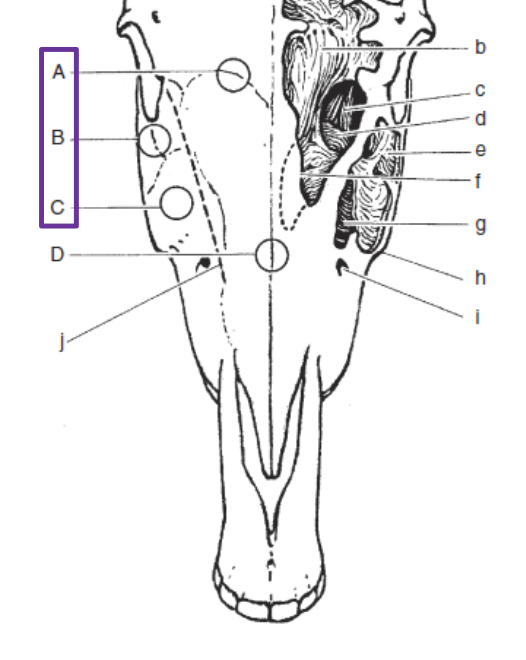
What are A, B, and C?
sinus trephination sites
What are the considerations for healing from equine URT sx?
mucosa heals rapidly
potential for mucosal “webbing” (requires later revision)
What are the common complications of URT surgery?
excessive swelling that blocks airway
damage to nearby structures (cranial nerves)
surgeries that are (re)opening airway
too large of opening → aspiration
too small of opening → problem not corrected
sx site infection
What diagnostics are included in a “colic work up”?
Rectal palpation
Abdominal U/S
Abdominal radiographs
Nasogastric tube intubation
Abdominocentesis
Bloodwork
What are the approaches for a celiotomy?
Ventral midline – most common
Paramedian – right side
Paralumbar fossa - uncommon
Laparoscopic portals
What are the common GI procedures done in LA?
exploration
de-rotation
enterotomy
resection and anastomosis
biopsy
What is the major cause of post-operative colic and death after GI surgeries?
intra-abdominal adhesions - a dysfunction of fibrinolysis
What are the ways to reduce intra-abdominal adhesions?
Gentle handling of tissues – avoid excessive handling
Keep tissues moist
Use of lubricants (carboxymethylcellulose)
Strict asepsis
Prevent blood from entering abdomen - Flush abdomen if needed!
do NOT use dry gauze EVER
What are the most common post-surgical complications after a GI procedure in horses?
adhesions
hemoabdomen
peritonitis
ileus
diarrhea
endotoxemia
incisional infections
What are the common urogenital procedures in male horses?
castration
cryptorchid castration
urolithiasis
penile injuries & problems
preputial injuries & problems
inguinal hernia
What are the common urogenital procedures in female horses?
repair foaling injuries
correct vaginal conformation
ovariectomy
What is the common urogenital procedure in foals?
bladder rupture
What are the different approaches for an equine ovariectomy?
• Laparoscopy
• Flank
• Vagina
• Ventral midline celiotomy
What special surgical considerations need to be evaluated for equine urogenital procedures?
may need to catheterize bladder
function is important outcome
challenging approaches: small spaces, bladder difficult to access in adult horse
What considerations for healing need to be evaluated for equine urogenital procedures?
stricture formation or breakdown of repair
back end of mare has a lot of contamination = repair breakdown common
can create a perineal urethostomy to give distal urethra a rest
What are the common uses for equine laparoscopy?
cryptorchidectomy: usually done in dorsal recombency, but can be done standing; trendelenburg position
ovariectomy: usually done standing
explore abdomen in chronic cases: usually done standing
What are the pre-operative considerations for laparoscopic procedures in equids?
withhold feed: space in abdomen, less weight on diaphragm if in Trendelenburg position
NSAIDs
Antibiotics
What are the general complications associated with equine laparoscopic procedures?
subcutaneous emphysema
retroperitoneal insufflation
bowel perforation
hemorrhage: body wall incisions, mesovarium or mesorchium, ligature slippage
How is a laparoscope placed?
abdomen insufflated with CO2 (8-12 mmHg)
blind stab incision made to place scope portal
scope introduced through portal that maintains pressure in abdomen
remaining portals created with visualization from scope: generally need 3 total- 1 scope & 2 instrument portals