Cogn & perception: chem senses (smell) w3
 Call Kai
 Learn
Learn Practice Test
 Spaced Repetition
 Match
Match Flashcards
 Knowt Play
1/45

There's no tags or description
Looks like no tags are added yet.
Name | Mastery | Learn | Test | Matching | Spaced | Call with Kai |
|---|
No analytics yet
Send a link to your students to track their progress
46 Terms
Smell fucntions
warns of danger
Makes food taste better
Identification of disease, gender
Sexual communication?
Smell and disease
smell nail polish breath diabetic
Foul smell of lung absess
stale beer stench of scrofula
baked bread odor of typhoid fever
windex smell of liver failure
Smell and taste Mozel 1969
percentage of ppl who can identify food by smell
High on coffee, lemon, whiskey
sugar water was lower
chocolate pretty high too
lemon pretty high
garlic lower
Reognition by smell
better idetnification of food by taste. Enhances taste of food
Women outweigh men in smell. Out of stimuli tested, 65 women were better, 15 men were better
The olfactory pathways
taken in in olfactory mucosa at base of the brain. Cilia of olfactory receptor cells take in.
nose —) olfactory mucosa (cilia —) olfactory receptor cell —) axons —) neuron) —) olfactory bulb
Rhineencephalon (nose brain)
olfactory bulbs (coding of odour)
Amygdala (emotional)
Hippcampus (memory)
The olfactory pathway process
Nose —› olfactory bulb —› hypothalamus —› pituitary gland —› reproductive organs
The olfactory pathways
short links between incoming olfactory info and hippocampus —) olfaction in memory
olfactory info and pituitary gland —) reproductive behaviour
The Proust Effect
smell very good at evoking memory. long lasting in time and place
Smell and memory (Shepard 1967 + Engen & Ross 1973)
Pictures - clear retention, correct recognition detailed at first, but quickly drops off
less accurate recognition, but stays for longer with smell
Otherrr
Inuit - rub noses, rub palms
Certain indian languages ”kiss” meaning - request for a kiss = please smell me
Europeans, cheek kisses
Pheromones (bringer of excitement in greek)
chemicals used in animals for communication
Dispersers - mark territory
Aggregators - sexual attractors (pigs, moths, deer)
Pig on a truffle hunt (Dorries et al 1996)
pheromones in male pigs. Used for truffle hunt
Female pig for threshold for androstenone is 5-fold lower than make
Human pheromones??
Apocrine glands produce steroids (androstenes)
Forehead, nose, lips, ear lobes, genitals etc
Do we detect pheromones? Not sure
Are body odours important? Yes
produced on puberty and onward
Sweaty vest study (1976 Russell)
wear clean white shirt, shower with non perfume soap, not eat spicy foods, no aftershave etc
Had ppl identify own vest vs others, male vs female
Women better at it
Mentrual cycle synchrony (1971)
11 female subjects (6 dropped out)
1 female donor
4-5 synchronised with donor female subject
Why do we mask our odour with perfume?
many perfumes use other animal pheromones
- civetone - anal glands of civets
- musk - anal glands of male musk deer
who knows?? the slides sure as heck not and my notes sure as heck not
Milinski & Wedekind (2001)
137 subjects into 3 immune system types
Tested preferences in perrfumes
Rose, civet, vanilla, bergamot, etc…
There is a correlation between immune type
ppl choose their perfumes to complement their body smell and to advertise their genes
Body odour for distinguishing…?
can distinguish genders, family etc
self from others
women prefer the scent of men with a different immune system (sounds heteronormative but okay)
Perception of colour - what is it for?
SCENE SEGMENTATION colour aid distinguishing different environments and arguemnts
CAMOUFLAGE Different animals that may camoflage
PERCEPTUAL ORGANISATION ,illustrate powerr of color in grouping
How do we perceive colour?
The colour isnt in our external environment itself, its about how we perceive it
Will we all perceive red the same?
Dimesion of colour
wavelength —› hue or colour
Intensity —› brightness
Mixture —› saturation
Colour tree
hue (around)
Saturation (radius)
Brightness (up and down)
After image
eyes have 3 colour receptors (blue red green)
Staring at the image, fatiguing different cones
Ex: purple grass - red and blue are fatigued. Green isn’t fatigued and is cleared
May not always see it bc it must fit just right on the retina of the old image
Neurons habituate - not continually processing same stimuli bc tiring. Happens in touch as well (aren’t thinking about how your clothes are touching you all the time)
Trichromatic colour theory or Yong Helmholtz theory
IMPORTANT FOR MCQ!!
the combined responses of 3 receptors give rise to the perception of all colours
evidence:
any colour can be made up by an additive mixture (mixing lights) of 3 primary colours
Three cone types in retina
There are types of colour blindness where 1 cone type is missing
Computer use colour mixing on screens (old ones)
Pointillism (painting made up of tiny dots)
3 diff wavelengths that the cones take in
but why do we experience after images?
Opponent process theory (Hering)
2 opponent processes
red green, blue yellow, black white
one fatigued, the other dominates. it’s a scale between one dimension or the other
Evidnce:
there is no reddish green, No bluish yellow
Common colour blindness is red-green or blue-yellow. (also red-green is most common, 5% of males)
Complementary nature of after images
Retinal ganglion cells code colour in an opponent mater
Ganglion cells code colour
three cones, opponent process mechanism
Yellow light stimulates red and green cones etc
Colour and the cortex (Pearlman et al 1979)
male patient w/ v4 lesion (ventral pathway)
Poor colour matching. Problems with choosing clothes, ripe fruit, sees life in shades of gray
Oliver Sachs interview
the case of the colourblind painter
Tomatoes black, had to close eyes to eat bc all of it looks bac
Perception of colour summary
mapping of wavelength
We need both opponent and trichromatic theories to understand colour (stage 1: trichromatic. Stage 2: brain subtracts signals from each other, (if fire for green but stops for blue, separated?)
Conscious perception of colour in cortex
The puzzle of depth perception
how construct 3D from 2D retinal perception?
How do we know true size of any object?
(IMPORTANT FOR MCQ ANSWER THESE)
The principal monocular depth cues
depth cues: monocular cues, binocular cues
Monocular: pictorial cues (photos, drawings), motion parallax)
Pictorial: interposition, size, linear perspective, texture, haze, shading, elevation
Binocular: convergence, retinal disparity
Occlusion/interposition
when something is covered, believed to be in the back
Elevation or height
higher = further back
Reative size
Bigger object is closer
Linear perspectives
further away = smaller
parallel lines converge at a vanishing point
Aerial perspective
further images travel through atmosphere, more distant less colur. faded like distant mountains
Light and shade
creates depth through light and shadows
Why pictorial cues effective?
mimics irl
we interpret pictorial cues in art in the same way we interpret 2D retinal image
Size constancy
our perception of size of objects is relatively constant. Estimate of distance
When perception of stiance is wrong, size constancy breaks down
Seen in moon illusion and Ames room illusion (IMPORTANT)
Moon illusion
moon looks larger by horizon than in the sky
we have a bad understanding of how far the moon is
objects on the landscape suggest to us that the moon is very far away but for the zenith moon, there are no cues for distance. we assume it is closer this way
moon subtends the same retinal image in both cases, we erroneously perceive a small (zenith) and a large (horizon) moon
Gibson’s visual Cliff Experiment
Gisbon and Walk
Put kids on visual cliffs
Kids encouraged to climb over cliff, small crawling kids mostly said no
babies with more crawling experience avoid it more
suggests human experience plays a role in perception of depth in humans
6 month old
(1960)
Smell & taste known as
chemical senses
near senses
the minor senses (okay Kant, 1798)
What are men better at?
mothballs, beer, ivory soap, bananas, brut afershave, bourbon, sherry, black pepper, rasperry syrup, sardines
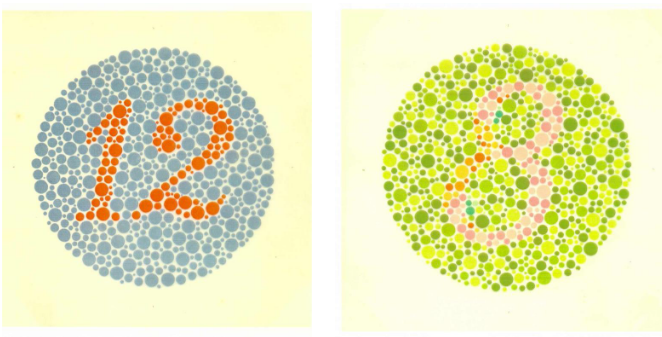
Ishihara Colour Blindness test
the numbers and colours thing
The perception of colour & the theories
colour and hue are psychological attributes of the wavelength of light
our perception of colour (hues we can discriminate) reflect neural coding of both trichromatic & opponent process nature
conscious perception of colour is based in cortex