Benefits of Trade
 Call Kai
 Learn
Learn Practice Test
 Spaced Repetition
 Match
Match Flashcards
 Knowt Play
1/15

There's no tags or description
Looks like no tags are added yet.
Name | Mastery | Learn | Test | Matching | Spaced | Call with Kai |
|---|
No analytics yet
Send a link to your students to track their progress
16 Terms
Benefits of trade (9)
- availability of goods and services
- increased competition
- productive efficiency
- allocative efficiency
- learning
- access to markets
- economies of scale
- production costs
- source of foreign exchange
benefits of trade: availability of goods and services
- consumers and businesses can access goods/ services that cant be produced domestically
benefits of trade: increased competition
- markets have become more competitive as businesses from different countries enter markets
- benefits consumers: market competition = lower prices + greater choice of goods/ services
benefits of trade: productive efficiency
- foreign competition in domestic markets means domestic producers strive to be more productively efficient = produce at lowest possible cost
benefits of trade: allocative efficiency
- a domestic country no longer has to be producing goods which have a high cost of production because they can import from another country which has lower costs of production for those goods, instead domestic country can focus on producing goods it is efficient at producing
benefits of trade: learning
- domestic firms can learn from production techniques of foreign competitors = increasing efficiency
benefits of trade: access to markets
- export markets offer firms huge increase in potential revenues compared to selling only in their domestic markets
benefits of trade: economies of scale
- by exporting to intl market, firms face greater demand so they can achieve economies of scale when increasing production = cost per unit falls
benefits of trade: production costs
- access to imported inputs/ raw materials at a lower cost = lower production costs
benefits of trade: source of foreign exchange
e.g. by selling exports to US, developing country earns US $ which it can use to buy imported capital from the US = long-term growth
The theory of specialisation
- explains gains countries get from specialisation in intl trade
Absolute advantage
Comparative advantage
Absolute advantage
when one country is more productively efficient (with the same quantity of FoPs it can produce more of the good than another country) at producing a good than another country
- one country produces more units of good x and the other country produces more units of good y
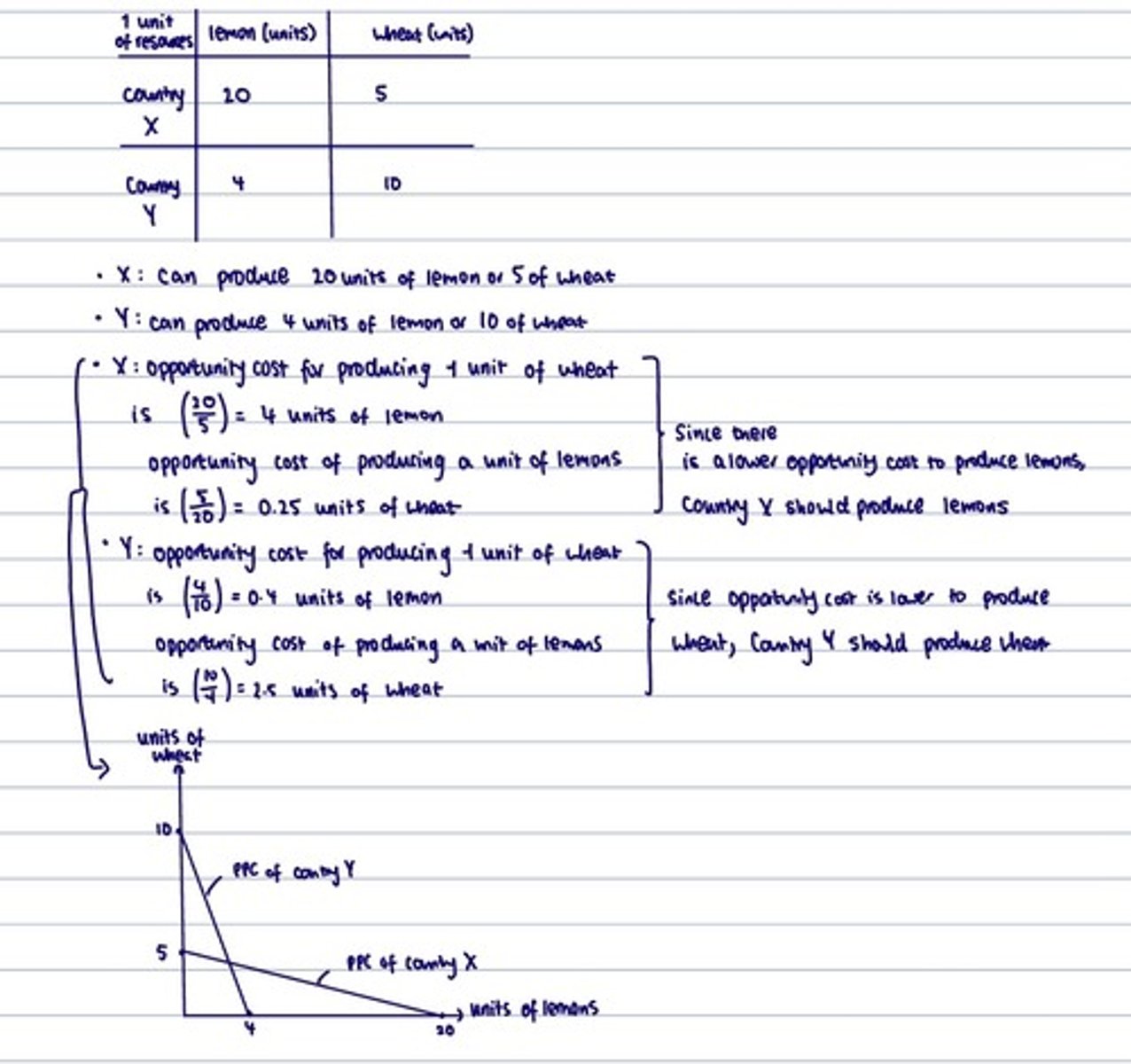
Absolute advantage - example: Country X: 20 lemons or 5 wheat, Country Y: 4 lemons or 10 wheat - draw table and PPC
Comparative advantage
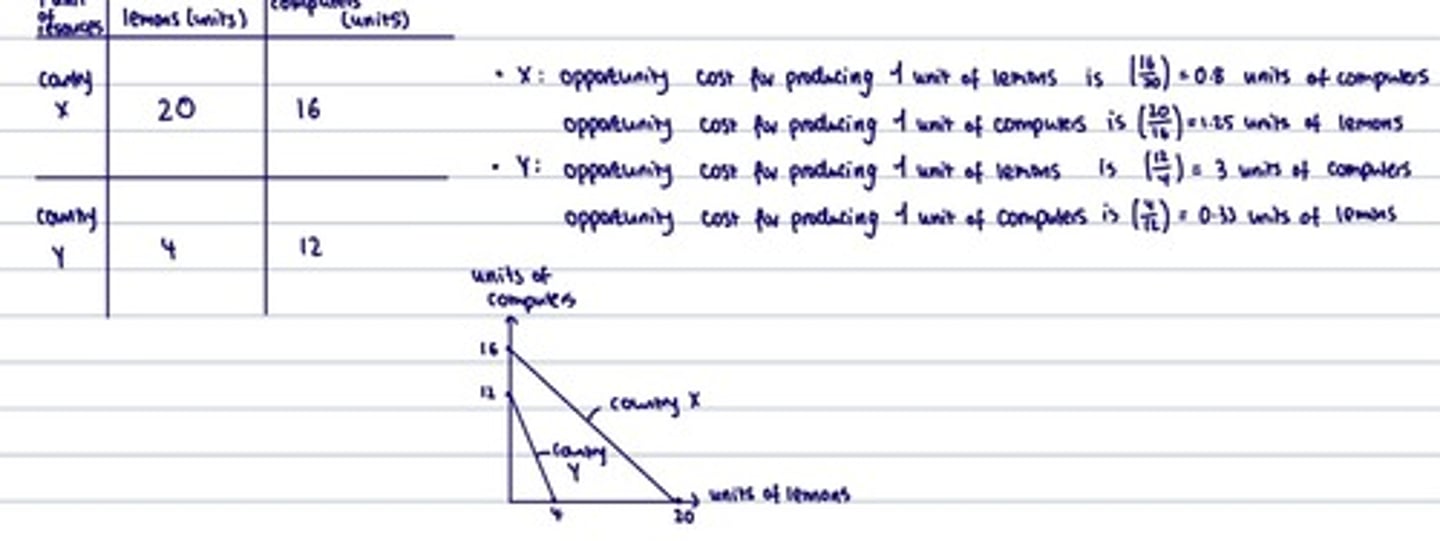
- one country has a lower opportunity cost of producing a good than another country
- however there are still efficiency benefits from trade because the countries have different opportunity costs of producing the two goods
ie. one country can produce more of good x and of good y but it will still trade with the other country because there is an opportunity cost if it is producing x instead of just y
Weaknesses of the model
- specialisation is more complex than the two-industry, two-country model
- model assumes zero transport costs
- gains from specialisation are constantly changing
- as specialisation occurs in a country and an industry grows, productive efficiency may improve as the industry benefits from economies of scale
Still learning (2)
You've begun learning these terms. Keep up the good work!