Psych Terms - Exam 3 (FINAL - not accumulative)
 Call Kai
 Learn
Learn Practice Test
 Spaced Repetition
 Match
Match Flashcards
 Knowt Play
1/111

There's no tags or description
Looks like no tags are added yet.
Name | Mastery | Learn | Test | Matching | Spaced | Call with Kai |
|---|
No analytics yet
Send a link to your students to track their progress
112 Terms
Major issues in developmental psych
nature and nurture, continuity and stages, stability and change
Continuity vs. Stages
Is development a gradual, continuous process or a sequence of separate (can be predisposed) stages?
Stability and Change
Do our early personality traits persist through life, or do we become different persons as we age? (life requires both)
cross-sectional research
research that compares groups of people who differ in age but are similar in other aspects (ex. air pollution w/ diff aged pgh residents)
Longitudinal Research
A research design in which the same individuals are followed over time and their development is repeatedly assessed.
Stages of Prenatal Development
germinal, embryonic, fetal
germinal stage
2 week period that begins at conception
Zygote
the fertilized egg; it enters a 2-week period of rapid cell division and develops into an embryo
embryonic stage
2nd-8th week, when organs begin to form, up to 25% die
Fetal stage
3rd stage, lasts from the ninth week until birth, after 3rd month can see sex organs (only weighs 3oz at 3in long)
Stages of prenatal development: months 4-6
Huge brain development, age of viability (can survive on own if born)
Stages of prenatal development: months 6-9
Lungs, heart, arteries, and veins mature; fetus gains about 4.5 pounds
Stages of prenatal development (28th week, around 7th month)
auditory communication from mother to child (can hear voices/music etc)
Factors affecting prenatal development - check slide 15ish
- Teratogens - substances that cause birth defects
o Drugs and Alcohol
o Medications
o Diseases
o Critical period - period of prenatal development when a particular structure is vulnerable (?)
When do you have the maximum number of neurons?
at birth, but not enough neural connections
Sequence of motor development
Roll over, sit, crawl, walk, run (identical twins start walking on same day often)
cognition
all the mental activites associated with thinking, knowing, remembering, and communicating
Jean Piaget's Theories + Psychological Contributions
Stages of cognitive development, schemas, assimilation, accommodation
Name of cognitive development stage from Birth - 2 years
Sensorimotor (lack object permanence ex. peek-a-boo)
Name of cognitive development stage from 2-6/7 years
Preoperational (pretend play, egocentric, lack concept of conservation - think of glasses same height diff sizes same amt)
Name of cognitive development stage from 7-11 years
Concrete operational (begin to grasp conservation and math)
Name of cognitive development stage from 12-adulthood
Formal operational (capable of abstract thinking)
attachment
emotional tie with another (monkeys more drawn to comfort than nourishment)
insecure attachment
extra clingy or apathetic children (usually towards insensitive or neglectful mothers)
parenting styles:
authoritarian (Strict), permissive (spoiling), uninvolved, authoritative (resopnsive but demanding)
Kohlberg's stages of moral development
pre-conventional (self-interested, before 9), conventional (social appeal, early adolescence), post-conventional (ethical principles, adolescence + beyond)
Erikson's stages of psychosocial development
Infancy: trust vs. mistrust
Toddlerhood: autonomy vs. shame and doubt
Preschool: initiative vs. guilt
Elementary school: industry vs. inferiority
Adolescence: identity vs. role confusion
Young adulthood: intimacy vs. isolation
Middle adulthood: generativity vs. stagnation
Late adulthood: integrity vs. despair
crystallized intelligence vs fluid intelligence
our accumulated knowledge and verbal skills; tends to increase with age vs active recall (Decreases with age)
Psychodynamic theories
Id (unconscious psychic energy), Superego (internalized ideals), and ego (executive mediator)
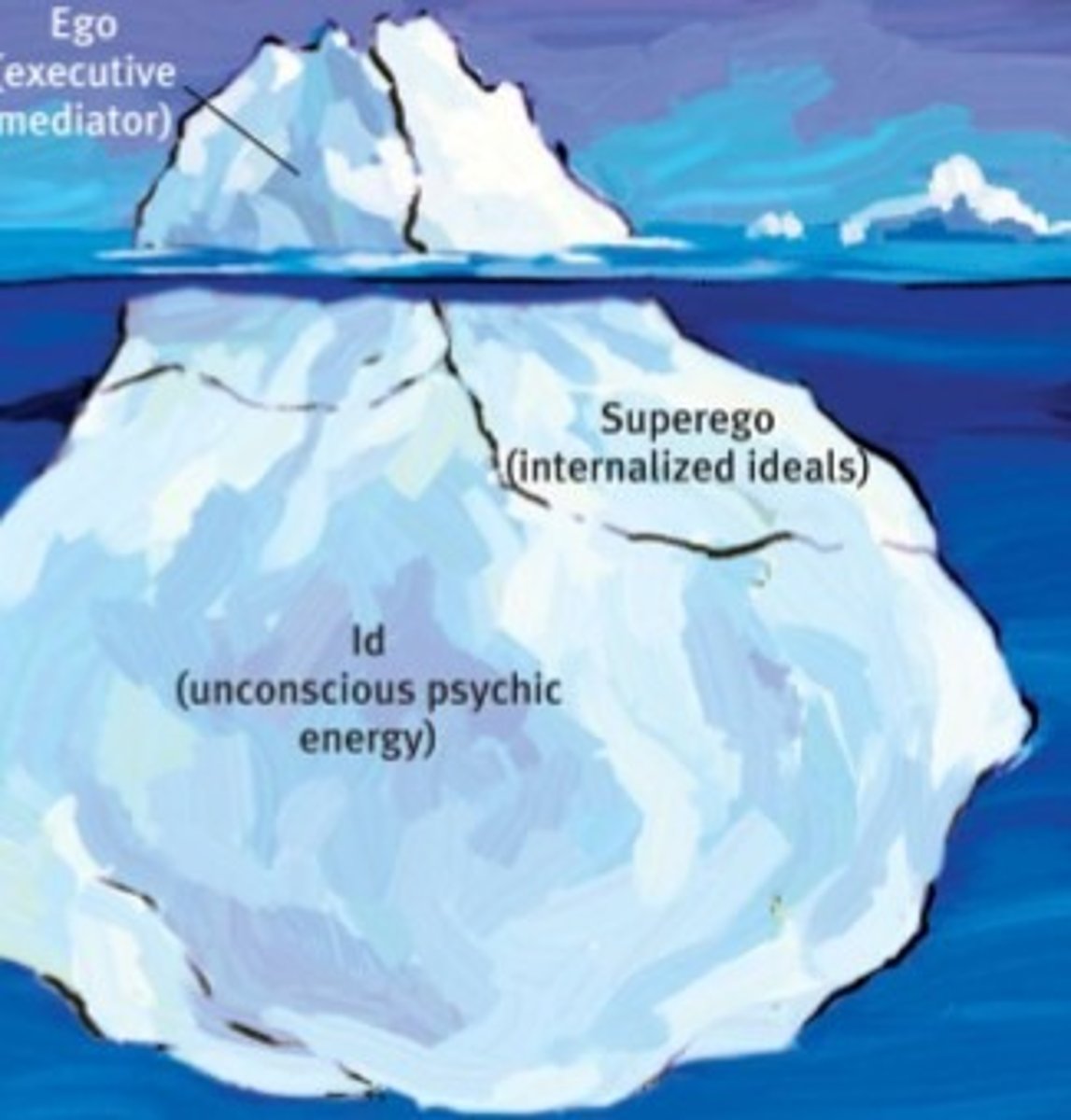
Id (unconscious psychic energy)
a reservoir of unconscious energy that, according to Freud, aims to satisfy basic physical and sexual urges, operates on the pleasure principle (Example: having a desire to hit the vape on the ground)
Superego
ideal self, moral compass, judge, conscious
ego
middleground between ID and superego, operates on reality principle, balance between both
psychosexual stages (freud)
the childhood stages of development (oral, anal, phallic, latency, genital) where the id's pleasure-seeking energies focus on distinct areas
Oral Stage (0-18 months)
pleasure centers on the mouth- sucking, biting, chewing
Anal Stage (18-36 months)
pleasure centers on their bowel and bladder movements
Phallic Stage (3-6 years)
please arises from incestual urges, which makes us have to differentiate between romantic and platonic/family relationships
first 3 psychosexual stages
Oral, anal, and phallic
Latency (6-puberty)
dormant (inactive/sleeping) sexual feelings
Genital (puberty on)
maturation of sexual interests in light of lessons and societal expectations from previous stages
defense mechanisms
repression, regression, reaction formation, projection, rationalization, displacement, denial
Repression (defense mechanism)
blocking of unpleasant feelings and experiences from ones awareness, underlies other defense mechanism
Regression
slipping to an earlier stage of development when faced with stress (Ex. age regression -- hugging stuffed animals with painful operations)
Reaction formation
Defense mechanism by which people behave in a way opposite to their usual self (overly nice to someone you dont like - mom)
projection
disguising one's own threatening impulses by attributing them to others
Rationalization
offers self-justifying explanations in place of the real, more threatening, unconscious reasons for one's actions
Displacement
psychoanalytic defense mechanism that shifts sexual or aggressive impulses toward a more acceptable or less threatening object or person, redirecting anger toward a safer outlet, (instead of yelling at your mom, critique your father, "taking it out on someone else")
Denial
refusing to believe or even perceive painful realities (ex wouldn't cheat on me! jk bro why tf would he be at evas dorm and wear her clothes otherwise)
Psychodynamic theorists
Freud, Carl Jung, Alfred Adler, Karen Horney
Carl Jung's theories
Collective unconscious, archetypes
Carl Jung: Collective Unconscious
shared, inherited reservoir of memory traces from our species' history and genealogy
Carl Jung: Archetypes
father figure, mother earth, reveals how connected we are as humans
Alfred Adler
inferiority complex
Alfred Adler: inferiority complex
innate sense of inferiority and strive to overcome deficiencies by becoming superior, some struggling with these feelings throughout their life and others challenge and reject them as they grow by striving for superiority
Karen Horney
Childhood anxiety triggers desires for love and security, coping styles
Karen Horney and basic anxiety
a sense of uncertainty and loneliness on a hostile world and can lead to maladjustment, induces a craving for love and security (if not then deals with it by coping styles)
Projective Tests
Rorschach inkblots, thematic apperception task (tat)
Rorschach inkblot test
a projective technique in which respondents' inner thoughts and feelings are believed to be revealed by analysis of their interpretations of unstructured inkblots
Thematic apperception task (slide 19)
respondents write a story in response to a picture; used to measure motives including the need for affiliation, for power, and most often, achievement
Abraham Maslow's Hierarchy of Needs
physiological, safety, love/belonging, esteem, self-actualization
Maslow's Hierarchy of Needs: Physiological
breathing, food, water, sex, sleep, homeostasis, excretion
Maslow's Hierarchy of Needs: Safety
security of body, employment, resources, morality, family, health, property
Maslow's Hierarchy of Needs: Love/belonging
friendship, family, sexual intimacy
Maslow's Hierarchy of Needs: Esteem
Self-esteem, confidence, achievement, respect of others, respect by others
Maslow's Hierarchy of Needs: Self-actualization
morality, creativity, spontaneity, problem solving, lack of prejudice, acceptance of facts
Carl Rodgers
growth-promoting climate of genuineness, acceptance, and empathy
Gordon Allport's Trait Theory
people have traits that make up personality
Allport's definition of trait
a characteristic behavior or a disposition to feel and act
The big 5 factors of trait theories
Conscientiousness, agreeableness, neuroticism, openness, extraversion
Conscientiousness
Organized, careful, disciplined
Agreeableness
soft-hearted, trusting, helpful
Neuroticism
anxious, insecure, self-pitying
Openness
imaginative, prefers variety, independent
Extraversion
sociable, fun-loving, affectionate
Social-Cognitive Theories
incorporate traits and social context
Reciprocal determinism
behavior, internal cognition, and environment interact to influence personality
What is the best way to predict behavior of a situation?
Past behavior in similar situations
The spotlight effect
feeling like everything revolves around you/everyone is looking at you
Self-serving bias
we tend to perceive ourselves favorably (tend to take credit for the good, blame others for the bad, and see ourself as above average)
narcissism
excessive self-love
Cultural Influences - Individualism and collectivism
people from individualistic cultures tend to be more independent and seek progress for their own life, people from collectivistic cultures tend to be more socially responsible and link their identity to a group (e.g., family).
social psychology
the scientific study of how we think about, influence, and relate to one another
attribution theory
the theory that we explain someone's behavior by crediting either the situation or the person's disposition
fundamental attribution error
underestimate the impact of the situation and to overestimate the impact of personal disposition (assume it has to do with character)
peripheral route persuasion
uninformative cues, fast results, no systematic thinking (Sydney sweeney's jean ad)
Social thinking
offers evidence, best with those involved, durable results (burger king ceo eating burger ad)
Foot-in-the-door technique
tendency for people who have agreed to something small to agree to something bigger after (can i go out with friends? can i have cash for it? yesyes)
Door-in-the-face technique
tendency for people comply with a request that seems smaller than the first request (can i sleepover there? ok can i just hangout? noyes)
cognitive dissonance
when behaviors clash with beliefs (nurse smoking cigs)
cultural norms
rules for accepted and expected behavior
Asch's studies
Conformity- people don't like to contradict the opinions of a group (which is the longer line, clap when others do, cult anonimity)
Normative conformitive
wanting social approval (don't wanna be outcase/exception)
informational conformity
wanting to be correct (not trusting self)
Obedience - milgram's experiment
over 60% of participants produced harmful shock to the most extreme level "because they were told to" (gestapo inhumanity vibes/cult motivated killers)
Bystander effect
Diffusion of responsibility, pluralistic ignorance (when others don't do anything we assume we don't know whats going on)
Social loafing
tendency to work less hard when in a group
Group polarization
group becomes more radical as each person agrees with each other
Groupthink
not wanting to disturb others, losing critical thinking skills (cult)
just world phenomemon
world is just and people get what they deserve (stereotypes can help rationalize systemic inequalities)
in group + out group bias
favoring those similar to us even if it leads to cognitive dissonance
scapegoat theory
the theory that prejudice offers an outlet for anger by providing someone to blame