Evaluae the viw that referendums have a positive impact on democracy and politics in the UK
 Call Kai
 Learn
Learn Practice Test
 Spaced Repetition
 Match
Match Flashcards
 Knowt Play
1/7

There's no tags or description
Looks like no tags are added yet.
Name | Mastery | Learn | Test | Matching | Spaced | Call with Kai |
|---|
No analytics yet
Send a link to your students to track their progress
8 Terms
Introduction
a referendum is a popular vote on a particular issue, usually requiring aa yes/no vote eg. 2016 EU Referendum
in the UK, there is no constitutional mechanism requiring them to be held, instead the prime minister call when when they think it is right
Paragraph Focus
Para 1 = Representative democracy
Para 2 = Referendum’s Purpose
Para 3 = Turnout and Political Awareness
Para 1 = Weaker Argument - Negative Impact
it can be argued that the direct democracy of referendums are a challenge to representative democracy in the UK.
The UK political system is based on voters electing professional representatives to take decisions on their behalf
It can be argued that ordinary people lack the expertise to make decisions on complex issues
questions and campaigns can be easily misled by campaigns and political leaders
For example, the likely future level and negative impact of EU immigration to the UK was overstated by the Leave campaign
Para 1 = Stronger Argument - Positive Impact
It can be argued that referendums benefit democracy in the UK by directly involving the people in decision making on important issues
The 2014 Scottish Independence Referendum is a good example of this….
This shows that referendums have a positive impact as it gives the people decision making power over key constitutional issues
this gives them real power in democracy and prevents their wishes being ignored by representatives, preventing a elected dictatorship
Para 2 = Weaker Argument - Negative Impact
the holding of referendums has also been influenced by political party motivations
This can be seen as negative for democracy and politics as it leads to important constitutional issues being decided in order to benefit individual parties at a specific time
this can be said of the 2016 Brexit referendum, which aided Cameron's Conservative Party.
In the run up to the 2015 election, the rise of UKIP risked the Conservatives losing a lot of votes
Pledging to hold an EU Referendum in the 2015 election campaign enabled the Conservatives to maintain the support of many important voters and win the 2015 election
Para 2 = Stronger Argument - Positive Impact
Referendums are also sometimes called to give legitimacy to key constitutional issues.
Referendums give constitutional changes legitimacy and ensure they're unlikely to be reversed, even though the UK has an uncodified constitution.
The devolution referendums in Scotland, Wales and Northern Ireland are good examples of this, ensuring the new devolved bodies had legitimacy
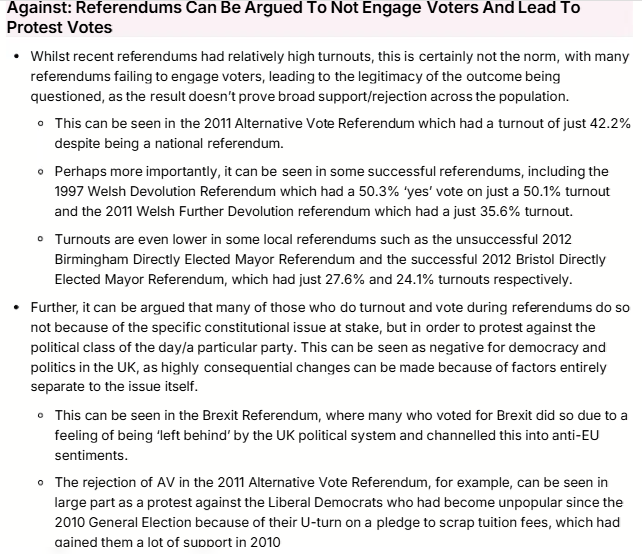
Para 3 - Weaker
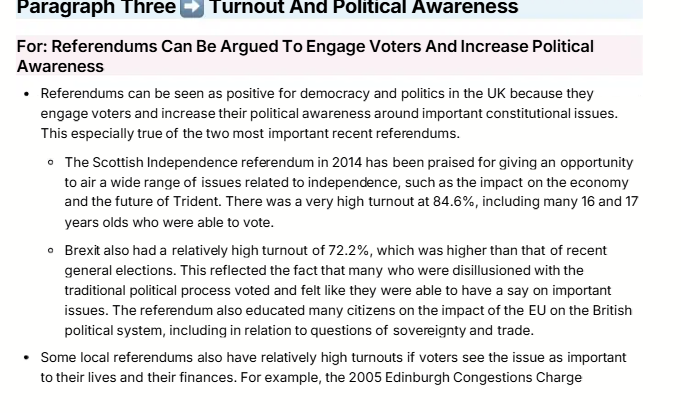
Para 3 - Stronger