ec204 microeconomics
 Call Kai
 Learn
Learn Practice Test
 Spaced Repetition
 Match
Match Flashcards
 Knowt Play
1/13

Earn XP
Name | Mastery | Learn | Test | Matching | Spaced | Call with Kai |
|---|
No analytics yet
Send a link to your students to track their progress
14 Terms
assumptions of preferences
completeness, transitivity, monotonicity, continuity, convexity
assumptions of preferences: completeness
the idea that consumers can rank all possible bundles of goods; agents are never indecisive
assumptions of preferences: transitivity
the principle that if a consumer prefers bundle A over bundle B and bundle B over bundle C, then they must prefer bundle A over bundle C, ensuring consistent choices; no possibility of cycles
assumptions of preferences: monotonicity
the idea that more is better; consumers will always gain more utility from a greater quantity of a good in their bundle
assumptions of preferences: continuity
the idea that small changes in bundles will not change the ordering of preferences
assumptions of preferences: convexity
averages, or a balanced combination of goods, are better than extremes of just one good
assumptions of rational preferences
completeness, continuity, and transitivity
assumptions of well-behaved preferences
monotonicity and convexity
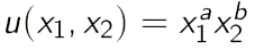
types of preferences: cobb douglas
utility function where the consumer wants a balance between the two goods; more of either good increases utility, and a and b>0;
types of preferences: perfect complements
utility function for when goods are only useful when consumed together in fixed proportions

types of preferences: perfect substitutes
utility function for when the consumer views the goods as interchangeable; one unit of x1 can replace another fixed amount of x2

types of preferences: quasi linear
the consumer cares strongly about one good in a nonlinear way, while the other good enters utility linearly; 'v' represents a generic function, such as a log, square root, or power

types of preferences: homothetic
a utility function is homothetic if it is a monotonic transformation of a homogeneous function; the ratio of goods demanded stays constant as income changes
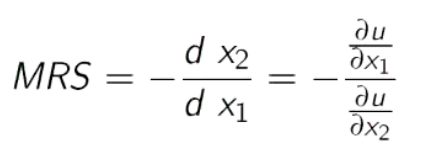
marginal rate of substitution [MRS]
the derivative/slope of a tangent point on an indifference curve = MRS; shows how goods need to be swapped or traded to remain indifferent