PSYC221 Test 3
 Call Kai
 Learn
Learn Practice Test
 Spaced Repetition
 Match
Match Flashcards
 Knowt Play
1/37

There's no tags or description
Looks like no tags are added yet.
Name | Mastery | Learn | Test | Matching | Spaced | Call with Kai |
|---|
No analytics yet
Send a link to your students to track their progress
38 Terms
what is a group?
a collection of people that can vary in structure, purpose, and connection, but often involves interaction, shared goals, or identity
What are the types of groups?
Intimacy groups (family, friends, romantic partners)
Task groups (committees, sports teams, bands, classes)
Social categories (high school cliques, religious groups, gender)
Loose associations (same neighborhood, same music taste)
what are intimacy groups?
close, personal relationships (family, friends, romantic partners)
what are task groups?
groups formed to accomplish a goal (teams, committees, classes)
what are social categories?
groups based on shared identity (gender, religion, cliques)
what are loose associations?
weak connections (same neighborhood, shared interests)
entitativity (What makes a group feel like a “group”?)
the extent to which a collective feels like a cohesive, unified group
common bond (What makes a group feel like a “group”?)
how much group members interact with and depend on each other
communal sharing vs. market pricing? (What makes a group feel like a “group”?)
communal sharing: a norm where resources are shared freely (e.g., “what’s mine is yours”)
market pricing: a norm based on reciprocal exchange (“I scratch your back, you scratch mine”)
Common identity
a shared sense of “we” through goals, synbols
Why do people join groups? (What do groups give us?)
promoting survival
achieving goals
reducing uncertainty
reinforce cultural worldviews
how do groups promote survival?
they help humans adapt and work together to survive challenges
how do groups achieve goals?
they allow cooperation on complex tasks
how do groups reduce uncertainty?
they provide clarity about ourselves and others
evolutionary function of groups (promoting survival)
evolutionary perspective explains adaptation to care about groups
groups helped humans survive threats and navigate complex environments
What did the Hogg et al (2007) study show?
we can turn to groups when we feel uncertain
social identity theory (throwback term)
group identities are important for self-concept and a key source of self-concept and self-esteem
basking in reflected glory (throwback term)
feeling good about oneself because one’s group is successful
terror management theory + groups
groups help manage mortality concerns by offering symbolic immortality
what do groups give you?
a sense that part of you will live on or have impact on (e.g., family line, religious group, part of national history, etc)
how are cooperation in & between groups?
it enables survival
essential for our global problems (e.g., nations getting along, addressing climate change, climate disasters, hunger, homelessness)
what are obstacles that prevent cooperation?
social dilemma
prisoner’s dilemma
commons dilemma
public good dilemma
free riders
social dilemma
conflict between self-interest and group benefit
prisoner’s dilemma
a situation where trust determines whether individuals cooperate or defect
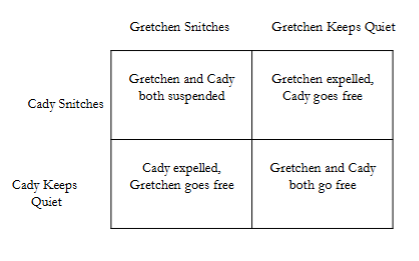
tit-for-tat
a strategy of mirroring another’s behavior (cooperate if they cooperate)
commons dilemma
overuse of shared resources leads to depletion
“If everyone uses a little, we all benefit. If some of use a lot, resource goes away.”
public goods dilemma
resources only exist if everyone contributes
“If everybody gives, everyone benefits. If only some give, resource can’t survive for those who need or want it.”
free riders
people who benefit without contributing
ultimatum game
one proposes a split; the other can either accept or reject it (both get nothing if rejected)
dictator game
one person decides the split with no input from the other
what do ultimatum and dictator games reveal?
people tend to value fairness, even without punishment
what personality traits increase cooperation?
Agreeableness and honesty-humility
Agreeability = caring about people, warm, friendly, helpful
Honesty-humility = response more to fairness of others
How do situational factors affect cooperation?
framing
People cooperate more when prisoner’s dilemma games is called “community game” than when called “Wall St. game”