Labour markets
0.0(0)
Studied by 1 person Call Kai
 Learn
 Practice Test
 Spaced Repetition
 Match
 Flashcards
 Knowt Play
Card Sorting
1/31

32 Terms
1
New cards
What does the demand for labour show
How many workers will be hired at any given wage rate over a given period of time
2
New cards
MRP =
MP x Price
3
New cards
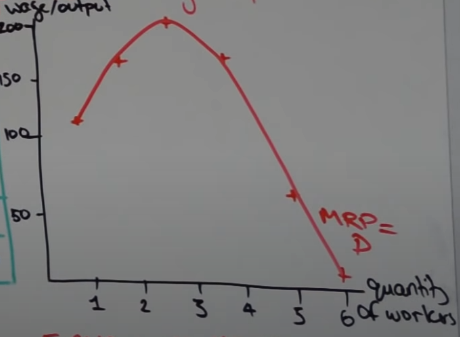
Draw the MRP curve
\
4
New cards
Why does the MRP graph fall
The law of diminishing marginal utility : the constrains of fixed fop affect individual productivity decreases so MRP falls
5
New cards
What condition will firms employ up to
MRP=MC
6
New cards
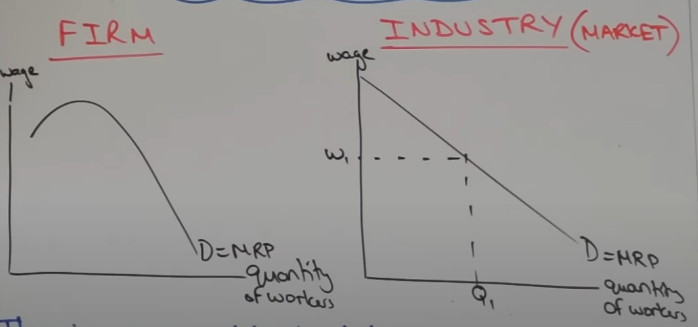
Draw the Labour Demand Curve (Market and Firm)
7
New cards
Why is there an inverse relationship between wage and Quantity of workers demanded
SR - Law of diminishing returns
LR - Substitutibility of labour and capital
LR - Substitutibility of labour and capital
8
New cards
Criticisms of MRP
* How to measure productivity
* Teamwork makes it difficult to measure individual productivity
* Self employed are not payed by measure of their MRP
* Imperfect labour market - trade unions
* Teamwork makes it difficult to measure individual productivity
* Self employed are not payed by measure of their MRP
* Imperfect labour market - trade unions
9
New cards
Why does the labour demand curve shift (non-wage factors)
1 - A change in the final price of the product labour is making affects MRP
2 - A change in the demand for the product, demand for labour is derived from demand for goods and services
3 - A change in the labour productivity affects MR and therefore MRP
4 - A change in the price of capital
2 - A change in the demand for the product, demand for labour is derived from demand for goods and services
3 - A change in the labour productivity affects MR and therefore MRP
4 - A change in the price of capital
10
New cards
What does elasticity of the Labour Demand curve measure
Measures the responsiveness of labour demanded given a change in the wage rate
11
New cards
Factors affecting the elasticity of the demand curve
* Substitutibility of Capital for labour
* PED the product
* Cost of labour as a proportion of total costs
* SR v LR
* PED the product
* Cost of labour as a proportion of total costs
* SR v LR
12
New cards
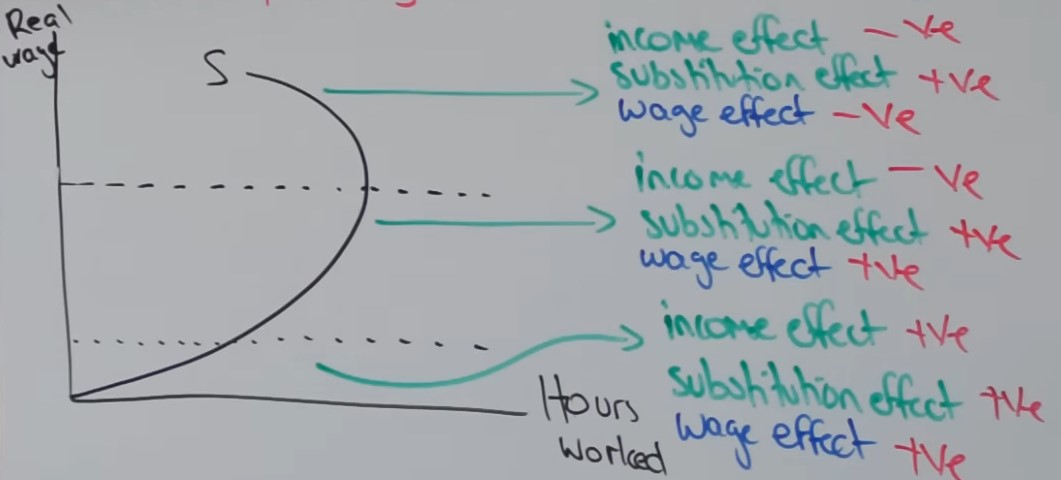
What is the substitution effect
As wages rise, the opportunity cost of leisure time increases providing an incentive to work (always +)
13
New cards
Draw the Individual Labour Supply Curve (Backward Bending Labour Supply Curve) with the effects
second chunk approaching target income income effect is becoming negative
14
New cards
What is the income effect
The rise in income as wages rise but with the potential of individuals reaching a target income
15
New cards
Why is the supply of industry markets upwards sloping
The high wage attracts the economically inactive and qualified workers in other industries
16
New cards
Draw the industry supply curve

17
New cards
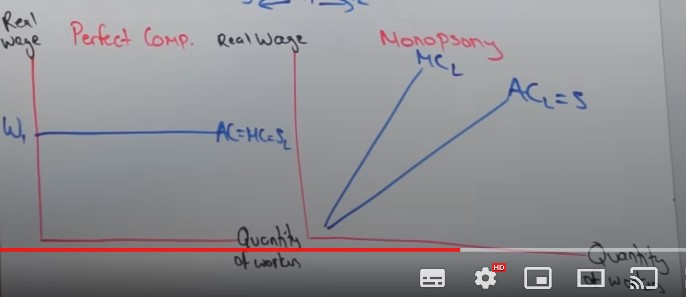
Draw the supply curves of firms in perfect competition and Monopsony
18
New cards
Explain the MC & AC relationship in a monopsony
As the monopsony has wage setting power it can set the wage higher but the wage must be raised for all workers not just one, so MC increases faster
19
New cards
What are the non wage determinants of shifts in the supply of labour curves
* Wage on offer in substitute occupations
* Barriers to entry
* Non-monetary characteristics
* Improvements in occupational mobility
* Potential for overtime
* Size of the working population e.g. immigration
* Value of leisure time
* Barriers to entry
* Non-monetary characteristics
* Improvements in occupational mobility
* Potential for overtime
* Size of the working population e.g. immigration
* Value of leisure time
20
New cards
What does the Elasticity of the Labour Supply Curve measure
Measures the responsiveness of labour supplied given a change in the wage rate
21
New cards
Factors affecting the Elasticity of the Labour Supply Curve
* The nature of skills required in the job
* Length of the training period
* Vocational element
* SR v LR - notice periods, expectations of a return to the original wage rate
* Length of the training period
* Vocational element
* SR v LR - notice periods, expectations of a return to the original wage rate
22
New cards
Characteristics of a Perfectly Competitive Labour Market
* Many workers and employers
* Labour is homogeneous & perfectly mobile
* There is perfect information
* Firms are wage takers
* There are no barriers to entry or exit
* Labour is homogeneous & perfectly mobile
* There is perfect information
* Firms are wage takers
* There are no barriers to entry or exit
23
New cards
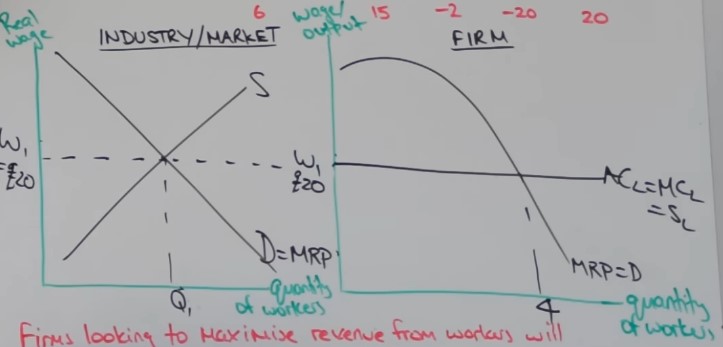
Draw the industry/market and firm diagram for a perfectly competitive labour market
\
24
New cards
What do firms looking to maximise revenue from workers hire workers up until
MRP = W = MC of labour
25
New cards
Labour market imperfections causing a wage differential
1 : Labour is not homogeneous :
workers have different MRP’s and therefore wages
Some jobs where not all workers are suitable for jobs - different supplies of labour
Discrimination
2 : Non-monetary considerations : Compensating wage differentials
e.g. pensions, potential for overtime, holidays, working hours, company cars, potential for promotion
workers will consider these alongside the wage not just the wage itself
3 : Labour is not perfectly mobile
Occupational mobility
Geographical immobility
Lack of perfect knowledge
4 : Trade Unions and supply restrictions
5 : Monopolies and wage setting ability
26
New cards
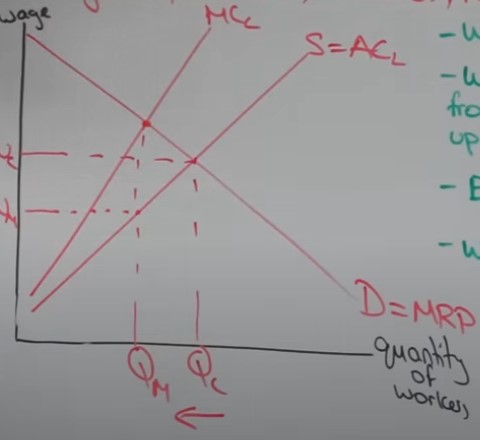
What is a monpsony labour market + characteristics + graph
A monopsony is the sole employer of labour in a given profession e.g. teachers, nurses
* wage maker
* will maximise revenue from workers by hiring up to where MRP-MC
* wage maker
* will maximise revenue from workers by hiring up to where MRP-MC
27
New cards
What is the impact of monpsony labour markets on employment and wages
Employment decreases and wages also decrease
28
New cards
How to measure monopsony power
Compare MRP to wages
29
New cards
What do trade unions do
Lobby firms to negotiate better pay and working conditions
30
New cards
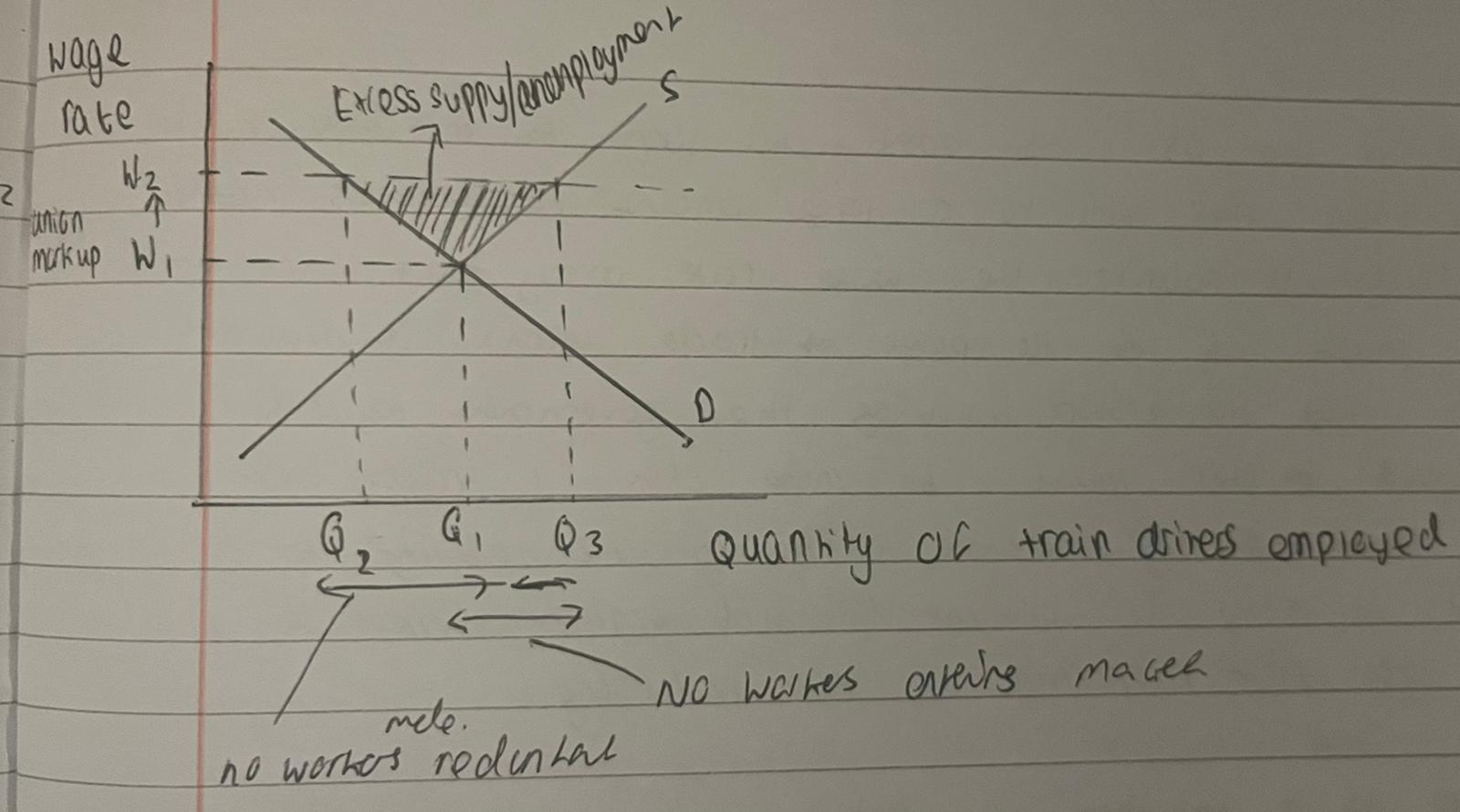
Trade union labour market graph
31
New cards
Benefits vs limitations of TU
\+ Greater income - Success is determined by the union markup
\+ TU in a monopsony
\- Depends on TU density
\- Government legislation : 75% anonymous + more than 1 TU in each industry
\- Employment
\+ TU in a monopsony
\- Depends on TU density
\- Government legislation : 75% anonymous + more than 1 TU in each industry
\- Employment
32
New cards