Chapter 12 of AP Psychology
 Call Kai
 Learn
Learn Practice Test
 Spaced Repetition
 Match
Match Flashcards
 Knowt Play
1/51

There's no tags or description
Looks like no tags are added yet.
Name | Mastery | Learn | Test | Matching | Spaced | Call with Kai |
|---|
No analytics yet
Send a link to your students to track their progress
52 Terms
What are attitudes?
a relatively enduring evaluation—positive, negative, or mixed—of people, objects, events, or ideas.
What is cognitive dissonance?
the mental discomfort experienced when holding two or more contradictory beliefs, values, or attitudes, or when behaving in a way that conflicts with them
What is Belief Perseverance?
the cognitive bias where people continue to hold onto their beliefs even after receiving clear, contradictory evidence
What is Confirmation bias?
is the unconscious tendency to seek, interpret, and recall information that validates one’s pre-existing beliefs while ignoring or discounting contradictory evidence
What is False Concensus Effect?
a cognitive bias where people overestimate the extent to which their opinions, beliefs, and behaviors are shared by others
What are stereotypes?
an oversimplified, often unfair, and generalized belief about a group of people, based on traits like race, gender, or appearance
What are implicit attitudes?
unconscious, automatic evaluations or feelings about people, objects, or concepts that exist outside conscious awareness
What is out-group homogeneity bias?
the cognitive tendency to view members of one's own group (ingroup) as diverse individuals while perceiving members of outside groups (outgroups) as similar, "all the same," or interchangeable
What is in-group preference?
a cognitive bias where individuals favor, trust, and allocate more resources to members of their own group (friends, family, team, nation) over those in an "out-group"
What is ethnocentrism?
the belief that one's own culture, ethnic group, or nationality is superior to all others
What is compliance?
a form of social influence where an individual changes their behavior in response to a direct, usually polite, request from another person, even if they do not privately agree with it.
What is the foot-in-the-door technique?
a persuasion strategy used to increase compliance by first asking a person to agree to a small, modest request, followed by a larger, more significant request.
What is the door-in-the-face technique?
a persuasion method where a large, unreasonable request (likely to be refused) is followed by a smaller, reasonable request, which is the target request
What is Persuasion?
the process of guiding people toward the adoption of an idea, attitude, or action through rational or emotional communication, rather than force
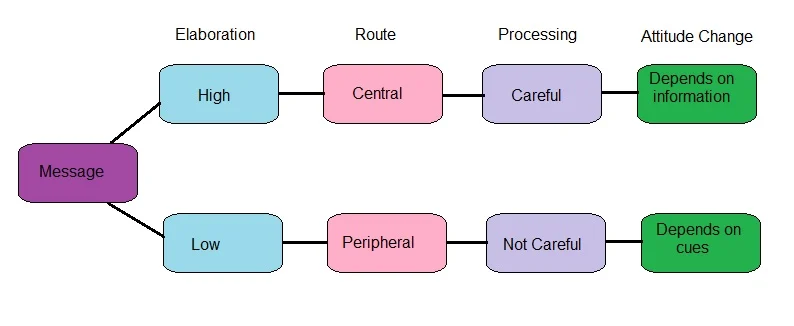
What is the elaboration likelihood model?
a theory of persuasion developed by Richard Petty and John Cacioppo in the 1980s that explains how individuals process messages to form or change attitudes.
It posits two main routes—central and peripheral—based on the audience's motivation and ability to think deeply (elaborate) about a message, dictating whether attitude change is long-lasting or temporary.
What is the Central Route?
Involves high-effort processing, deep thought, and careful evaluation of the argument's quality; this leads to lasting attitude changes that predict behavior.
What is the peripheral route?
Involves low-effort processing, where individuals rely on superficial cues, such as the speaker’s attractiveness, expertise, or emotional appeals, rather than the content. This often results in temporary attitude changes.
What is the halo effect?
a cognitive bias where one positive trait of a person or entity (e.g., attractiveness, kindness) influences observers to assume other, unrelated positive traits (e.g., intelligence, competence)
What is the mere exposure effect?
a psychological phenomenon where people develop a preference for things merely because they are familiar with them
What are social norms?
the unwritten, shared rules and standards that guide acceptable, typical behaviors within a group or society, regulating social interactions and influencing individual actions
What is conformity?
the act of matching attitudes, behaviors, and beliefs to group norms, societal standards, or authority rules
What is the informational social influence?
where individuals conform to the actions or beliefs of others because they believe the group possesses more accurate information, especially in ambiguous or uncertain situations
What is the normative social influence?
a type of social influence where individuals conform to group norms, behaviors, or beliefs to be liked, accepted, or avoid social disapproval
What is obedience?
a form of social influence where an individual acts in response to a direct order or command from a perceived authority figure
What is individualism?
a cultural and behavioral orientation prioritizing personal autonomy, self-reliance, and individual goals over group harmony.
What is collectivism?
a cultural paradigm emphasizing group goals, harmony, and interdependence over personal desires
What is multiculturalism?
the coexistence, acceptance, or promotion of multiple cultural traditions within a single jurisdiction, usually recognized by laws or policies that promote equality and diversity
What is groupthink?
a psychological phenomenon where the desire for group cohesion and consensus overrides critical thinking, leading to poor, irrational, or risky decisions
What is group polarization?
the psychological phenomenon where individuals in a group discussion move toward more extreme positions than their initial inclinations
What is deindividuation?
a psychological phenomenon where individuals in a group or crowd lose their sense of self-awareness, personal identity, and accountability
What is diffusion of responsibility?
a social psychological phenomenon where individuals are less likely to take action or feel personal accountability in a group setting, assuming others will intervene
What is social loafing?
the psychological phenomenon where individuals exert less effort when working collectively in a group than when working alone, often leading to reduced productivity
What is social facilitation?
a psychology concept where the mere presence of others (an audience or co-actors) improves an individual's performance on simple or well-practiced tasks
What is superordinate goals?
high-level, shared objectives that require the cooperation of two or more individuals or groups to achieve, taking precedence over individual or subgroup goals
What are social traps?
a situation where individuals or groups pursue immediate, self-interested gains, leading to long-term negative consequences for the entire group
What are industrial organizational psychologists?
a scientist-practitioner who applies psychological principles, research methods, and behavioral science to workplace issues
What is prosocial behavior?
voluntary actions intended to help, benefit, or support others
What is altruism?
the unselfish concern for the well-being of others, characterized by actions that benefit someone else at a cost to oneself without expecting rewards
What is social reciprocity?
the back-and-forth, give-and-take flow of social interaction and communication, forming the foundation of healthy relationships
What is the bystander effect?
a social psychological phenomenon where individuals are less likely to offer help to a victim when other people are present.
What is dispositional attribution?
the tendency to explain behavior as the result of internal characteristics—such as personality traits, motivations, beliefs, or abilities—rather than external situational factors
What is situational attribution?
the psychological process of assigning the cause of a person's behavior to external factors—such as environment, social pressure, or luck—rather than to their internal personality traits or disposition.
What is optimistic explanatory style?
a cognitive framework where individuals attribute negative events to external, temporary, and specific causes, while viewing positive events as internal, stable, and pervasive
What is pessimistic explanatory style?
a cognitive framework where individuals attribute negative events to internal, stable, and global factors (personal, permanent, and pervasive), while viewing positive events as external, unstable, and specific
What is fundamental attribution error?
a cognitive bias where people overemphasize personality-based explanations for others' behaviors while underestimating situational influences
What is actor/observer bias?
a cognitive bias where people attribute their own actions to external, situational causes, but blame others' behavior on internal, personal character traits
What is self-serving bias?
the common tendency to attribute successes to internal factors (intelligence, hard work) while blaming failures on external factors (bad luck, unfairness)
What is just-world bias?
a cognitive bias where people believe the world is fundamentally fair, assuming individuals get what they deserve—good actions are rewarded and bad actions punished
What is the self-fulfilling prophecy?
a psychological phenomenon where an initially false belief or expectation leads to behaviors that make that expectation come true
What is social comparison?
the psychological process of evaluating one’s own abilities, opinions, and status by comparing them to others
What is relative deprivation?
the experience of discontent or resentment that arises when individuals or groups perceive a gap between their actual circumstances and what they believe they are entitled to, usually based on comparing themselves to others
What is Scapegoating?
a defense mechanism where individuals or groups project blame, hostility, and frustration onto an innocent target to avoid accountability, reduce anxiety, or manage collective stress