Intro to Contemporary Art Final Exam
 Call Kai
 Learn
Learn Practice Test
 Spaced Repetition
 Match
Match Flashcards
 Knowt Play
1/42

There's no tags or description
Looks like no tags are added yet.
Name | Mastery | Learn | Test | Matching | Spaced | Call with Kai |
|---|
No analytics yet
Send a link to your students to track their progress
43 Terms
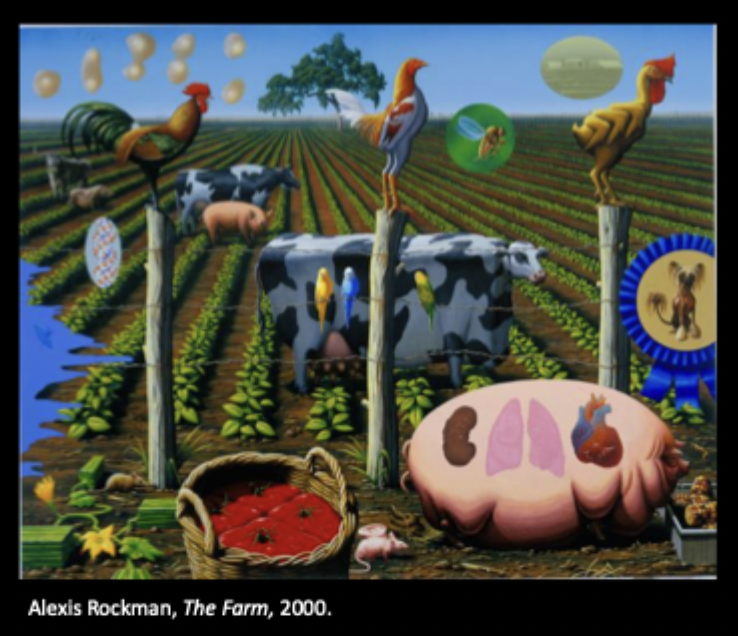
Alexis Rockman, The Farm, 2000.
Transgenic organisms: a living entity whose genome has been deliberately altered by inserting foreign DNA, often from a different species, using biotechnology.
This piece highlights how what we consider “wildlife” only makes up a small percent of life on land and how all other life is product of human culture. This piece shows this through transgenic organisms, as the painting imagines a future shaped by biotechnology, genetic engineering, and human manipulation of animals and food systems.
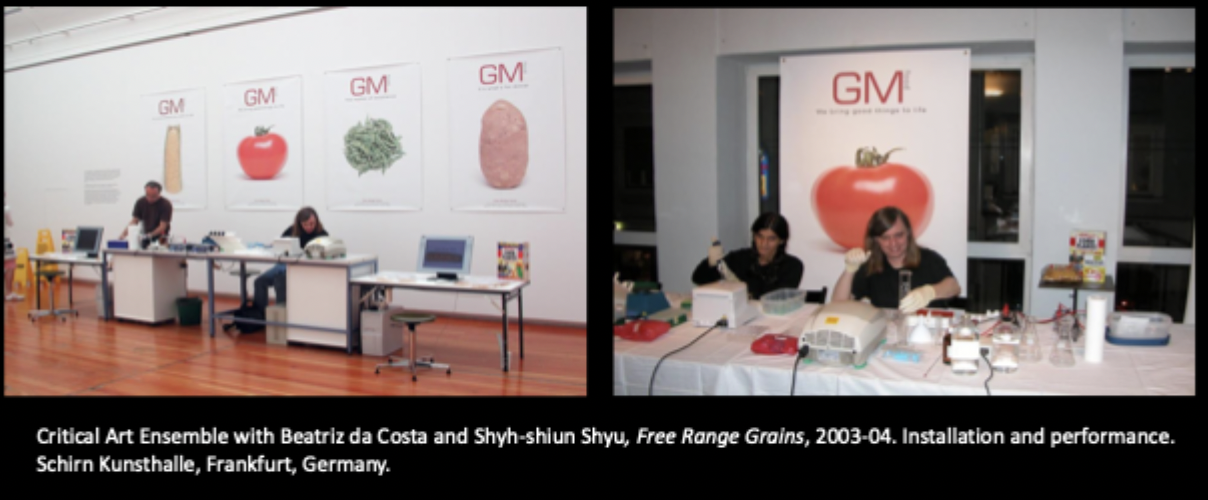
Critical Art Ensemble with Beatriz da Costa and Shyhshiun Shyu, Free Range Grains, 2003- 04.
Public science: art that collaborates with research, bringing science and the public together.
This piece focuses on the issue of food production by setting up a mobile laboratory to test food products for genetically modified organisms (GMOs). It is an example of public science because it turns scientific testing into a public experience, allowing people to investigate GMOs themselves instead of depending only on experts.
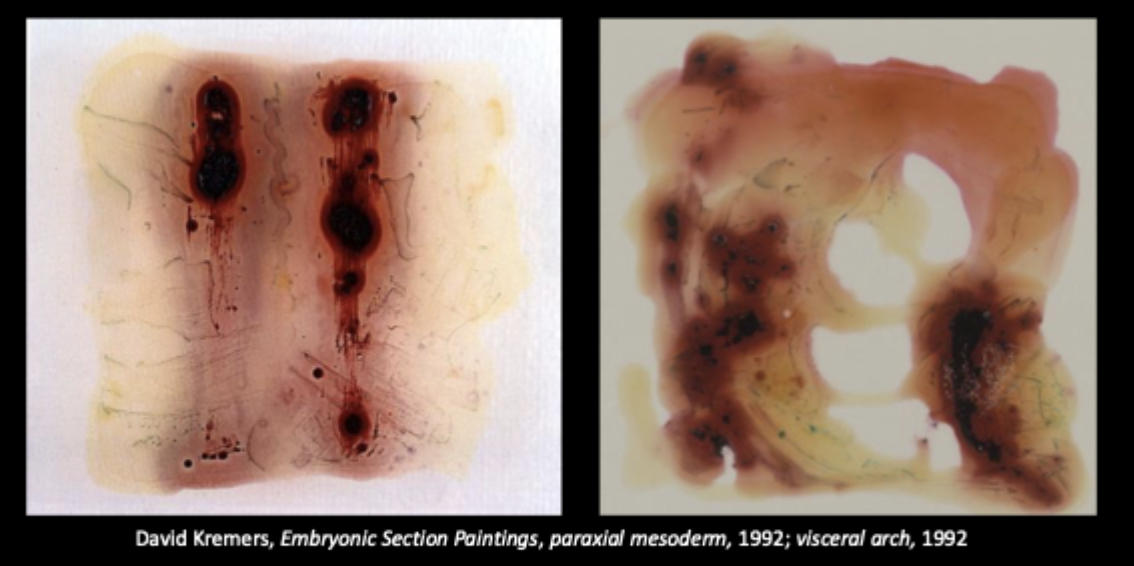
1992.
System art: art based on an organized system, set of rules, or process rather than personal expression alone.
This paintings follow the “system” of embryology, which is the natural developmental plan of the body. It is built from an existing scientific framework, a system that is organized and expressed through art, making it an example of system art.
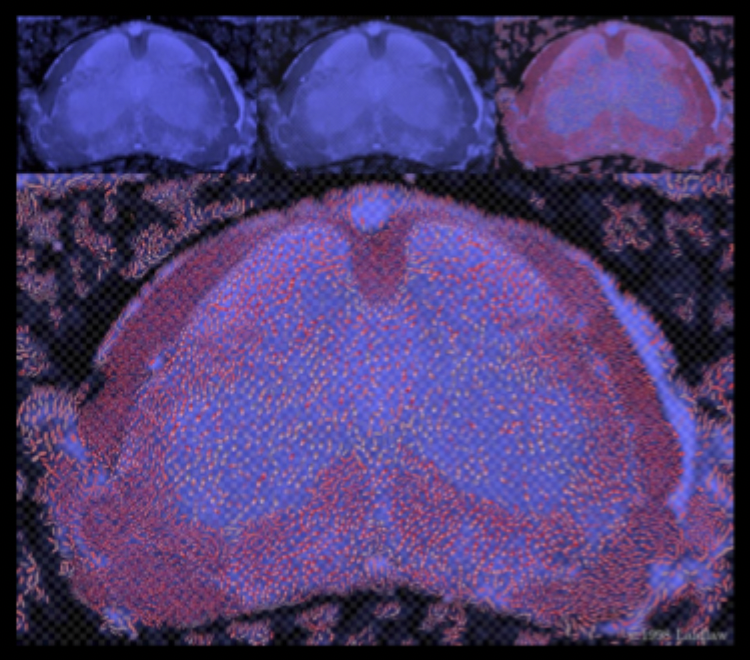
David Kremers (with scientists: David Laidlaw, Eric T. Ahrens, and Matthew J. Avalos), Mouse Spinal Cord Diffusion Tensor Visualization Using Concepts from Painting, 1998.
Public science: art that collaborates with research, bringing science and the public together.
This piece combines scientific imaging (specifically of a mouse spinal cord) with artistic methods of painting. this painting brings scientists and the public together by showing people how they can see and understand science, through turning invisible biological structures into something visually meaningful.
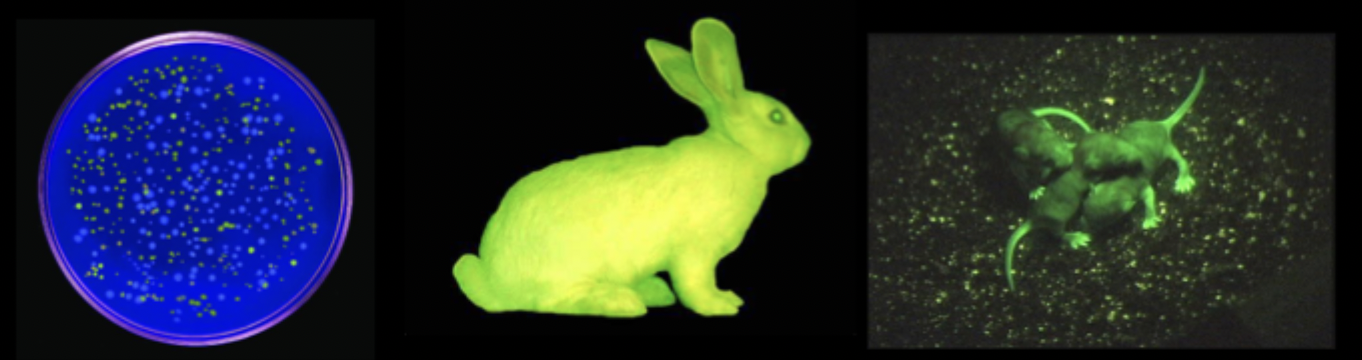
Bio-art: art that uses living organisms, biological processes, genetics, or biotechnology as part of the artwork itself.
This piece has three parts which all show bio-art:
Genesis - this art took a sentance from Genesis in the Bible, translated it into morse code, then into synthetic DNA, and inserted into bacteria. This piece uses genetic code as the material, the same biological material that scientists use, making it bio art.
GFP Bunny - genetically modified rabbit from GFP gene found in jelly fish, making him glow in the dark. genetic manipulation is a part of biology, making it bio art. also note that Alba became very well-known in society with many advocating for him and animal cruelty.
The Eighth Day - installation included genetically modified organisms living together in an artificial ecosystem. this pieced used living transgenic organisms, also a part of bio-art
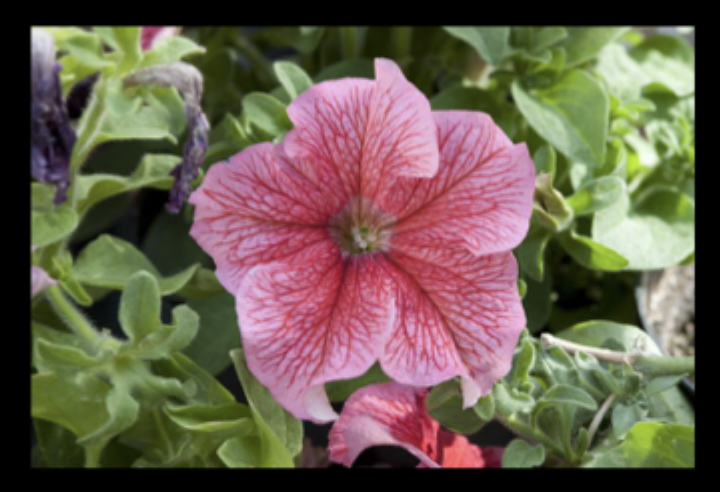
Plantimal: hybrid organism possessing characteristics of both a plant and an animal
This piece is a transgenic flower with the artist’s own DNA expressed in the red veins, giving it its appearance. It is a clear example of plantimal
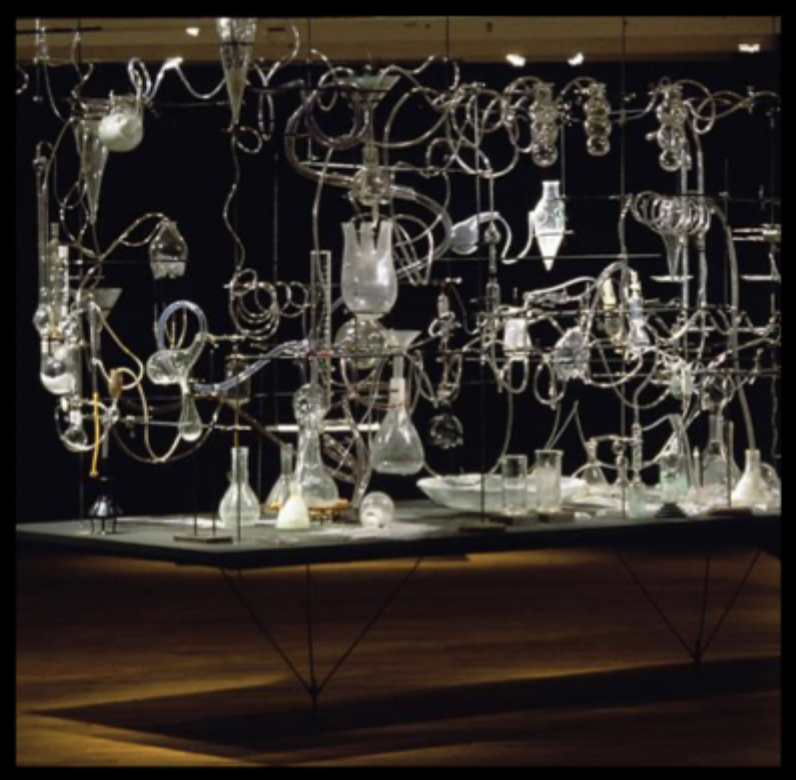
Eve Andree Laramee, Apparatus for the Distillation of Vague Intuitions, 1994-98.
Conceptual Art: art where the idea or concept is more important than the physical artwork itself
This piece challenges objectivity and scientific fact/data. The artist hand blew all the glass equiptment in this installation. Doing so creates tension towards the idea that facts and science can back everything, when really not everything has to be objective, it can also be perceptive.
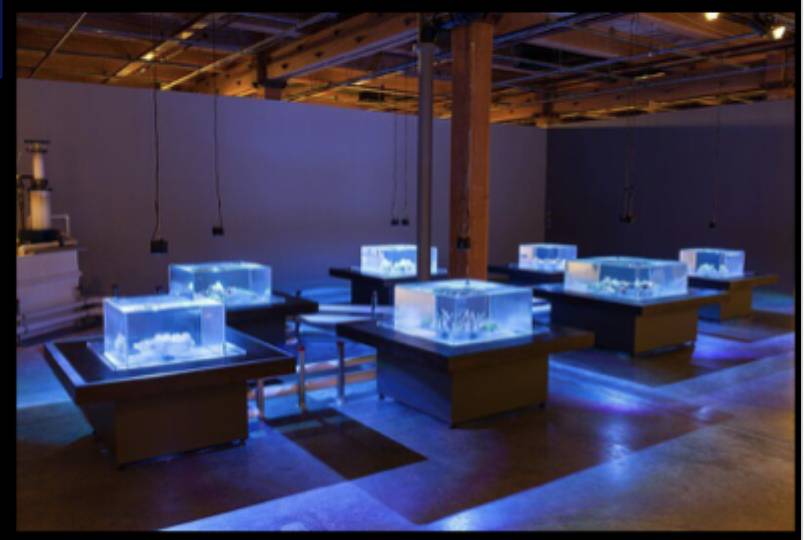
Reef-Ex: a U.S. Army/Department of Defense program where old military tanks were submerged in the ocean so they could become artificial coral reefs and become habitats for marine life.
This piece is reenacts this experience by showing mini versions of it and the process it is going through.
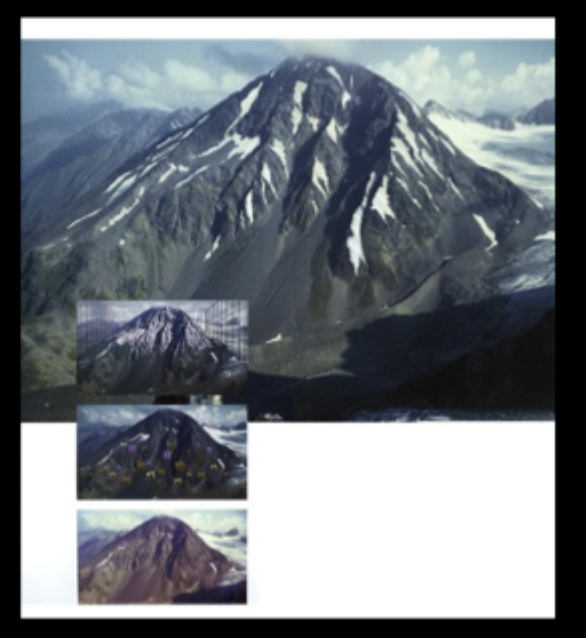
Helen Mayer Harrison and Newton Harrison, The Mountain in the Greenhouse, 2001.
Ecoart: focuses on environmental systems, ecology, and sustainability.
This piece shows and imagines how a mountain ecosystem might function under greenhouse conditions, showing climate change. It is an example of ecoart because it is fundamentally about ecological systems and environmental responsibility as artistic practice.
HMs: The Anthropocene (because it deals with human impact on the environments), Global Warming (because that is the overall theme), Earth Art (because it treats the entire landscape of the mountain as the material and subject of the art)
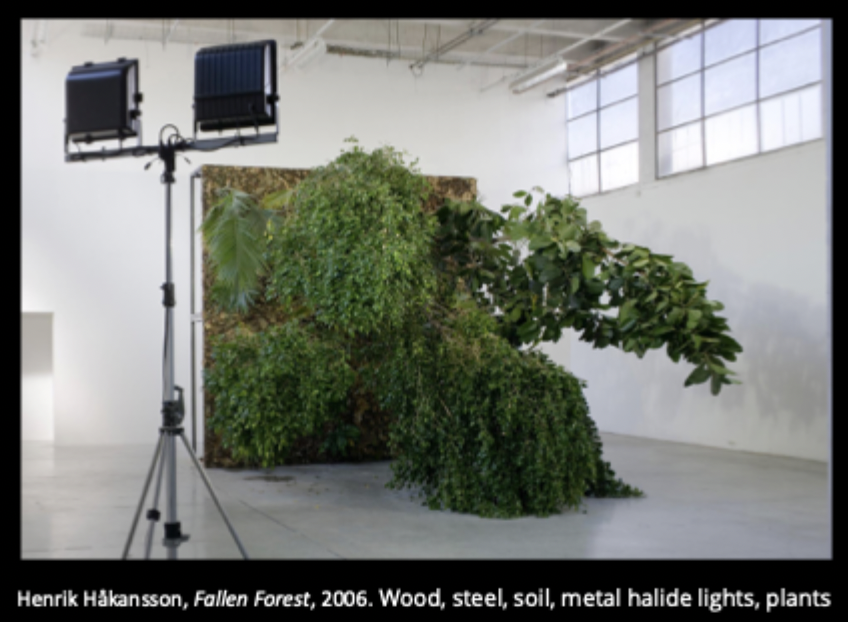
Natural dislocation: to the removal, displacement, or relocation of natural environments or ecosystems from their original context
In this piece, the artist takes an entire forest-like environment—trees or parts of trees—and places it into a gallery or controlled exhibition space, removing it from its natural ecosystem. It is quite literally the definition of natural dislocation.
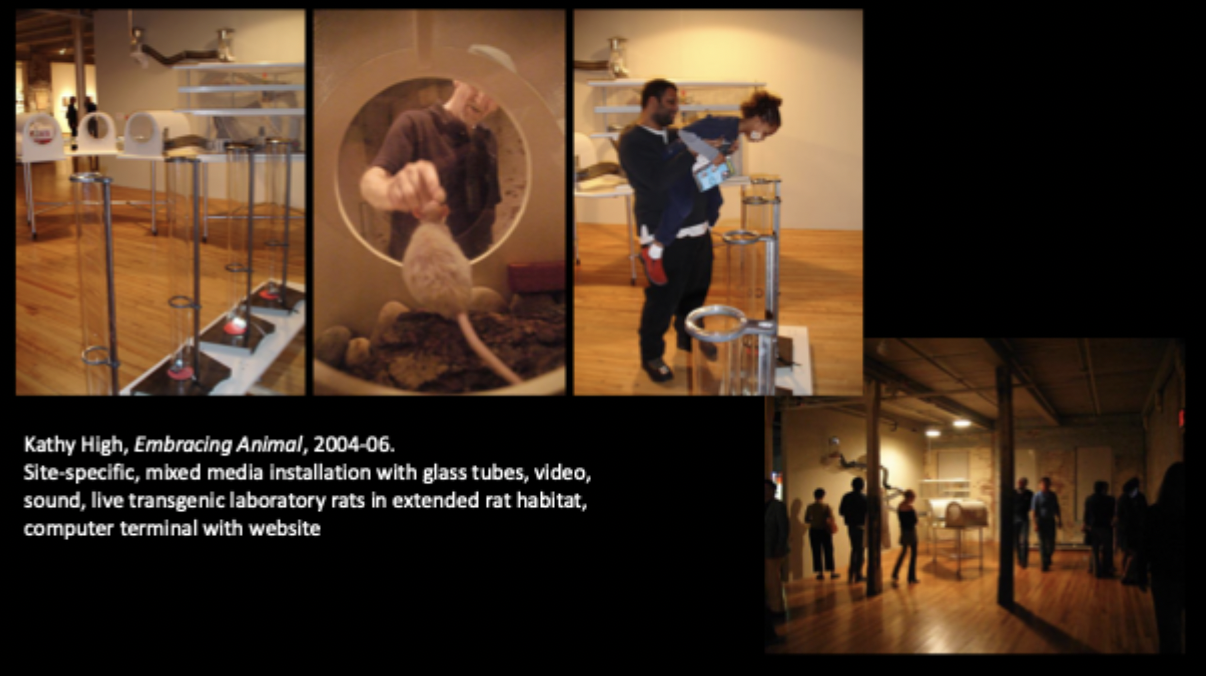
Kathy High, Embracing Animal, 2004-2006.
Process art: the making, development, and ongoing change of the work are more important than the final finished object.
This mixed media installation shows a rat habitat over time. It is process art because it unfolds over years through the ongoing care of a living rat named Lala.
HM site-specific: artwork that is created for—and deeply shaped by—a particular location, context, or environment.
The work is site-specific because it exists through and depends on the particular biological and medical care environments in which the animal’s life and treatment take place.
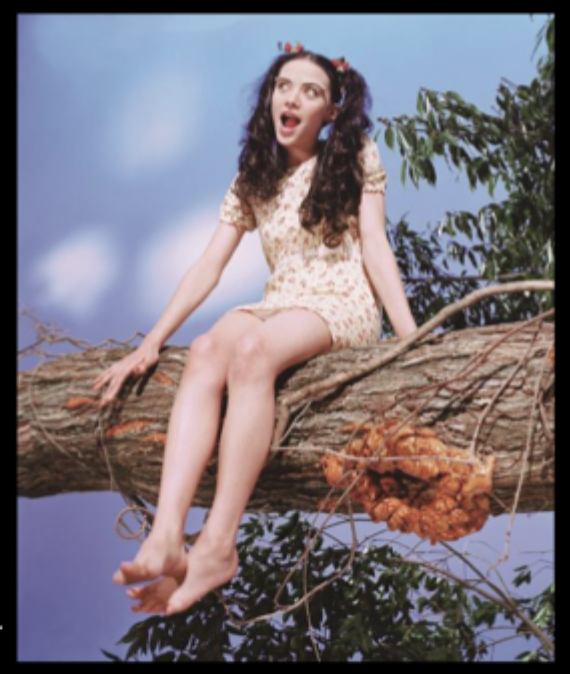
Motohiko Odani, Rompers, 2003.
transgenic organisms: a living entity whose genome has been deliberately altered by inserting foreign DNA, often from a different species, using biotechnology.
This print shows a human/bird/animal creature. The work reflects transgenic organisms by presenting a hybrid creature that suggests life altered beyond natural evolution through human intervention and genetic manipulation.
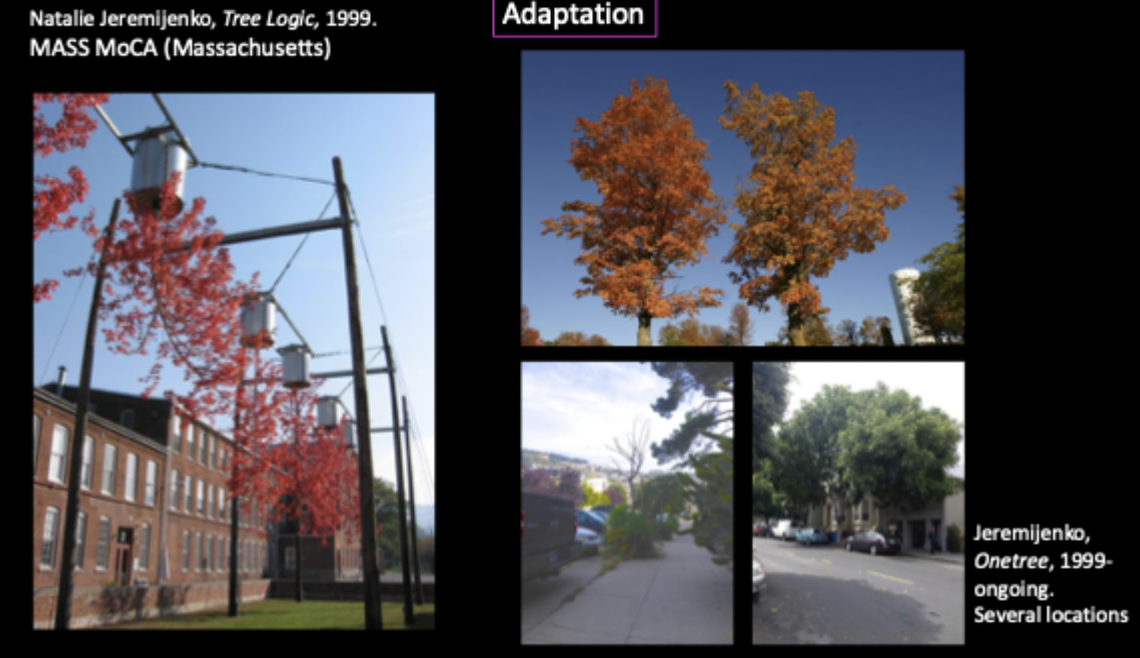
Natalie Jeremijenko, Tree Logic, 1999; One Tree, 1999.
Adaptation: how living organisms, environments, or human systems adjust to changing conditions in order to survive or function.
These pieces show how trees adapt to environments shaped by humans. One shows how even suspended in the air, they can survive and adapt, and the other shows how even genetically engineered to be identical, they can survive
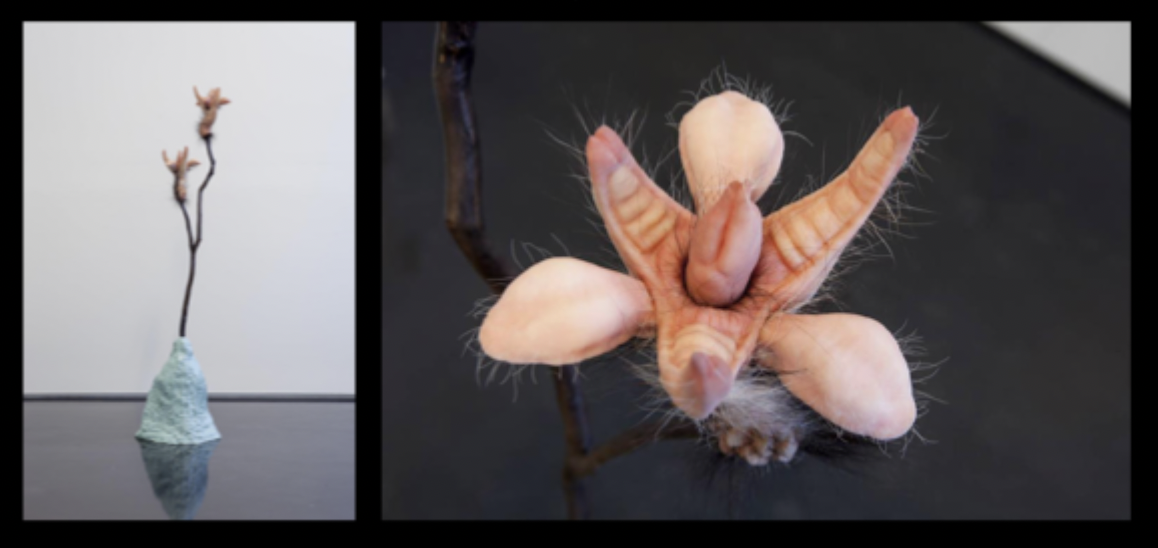
Patricia Piccinini, Metaflora, 2015.
Plantimal: hybrid organism possessing characteristics of both a plant and an animal
the artwork imagines plant-animal hybrids that combine floral and bodily characteristics, literally a plantimal.
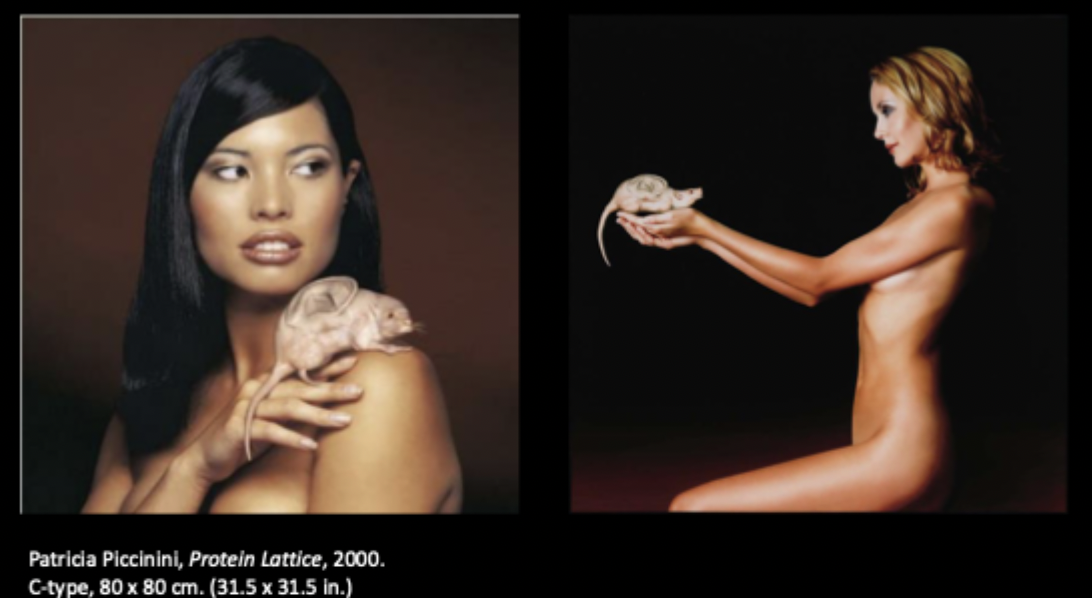
Patricia Piccinini, Protein Lattice, 2000.
transgenic organisms: a living entity whose genome has been deliberately altered by inserting foreign DNA, often from a different species, using biotechnology.
This piece reflects the idea of organisms whose biological structure has been altered at the genetic level through the mouse. It centers on genetically altered and biologically engineered forms of life.
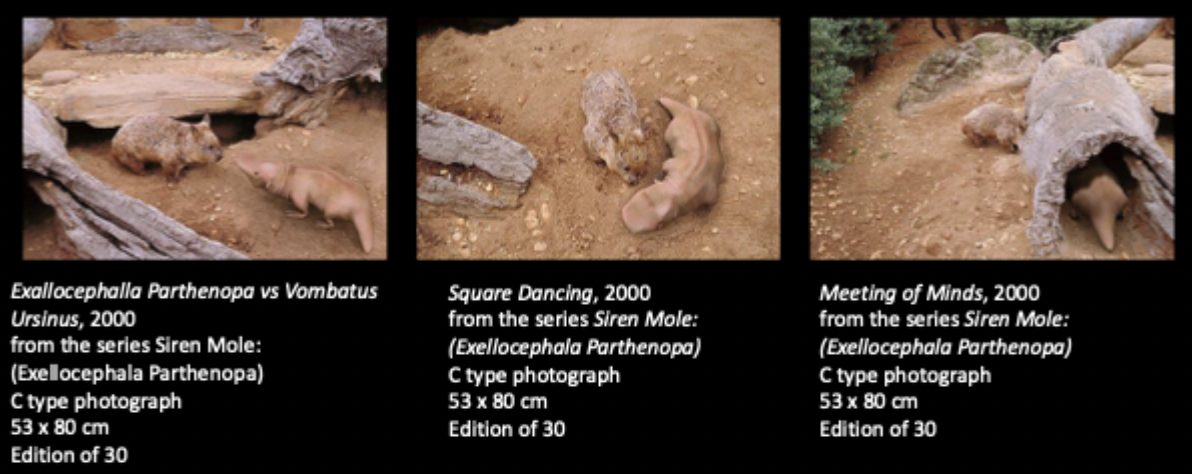
Patricia Piccinini, Siren Mole; Exellocephala Parthenopa, 2000.
Evolutionary creatures: imagined or altered life forms that suggest how species might change over time—either naturally or through human influence
This piece presents a creature that appears to be newly evolved, suggesting mutation or adaptation over time. It feels like it could be futuristic and referring to evolution, which is what evolutionary creatures are all about.
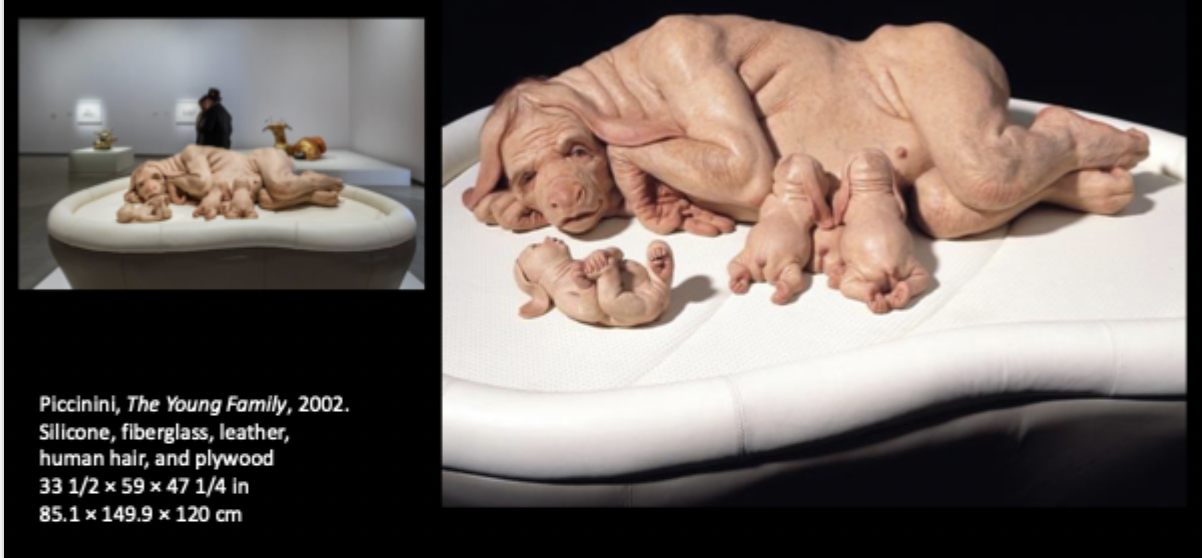
Patricia Piccinini, The Young Family, 2002.
Evolutionary creatures: imagined or altered life forms that suggest how species might change over time—either naturally or through human influence
This piece imagines a believable new life form that could exist if evolution—or human intervention—created species beyond the ones we know today. It literally shows an evolutionary creature.
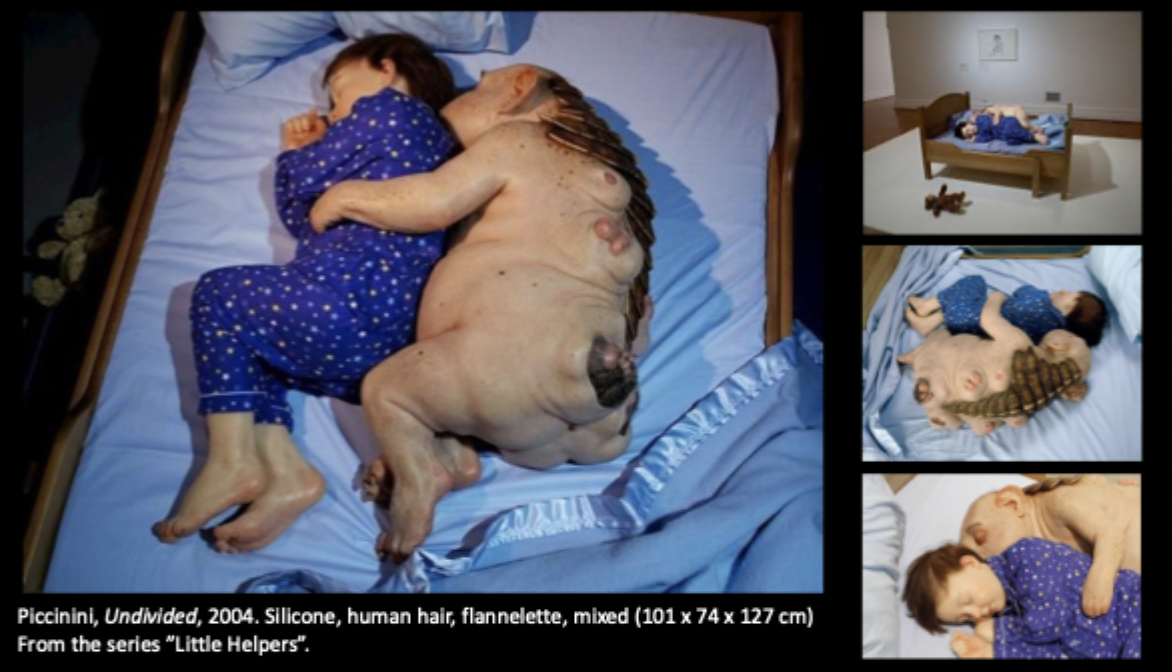
Patricia Piccinini, Undivided, 2004.
Evolutionary creatures: imagined or altered life forms that suggest how species might change over time—either naturally or through human influence
Undivided represents evolutionary creatures because it shows a believable hybrid species that suggests how life could evolve beyond today’s human and animal forms.
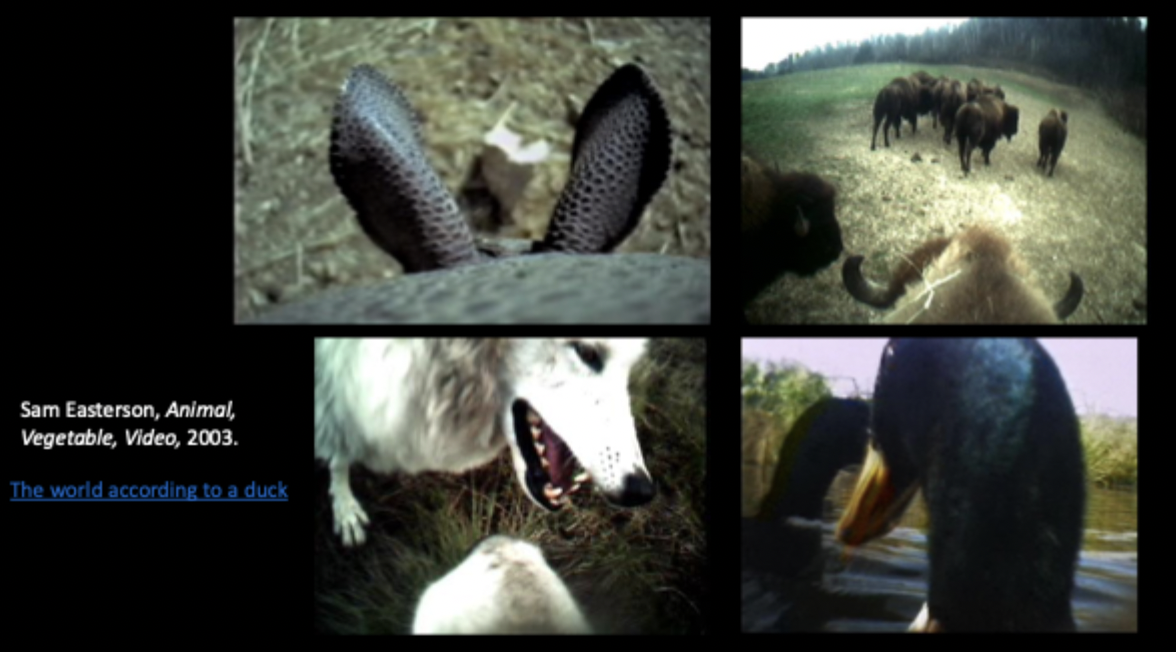
Time-based art: artwork that relies on technology and have a durational element, unfolding to the viewer over time
This piece is an example of time-based art because it is a video recording of the world according to a duck. The viewer gets to see how time goes on through the eyes of a duck, unfolding overtime.
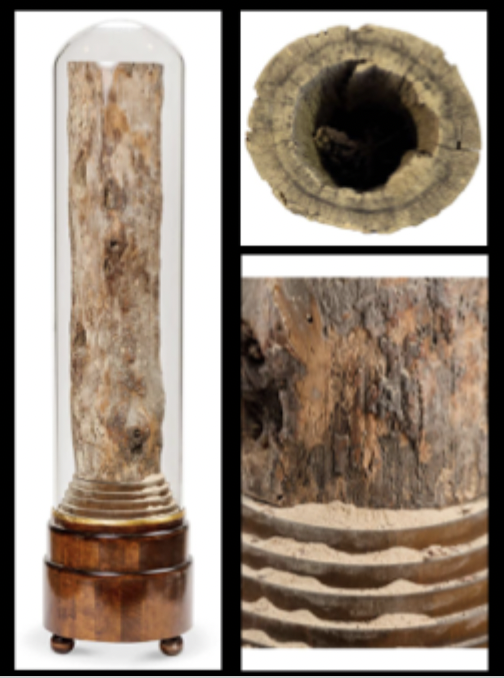
Entropic system: a system that is moving toward disorder, decay, or breakdown over time
This piece is one that shows human attempt to conserve, but it really is just moving towards decay. It stages the conflict between human attempts to preserve nature and nature’s own tendency to change and decay.
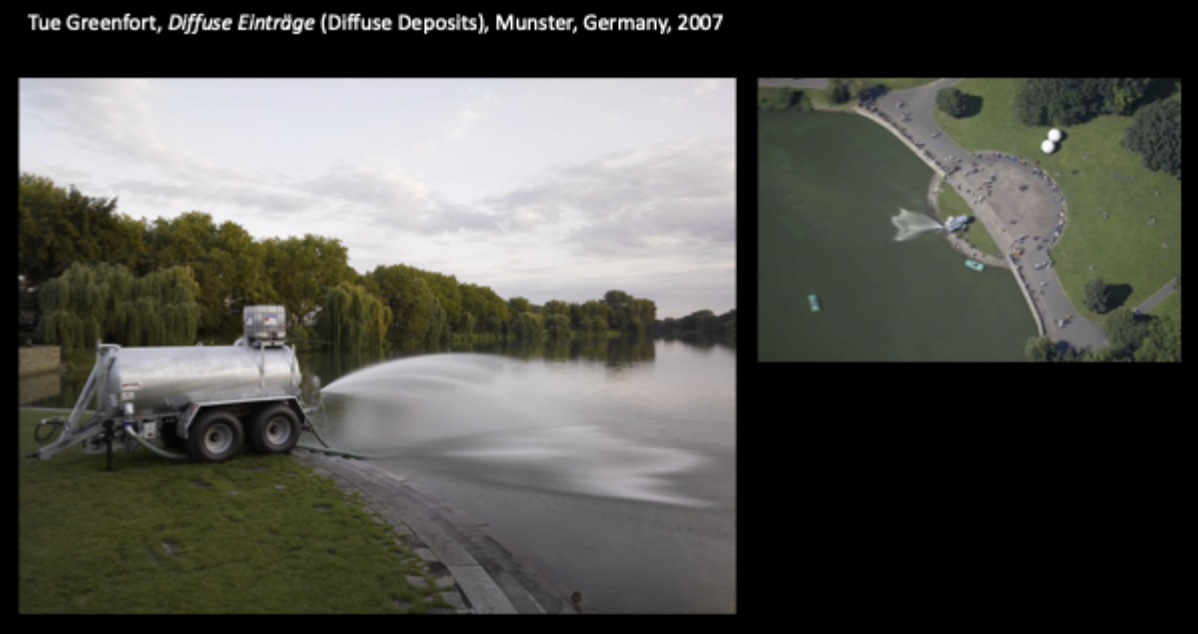
Anthropocene: a proposed geological era in which human activity is the dominant force shaping Earth’s climate, ecosystems, and geological processes.
This piece shows how pollution and waste don’t disappear, they spread and settle in ecosystems over time. It critiques how environmental damage is often “diffuse” and out of sight but still present. The work reflects the anthropocene because it reveals how human industrial activity is embedded in and continually reshapes natural environmental systems.
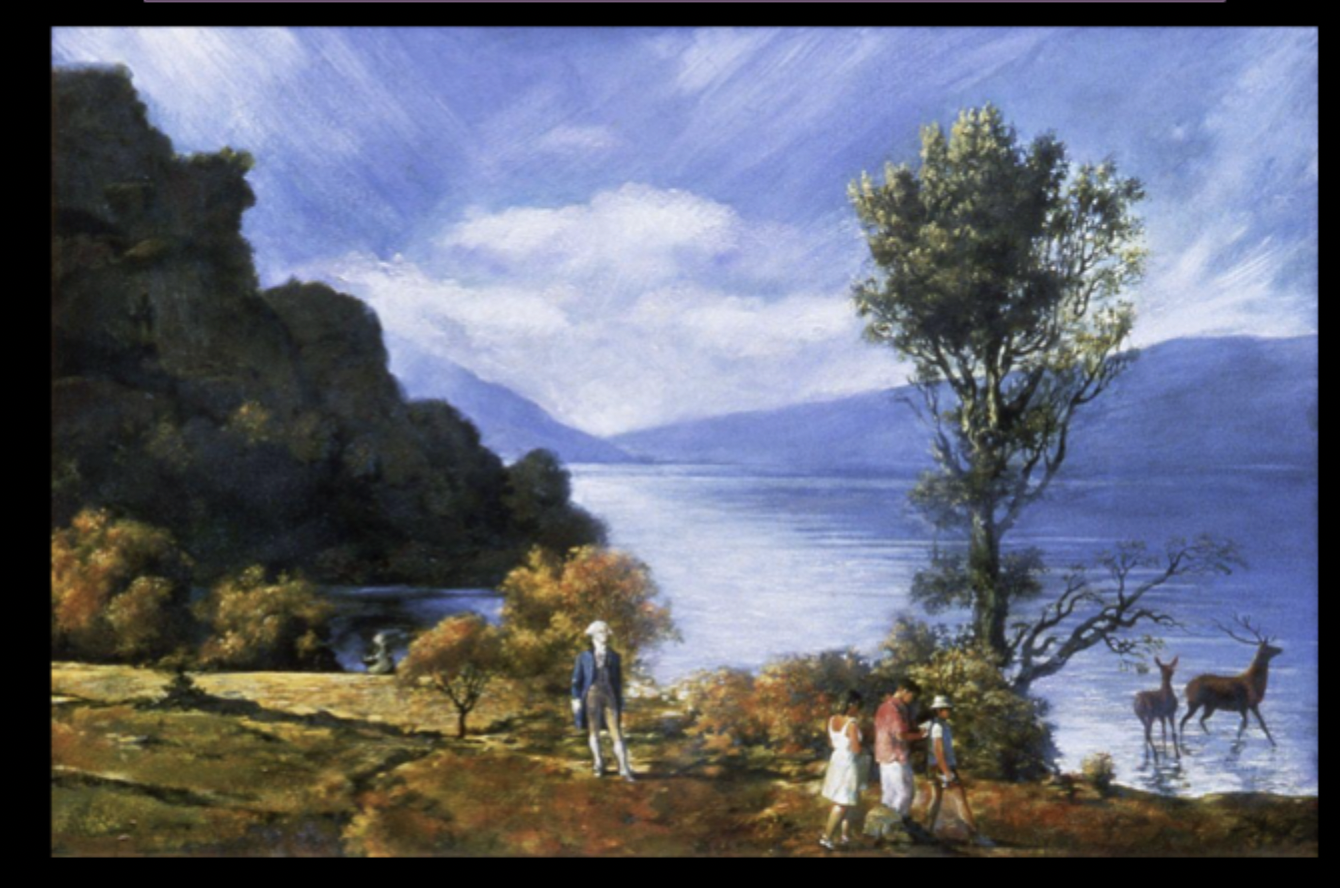
Conceptual Art: art where the idea or concept is more important than the physical artwork itself
This piece is more about the concept than the actual objects it shows. This piece is an application of the scientific method as used in the social sciences, as the artists surveyed people to create a painting that is what people want to see the most. It is a reflection of public opinion, like research data would, but instead turning the information into artwork.
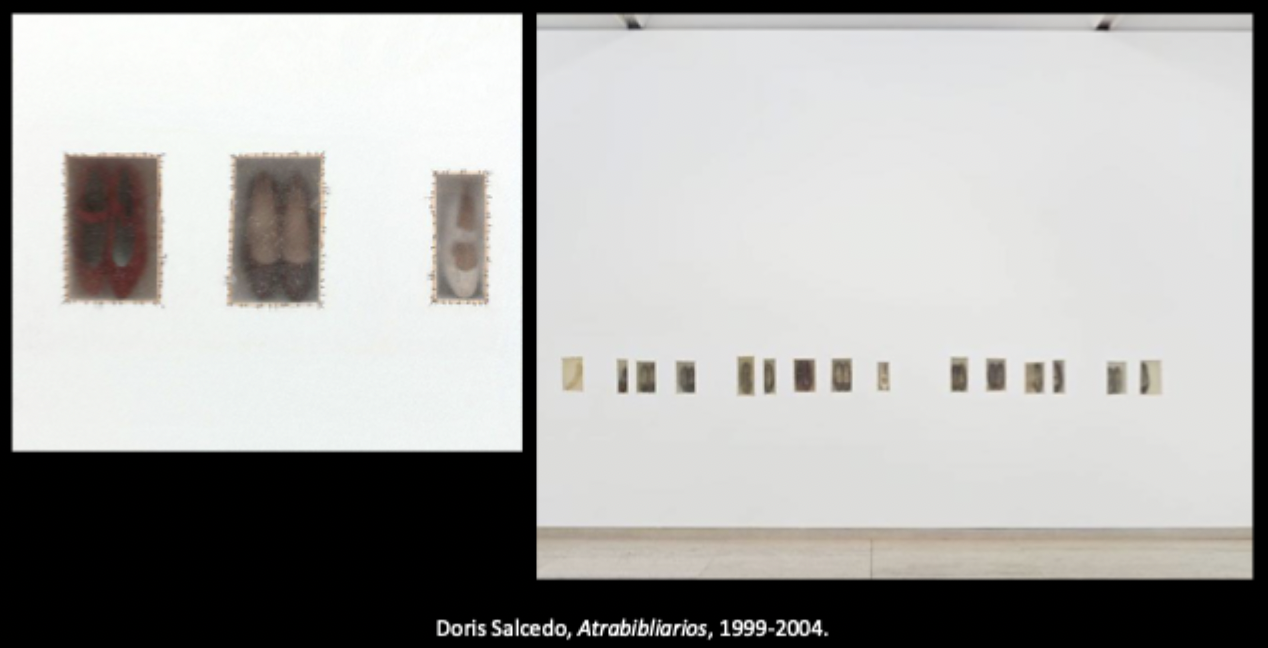
Doris Salcedo, Atrabibliarios, 1999-2004. (compare and contrast)
The Columbian government framed this violent time often erasing narratives of those who disappeared, but this artist brings attention to the victims who went missing by showing evidence of their absence, their shoes.
The artist shows how the shoes were once used, reminding people of the forensic investigation where the shoes were used to identify the body.
With political persuasion, the narratives of these people were lost, but she shifts people’s memory of this time to remembering them and their absence (memory politics)
She now uses the shoes as a way to honor the lives of the people who were lost.
The way she puts them covered up shows how the memory is partially hidden and unclear due to political persuasion.
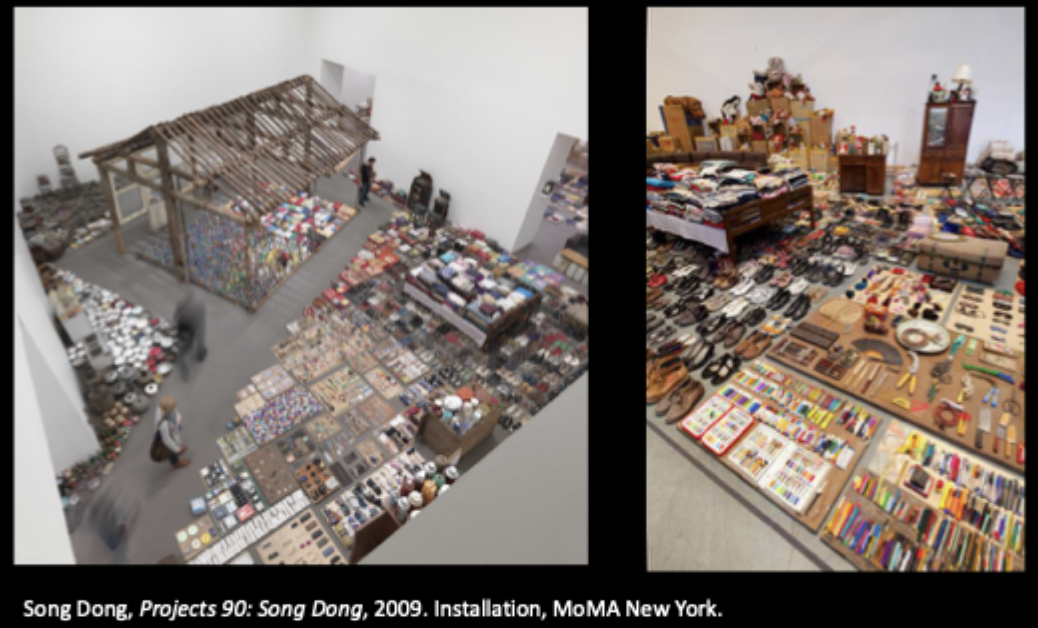
Song Dong, Projects 90: Song Dong, 2009. (compare and contrast)
This installation is of thousands of objects from his Chinese mother, which serve as preserving memory of her and this time of scarcity/economic hardship in China.
Objects document everyday life as a record of memory, like a visual diary. Demonstrates the mother’s life and her habits
Shows both meaningful memory and ordinary memory.
This installation contrasts official history with personal memory and how they can both be preserved through objects. Shows that objects hold memories, showing the economic hardship people were in historically and personally.
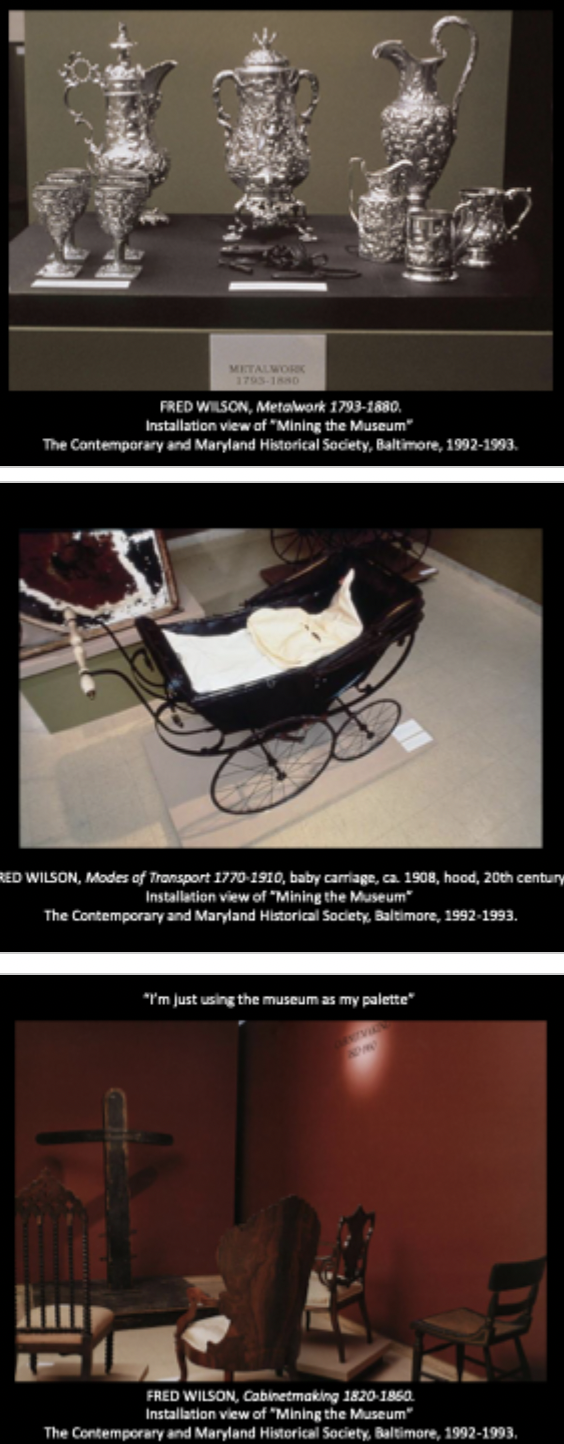
Fred Wilson, Mining the Museum, The Contemporary and Maryland Historical Society, Baltimore, 1992-1993. (compare and contrast)
All different sections he did which use objects already in the museums collection but reframing their meaning through juxtaposition. He pairs the historical objects with things that contradict each other to show.
This challenges and critics the way museums present history and how it shapes historical narratives.
Using objects to reveal hidden or forgotten memories of the time in which they are displaying. In this case, especially for erased histories of enslaved people.
He is curating what people remember (artist as the curator)
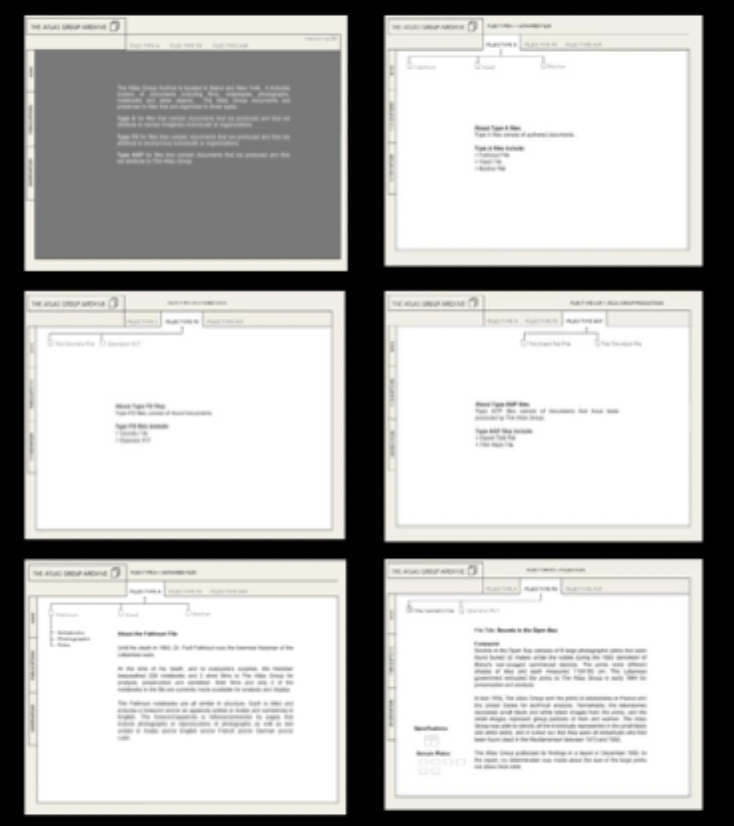
Walid Raad, The Atlas Group Archive, 1986-2006. (compare and contrast)
Presenting historical archives of Lebanese history from their Civil War, but it is unclear what is real or crafted by the artist.
This blurs the line between fact and fiction, critiquing the way history is recorded.
It also represents trauma and missing history.
Shows how memory can be unstable and constructed, not fully reliable
Makes viewers question who controls historical memory and how it’s written
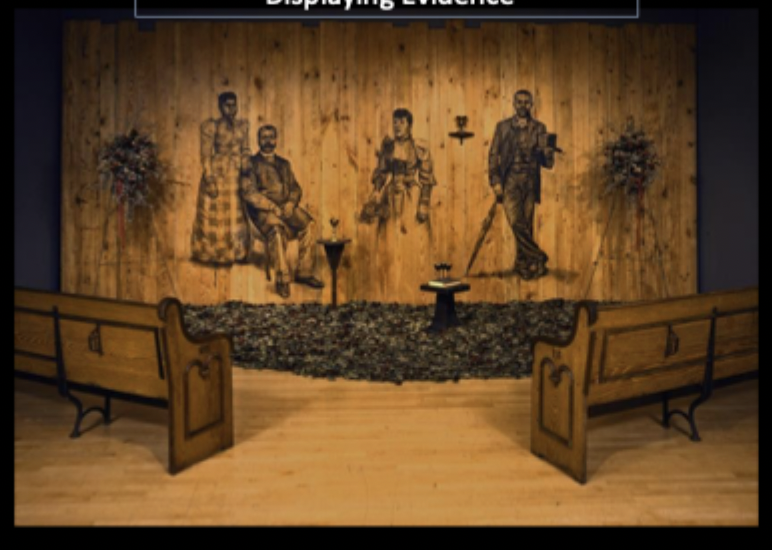
Whitfield Lovell, Grace, 2003. (compare and contrast)
Wooden installation that shows a frozen moment in time, carefully staged. It implies a story, and evokes historical memory without movement.
It incorporates everyday objects, making the experience feel lived and personal history
Figures and installation make it seem like there is a presence and absence at the same time, which makes people think about the memory of those people or the ones that aren’t there.
Invites viewers to imagine stories behind the subjects memory as reconstruction
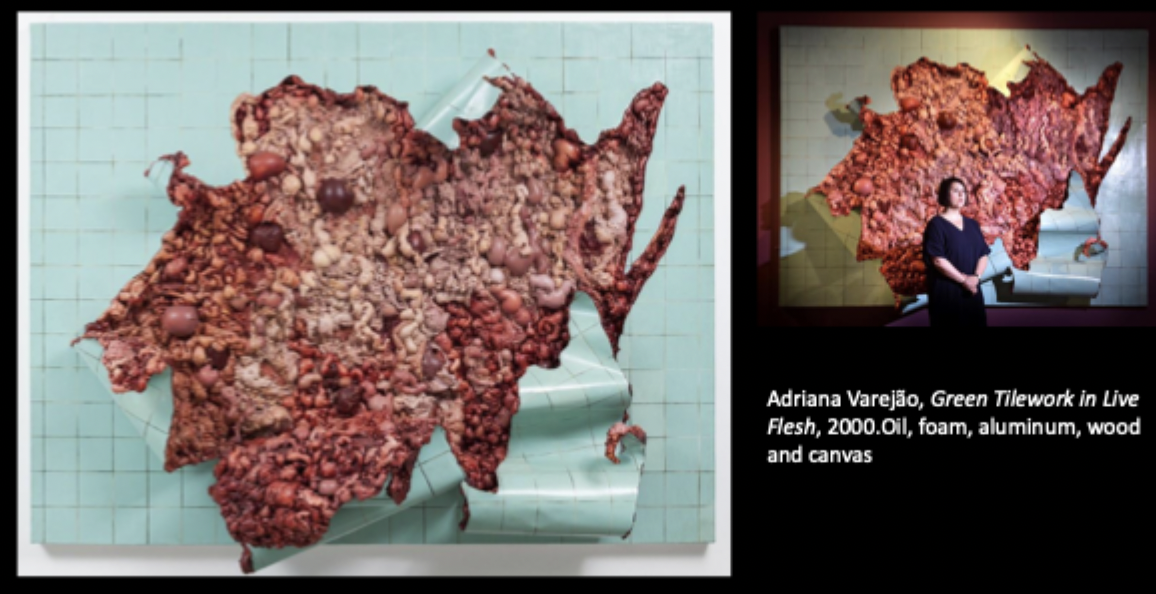
Adriana Varejão, Green Tilework in Live Flesh, 2000. (compare and contrast)
Artist shows beautiful tile work that is broken and revealing hidden violence beneath the surface. It is in reference to colonial history and cultural memory for Brazil.
Shows how national memory often covers over violent pasts
Memory of pain is covered up by the memory of past architecture/art
The artist is creating an alternative memory of Brazil’s colonial past
Suggests colonial violence remains present, not fully healed or forgotten.
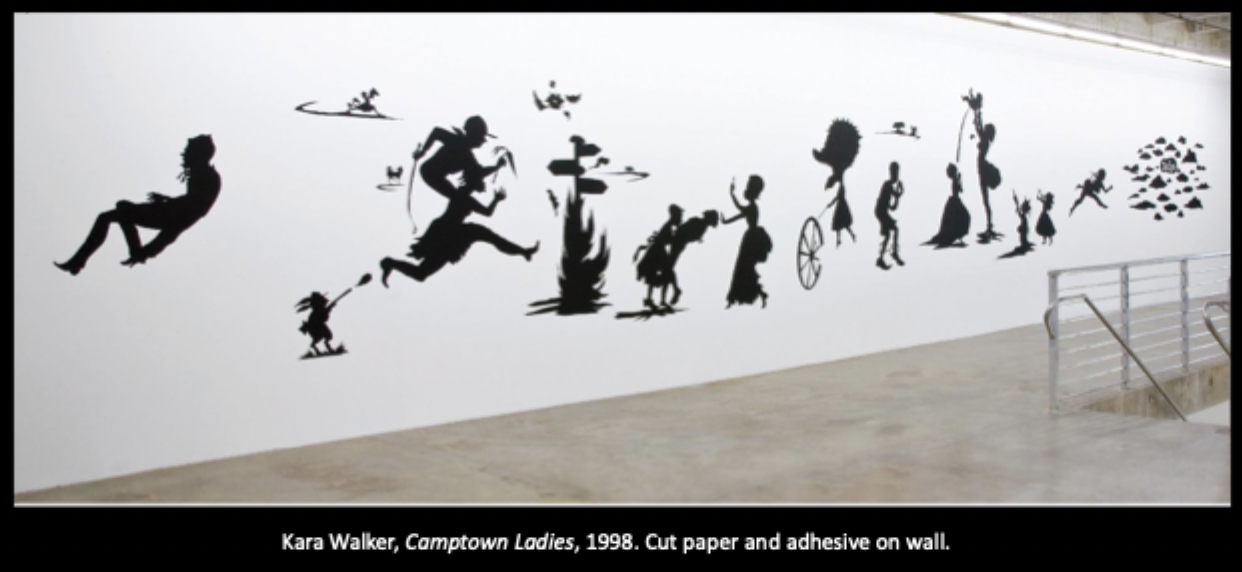
Kara Walker, Camptown Ladies, 1998. (compare and contrast)
Uses paper of black silhouettes of the figures to tell the story and suck them to a wall.
The silhouette is a story telling device.
Uses silhouette figures to reference historical memory of slavery and racism.
The black shadows show how the memory is generic but also a bit unclear.
Forces viewers to confront collective memory of violence, power, and oppression.
Uses exaggerated stereotypes to expose how racist images remain in cultural memory.
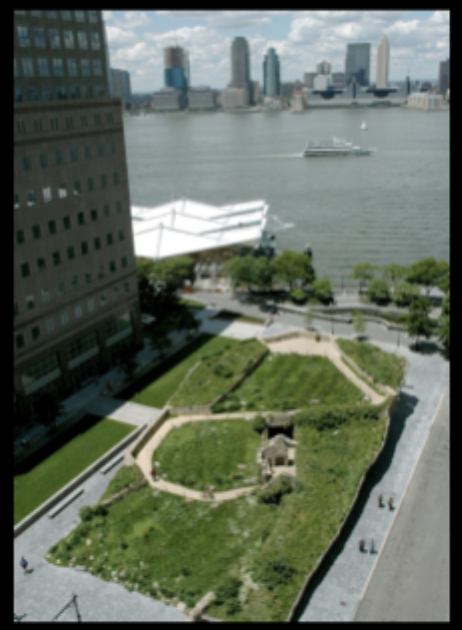
Brian Tolle, Irish Hunger Memorial, 2002. (compare and contrast)
A reconstructed Irish landscape placed on an elevated stone structure in New York City, commemorating the Irish Potato Famine and migration.
recreates a physical place in Ireland, using architecture and landscape to preserve the cultural memory of place.
Connects the place to the original and the original memories held from that place.
Contrasts natural landscape with modern city around it.
Represents displacement - leaving ones homeland and rebuilding another.
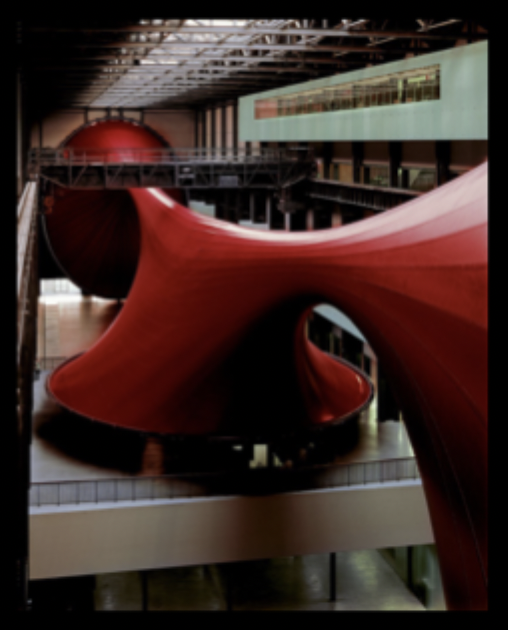
Anish Kapoor, Marsyas, 2002. (compare and contrast)
A massive red sculptural installation made of stretched PVC membrane and steel, filling the interior of the Tate Modern’s Turbine Hall.
Designed specifically for the place it is in, Turbine Hall. It cannot be separated from its location (site-specific)
Transforms the museum space into an immersive experience
Connects place to physical movement and spatial experience.
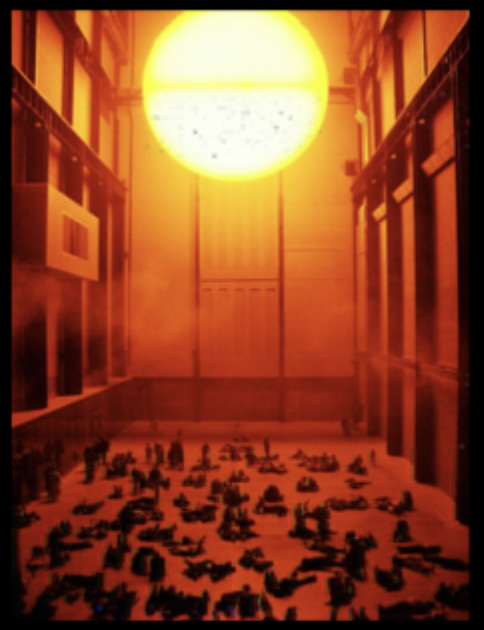
Olafur Eliasson, The Weather Project, 2003. (compare and contrast)
A large installation in the Tate Modern’s Turbine Hall featuring a glowing artificial sun, mist, and mirrored ceiling that transformed the museum into an atmospheric environment.
Created specifically for Turbine Hall (site-specific)
Creates an immersive environment with the space. The audience is inside the art/installation. (multisensorial)
Turns a place into human interaction and shared public experience
Place is formed from perception, not just location.
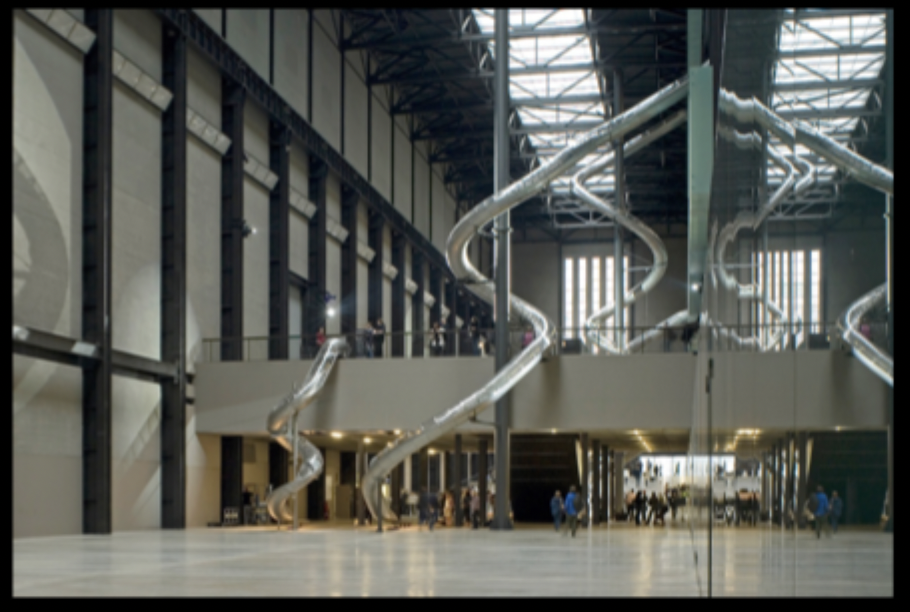
Carsten Höller, Test Site, 2006. (compare and contrast)
A large installation of giant metal slides built inside the Tate Modern, allowing visitors to physically move through the museum by sliding
Created specifically for Turbine Hall (site-specific)
Connects place to bodily experience, speed, and movement
Turns a space meant for viewing into an interactive space (relational aesthetics)
Place is formed from participation, not just location
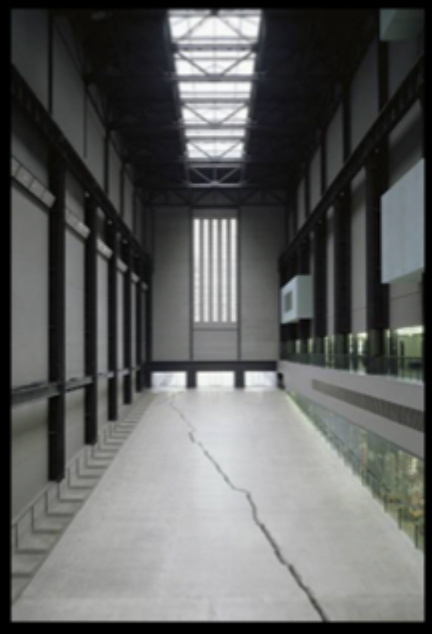
Doris Salcedo, Shibboleth, 2007. (compare and contrast)
A long crack cut into the floor of the Tate Modern’s Turbine Hall, creating the appearance of a deep fracture running through the museum space
Created specifically for Turbine Hall (site-specific)
Uses architecture (the ground) as part of the artwork
The crack is a symbol for division and separation, not just simply to be there
Connects place to a symbol and shows that place can hold hidden meanings of division and power
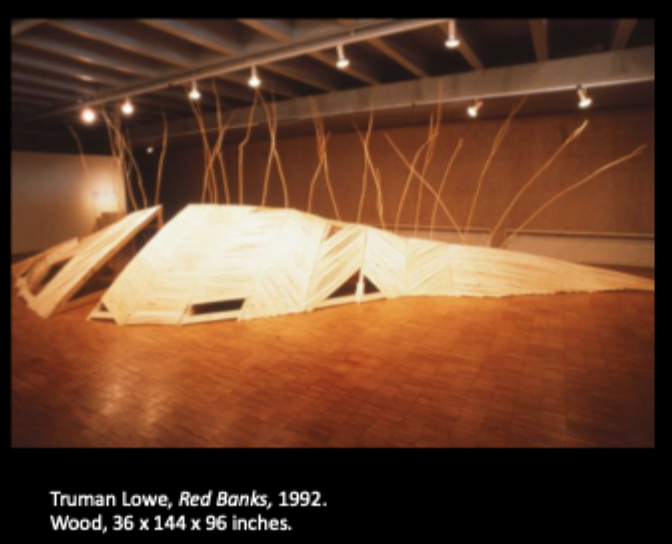
Truman Lowe, Red Banks, 1992. (compare and contrast)
A large sculptural installation made of natural wood forms that suggest flowing water, branches, and the landscape of the Wisconsin riverbanks
Inspired by a place: the Wisonsin riverbanks
Actually uses parts of the place from the environment with the wood (Earth Art)
Connects land and environment
Suggests movement in a place instead of a fixed and still scene
Reflects the artist’s Ho-Chunk cultural connection to land and environment
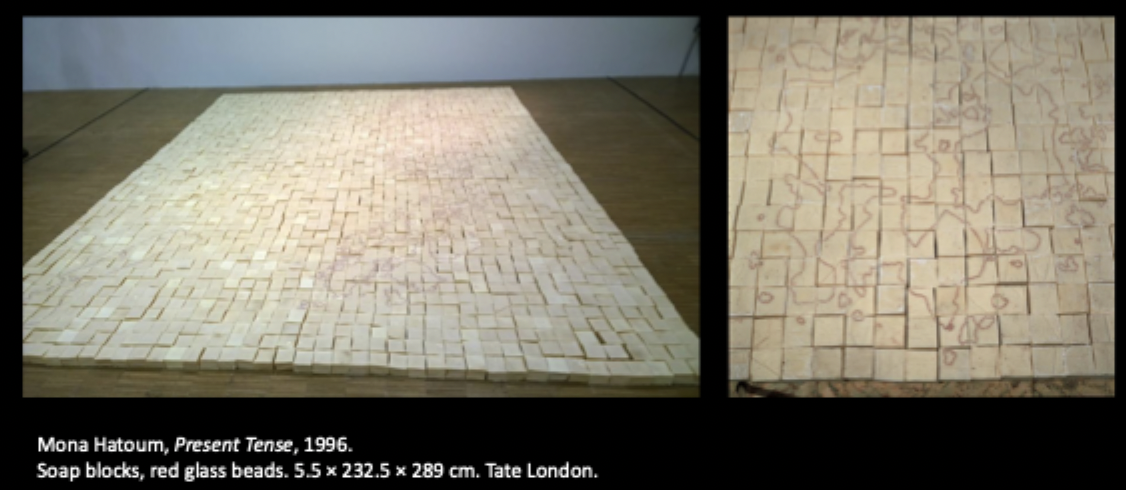
Mona Hatoum, Present Tense, 1996. (compare and contrast)
A rectangular block of soap embedded with red beads arranged into a map-like pattern of the Middle East
Uses a real geopolitical region map which shows specific geographical place
Suggests that place changes from different effects. when the soap is used, they change shape and change the territories on them.
Suggests that geographic locations can be contested by different groups, often due to political, historical, or cultural conflicts over land, borders, identity, or control. These elements change them over time (disputed places)
Emphasizes place as something shaped by power and interpretation, not just geography
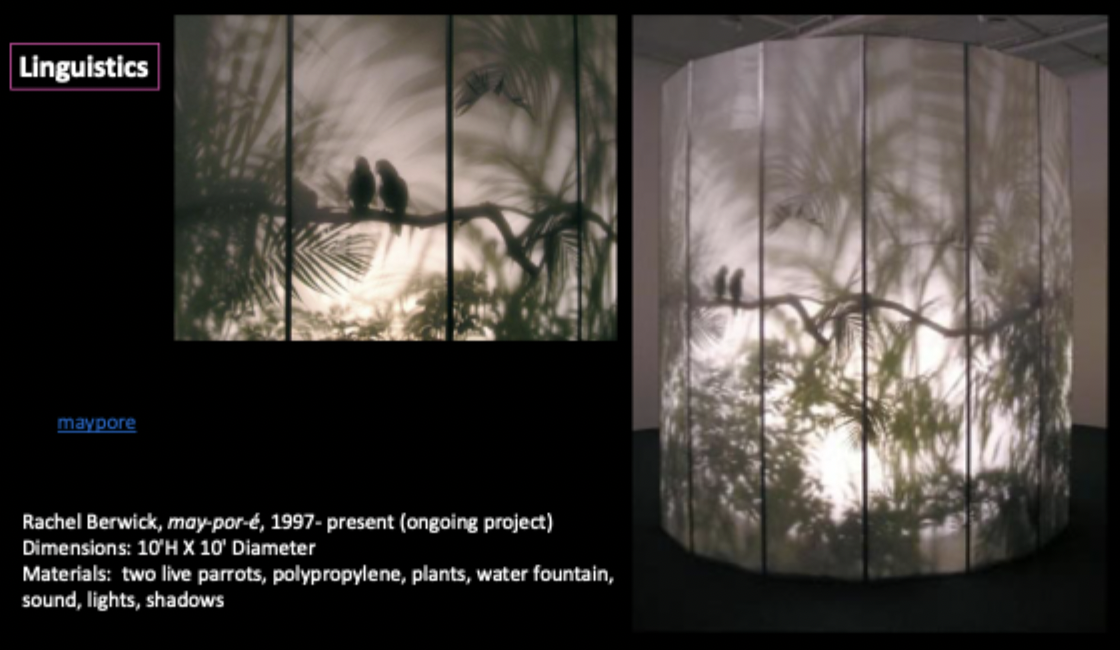
Rachel Berwick, may-por-é, 1997 - present (ongoing project). (compare and contrast)
An installation and ongoing project involving the preservation and reconstruction of the nearly extinct Mayan language “May-por-é” through recorded sounds, text, and archival materials
Focuses on the preservation of an extinct language, showing that language is fragile and easy to lose
Shows language as a representation of culture and memory of people
Shows language as living, not static
Frames language as an archive that can be studied, preserved, or reconstructed
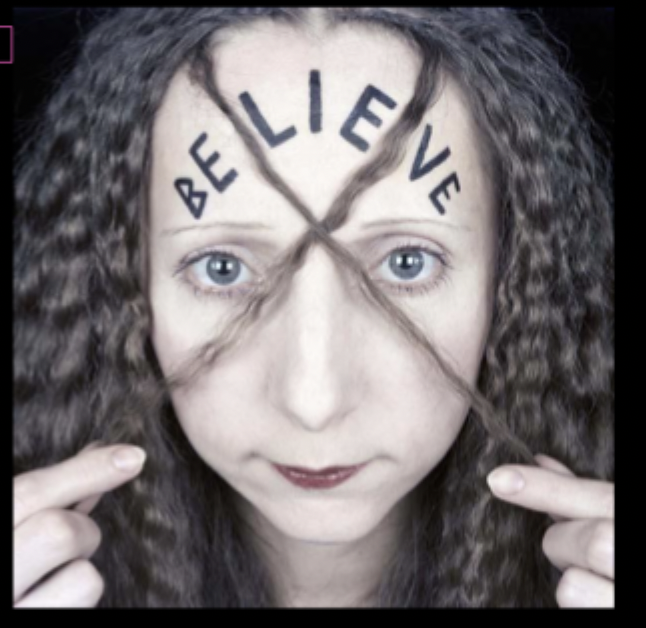
Rima Gerlovina and Valeriy Gerlovin, Be-Lie-Ve, 1990. (compare and contrast)
A photographic work where the word “believe” is visually split and reconfigured into “be-lie-ve,” often using staged imagery of bodies and text
Shows how words/language can be broken and reconstructed to have a new meaning
Shows language as both visual form and semantic system
Uses typography and bodies to merge text with physical expression
Suggests language can manipulate perception and belief. Meaning is unstable and created through reading.
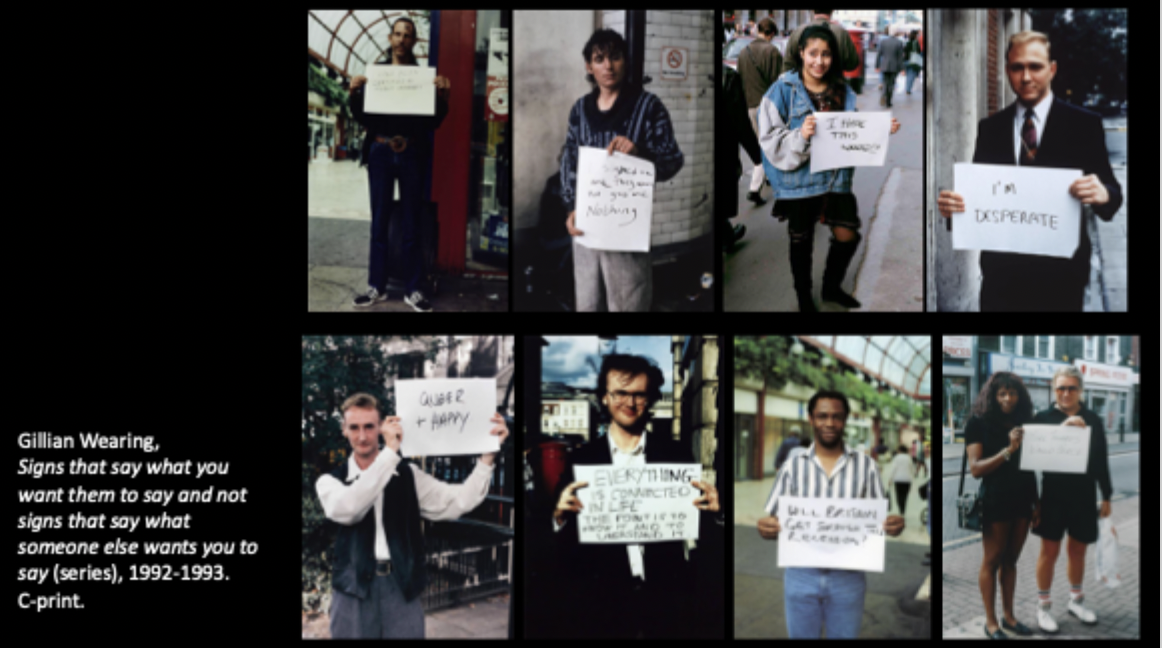
Gillian Wearing, Signs that say what you want them to say and not signs that say what someone else wants you to say (series), 1992-1993. (compare and contrast)
A photographic series where strangers hold handwritten signs expressing their personal thoughts or confessions
Focuses on personal expression through written language. Which challenges the idea that identity is fixed, instead showing it is constructed and dependent on language and context.
Highlights how language can reveal hidden emotions or truths
Demonstrates language as both intimate and performative
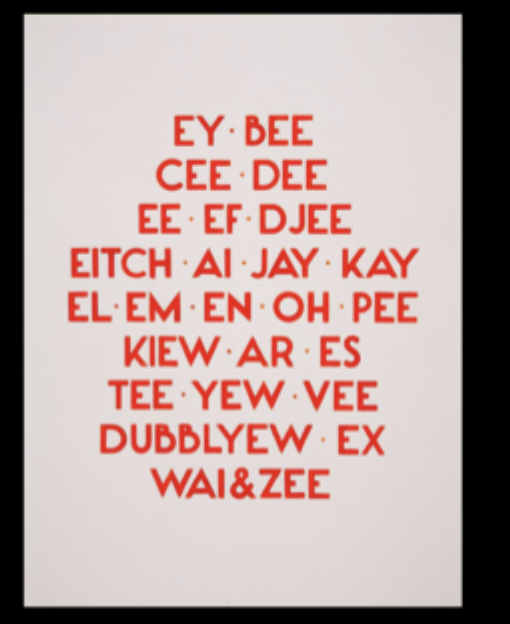
Tauba Auerbach, How to Spell the Alphabet, from series “Ecstatic Alphabets/Heaps of Language”, 2005. (compare and contrast)
A visual work that deconstructs the alphabet, rearranging or abstracting letters into non-standard forms and structures.
Breaks down language into its most basic unit: the alphabet
Makes the viewer think about spelling, sequence, and the mechanics of language itself.
Emphasizes pronunciation in language, specifically the English alphabet.
Shows language as visual material, not just communication
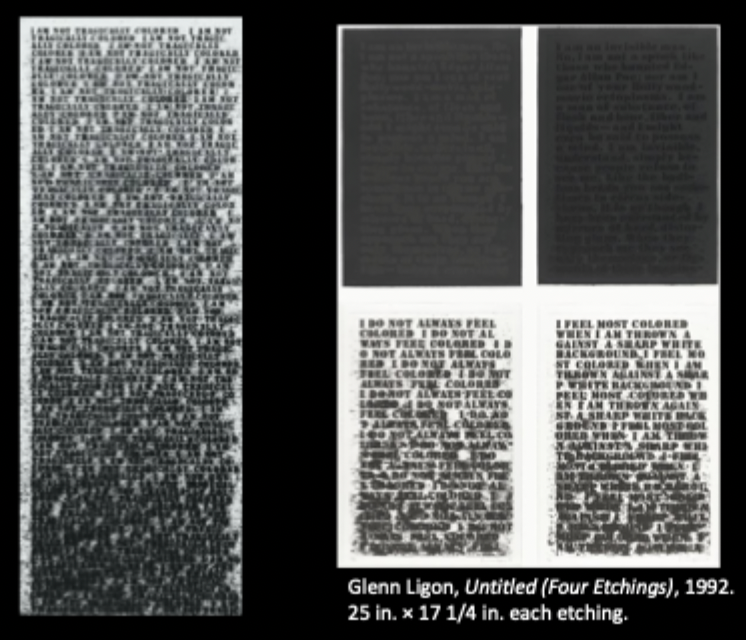
Glenn Ligon, Untitled (I am not Tragically Colored), 1990. (compare and contrast)
A text-based painting using stenciled repetition of a quote from Zora Neale Hurston about identity and race
Uses written text as the main visual element of the artwork
Repetition of words shows how meaning can shift and break down as it interpreted overtime.
Emphasizes how language carries history, culture, and social meaning
Shows how identity is shaped and questioned through written expression
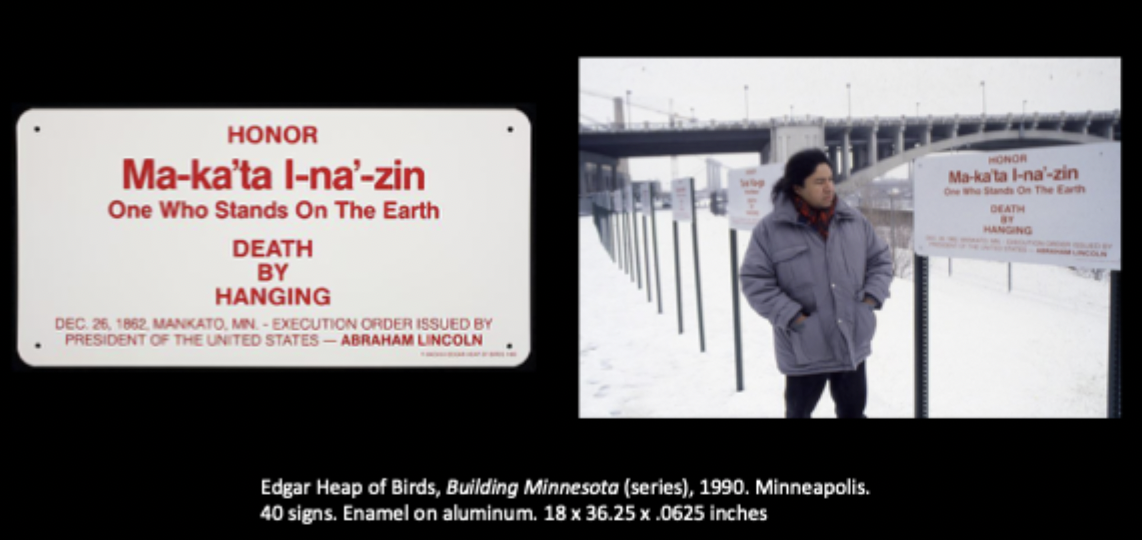
Edgar Heap of Birds, Building Minnesota (series), 1990. (compare and contrast)
A series of text-based works using stark, often public signage-style language referencing Native American presence and displacement in Minnesota
Shows language as a public statement
Language functions as a tool for political resistance and visibility
Makes viewers confront uncomfortable historical truths through words
Serves as a representation of a specific population
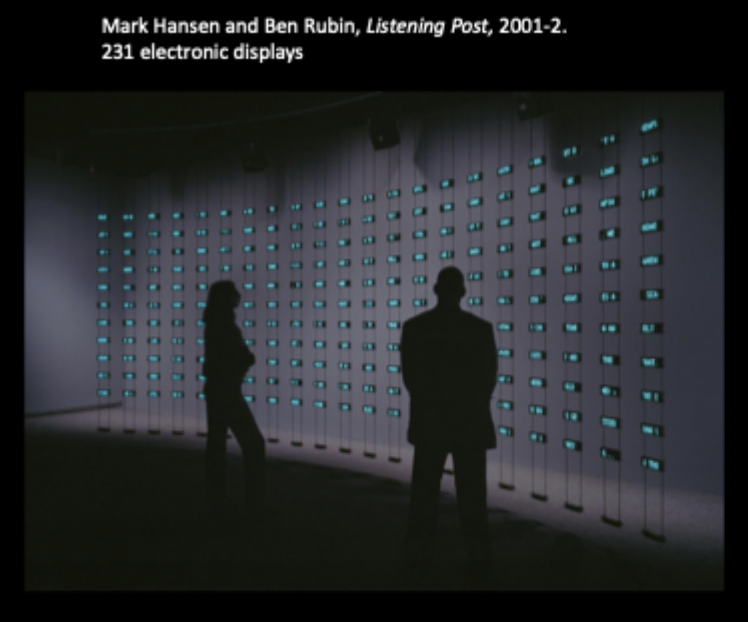
Mark Hansen and Ben Rubin, Listening Post, 2001-2. (compare and contrast)
An installation that displays real-time fragments of text from online chat rooms and forums on a grid of small screens, combined with synthesized audio readings.
Turns digital communication into visual and sonic experience
Language becomes data, constantly generated and shifting
Makes the viewer stop and slow down by reading
Shows how technology reshapes how language is produced and consumed