EX. 15 | Protein Catabolism, Part 1
 Call Kai
 Learn
Learn Practice Test
 Spaced Repetition
 Match
Match Flashcards
 Knowt Play
1/3

There's no tags or description
Looks like no tags are added yet.
Name | Mastery | Learn | Test | Matching | Spaced | Call with Kai |
|---|
No analytics yet
Send a link to your students to track their progress
4 Terms
3 Main Tests
Gelatin Hydrolysis
Urease Test
Litmus Test
Gelatin Hydrolysis
Purpose
Detects if bacteria produce gelatinase (enzyme), which breaks down gelatin into amino acids
Gelatinase
Exoenzyme that hydrolyzes gelatin, causes it to stay liquid even when cooled below 20oC
Medium used
Nutrient gelatin
Results
Positive result: Gelatin remains liquid even after being placed in ice (stays liquefied below 20oC) → gelatinase was produced → bacteria produce gelatinase, which breaks down gelatin into amino acids
Negative result: Gelatin re-solidifies / stays solid when cooled in ice → no gelatinase produced → gelatinase is absent → bacteria did not break down the gelatin
Urease Test
Purpose
Detects if bacteria produce urease (enzyme), which breaks down urea into ammonia and carbon dioxide
Urea agar starts at pH 6.8 (yellow) — any rise in pH from ammonia production shifts it toward fuchsia (hot pink)
Urease
An enzyme that liberates ammonia from urea
Urea agar
Contains peptone, glucose, urea, and phenol red
Urea
Waste product of protein digestion, excreted in urine
Medium used
Urea agar
Results:
Positive result: Ammonia released → pH rises → Phenol red turns hot pink at pH 8.4
Negative result: No color change (phenol red stays yellow at pH 6.8 or below)
A positive result indicates a color change from yellow to pink
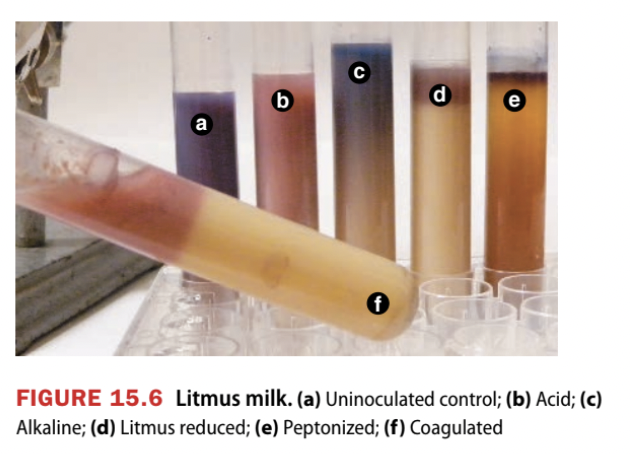
Litmus Milk Test
Purpose
Detects many bacterial activities such as casein hydrolysis, lactose fermentation, and litmus reduction
Also determines if a solution is acidic or basic by changing color
Litmus milk
Skim milk + litmus indicator, used to detect protein hydrolysis and lactose fermentation
Results:
Acid produced → Pink → Meaning that lactose fermentation occurred, which produces lactic acid
Alkaline produced → Purple → Meaning that amino acids were catabolized
Litmus reduced → White → White color indicates litmus has been reduced, meaning that bacteria consumed dissolved oxygen to create an anaerobic environment, using the litmus as its electron acceptor
Peptonization → Clear → Casein fully hydrolyzed to amino acids
Coagulation → Curd/solid → Excessive acid caused curd formation