Triage Workshop
 Call Kai
 Learn
Learn Practice Test
 Spaced Repetition
 Match
Match Flashcards
 Knowt Play
1/27

There's no tags or description
Looks like no tags are added yet.
Name | Mastery | Learn | Test | Matching | Spaced | Call with Kai |
|---|
No analytics yet
Send a link to your students to track their progress
28 Terms
What are the important questions to ask when considering equine emergencies?
What clinical signs and behaviours have you seen?
How long has the horse had clinical signs/when was it first noticed?
Has the horse been treated in any way?
Has the horse previously had the condition: if so, what was the course of treatment and the response?
What are the most common emergencies in equine practice?
Colic
Wounds
Severe lameness
Respiratory distress
Choke
Eye problems
Laminitis
What are some treatment considerations in equine emergencies?
Owner factors
Horse suitability
Referral options
Ethics/welfare
Concurrent conditions
Finances
Availability of treatment
What are some stabilisation options in equine emergencies?
Condition-specific treatments
Symptomatic treatments
Supportive therapies
Consider home/hospital
What are the key questions to ask when considering exotic emergencies?
How long has the animal had clinical signs/when was it first noticed?
What is their environment/husbandry like?
What are the financial limits: is referral an option?
What are the most common emergencies in exotics practice?
Respiratory issues
Gastrointestinal issues
Cloacal prolapses
Fractures
Injuries
Unresponsive animals
Neurological signs (e.g seizures)
Regurgitation
Fly strikes
What are some treatment considerations in exotics emergencies?
Reptiles do not show pain outwardly: do not forget about analgesia
Reptiles are ectotherms: become unresponsive when cold
Small mammals get ‘gut stasis’ secondary to other issues: can be life threatening
Acute changes can often be more life threatening than the primary issue(s)
What are some stabilisation options in exotics emergencies?
Analgesia
Warmth
Oxygen
Fluids
Monitoring heart rare
Providing nutrition
Antibiotics (if applicable)
Fracture stabilisation (if applicable)
What are some key things to consider in exotics emergencies?
Reptiles get sick slowly and get better slowly
Birds get sick quickly and get better quickly
Prey species (e.g rabbits) often hide disease very well: when they begin to look poorly, they are often very unwell and unable to hide it anymore
What are the most common emergencies in farm animal practice?
Cardio-respiratory: haemorrhage
Urogenital: calving/prolapse
Neurological: hypomagnesaemia/hypocalcaemia
Trauma
Intoxications
Which factors should you consider when prioritising farm animal emergencies?
Body systems/presenting signs
Location
Description of events
Duration of signs
Treatment administered
Which safety questions should you ask in farm animal emergencies?
Is the animal adequately restrained?
Is there any machinery involved?
Are there other animals involved?
How should you organise your clinical exam in farm animal emergencies?
Assess main body systems thoroughly
Create a list of all the problems and prioritise them
Focus on the main issue(s)
Think about further treatment moving forwards
Who are the emotional stakeholders in small animal emergencies?
Vet
Nurse
Receptionist
Client
Animal
What are the 2 types of language barriers in emergency medicine?
Veterinary terminology
Actual language barrier
What are the logistical questions to consider in small animal emergencies?
Will the patient arrive on time?
Is there another emergency on the way?
Will we have time to stabilise the patient before it worsens?
How big is the patient that’s coming?
Is the patient insured?
Can the owner afford treatment?
Will the owner’s finances affect the treatment that can/should be administered?
Should we consider euthanasia?
Should this patient be saved?
Who has brought the patient in? Owner/guardian/member of the public?
Can they legally sign
What is meant by the term ‘triage’?
The evaluation and allocation of treatment to patients according to a system of priorities designed to maximise the number of survivors
What is the system of priorities in small animal emergencies?
Body systems
Cardiovascular, respiratory and neurological are most important
Renal and abdominal
Intoxications
Trauma (wounds/fractures)
What does DR ABC stand for?
D: Danger
R: Response/rapid bleeding
A: Airway
B: Breathing
C: Circulation
What should you check for if there is no response during a small animal emergency?
Airway:
Is there anything obstructing the airway?
Secure with an endotracheal tube if possible
Take care not to get bitten
Breathing:
Is the chest rising and falling?
Can you hear/feel breath?
If not: give 2 rescue breaths
Circulation:
Is there a heartbeat/femoral pulse?
If not: start compressions
Draw out the CPR initial assessment algorithm
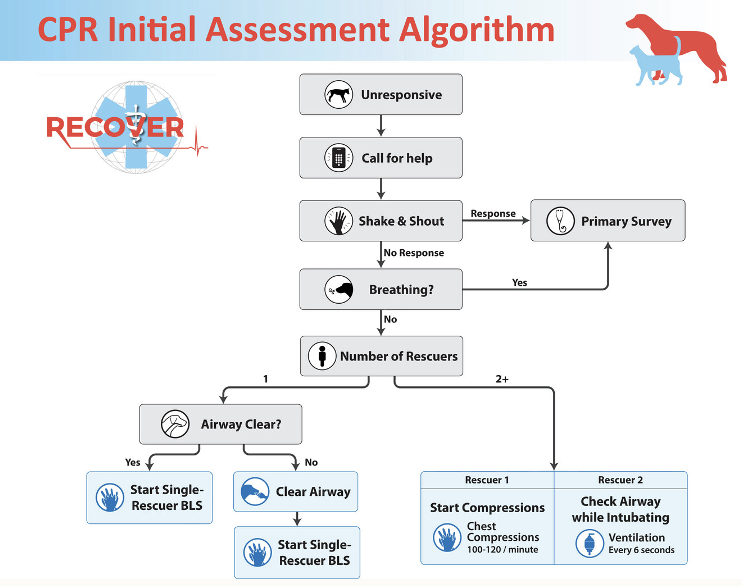
What neurological symptoms should you look for during small animal emergencies?
Seizures
Abnormal gait
Coma
What renal symptoms should you look for during small animal emergencies?
Urine output
Palpable bladder
GFAST
What abdominal symptoms should you look for during small animal emergencies?
Abdominal pain
Distension (blood/fluid)
GFAST
What intoxication symptoms should you look for during small animal emergencies?
History of ingestion
Strange behaviour
Organ failure
What trauma symptoms should you look for during small animal emergencies?
Blood/wounds
Recumbency
Lameness/gait abnormalities
Define a veterinary emergency
Any sudden, unforeseen injury, illness, or condition in an animal that threatens its life, or risks permanent damage or severe pain- requiring immediate veterinary treatment
How can you safely work around recumbent animals?
Wear protective gear
Approach calmly- avoiding sudden movements
Protect the head (e.g using a blanket)
Turn the animal every few hours