P/S mcat
 Call Kai
 Learn
Learn Practice Test
 Spaced Repetition
 Match
Match Flashcards
 Knowt Play
1/69

There's no tags or description
Looks like no tags are added yet.
Name | Mastery | Learn | Test | Matching | Spaced | Call with Kai |
|---|
No analytics yet
Send a link to your students to track their progress
70 Terms
Reliability
producing similar results every time
Internal validity
Extent of true accurate results
External validity
Generalize to other settings
Proactive interference
Old information interferes with new learning
Retroactive interference
New information interferes with old memories
Episodic memory
Memory of personal events and experiences
Semantic memory
Memory of facts and concepts
Difference threshold
minimum difference perceived between two stimuli
Weber’s law
JND is proportional to the original stimulus intensity
Top-down processing
Perception influenced by expectations and prior knowledge
Bottom-up processing
Perception begins with sensory input
Cultural relativism
Understanding a culture based on its own standards
what is Symbolic interactionism?
development of identity through social interactions
Social facilitation
Performance changes in the presence of others
Groupthink
Pressure to conform in group decision-making
Frontal lobe
planning, impulse control, motor function
Parietal lobe
touch, spatial awareness
Amygdala
fear, aggression
Hippocampus
long-term explicit memory
Hypothalamus
homeostasis, 4 F’s (feed, fight, flight, fornicate)
Thalamus
sensory “way station" except for smell
Cerebellum
maintain posture and balance and coordination
Basal ganglia
movement, Parkinson’s
Broca’s area
speech production
Wernicke’s area
language comprehension
Sensorimotor stage
from 0-2, object permanence
Preoperational stage
from 2 -7, egocentrism
Concrete operational stage
from 7-11. conservation
Formal operational stage
from 12+ abstract reasoning
Kohlberg's moral Preconventional stage
punishment / reward
Kohlberg's moral Conventional stage
social approval / laws
Kohlberg's moral Postconventional stage
universal ethics
Characteristic of Stage 1 of sleep
Theta waves, light sleep
Characteristic of Stage 2 of sleep
sleep spindles, K complexes
Characteristic of Stage 3 of sleep
delta waves, deep sleep
Characteristic of REM sleep
dreaming, beta-like activity
Dissociative fugue
new location + new identity = coping mechanism for trauma
Dissociative amnesia
inability to recall past experience
James-Lange theory
arousal leads to an emotional experience.
Cannon-Bard theory
arousal and emotion occur simultaneously
Schachter-Singer theory
arousal + cognition leads to emotion.
Foot-in-the-door
small then large request
Door-in-the-face
large then smaller request
function of hindbrain
balance, coordination, breathing, digestion, arousal
function of medulla oblongata
vital functions: breathing, HR, digestion
GABA is a excitatory or inhibiting neurotransmitter
inhibiting
glutamate is a excitatory or inhibiting neurotransmitter
excitatory
what waves are visible when awake
beta and alpha
Personality disorders are characterized by
inflexible and enduring patterns
What is Manifest Functionalism?
Intended and obvious purpose
What is latent functionalism?
Unintended results
Positive symptoms of schizophrenia
Hallucinations, delusions, disorganized speech and behavior
Normative social influence
To fit in a group of people standards
Informational social influence
When you don’t know what to do and follow someone’s advice
what’s the behaviorist approach
environment shapes behaviour
When you see: low response rate (like 40–60%)
Think immediately:
selection bias / nonresponse bias
gender socialization in men include
high-risk behaviors
What’s disinhibition?
loss of behavioral control that leads to injuries
What is institutional discrimination?
systemic policies and structures that create unequal outcomes across groups
external locus of control refers to
fate
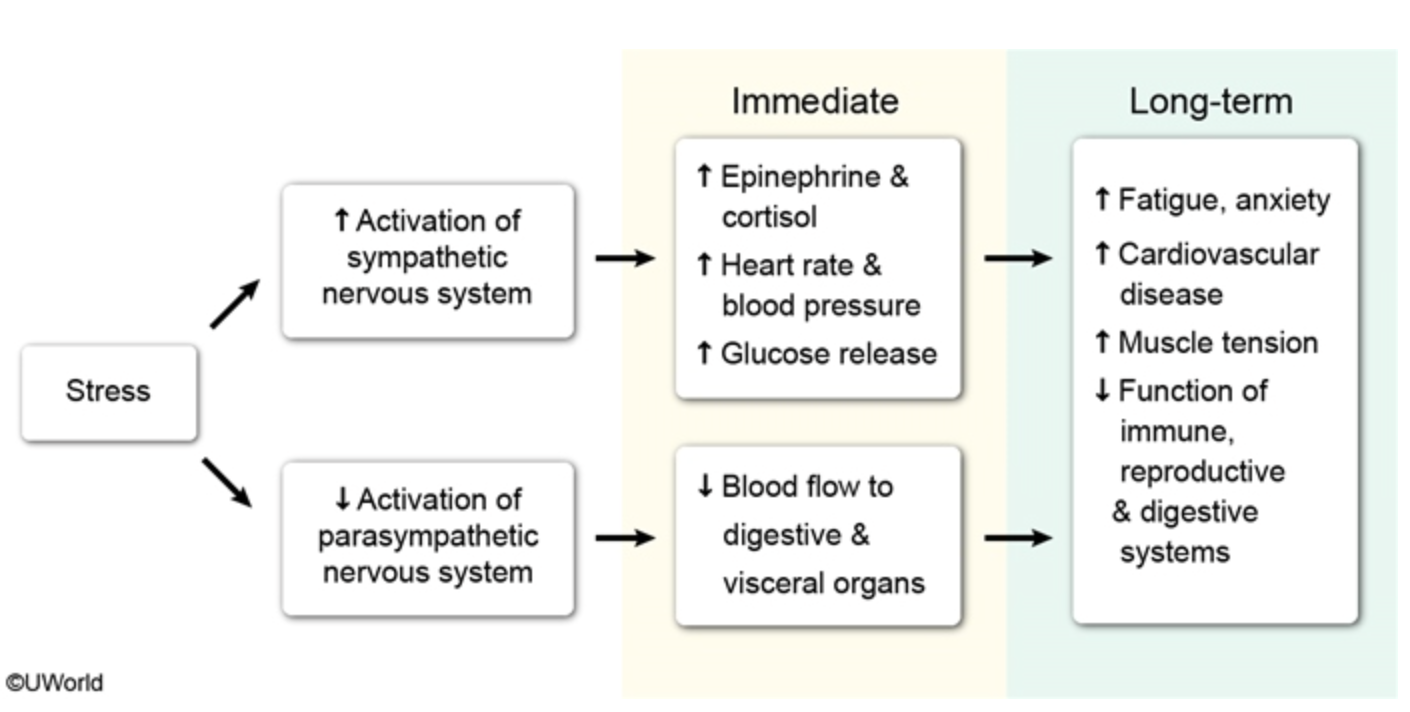
sympathetic vs parasympathetic nervous symstem
sympathetic: stress; parasympathetic: relaxation
what’s the biomedical approach?
treating psychological disorders primarily through medical interventions.
what’s Mead's Theory of Identity?
What do I want to do? and What does society expect from ME?
Fluid vs crsytallized intelligence
Fluid intelligence: problem-solving and reasoning skills; crystallized intelligence: accumulated knowledge and experience.
Aging decreases what types of memory?
episodic, fashbulb and source
Self-positivity bias
Bad things happen to other people, not me.
Elaboration Likelihood Model
scientific article and catchy phrases or celebrities
Optimism bias
tendency to believe you'll experience better outcomes than average.
Left hemisphere involves
language processing and analytical tasks.
right hemisphere involves
visual-spatial skills and creativity.