Biol005C Module 3 Learning Objectives (copy)
 Call Kai
 Learn
Learn Practice Test
 Spaced Repetition
 Match
Match Flashcards
 Knowt Play
1/23

There's no tags or description
Looks like no tags are added yet.
Name | Mastery | Learn | Test | Matching | Spaced | Call with Kai |
|---|
No analytics yet
Send a link to your students to track their progress
24 Terms
Define an ecological community and recognize different ways to describe their structure and organization.
An ecological community is made up of a group of populations of various species living close enough for potential interactions. Community structure and organization can be described by their niche differences, species diversity, trophic structure, and stability over time.
Describe the key assumptions of neutral theory and predict how those assumptions influence expected patterns of species distributions (e.g., Island Biogeography Theory).
Neutral Theory assumes that there is ecological equivalence, no niches/no selection, random birth/deaths/dispersal, dispersal limitation, slow speciation, and fixed community sizes. These assumptions can influence immigration, distribution (more common species), extinction, and isolation of species.
Construct and interpret graphical models of immigration and extinction to determine and explain equilibrium species richness.
As the number of species increases, immigration will decrease as there is less chance a new species will arrive on the island. In addition, there are already so many species on the island that there will be less room for new species. As the number of species increases, extinction will increase as there will be more competition and predation occurring. Equilibrium species richness occurs when immigration and extinction intersect.
Predict how island characteristics (size, distance) influence species richness, and justify predictions using assumptions of neutral theory.
As island size increases, species richness also increases as larger area provides more room for habitat diversity. As island distance increases, species richness decreases as there is less of a chance for species to migrate onto an island far away from the mainland. Because these species do not have niches and have random birth/death/dispersal, these predictions are justified.
Analyze real-world data to evaluate whether species distribution patterns are consistent with island biogeography theory.
If species richness and island size have a direct relationship, this is consistent with IBT. If species richness and distance have an indirect relationship, this is consistent with IBT.
Apply principles of island biogeography theory to evaluate conservation strategies (e.g., SLOSS), and justify recommendations using model predictions and assumptions.
According to IBT, it is better to have bigger islands that are closer together. IBT can be applied to SLOSS, which states that larger, continuous, close islands are best. If islands are small, there is less probability that species will survive.
Define and describe mechanisms of interspecific competition.
Interspecific Competition occurs when species compete for resources in short supply. There are two types of interspecific competition: interference and exploitative. Interference occurs when there are aggressive encounters among individuals. Exploitation occurs when individuals deplete resources by consuming or using them.
Differentiate between fundamental and realized niches and predict how species interactions (e.g., competition) shift a species’ realized niche.
Fundamental Niches are niches potentially occupied by a species, while Realized Niches are niches actually occupied by a species. Species interactions can shift a species’ realized niche by decreasing or increasing them.
Generate and justify predictions about how similar species can coexist by applying the competitive exclusion principle and resource partitioning, including how disruptive selection can drive character displacement and lead to niche differentiation.
Similar species can coexist if they each have different niches. That way, they can partition resources differently without having to compete for them and eliminating species (competitive exclusion). Disruptive Selection occurs when trait distributions peak on the left and right, which can drive character displacement in sympatric populations as a certain species may be more fit than the other. This can result in niche differentiation.
Interpret ecological data (e.g., grazer population changes over time) to infer mechanisms of coexistence, including facilitation and competition.
The grazer population changes over time can be an example of both facilitation and competition. This can be argued as an example of facilitation as the zebra helped eat the tall grass for the wildebeest and Thompson’s gazelle populations to eat the shorter grass that grows. This can also be argued as an example of competition as the three species are fighting for the same resources.
Distinguish among different types of niche partitioning (e.g., spatial, temporal, dietary) and apply them to novel ecological scenarios.
Spatial Niche Partitioning occurs when different species occupy different spaces in a habitat. An example is birds living in different parts of the same tree. Temporal Niche Partitioning occurs when different species access resources at different times. An example is the zebra, wildebeest and Thompson’s gazelle populations accessing the grass at different times of the year. Dietary Niche Partitioning occurs when different species eat different food. An example is herbivores eating either grass or shrubs.
Distinguish between facultative and obligate mutualisms and justify your classification using specific ecological examples.
Facultative Mutualisms are unnecessary for survival but improve fitness. An example is insects that eat ticks off of large mammals. Obligate Mutualisms are necessary for survival and improve fitness. An example is between coral and algae - corals provide protection for the algae and algae provides energy to the coral.
Explain why cooperation can evolve despite natural selection favoring selfish behavior, using concepts from game theory.
Cooperation can evolve despite natural selection favoring selfish behavior as cooperation can potentially result in the most fittest option for most organisms. As long as the interaction is strategic, cooperation can be beneficial.
Apply evolutionary stable strategy (ESS) concepts to cooperative ecological interactions.
Evolutionary Stable Strategies are strategies that remain the same and are not altered by alternative strategies. An example is plant-pollinators. Their interactions are stable as they repeatedly interact with each other and do not cheat off of each other.
Predict how environmental change alters mutualistic interactions (e.g., plant–pollinator interactions).
Environmental change can alter mutualistic interactions by resulting in the gain or loss of some species. An example is seen between plant-pollinator interactions. In the event of a drought, species richness and visitor abundance for the I. aggregata plant will increase as it is the most abundant plant during the drought.
Define and recognize examples of antagonistic exploitative interactions (+/-).
Predation: a predator kills and eats a prey; example: lion attacking an antelope
Herbivory: one species feeds on a plant but does not kill it; example: sheep eating bushes
Parasitism: a parasite derives nourishment from its host; example: ticks and lice
Analyze experimental data to determine how predation influences survival and habitat use in Anolis lizards.
Anolis lizards tend to roam on the ground because of their long legs. Around predators, however, they tend to linger on branches and twigs. Because of this, those Anolis lizards with short legs survive and their alleles get passed on.
Use evidence to explain how antagonistic exploitative interactions can drive rapid evolutionary change in populations (e.g., morphology and niche).
Antagonistic exploitative interactions can cause rapid evolutionary changes in populations as they can determine who is the most fit. In addition, different traits can change over time. This is seen with the Anolis lizards. Their leg length and niche changed over time as predators roamed the island.
Compare how cooperative and antagonistic interactions differently shape species’ niches and evolutionary strategies.
Cooperative interactions can shape species’ niches and evolutionary strategies by making their niches and evolutionary strategies more expansive and stable, while antagonistic interactions can generalize niches and cause partitioning.
Differentiate between consumptive effects (CEs) and non-consumptive effects (NCEs) of predators, using ecological examples and be able to construct a conceptual model for each that represent direct and indirect species interactions.
Consumptive Effects are behaviors that involve a predator eating its prey (example: a lion attacking a zebra), while Non-Consumptive Effects are behaviors that involve a predator scaring off its prey (example: fish and their predators in the Hungry, Hungry Herbivores Module). Depending on the interaction, each species can be positively or negatively affected.
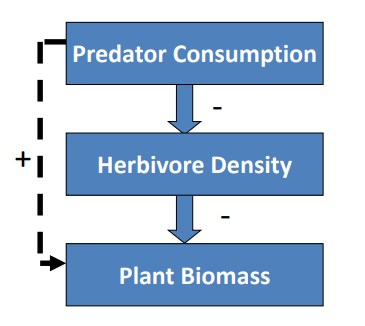
Describe the tradeoff organisms face between acquiring resources (e.g., food) and avoiding predation risk and be able to connect the consequences of tradeoffs across scales, from individual behavior to landscape patterns visible in satellite imagery.
Sometimes, organisms have to choose between safety or food when around predators. If an organism chooses safety, they will sacrifice their hunger for the predators, or the predators may not eat the food at hand. If an organism chooses food, they will risk their safety, but this may result in the loss of the food they are eating.
Predict how predator effects and reef rugosity (i.e., structural complexity) could interact to affect herbivore feeding behavior and how this in turn could influence coral and use a design/conceptual model to illustrate your prediction.
If a predator is nearby, that will increase a prey’s fear factor around them, resulting in them feeling unsafe to eat. As for the coral, algae will remain on it, which will slowly strip away the coral. If there is higher reef rugosity, that increases a prey’s safety, resulting in them feeling safe to hide/eat. As for the coral, the prey will be able to eat the algae on the coral, saving the coral.
Compare group means using boxplots and statistical tests (t-test and ANOVA) and draw biological conclusions from p-values.
Boxplots show how distributed data is.
T-Tests are used when comparing two groups. The p-value should be less than 0.05 for the data to be considered significant.
ANOVA Tests are used when comparing more than two groups. The p-value should be less than 0.05 for the data to be considered significant.
Evaluate how human activities such as overfishing of predators and loss of reef structural complexity influence the “reefscape of fear” and the resilience of coral reef ecosystems.
Overfishing of predators can result in less fear among prey and less algae, but it can also affect food webs and result in overpopulation of prey and biodiversity loss. Loss of reef structural complexity can result in increased fear among prey and more algae.