psych 1101 module 43 prosocial relations
 Call Kai
 Learn
Learn Practice Test
 Spaced Repetition
 Match
Match Flashcards
 Knowt Play
1/43

There's no tags or description
Looks like no tags are added yet.
Name | Mastery | Learn | Test | Matching | Spaced | Call with Kai |
|---|
No analytics yet
Send a link to your students to track their progress
44 Terms
by studying prosocial behavior
behavior that intends to help or benefit someone
Our positive behaviors toward others are evident from explorations of attraction, altruism, and peacemaking
let’s consider three ingredients of our liking for one another: (psychology of attraction)
proximity, attractiveness, and similarity.
proximity
geographic nearness—is friendship’s most powerful predictor.
Can provide provide opportunities for aggression
Mere exposure effect > the tendency for repeated exposure to novel stimuli to increase our liking of them.
Familiarity with a face also makes it look happier
For our ancestors, this mere exposure effect likely had survival value
Mere exposure increases our liking not only for familiar faces, but also for familiar musical selections, geometric figures,
We like other people when their faces incorporate some morphed features of our own.
mere exposure effect
the tendency for repeated exposure to novel stimuli to increase our liking of them.
similarity
in real life, opposites retract
Tall people like tall people, share interests
We also like those who like us.
reward theory of attraction: We will like those whose behavior is rewarding to us, including those who are both able and willing to help us achieve our goals
physical attractiveness
But studies show that a man’s looks do affect women’s behavior, women more likely to say that another's looks does not affect them
predicts how often people date and how popular they feel. And it affects initial impressions of people’s personalities
By providing reproductive clues, bodies influence sexual attraction
.When people rate other-sex faces and bodies separately, the face tends to be the better predictor of overall physical attractiveness
Our feelings also influence our attractiveness judgment > we are attracted to appealing personality traits
Our feelings influence our perceptions. Those we like we find attractive.
As we see our loved ones again and again, their physical imperfections grow less noticeable and their attractiveness grows more apparent
for those who find the importance of looks unfair and unenlightened, three other findings may be reassuring.
people’s attractiveness is surprisingly unrelated to their self-esteem and happiness
Unless we have just compared ourselves with superattractive people, few of us (thanks, perhaps, to the mere exposure effect) view ourselves as unattractive Strikingly attractive people are sometimes suspicious that praise for their work may simply be a reaction to their looks. Less attractive people have been more likely to accept praise as sincere
For couples who were friends before lovers—who became romantically involved long after first meeting—looks matter less With slow-cooked love, shared values and interests matter more
Once proximity affords us contact, what most affects our first impressions?
physical appearance
romantic love
If love endures, temporary passionate love will mellow into a lingering companionate love
modern matchmaking
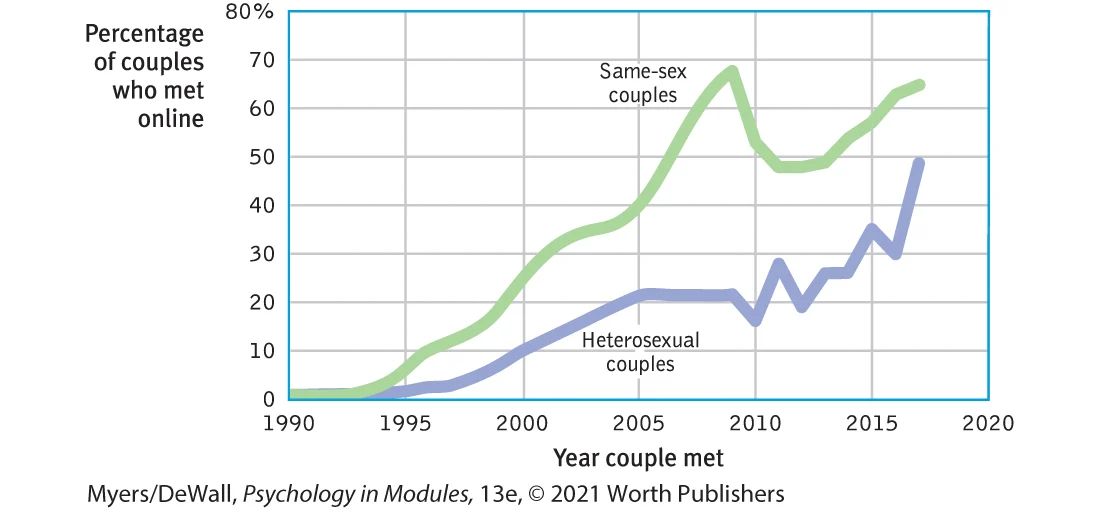
Those who have not found a romantic partner in their immediate proximity may cast a wider net, like dating sites/ dating apps
How effective is the matchmaking? Compared with those formed in person, internet-formed friendships and romantic relationships are, on average, slightly more likely to last and be satisfying
When conversing online with someone for 20 minutes, they felt more liking for that person than they did for someone they had met and talked with face-to-face. This was true even when (unknown to them) it was the same person! Internet friendships often feel as real and important as in-person relationships.
Those who want to meet again can arrange for future contact. For many participants, 4 minutes is enough time to form a feeling about a conversational partner and to register whether the partner likes them > concept of speed dating
For researchers, speed dating offers a unique opportunity for studying influences on our first impressions of potential romantic partners. Some recent findings:
People who fear rejection often elicit rejection > feared it least often selected for a follow up date
Give more options, people make more superficial choices > focus on more easily assessed characteristics when more partners
Men wish for future contact with more of their speed dates; women tend to be choosier > men stay, women circulate
Compatibility is hard to predict
passionate love definition
an aroused state of intense positive absorption in another, usually present at the beginning of a romantic relationship.
passionate love
We intensely desire to be with our partner, and seeing our partner stimulates blood flow to a brain region linked to craving and obsession
two factor theory of emotion
Adrenaline makes the heart grow fonder. Sexual desire + a growing attachment = passionate love
two factor theory of emotion can help us understand the intense positive absorption of passionate love That theory assumes that
emotions have two ingredients—physical arousal plus cognitive appraisal.
arousal from any source can enhance one emotion or another, depending on how we interpret and label the arousal.
companionate love
the deep affectionate attachment we feel for those with whom our lives are intertwined
equity
a condition in which people receive from a relationship in proportion to what they give to it
importance extends beyond marriage. Mutually sharing one’s self and possessions, making decisions together, giving and getting emotional support, promoting and caring about each other’s welfare
self disclosure
the act of revealing intimate aspects of ourselves to others (our likes and dislikes, our dreams and worries, our proud and shameful moments)
In addition to equity and self-disclosure, a third key to enduring love is
positive support
In the mathematics of love, self-disclosing intimacy + mutually supportive equity =
enduring companionate love
companionate love cont
the deep affectionate attachment we feel for those with whom our lives are intertwined
the flood of passion-facilitating hormones (testosterone, dopamine, adrenaline) subsides. But another hormone, oxytocin, remains, supporting feelings of trust, calmness, and bonding with the mate
Better, they say, to seek (or have someone seek for you) a partner with a compatible background and interests. Cultures where people rate love as less important for marriage do have lower divorce rates
altruism
unselfish regard for the welfare of others.
example of altruism
Kitty Genovese who was raped, no one intervened
bystander effect
the tendency for any given bystander to be less likely to give aid if other bystanders are present.
the odds for helping are the highest when
the person appears to need and deserve help.
the person is in some way similar to us.
the person is a woman.
we have just observed someone else being helpful.
we are not in a hurry.
we are in a small town or rural area.
we are feeling guilty.
we are focused on others and not preoccupied.
we are in a good mood.
The “good mood” result—that happy people are helpful people—is one of psychology’s most consistent findings
So happiness breeds helpfulness. But it’s also true that helpfulness breeds happiness. Helping those in need activates brain areas associated with reward
bystander intervention
Although initial reports of the Genovese murder overestimated the number of witnesses, the reports triggered outrage over the bystanders’ apparent “apathy” and “indifference.
instead attributed their inaction to an important situational factor—the presence of others
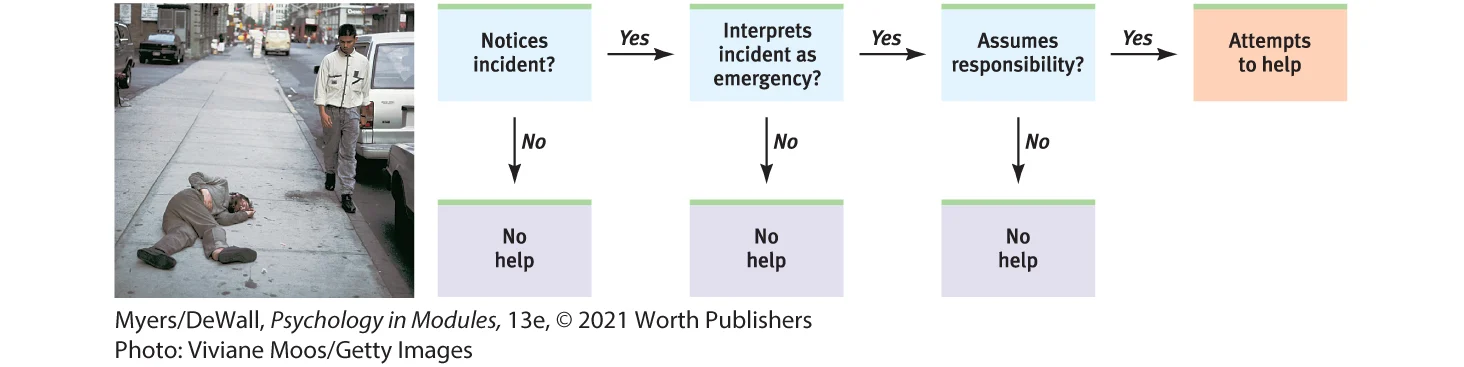
We will help only if the situation enables us first to notice the incident, then to interpret it as an emergency, and finally to assume responsibility for helping
At each step, the presence of others can turn us away from the path that leads to helping.
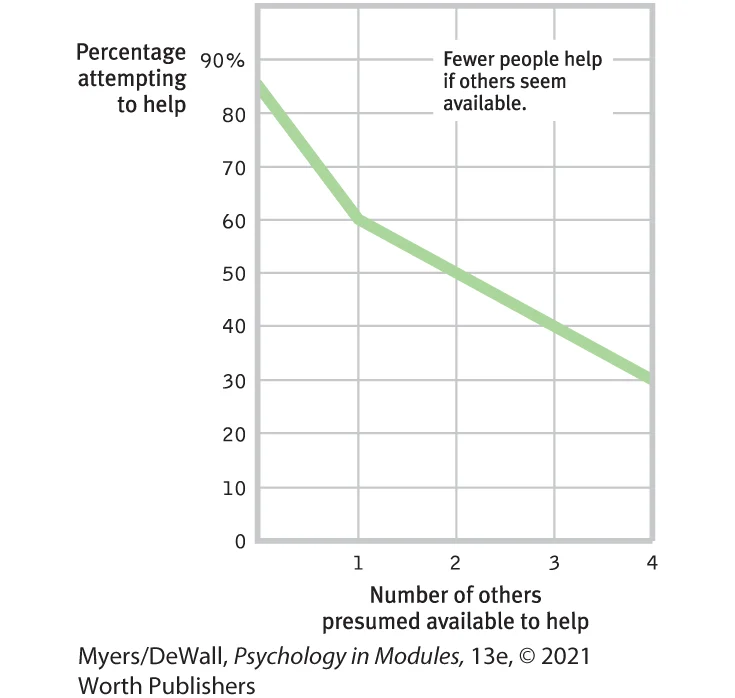
When more people shared responsibility for helping—when there was a diffusion of responsibility—any single listener was less likely to help.
social exchange theory
the theory that our social behavior is an exchange process, the aim of which is to maximize benefits and minimize costs
if the rewards exceed the costs, you will help.
Others believe we help because we have been socialized to do so, through norms that prescribe how we ought to behave
social responsibility norm
an expectation that people will help those needing their help.
young children and others who cannot give as much as they receive—even if the costs outweigh the benefits
example of social responsibility norm
Example of this was during COVID pandemic, going out despite risk of infection
the highly religious, despite being poorer, were about 50 percent more likely to report having “donated money to a charity in the last month” and to have volunteered time to an organization
reciprocity norm
an expectation that people will help, not hurt, those who have helped them
when people who were treated generously became more likely to be generous to a stranger
types of norms
social responsibility and reciprocity
One widely held view is that self-interest underlies all human interactions, that our constant goal is to
maximize rewards and minimize costs
from conflict to peace
Positive social norms encourage generosity and enable group living. But conflicts often divide us like global conflict
conflict
perceived incompatibility of actions, goals, or ideas
elements of conflict
In each situation, conflict may seed positive change, or it may be a destructive process that can produce unwanted results. Among the destructive processes are social traps and distorted perceptions
social traps
a situation in which the conflicting parties, by each pursuing their self-interest rather than the good of the group, become caught in mutually destructive behavior
challenge us to reconcile our right to pursue our personal well being with our responsibility for the well being of all
psychologists have therefore explored ways to convince people to cooperate for their mutual betterment through
agreed-upon regulations, through better communication, and through promoting awareness of our responsibilities toward community, nation, and the whole of humanity
mirror image perceptions
mutual views often held by conflicting parties, as when each side sees itself as ethical and peaceful and views the other side as evil and aggressive
As we see “them”—as untrustworthy, with evil intentions—so “they” see us, each demonizes each other
can often feed a vicious cycle of hostility.
feed similar cycles of hostility on the world stage
The point is that enemy perceptions often form mirror images. Moreover, as enemies change, so do perception
self fulfilling prophecies
a belief that leads to its own fulfillment; beliefs that confirm themselves by influencing the other country to react in ways that seem to justify those beliefs.
individuals and nations alike tend to see their own actions as responses to provocation, not as the causes of what happens next.
promoting peace
Contact, communication, and conciliationc
contact (part of promoting peace)
Does it help to put two conflicting parties into close contact? It depends. Negative contact increases disliking
But positive contact—especially noncompetitive contact between parties of equal status, such as fellow store clerks—typically helps.
countries with the most immigrants were the most supportive of immigrants; outgroup prejudice was strongest in countries with few immigrants
straight, cisgender people’s attitudes toward gay and transgender people are influenced not only by what they know but also by whom they know
extended contact”—knowing that ingroup friends have outgroup friends—improves attitudes toward the outgroup
When such mirror-image misperceptions are corrected, friendships may form and prejudices melt.
superordinate goals
shared goals that override differences among people and require their cooperation
cooperation
What reduced conflict was not mere contact, but cooperative contact.
Critics suggest that Sherif’s research team encouraged the conflict, hoping the study would illustrate their expectations about socially toxic competition and socially beneficial cooperation
children and youth exposed to war or conflict also develop strong social identities
at such times, cooperation can lead people to define a new, inclusive group that dissolves their former subgroups
members of multi-ethnic groups who work together on projects typically come to feel friendly toward one another
As we engage in mutually beneficial trade, as we work to protect our common destiny on this fragile planet, and as we become more aware that our hopes and fears are shared, we can transform misperceptions that feed conflict into feelings of solidarity based on common interests.
superordinate goals
communication (part of promoting peace)
Mediators help each party voice its viewpoint and understand the other’s needs and goals.
conciliation
Understanding and cooperative resolution are most needed, yet least likely, in times of anger or crisis
GRIT
Small conciliatory gestures alleviate tension
GRIT
Graduated and Reciprocated Initiatives in Tension-Reduction—a strategy designed to decrease international tensions
one side first announces its recognition of mutual interests and its intent to reduce tensions. It then initiates one or more small, conciliatory acts, open reciprocity from other party