Week 12: Biological Theories of Aging Web Page
 Call Kai
 Learn
Learn Practice Test
 Spaced Repetition
 Match
Match Flashcards
 Knowt Play
1/24

There's no tags or description
Looks like no tags are added yet.
Name | Mastery | Learn | Test | Matching | Spaced | Call with Kai |
|---|
No analytics yet
Send a link to your students to track their progress
25 Terms
Multiple theories on how decline in force of natural selection results in aging
Weisman (1890s) - aging evolved to give advantage to species (less competition for resources for younger generations)
Peter Medawar (1950s) - accumulated mutation theory - aging results from accumulation of damage to somatic cells and genes for repair
Williams (1957) - antagonistic pleiotropy - genes that might improve chance of early survival cause harm later on
Kirkwood (1972) - disposable soma theory
Evolutionary Trade-off
Evolutionary trade-off between somatic maintenance and early growth and reproduction and natural selection (disposable soma theory)
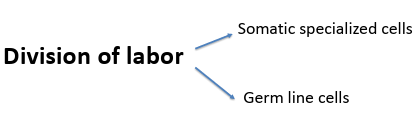
Division of labour (somatic specialized cells, and germ line cells)
Disposable soma theory
Aging occurs because our body must make a trade-off between reproducing and staying in good repair. Given limited supply of energy, the amount that goes to making and protect germ cells tips the scale away from ensuring somatic cells remain in good condition.
Cells accumulate damage over time, which causes disease. If enough function is compromised, death ensues.
Genetics and aging
Some genes influence how long an organism can live.
Some are involved in alteration of metabolism (insulin-IGF1 signaling pathway)
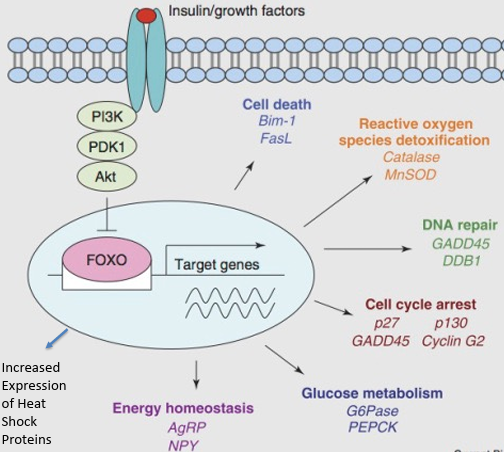
Lowering activity of this pathway turns up maintenance and repair (via FOXO)
dietary restriction affects same pathways and lowers rate of damage accumulation.
Role of FOXO
TFs are mediators of insulin and IGF-1 signaling (FOXO in mammals)
In the absence of insulin or growth factors, FOXO transcription factors are located in the nucleus, where they target gene expression
Targets of FOXO
Cell death, reactive oxygen species detoxification, DNA repair, cell cycle arrest, glucose metabolism, energy homeostasis, heat shock proteins
GH Resistance
Laron Syndrome
Mutation in GHR or GH-induced intracellular signaling molecules
Growth Hormone resistance
Growth hormone receptor deficiency leads to GH resistance and thus decrease in IGF-1 production and higher GH levels.
GH resistance cause increase insulin sensitivity and decreased insulin levels.
This combination leads to decreased cancer development.
Less GH signaling leads to abdominal obesity but for people with Laron syndrome, there is a lower rate of T2DM because of lower insulin resistance.
GH-IGF-1 Axis in Growth, Aging, and Longevity
Somatopause - steady decline in GH and IGF-1 levels with age
rGH touted as antiaging therapeutic, meta analysis on rGH use in elderly only showed minor benefits on body composition. (can reduce fat mass and increase muscle mass, at the cost of insulin resistance)
Genes that extend lifespan in yeast, worms, flies, and mice
Reduced insulin/IGF-1 Pathway increases lifespan
Sir2 genes - extra copy/activity increases lifespan, Resveratrol activates
mTOR (target of rapamycin) is a nutrient sensor - when mutated or inhibited by rapamycin increases lifespan
Centenarians
Longevity runs in families - twin studies, genetic contribution is 20-30%
Longevity genes - FOXO3 variants, IGFR variants
cholesterol and lipid metabolism genes
Barzilai and Ashkenazi Jewish - high correlation with high HDL and low LDL cholesterol levels genes
FOXO3A variants - correlated with longevity in Japanese and German centenarians
Programmed Theories of Aging
Biological clock programmed in our genes (turns on or shuts down genes at a certain time) epigenetic component to this
Damage-based/Stochastic Theories of Aging
Wear & Tear - damage due to assaults from both internal and external environments. Failure of cellular repair mechanisms
Biological clock theory
Gradual shutdown of nervous, endocrine, and immune systems
Triggered by genetic programs - maximum lifespan consistent across species, genes associated with longevity found in yeast, fruit-flies, worms, mouse, and human
Clock in DNA of the cell - all somatic cells have finite lifespan - 40-60 divisions (Hayflick limit) → telomeres
Telomeres
Repeated DNA sequences at end of chromosomes act as insulators.
Shorten with every cell division (usually restored by telomerase but thats only found in germ cells and little in stem cells) not found in somatic cells
Acceleration of telomere shortening is associated with certain diseases, unhealthy behaviours, and stress
Extreme shortening -SOS response (cellular senescence, apoptosis, abnormal)
Association between telomere length and health/lifespan
The good and bad of senescent cells
Good - stop damaged cells from dividing, prevent tumor formation.
Bad - senescent cells secrete inflammatory factors (SASP), lead to chronic inflammation, tissue damage, stimulate nearby cells to become cancerous.
Inflammation contributes to cancer, and age-related disorders like Alzheimer’s, diabetes, and atherosclerosis.
Damage-based/Stochastic Aging - the accumulation of errors
Assaults from internal and external environment cause damage to the cell and its components (DNA, protein, lipids) which cannot be repaired
- accumulation of waste
- increased DNA breaks, mutations with age
Free radical theory - damage from highly reactive molecules
- accumulation of misfolded proteins
- cross-linking of DNA and proteins
- decreased efficiency of repair mechanisms
Random Aging: DNA Damage theory
DNA mutations and chromosomal abnormalities increase with age.
Some progeroid syndromes (rare genetic diseases of accelerated aging) are caused by mutations in genes related to DNA repair
Process of DNA Damage Theory
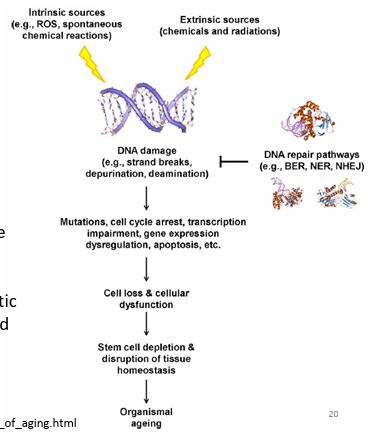
Intrinsic sources (ROS, spontaneous chemical reactions) and extrinsic sources (chemical and radiations) cause DNA damage.
Leads to mutations, cell cycle arrest, transcription impairment, gene expression, dysregulation, apoptosis
Cell loss & cellular dysfunction
Stem cell depletion & disruption of tissue homeostasis
Organismal ageing
Attempts to slow aging
Calorie restriction
Sirtuin pathway - resveratrol activates
mTOR (target of rapamycin) pathway - rapamycin inhibits
ROS - neutralize with:
antioxidants - vitamins A & C, flavonoids and carotenoids in food
Enzymes - superoxide dismutase enzyme (SOD)
Blood transfusions
Calorie restriction
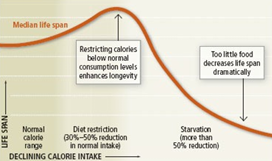
Calorie restriction lengthens median life span of flies, worms, and mice over animals eating a normal diet. Unclear whether calorie restriction can work in humans.
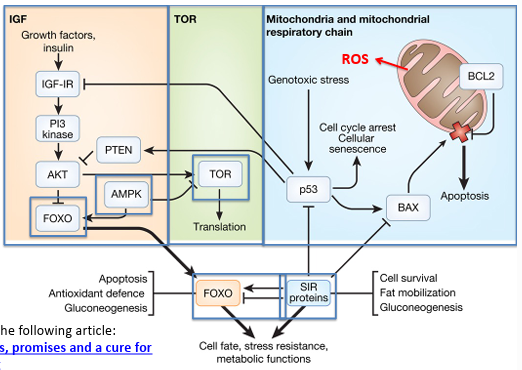
Pathways of Aging (major players)
IGF triggers cascade PI3K → AKT. AKT turns on growth and metabolism, and inhibits FOXO.
High nutrients - AKT on → FOXO off → less longevity
Low nutrients/stress → FOXO on → more survival mechanisms
TOR activated when nutrients abundant, for protein synthesis and cell growth, too much linked to aging.
AMPK - inhibits TOR, activates FOXO - promotes anti-aging when energy is low
Sirtuins - activated during low energy states. Activate FOXO.
p53 senses ROS damage - decides on apoptosis (BAX =death, BCL2 = no death)
Blood transfusions
No proven clinical benefit of transfusing plasma from young donors.
Parabiosis experiments - circulatory systems of young and old mice connected, older mice had signs of cell/tissue regeneration, higher cognitive and physical performance.
Reasons for skepticism
Yeast, worms, flies, and mice are not humans.
Gains in lifespan with calorie restriction depend on strain and decrease with complexity of organism
Genetic pathways are much more complicated in humans (TOR, FOXO, SIRT)
Rapamycin that extends lifespan has dangerous side effects on humans
Conflicting evidence on ROS