Materials & Methods of Construction - Final Exam
 Call Kai
 Learn
Learn Practice Test
 Spaced Repetition
 Match
Match Flashcards
 Knowt Play
1/56

There's no tags or description
Looks like no tags are added yet.
Name | Mastery | Learn | Test | Matching | Spaced | Call with Kai |
|---|
No analytics yet
Send a link to your students to track their progress
57 Terms
brick
a masonry unit comprised of a block of clay
hardened by drying in the sun or burning in a kiln, and
used in the construction of buildings as a structural or
self supporting surface material
concrete masonry unit (cmu) or concrete / cinder block
What is a more recent (1850’s) modular rectangular building unit comprised of Portland cement, aggregate, sand, and water.
concrete block
what is Commonly used as an independent structural element for
compressive strength and/or as a structural support for
brick facing.
wythe
what is is a vertical section of bricks or other masonry that is one
unit thick
veneer
A single wythe of brick that is
not structural in nature
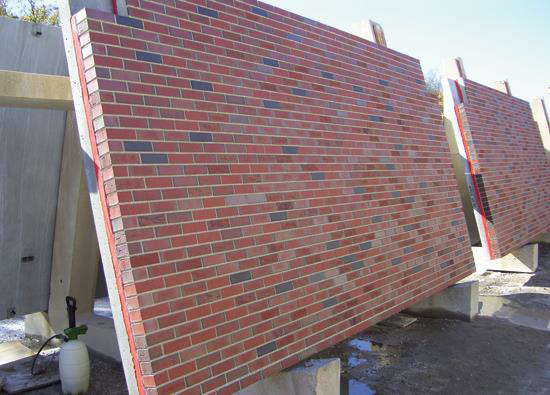
The actual size of a brick is typically 3/8” less
than the nominal size to allow for a 3/8” mortar joint.
actual vs nominal size of brick
The actual size of a concrete block is typically 3/8” less
than the nominal size to allow for a 3/8” mortar joint.
actual vs nominal size of concrete block
8” long x 4” deep x 2 ½” high. (including a 3/8” mortar
joint)
nominal size of a common brick
16” wide x 8” deep x 8” high (including a 3/8” mortar
joint)
nominal size of a concrete block
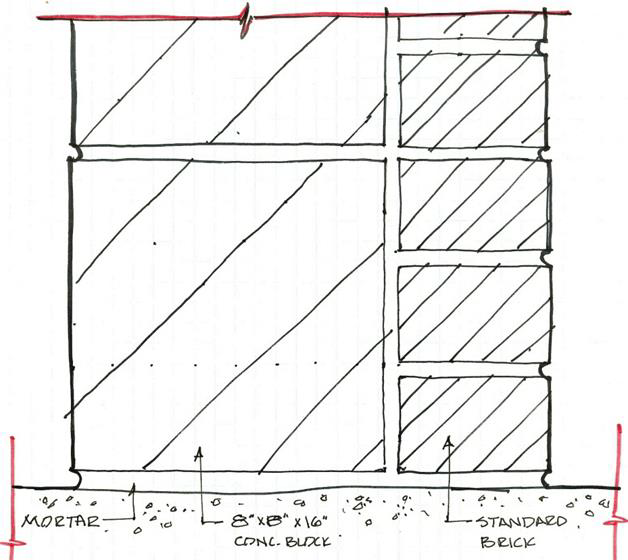
The height of one concrete block equals the height of
three bricks.
This allows the introduction of an accessory
product at every third joint which ties the two wythes
together monolithically.
height of concrete block vs brick
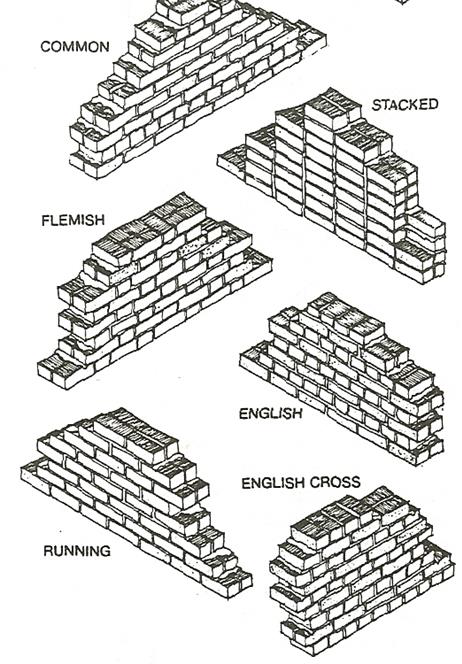
how brick walls may be constructed
Common
Running
Flemish
Stacked
bond patterns
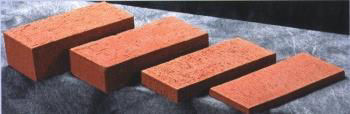
The depth of brick pavers can be shallower than for other
brick uses, and typically half the thickness of solid face
brick.
Pavers are typically installed without mortar over a stone
dust or sand bed.
brick paver installation
Installation over compacted sand and gravel allows
rainwater runoff to seep between the open joints and
drain down into the aquifer below. This is a more
sustainable approach to rainwater management then filling
the joints solid with mortar and needing to direct rainwater
to catch basins and other man made underground storm
water drainage pipes and systems.
Brick Paver installation (no mortar)
concrete
a man made material, a mixture of water, sand,
small stones, and a gray powder called cement, that
hardens to full strength in twenty eight (28) days
Concrete is very strong in compression because it is very
compact: the grains of sand fill the voids between the
stones and the “paste” of cement and water fills the voids
between the grains of sand.
why is concrete strong in compression
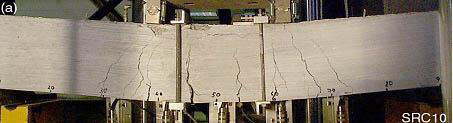
tension. Concrete made with good cement and stones, sand, and
water in the right proportions can be stronger in
compression than most natural stones, but like bricks and
stones, concrete is weak in tension
what is concrete weak in?
cement
fine gray powder which binds sand and rocks
into a matrix of concrete.
portland cement
the generic term for nearly all
modern cement.
cement
the product of high temperature conversion of
finely ground materials often as basic as blends of
limestone, clay, and shale containing four key
ingredients: calcium oxide, silica, alumina, and iron.
concrete
a mixture of two components: aggregates (sand and gravel or crushed stone) and paste
The most commonly used maximum aggregate is ¾ inch or 1 inch
The most commonly used maximum aggregate of concrete
Paste, or mortar, in addition to the Portland cement and
water contains entrapped air or purposefully entrained air
which makes the concrete cellular which increases
workability of the concrete while in a plastic state, and the
paste ordinarily constitutes about 25 to 40 percent of the
total volume of concrete.
paste/mortar in concrete
workability (paste/mortar helps)
what is making the otherwise heavy consistency of
the concrete relatively easy to move while pouring, placing,
and smoothing the surfaces.
hydration
The binding quality of Portland cement paste is due to the
exothermic chemical reaction between the cement and the
water which results in harden
admixtures
chemicals added to the concrete mix to
control its setting properties such as workability, curing
time, aesthetics, waterproofing, and very often used when
placing concrete during weather extremes such as high
or low temperatures, windy conditions, etc.
yes
is concrete dimensionally stable
low when sealed properly but high when not sealed properly
does concrete have high or low permeability (can water get through)
yes
is concrete a good insulating material
Consumes the largest quantity of non renewable materials
(cement, water, stone or aggregate, other components) of
all the industries of the world
what is a big disadvantage to concrete
Pervious concrete
a new type of concrete with a
high porosity used for concrete applications that
allows water from rain, melting snow, and other sources
to pass directly through, thereby reducing the runoff
from a site and allowing groundwater recharge.
architectural concrete
specialty concrete that while serving a structural function
provides an aesthetic finish to the building.
Decorative concrete
specialty concrete flatwork or
building elements such as panels, that while enhanced with
texture or color, are not structural building members
stone
the naturally occurring mineral matter in the
ground of which rock is made
Igneous Stone
What type of stone:
Formed by volcanic action, the molten rock having
cooled to a crystalline structure.
Usually composed of four minerals quartz, feldspar,
mica, and hornblende.
The strongest and hardest of common building stones.
Granite
Igneous Stone that is:
Available in many colors and patterns
Characterized by a distinctive granular or speckled
appearance
Major quarries in New Hampshire and Minnesota
Granite countertops are impervious to most stains
and chemicals
Granite countertops may be stained by hot oil and
hydrofluoric acid (found in rust removers).
Sedimentary Stone
What type of stone is:
Typically found in river deltas.
Formed when sediment silt, sand, and sea organisms
is acted on by heat, pressure, and chemical action.
Minerals are “cemented” together, not crystallized.
Relatively soft, will not take a high polish.
Alabaster
Sedimentary stone that is:
Composed of Gypsum
Translucent pale pink, yellow, or white
Carves easily; too soft for exterior use
Used for lighting fixtures and sculpture
Brownstone
Sedimentary stone that is:
a Type of sandstone local to New York, New Jersey,
and Connecticut
Flagstone
Sedimentary stone that is:
Typically sandstone
Splits into planes of cleavage
Used for walks and terraces
Bluestone
Sedimentary stone that is:
Fairly durable, being resistant to cracking
Available in many colors
Relatively easy to process into slabs of desired size
Several face finishes are available
Limestone
Sedimentary Stone that is:
Calcium carbonate formed around fragments of
shells and fossils
Usually gray, white, or beige with minimum graining
Mined in Indiana and many other places
Hard and lasting but softer than marble and granite
May be processed to make Portland Cement
Metamorphic Stone
What type of stone is:
sedimentary or any pre existing
stone type crystallized in the Earth’s crust by additional
heat and high pressure so as to be chemically altered
Marble
Metamorphic stone that:
Takes a high polish
**Appearance distinguished by prominent grain or
veins**
Many colors and patterns. May be translucent
Major quarries in Vermont, Tennessee, and Georgia.
Somewhat porous and will stain without proper
sealing and maintenance
Travertine
Metamorphic stone that:
is formed by hot springs
Characteristically **has open pores or “pockets”**
Usually white or cream color
Onyx
Metamorphic stone that:
is found principally in Mexico and
Pakistan
Semi precious stone with unique, colorful patterns
May be highly translucent
Slate
Metamorphic stone that is:
High silica clay laid down as silt in ancient sea
bottoms
Used for flooring, wall surfacing, countertops,
roofing, and chalkboards
Usually black or gray but also many other colors
Splits along planes called **cleavage**
soapstone
Metamorphic stone that:
Contains more than 50% talc
Typically flannel gray or dark green
Denser than granite, but soft may be cut or shaped
with woodworking tools
High resistance to acids and stains used for
laboratory counter tops
**Not slippery when wet** good for bathroom floors
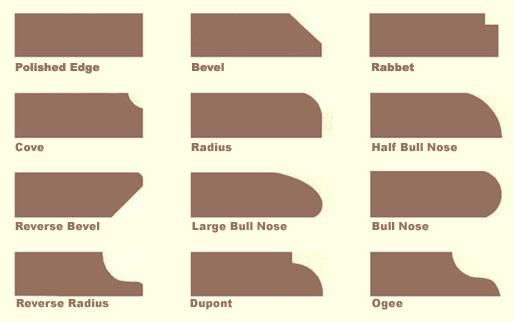
stone edge shapes
dry stacking (constructed with or withour mortar)
how is stone masonry installed
Riven Finish stone
finish found naturally on stone with cleavage plates,
such as slate and bluestone, used in its natural state for
walkways and paving.
Tumbled Finish stone
finish achieved by placing stone such as marble
or limestone in a barrel of gravel until the rough edges and
surfaces are smoothed to a “soft” finish., resembling broken
glass that has been tumbled by the tide in beach sand for
many years.
Honed Finish stone
finish achieved by polishing stone to a matte
finish, similar to the results years of foot traffic has on
marble, granite, or slate.
Polished Finish stone
stone finish where results appear as a high gloss, even mirror
like appearance on igneous and metamorphic stone.
Polished stone may be very slippery particularly when wet
and is not recommended for paving or flooring.
Flamed (Thermal) Finish stone
Stone finish that results when a blowtorch is passed
over the surface of granite, causing small particles to pop
off the surface creating a very rough flamed finish.
Brush Finish stone
Stone finish that appears as a worn down look achieved by
brushing the surface of the stone, simulating natural wear
over time.
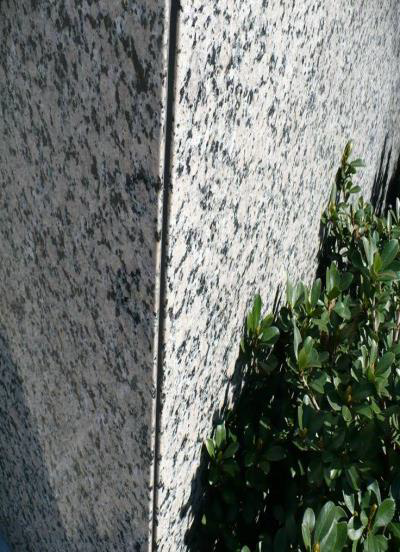
Quirk corner
A stone finish detail - is an aesthetic detail intended to emphasized
the corner but to visually minimized the mortar joint.
Rustication
an aesthetic device originating during the
Renaissance used to exaggerate mortar joints to give
weight and importance to the lower floors of a building,
particularly monumental buildings such as palaces, banks,
and governmental buildings.