MATH 141 Exam 1
 Call Kai
 Learn
Learn Practice Test
 Spaced Repetition
 Match
Match Flashcards
 Knowt Play
1/52

There's no tags or description
Looks like no tags are added yet.
Name | Mastery | Learn | Test | Matching | Spaced | Call with Kai |
|---|
No analytics yet
Send a link to your students to track their progress
53 Terms
∫(1/x)dx =
ln|x| + C
∫exdx =
ex +C
∫axdx =
(ax/lna) +C
∫(f’(x)/f(x))dx =
ln |f(x)| +C
∫ (1/√1-x2)dx =
sin-1x +C
∫ (1/√1+x2)dx =
tan-1x+C
∫ sinxdx =
-cosx +C
∫ cosxdx =
sinx + C
∫ sec2xdx =
tanx + C
∫ tanxdx =
ln|secx| +C
∫ csc2xdx =
-cotx +C
∫ secx tanxdx =
secx + C
∫ cscx cotxdx =
-csc x +C
∫ sinaxdx =
-(1/a)cosax + C
∫ cosaxdx =
(1/a)sinx + C
d/dx (lnx) =
1/x
d/dx (logax) =
1/x * lna
d/dx (ex) =
ex
d/dx (ax) =
ax * lna
∫ (1/x*lna) dx =
logax +C
∫ (cosx)/(sinx)dx =
ln|sinx| + C
ln (e) =
1
ln (1) =
0
cos (0) =
1
cos (π) =
-1
xndx =
(xn+1/n+1) + C when x doesn’t = -1
∫ sinhxdx =
coshx + C
∫ 1/(x2+a2)dx =
1/a tan-1(x/a) +C
∫ cos hx dx =
sinhx + C
∫ cotxdx =
ln |sinx| + C
∫ 1/ (√a2-x2)dx =
sin-1 (x/a) + C
by parts formula
u * v - ∫ v * du
d/dx logax =
(lnx/lna)dx
sin2x + cos2x = (pythagorean identity)
1
sin2x = (pythagorean identity)
1 - cos2x
cos2x = (pythagorean identity)
1 - sin2x
sin2x = (double angle formula)
2sinxcosx
cos2x = (double angle formula)
cos2x - sin2x
1 - 2sin2x
2cos2x - 1
sin2x = (half-angle formula)
(1-cos2x)/2
cos2x = (half-angle formula)
(1+cos2x)/2
∫sinaxdx =
(-cosax)/a + C
∫cosaxdx
(sinax) / a + C
∫sinnxcosmxdx ** if both exponents are even use:
half-angle formula
∫sinnxcosmxdx if both exponents are odd (or one is even, one odd):
u = sinx ; du = cosxdx
u = cosx ; du = -sinxdx
∫tannxsecmxdx **if both exponents are even:
d/dx tanx = sec2x
sec2x = 1 + tan2x
let u = tanx ; du = sec2xdx
∫tannxsecmxdx **if both exponents are odd:
d/dx secx = secxtanx
tan2x = sec2x -1
let u = secx ; du = secxtanxdx
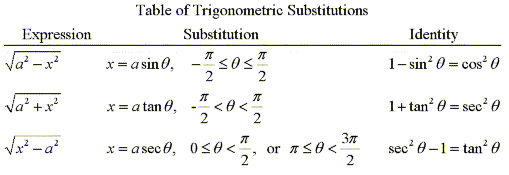
trigonometric substitution table
Proper Rational Function
degree of demoninator > degree of numerator
Improper Rational Function
Degree of numerator > degree of demoninator
Proper Functions Procedure:
Step one: factor demoninator completely
Step two: express function as:
(A1/a1x+b1) + (A2/a2x+b2) + … + (Ak/akx+bk)
if the demoninator is repeated (x2(x-1)3) for example, then:
(A1/a1x+b1) + (A2/(a1x+b1)2) + … + (Ar/(a1x+b1)r)
if the denominator has an irreducible quadratic factor; (x-2)(x2+1)(x2+4), for example, then:
(Ax+B) / (ax2+bx+c)
For improper functions:
∫Q(x) + (R(x)/original demoninator)
Q(x) = quotient and R(x) = remainder; long divide to get these variables, then integrate.