Topic 5: Mircoevolution
 Call Kai
 Learn
Learn Practice Test
 Spaced Repetition
 Match
Match Flashcards
 Knowt Play
1/16

There's no tags or description
Looks like no tags are added yet.
Name | Mastery | Learn | Test | Matching | Spaced | Call with Kai |
|---|
No analytics yet
Send a link to your students to track their progress
17 Terms
Microevolution
Changes in the frequency of an allele within a population
Macroevolution
The over-arching history of life; changes in lineages
Over time, microevolutionary change can lead to macroevolution
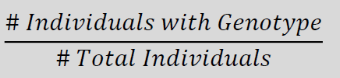
Genotype frequencies
Note that by definition, frequencies must sum to 1 (or 100%)
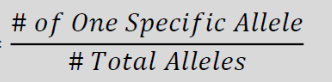
Allele Frequencies
Hardy Weinberg model
In the absence of evolutionary processes, the allele frequencies in a population do not change from generation to generation
a NULL MODEL
Assumes that there is no natural selection, genetic drift, gene flow, or mutation.
(no migration, large population, no selection)
Directional selection
Changes the average trait value
An extreme phenotype provides a fitness benefit so the average phenotype in the population moves towards that extreme
Stabilizing selection
Reduces the amount of variation in a trait
Phenotypes in the middle of the range provide a fitness benefit, so extreme phenotypes become less common.
Disruptive selection
Increases the amount of variation in a trait Phenotypes at both extremes provide a fitness benefit, so intermediate phenotypes become less common
Balancing selection
Genetic variation maintained No single phenotype is favoured at all times, so a diversity of phenotypes is maintained in the population
Genetic Drift
When random chance changes allele frequencies
• All populations experience random events that can shift allele frequencies
• These random events do not lead to adaptation
• The effect of genetic drift is greater in small populations where any random event affects a larger proportion of the population
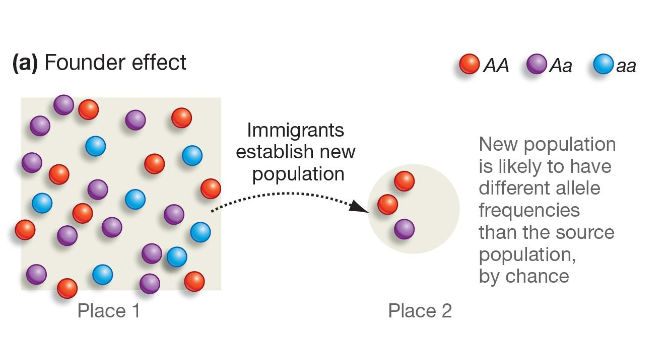
Founder Effect
A new population is formed (“founded”) with different allele frequencies
Random immigration of individuals means the new population has different allele frequencies.
Genetic Bottleneck
A sudden decrease in population size reduces allele number
individuals are removed at random from the population; severe bottlenecks may lead to local extinction.
Gene Flow
When individuals (or gametes) migrate between populations
Gene flow increases the similarity in allele frequency between populations that exchange genes.
Gene flow can increase or decrease the fitness of a population
Mutation
Produces new alleles: the ultimate source of all genetic variation
Mutation rates are so low that they rarely cause evolution within populations EXCEPT in combination with selection or drift
Not all mutations add alleles to the gene pool
Point mutation
a change in a single base pair in DNA
Chromosome-level mutation
a change in the number of composition of chromosomes
Somatic mutations
mutations within the body (soma) of an organism—as they are in non-reproductive cells, these are not passed on to offspring and do not change allele frequencies