Physics- Forces and Motion - Topic 1
 Call Kai
 Learn
Learn Practice Test
 Spaced Repetition
 Match
Match Flashcards
 Knowt Play
1/28

There's no tags or description
Looks like no tags are added yet.
Name | Mastery | Learn | Test | Matching | Spaced | Call with Kai | Chat |
|---|
No analytics yet
Send a link to your students to track their progress
29 Terms
Scalar Quantity
A quantity with magnitude (size) only
Vector quantity
a quantity with both magnitude and direction.
How can a vector be represented
An arrow -length represents magnitude -direction represents direction of quantity
Scalar Examples
distance, speed, time
Vector Examples
displacement, velocity, acceleration
Forces
A push or a pull that acts on an object due to the interaction with another object
Contact force examples
friction, air resistance, tension and normal contact force
Non contact force examples
Gravitational force, Electrostatic force, Magnetic force
Stopwatch vs Lightgate
Lightgate doesn't have errors due to reaction time
Lightgates have a greater resolution
Typical speed- Walking
1.5 m/s
Typical Speed of Running
5 m/s
Typical Speed of Cycling
7 m/s
Typical speed of a car
13-30 m/s
Gradient
change in y/change in x (speed in distance time graphs)
Acceleration
Acceleration = final velocity -initial velocity/ time
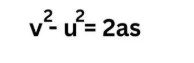
Final velocity
Final Velocity ^2= Initial Velocity ^2 + 2 acceleration x distance
v^2=u^2 +2as
Distance Traveled
Area under the graph
Mass
-the amount of matter that makes up an object -(kg)
Weight
Force that acts on an object due to gravity -(N)
Weight (equation)
Weight = mass x gravitational field strength (10N)
What is weight measured with
Newton meter
Resultant Force
the single, overall force that is equivalent to the combined effect of two or more forces acting on an object
Resultant force equation
mass x acceleration (F=ma)
Newton's 1st Law
objects will remain at rest or move with a constant velocity unless acted on by a resultant force
What does resultant force make objects do
accelerate / decelerate
Newton's 2nd Law
the acceleration of an object is proportional to the resultant force acting on the object, and inversely proportional to the mass of the object
Newton's 3rd Law
When two objects interact the forces they exert on each other must be equal and opposite
Inertia
the tendency of objects to continue in their state of rest or of uniform motion
inertial mass
force/acceleration