Intro to Language Test #2
 Call Kai
 Learn
Learn Practice Test
 Spaced Repetition
 Match
Match Flashcards
 Knowt Play
1/46

There's no tags or description
Looks like no tags are added yet.
Name | Mastery | Learn | Test | Matching | Spaced | Call with Kai |
|---|
No analytics yet
Send a link to your students to track their progress
47 Terms
What is categorical perception?
Abilities develop and allow listeners to distinguish between phoneme so they can quickly and efficiently process speech by ignoring variations that are not meaningful
Able to hear all variations of language
What is prosodic regularities?
characteristics of speech include frequency, duration and intensity
stress
intonation
What is phonetic regularities?
Phonetic detail of speech include phonemes nd combinations of phonemes
What is stress?
Prominence place on certain syllables of multisyllabic words
What is intonation?
Prominence place on certain syllables but also apply to entire phrases or sentences
What is the hierarchical structure of categories?
Basic = general concepts in a category; usually children’s first words
Ex: Apple
Subordinate = Lowest level; specific concepts in a category
Ex: Granny Smith (kind of apple)
Superordinate = the most general concept in a particular category; does not typically develop until preschool
Fruits
What is perceptual categorization?
Formed based on similar appearing features: color, shape, texture, size, etc.
By 3 months they can distinguish between cats and dogs
By 4 months they can distinguish between animals and furniture
What is conceptual categorization?
requires infants to know what an object does
Balls roll, dogs bark
This requires more complexity and able to organize language
what is reduplicated babbling?
repeating C-V pairs
Ma, ma, ma
what is non reduplicated babbling?
variegated babbling, nonrepeating C-V combination
Ma, ba, ga, da
what is jargon?
Babbling containing at least two syllables and at least two consonants and vowels, as well as varied stress or intonation patterns
happens between 9 months - 18 months
What are true words?
Must be said with clear intention
Must have recognizable pronunciation
Must be used consistently and in different contexts
What are the different joint reference and attention phases?
Phase 1 = Attendance to social partners (birth to 6 months)
Interred in looking at people’s faces (parents)
React to emotional support other provide and other reactions to their actions
Phase 2 = Emergence and coordination of joint attention (6 months to 1 year)
Should be able to have have joint attention and be able to shift attention
Supported joint engagement = adults may speak with an animated voice
Phase 3 = Transition to language (1 year and beyond)
Begin to incorporate language into communication with other people
Use language to represent events and objects
What is phase 1 in joint reference and attention?
Attendance to social partners (birth to 6 months)
What is phase 2 in joint reference and attention?
Emergence and coordination of joint attention
What is phase 3 in joint reference and attention?
Transition to language (1 year and beyond)
Be able to read the phonology chart
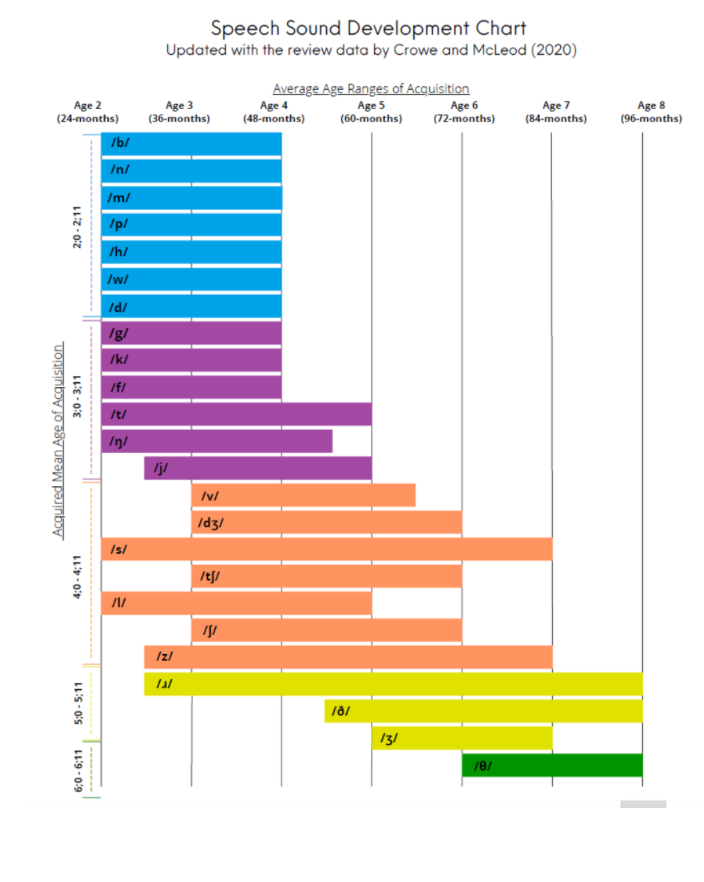
What is overextension?
Overgeneralization = children use words in an overlay general manner
What is under extension?
Toddlers use words to refer only to a subset of possible referents
More common than overextensions
What is overlap?
When toddlers overextend a word in a certain circumstances and underextend in other circumstances
What are the different types of gestures?
Referential gestures
Deictic gestures
Gestures use at 14 months is a predictor of vocab size at 42 months
What are referential gestures ?
Have a precise referent and meaning that is stable across contexts
hand to hear for phone
What are deistic gestures ?
Meaning depend on context (such as pointing)
This can predict the child's vocab
What is the MLU formula?
total number of morphemes / # of utterances (usually 50)
What is the number of bound morphemes?
must be attached to other morphemes
(un-, -able, dis-)
What is the number of grammatical morphemes?
Changes the grammar of the word
(plural -s, possessive ‘s, past tense -ed, present progressing -ing)
When does the first morphemes emerge?
at 18 months and 2 years
Present processing
(-ing = baby eating, sleeping, eating, running)
What are discourse functions?
Instrumental
Regulatory
Interactional
Personal
Heuristic
Imaginative
Informative
what are the thematic roles?
agent
theme
source
goal
location
What is an agent ?
entity that performs the action
Molly jumped on the trampoline
What is an example of an agent?
Molly jumped on the trampoline
what is a theme?
Entity undergoing on action or movement
What is an example of theme?
I walked the dog
What is a source?
Starting point for movement
What is an example of source?
Drove from Montclair
What is a goal?
ending point for movement
What is an example of goal?
To Bloomfield
What is location?
the place where an action occurs
What is an example of location?
We walked through the mall
What is a child’s lexicon at 18 months?
Predominantly nouns (60%)
About 100 words - verbs appear (18 months - 24 months)
10 words generally names of animals, food, and toys within their environment
What is instrumental discourse functions?
to request satisfy needs
What is regulatory discourse functions?
control others’ behavior
what is interactional discourse functions?
interact socially
what is personal discourse functions?
express feelings
What is heuristic discourse functions?
Requesting information
What is imaginative discourse functions?
telling stories to pretend
What is informative discourse functions?
provide information to others