AP BIO COMBINED PT 2
 Call Kai
 Learn
Learn Practice Test
 Spaced Repetition
 Match
Match Flashcards
 Knowt Play
1/320

There's no tags or description
Looks like no tags are added yet.
Name | Mastery | Learn | Test | Matching | Spaced | Call with Kai |
|---|
No analytics yet
Send a link to your students to track their progress
321 Terms
life history
pattern of survival and reproduction events typical for a mmeber of the species
evovle by natural selection, and they rperesnt an opitmization fo tradeoffs between growth, surivval, and reproduction
A life history is the pattern of survival and reproduction events for a species
Includes traits like:
Age at first reproduction
Number of offspring
Lifespan
Life histories evolve through natural selection
Represent trade-offs between:
Growth
Survival
Reproduction
Strategies in life history
Organisms have limited resources due to competition and environmental constraints
Resources must be divided among:
Growth
Maintenance
Reproduction
Allocation of resources is shaped by natural selection
Strategies that maximize fitness are passed to offspring
Life history strategies are collections of traits such as:
Number of offspring
Timing of reproduction
Level of parental care
These depend on both genetic traits and environmental conditions
Fecundity
Fecundity is the reproductive capacity of an organism
Number of offspring produced
Fecundity is inversely related to energy per offspring
High fecundity:
Many offspring
Low energy investment per offspring
Little or no parental care
Offspring must survive on their own
Low fecundity:
Few offspring
High energy investment per offspring
More parental care
Higher survival rate per offspring
Reproduction times
Early Reproduction
Lower risk of leaving no offspring
Reproduce sooner before death
Trade-offs:
Less energy for growth and maintenance
Often lower fecundity or lower offspring quality
Late Reproduction
More time for growth and development
Can lead to:
Higher fecundity
Better parental care
Trade-off:
Risk of not surviving to reproductive age
Semelparity
life history strategy where an organism reproduces once and then dies
All resources are devoted to one reproductive event
Trade-offs:
Maximizes reproductive output at once
Sacrifices future survival and reproduction
Iteroparity
Iteroparity is a life history strategy where organisms reproduce multiple times over their lifespan
Resources are not all used in one reproductive event
Energy is divided among:
Growth
Maintenance
Multiple reproductive events
Animal Behaviors
The ways animals interact with other organisms and their physical environment
A behavior is a change in activity in response to a stimulus
Stimulus can be internal, external, or both
Nature vs Nurture
Some behaviors are inherited (genetic)
Some behaviors are learned
Many behaviors are a combination of both
Example
Male songbirds have species-specific songs
They must learn the song during a limited developmental (critical) period
Things to consider when evaluating behaviors
Causation (Mechanism)
What triggers the behavior?
Includes internal and external stimuli (hormones, environment, signals)
Development (Ontogeny)
How does the behavior develop over an organism’s lifetime?
Role of learning and genetic factors
Function (Fitness)
How does the behavior contribute to survival or reproduction?
Evolution (Phylogeny)
How did the behavior evolve over time?
What is its evolutionary history?
Hormones and. behavior
Hormones influence behavior by affecting development and physiological state
They can:
Change brain structure during development
Modify brain function in the short term
Alter neural activity
Hormones also:
Alter gene expression
Change internal conditions of the body
Influence responses to internal and external stimuli
🔑 Key idea:
Hormones regulate behavior by modifying development, brain function, and physiological state, which changes how an organism responds to stimuli.
Innate behaviors
Innate behaviors are behaviors that are inherited (genetically determined)
They are:
Automatic and involuntary
“Wired in” (genetically programmed)
Do not require prior experience or learning
Learned behaviors
Learned behaviors are changes in behavior based on experience
They:
Change with experience
Can be modified over time
Allow organisms to adapt to their environment
Kinesis
Kinesis is a simple change in activity or turning rate in response to a stimulus
It is random (non-directional)
Does not move toward or away from the stimulus
Helps organisms respond to environmental conditions
Example:
Speeding up movement in an unfavorable environment
Taxis
Taxis is an oriented movement toward or away from a stimulus
It is directional (non-random)
An organism moves either toward (positive taxis) or away (negative taxis)
Examples:
Phototaxis – response to light
Chemotaxis – response to chemicals
Proximate causes
Proximate causes explain the immediate mechanisms of behavior
Focus on how behavior occurs (stimuli, learning, physiology)
Behaviorism
Study of behavior based on learning and experience
Classical Conditioning
Learning by association between two stimuli
Example: associating a sound with food
Operant Conditioning
Learning through rewards and punishments
Behavior is strengthened or weakened based on consequences
Ethology
Study of innate (genetically programmed) behavior
Instinct (Fixed Action Pattern)
Innate, stereotyped behavior
Triggered by a specific stimulus
Once started, it is usually completed
Ethology
Ethology
Study of instinctive (innate) behaviors
Focuses on genetically determined behaviors
Fixed Action Pattern (Instinct)
Innate, stereotyped behavior
Not learned and resists modification
Triggered by a specific stimulus
Once started, it is carried to completion, even if conditions change
How to Identify
Behavior is performed correctly without prior experience
Imprinting
A type of learning that occurs during a critical period
Leads to long-lasting behavioral responses
Male stickleback fish attacks
Male stickleback fish show an innate aggressive behavior
Triggered by a sign stimulus:
The red underside of another male
This initiates a fixed action pattern:
The fish attacks anything with a red belly
Even unrealistic objects (like models) can trigger the attack
Behaviors and natural selection
To the extent that behaviors have a genetic basis, they are subject to natural selection
Behaviors that increase survival and reproductive success (fitness) are more likely to be passed on
Over time, these behaviors become more common in the population
Animal communication
Animals communicate using signals:
Visual
Auditory
Chemical
Tactile
The type of signal is closely related to the organism’s lifestyle and environment
Functions:
Mating, Establishing territory, Conveying information about food, Alarm calls (danger), Dominance and submission, Care for young
Response to external cues
Animal behavior can be triggered by internal cues (hormones, biological rhythms) and external cues (environmental stimuli)
Examples of Responses:
Hibernation
Long-term state of inactivity
Reduced metabolic rate
Occurs in response to cold temperatures and limited resources
Estivation
Reduced metabolic activity during hot or dry conditions
Helps conserve water and energy
Migration
Seasonal movement from one region to another
Triggered by changes in temperature, day length, and resource availability
Response to internal cues
animal behaviors in response to internal cues
Circadium rhythm
Mating is a combination of internal and external cues
Migration
Migration is the seasonal movement of populations over large distances
Triggered by environmental cues such as:
Temperature
Day length
Availability of resources
Helps organisms:
Find food
Reproduce
Survive unfavorable conditions
Foraging
Foraging is behavior related to finding and obtaining food
Animals aim to get the highest energy gain with the lowest energy cost
Types:
Solitary foraging
Individual searches for food alone
Group foraging
Animals search for food together
Can increase efficiency or protection
Influences:
Genetics (innate tendencies)
Learning (experience improves success)
Piloting
Piloting is navigation by using landmarks and remembering the structure of the environment
Animals rely on familiar visual cues to find their way
Example:
Gray whales migrate from Mexico to the Bering Sea by following the coastline
Homing
Homing is the ability to return to a specific location from long distances
Does not rely only on familiar landmarks
Example:
Pigeons can return home from unfamiliar locations
They can navigate without visual cues by:
Detecting the Earth’s magnetic field
Spatial learning
Involves understanding the spatial structure of the environment
Allows animals to:
Remember locations of resources (food, shelter)
Navigate efficiently
Habituation
Habituation is a simple form of learning
It involves a decrease (loss) of response to a repeated stimulus
Occurs when the stimulus provides little or no important information
Allows organisms to ignore irrelevant stimuli and conserve energy
Insight Behavior
Insight learning is the sudden realization (“ah ha” moment) that leads to solving a problem
Occurs when an individual in a novel situation displays a new behavior
The solution appears without trial-and-error
Habitat selection
Habitat selection is the process by which animals choose where to live
It is one of the most important behavioral decisions
A suitable habitat must provide:
Food
Shelter
Nesting sites
Escape routes
Animals use environmental cues to choose habitats
These cues are generally reliable indicators of good fitness outcomes
Cost-benefit approach
The cost–benefit approach is used to analyze and evaluate behaviors
Assumes animals have a limited amount of energy
A behavior will only be favored if:
Benefits (fitness gains) outweigh
Costs (energy, risk, time)
Animals cannot sustain behaviors that cost more than they provide
Potential cost regarding a behavior
Energetic cost is the difference between performing a behavior and not performing it
Risk cost is the increased chance of being injured or killed performing a behavior
Opportunity cost is the benefit the animal forfeits by not performing other behaviors during the same time
Territorial behavior
Territorial behavior is aggressive behavior used to deny other animals access to a habitat or resource
Costs:
Requires significant energy
Increases risk of predation
Reduces time available for:
Feeding
Parental care
Agonistic behavior
Agonistic behavior includes threats, displays, and submissive behaviors during competition
Occurs often in male–male competition
Reduces risk by:
Avoiding serious injury
Using ritualized displays instead of fighting
Allowing one individual to retreat without harm
Lek
A lek is a gathering where males display to attract females
Males compete for prime locations within the lek
Males in the best positions have higher mating success
Females visit the lek and choose mates based on displays
Game theory
Game theory evaluates alternative behavioral strategies
The success of a strategy depends on:
The individual’s behavior
The behavior of other individuals
No single strategy is always best
Success depends on interactions with others
Example:
Male side-blotched lizards show different mating strategies (polymorphism)
Mating success depends on the frequency of each type of male in the population
How can altruistic behavior be explained in terms of fitness?
Altruistic behavior benefits another individual at a cost to the performer
Inclusive Fitness
Total fitness = own reproduction + helping relatives reproduce
Kin Selection
Selection favors behaviors that increase the success of relatives
Works because relatives share genes
Example:
Scrub jays help at the nest
Helpers are previous offspring
Increases reproductive success of parents
Eusocial
Eusocial societies are an extreme example of kin selection
Characterized by:
Cooperative care of offspring
Overlapping generations
Division of labor (reproductive vs non-reproductive individuals)
Example:
In honey bees:
Most females are non-reproductive workers
Some act as soldiers to defend the colony
Only the queen reproduces
Diploid individuals are female
Haploid individuals are male
Living in a group has both benefits and costs.
Group living can increase foraging efficiency
Example: wild dogs hunting in packs
Can reduce the risk of predation
Safety in numbers
Increased vigilance
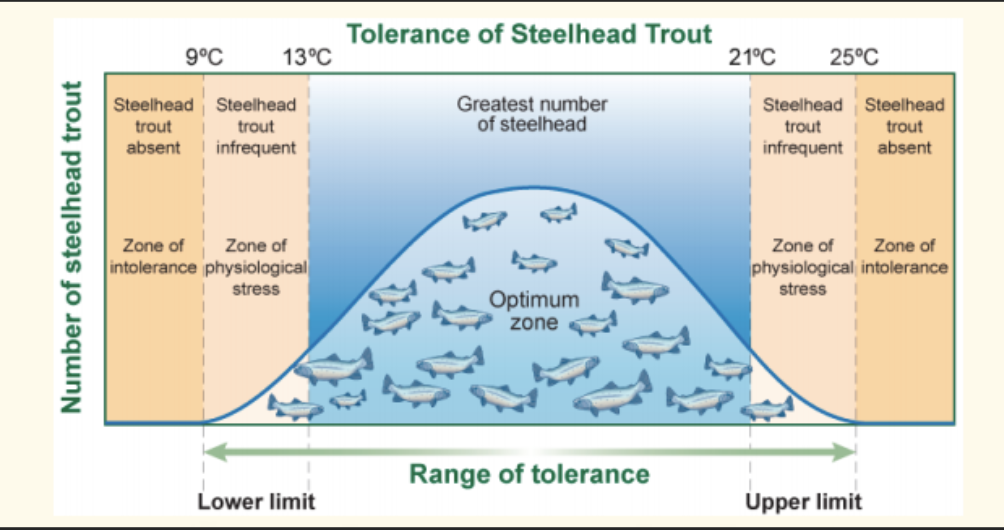
How might this graph change under current conditions of climate change?
Disruption of the Nitrogen Cycle
Human activities (fertilizer runoff, fossil fuels, livestock) dump excess nitrates (NO₃⁻) into waterways, disrupting the nitrogen cycle
Denitrifying bacteria can't remove it fast enough → nitrates accumulate and leach into aquatic ecosystems
Nitrates are a limiting nutrient → trigger rapid phytoplankton blooms (eutrophication = increased primary productivity)
Phytoplankton die → decomposers break them down via cellular respiration → dissolved O₂ depleted (hypoxia)
Hypoxia kills aerobic organisms → dead zones form, especially offshore in summer (warm water holds less O₂)
Natural Events May Lead to Changes in Ecosystems
El Niño (“Little Boy”) is a climate pattern where:
Surface waters in the equatorial Pacific become warmer than average
Trade winds weaken
La Niña is the opposite condition:
Cooler-than-average surface waters
Stronger trade winds
These climate shifts alter: temperature patterns, precipitation (rainfall/drought), Ocean productivity and food webs
Human & Ecosystem Effects
El Niño can cause:
Drought → food insecurity and reduced agricultural output
Flooding and heavy rains → habitat disruption
Temperature increases → heat stress
Disease outbreaks and respiratory illnesses
Continental drift
Continental drift = movement of Earth’s tectonic plates over long time scales, shifting continents
Effects on Ecosystems
Causes geographic isolation of populations
Leads to changes in climate and habitat conditions
Disrupts existing ecosystems by:
Separating species → allopatric speciation
Altering species distributions and migration pathways
Changing environmental conditions (temperature, rainfall, ocean currents)
Meteor impact
mass extinction
Invasive species
Invasive species are organisms introduced into an area outside their native range, often accidentally or intentionally
They can spread rapidly and disrupt ecosystems because they often:
Outcompete native species for resources (food, space, nutrients)
Lack natural predators or controls, allowing unchecked population growth
Change community structure, species interactions, and food webs
This can lead to reduced biodiversity and displacement or extinction of native species in the invaded area
Human activities
The human population is rapidly increasing, raising demand for food, water, energy, and space
Humans can exceed natural carrying capacity because technology (agriculture, medicine, industry) temporarily increases available resources
Population growth leads to major ecological impacts:
Land-use change: deforestation, urbanization, habitat destruction and fragmentation reduce biodiversity
Pollution: air, water, and soil contamination disrupt ecosystems and organism health
Resource exploitation: overuse of renewable and nonrenewable resources (e.g., fossil fuels, minerals) depletes natural systems
Movement of exotic species: global travel/trade increases introduced species, some becoming invasive and disrupting native communities
Ecosystem pressure beyond carrying capacity: increased consumption and waste reduce long-term ecosystem stability and biodiversity
Climate change
Climate change is driven mainly by increased greenhouse gas emissions, especially from burning fossil fuels and intensive animal agriculture
Greenhouse gases (e.g., CO₂, N₂O) trap heat in the atmosphere:
Incoming solar radiation reaches Earth
Some heat is radiated back, but greenhouse gases absorb and re-radiate heat, increasing global temperatures
Ecological impacts include:
Rising temperatures → species may be unable to adapt quickly enough, leading to local or global extinctions
Sea level rise and flooding → loss of low-lying coastal habitats
Habitat shifts → species distributions change as organisms move toward cooler regions or higher altitudes
Ecosystem disruption → altered species interactions, food webs, and community structure
Conservation
Conservation focuses on protecting ecosystems and species to prevent extinction and maintain biodiversity
Key goals include:
Preventing species extinction, especially endangered species
Maintaining species richness and ecosystem stability
Protecting biodiversity at genetic, species, and ecosystem levels
Conservation strategies often address:
Habitat protection and restoration
Reducing human impacts (habitat loss, pollution, overexploitation)
Controlling invasive species
Supporting sustainable resource use
Population ecology
Population
All individuals of a species that interact in a given area at a specific time
Population density
Number of individuals per unit area or volume
Population size
Total number of individuals in a population
Often estimated using methods like mark and recapture
Mark and recapture
A method used to estimate population size
Steps:
Capture a sample of individuals
Mark them and release them back into the population
Later, capture a second sample
Count how many are marked vs unmarked
Calculation:
Population size ≈
(number in first sample × number in second sample) / number of marked recaptured
How does abundance vary?
Abundance varies depending on spatial scale
Geographic Range
The region where a species is found
Within this range:
Species may only live in specific habitats
Distribution is not uniform
Habitat Patches
Suitable habitats exist as patches (“islands”)
Surrounded by unsuitable environments
Population density
Population densities are dynamic
They change over time due to environmental and biological factors
The density of one species can be related to other species
Examples:
Predator population depends on prey population
Competition between species affects densities
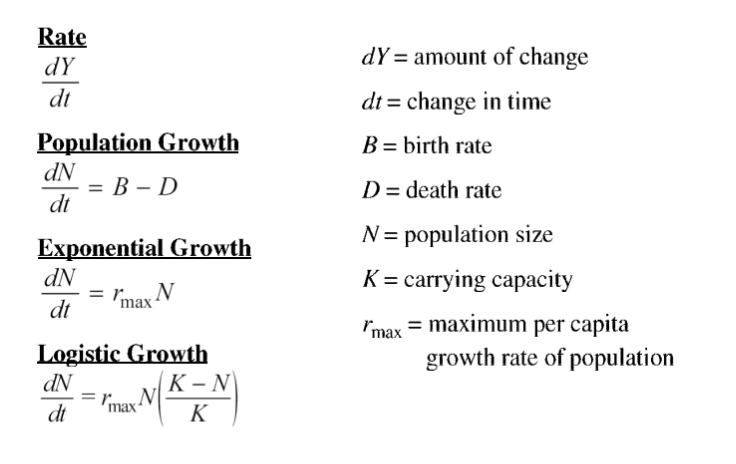
What is the difference between multiplicative and additive population growth?
Multiplicative growth
Population increases by a constant multiple (percentage)
Growth becomes faster over time
Leads to exponential growth
Additive growth
Population increases by a constant number each time period
Growth rate stays the same
Why don’t populations grow exponentially forever?
Populations cannot grow multiplicatively for long due to limiting factors
Growth slows and reaches a stable size
Density-Dependent Effects:
As population becomes more crowded:
Birth rates decrease
Death rates increase
Growth rate (r) decreases as density increases
Carrying Capacity (K):
When r = 0 → population size stops changing
Population reaches carrying capacity (K)
Maximum population size the environment can support
Population regulation
Density-Dependent Factors
Affect per capita growth rate depending on population density
Stronger effects in larger, crowded populations
Can lead to logistic growth
Examples (biotic):
Competition for food, water, light, shelter
Predation: more prey → easier for predators to find food
Disease spreads more easily in dense populations
Waste accumulation harms individuals in crowded environments
Density-Independent Factors
Affect populations regardless of density
Usually abiotic
Examples:
Natural disasters (fires, floods, storms)
Extreme temperatures
Do not regulate population size around a stable level
Population flunctuations
Population fluctuations are changes in population size over time
Occur when limiting factors interact
Can involve:
Density-dependent factors (e.g., predation, competition, disease)
Density-independent factors (e.g., weather, disasters)
Can occur even without density-independent factors
Example: predator–prey cycles
Population cycles
Population cycles are regular, repeating fluctuations in population size
Characterized by:
Cyclical oscillations
Continuous rise and fall of population size
Often caused by interactions between species
Example: predator–prey relationships
Why is human population growth unique?
Human population has grown at an increasing per capita rate
Doubling time has decreased over time
Technological advances have increased carrying capacity (K)
Examples:
Improved food production (agriculture, technology)
Advances in medicine and sanitation
Lower death rates
Increased life expectancy
life table
A life table shows ages at which individuals survive and reproduce
Tracks how many individuals successfully pass through life stages
Key Information:
Survivorship
Fraction of individuals that survive from birth to different ages
Fecundity
Average number of offspring produced at each age or stage
How do resources and environmental conditions affect organisms?
Organisms require:
Resources (materials and energy)
Physical conditions within a tolerable range
Resource acquisition depends on availability
More resources → faster acquisition
Ability to gather food depends on resource density
Higher density → easier and more efficient foraging
Lower density → more time and energy required
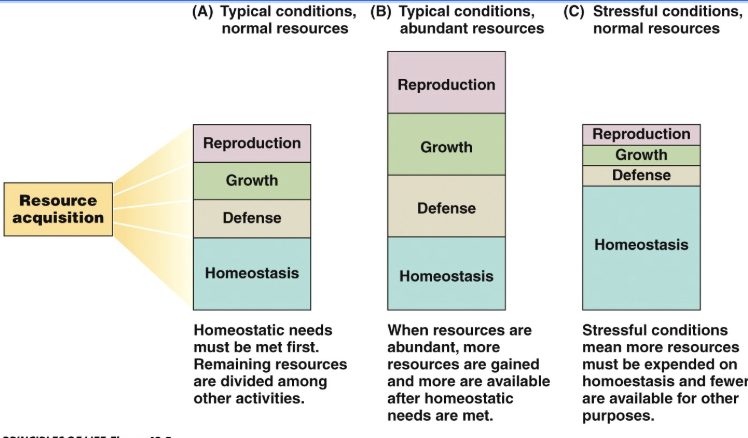
Principle of allocation
Principle of allocation—once an organism has acquired a unit of some resource, it can be used for only one function at a time: maintenance, foraging, growth, defense, or reproduction.
Community ecology
An ecological community = all populations of different species living and interacting in an area
Community boundaries can be:
Natural (pond, forest edge)
Arbitrary (chosen for study, e.g., bird community)
Communities are defined by:
Species composition (which species are present)
Relative abundance (how common each species is)
A species must be able to:
Colonize + survive + reproduce to be part of a community
Extinction
Local extinction = species disappears from a specific area but exists elsewhere
Causes include:
Inability to tolerate local abiotic conditions
Resource limitation
Competition, predation, or disease
Small population size → failure to reproduce (demographic collapse risk)
AP idea: local extinction often results from biotic + abiotic pressures + small population vulnerability
Species Interactions, Per Capita Growth, and Succession
A species’ per capita growth rate depends on interactions with other species
These interactions can drive ecological succession
Examples:
Competition (dung beetles): late species outcompete early colonizers for nutrients
Shading (plants): later plants reduce light, causing pioneer species to decline
AP idea: species interactions change community composition over time
Species richness
Species richness = number of species in a community
Highest richness near the equator (tropics) due to:
High solar energy → high NPP
Warm, stable climate
High rainfall + low seasonality
Lower richness near poles due to:
Low energy input
Harsh seasonal variation
Slower productivity and higher stress
Species evenness
Species evenness = how evenly individuals are distributed among different species in a community
Considers:
Number of species (richness)
Relative abundance of each species
High evenness = species have similar population sizes
Low evenness = one or few species dominate the community
Higher biodiversity (richness + evenness) generally leads to:
Greater ecosystem stability
Increased resilience to disturbances (disease, climate change, etc.)
Species Diversity
Higher biodiversity (richness + evenness) generally leads to:
Greater ecosystem stability
Higher resistance and resilience to disturbances (e.g., disease, climate change)
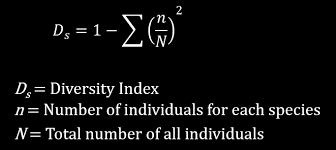
Simpson’s Diversity Index
A species diversity index quantifies diversity using:
Species richness (number of species)
Species evenness (relative abundance of species)
It combines richness + evenness to give a single value of community diversity
Community function is affected by diversity:
Higher species diversity → greater and more stable NPP (Net Primary Productivity)
More diverse communities are often more resilient to environmental changes
Within the same community type:
Higher diversity = more consistent energy production over time
Lower diversity = more fluctuation and instability in productivity
Factors shaping community structure
Community structure is shaped by:
Climate (temperature, rainfall, seasonality)
Geography (location, barriers, latitude)
Environmental heterogeneity (habitat variety → more niches)
Disturbance frequency (fires, storms, floods reset succession)
Species interactions (competition, predation, mutualism, parasitism)
Chance events (random colonization/extinction)
Geographic Patterns of Species Richness
Patterns of species richness help identify factors that influence biodiversity across ecosystems
Species richness follows predictable global patterns:
Highest in tropics (latitudinal gradient)
Due to high NPP, stable climate, long evolutionary time
Lower at higher latitudes
Island biogeography:
Islands have fewer species than mainland
Smaller islands → higher extinction rates
More isolated islands → lower immigration rates
keystone species
A keystone species is a species that has a disproportionately large effect on ecosystem structure and function relative to its abundance or biomass
Its removal can cause major community shifts or ecosystem collapse
Keystone species are:
Often not the most abundant species
Can occur at any trophic level, but are commonly top predators
Important because they regulate populations of other species and maintain community balance
Unlike foundation species (which shape habitat through abundance/biomass, e.g., trees, coral), keystone species:
Influence communities through ecological interactions (predation, competition control, etc.)
Have effects that are out of proportion to their population size
Foundation species
Foundation species are species that physically shape and structure an ecosystem by creating or modifying habitat
They are typically abundant and have high biomass
They increase ecosystem complexity by:
Providing physical structure and habitat
Creating niches for other species
Increasing biodiversity and community stability
Example: Brown algae (kelp forests)
Forms dense underwater “forests”
Provides shelter, food, and breeding space for many marine organisms
Supports high species richness by increasing habitat availability
Foundation species influence ecosystems through habitat formation and abundance
Unlike keystone species, their impact comes from being structurally dominant, not necessarily rare or highly interactive
Trophic cascade
A trophic cascade is a chain reaction across trophic levels caused by changes in a species’ population or behavior
Occurs when a species is reduced, removed, or behaviorally suppressed due to predation risk, disrupting ecosystem balance
Altering one species can trigger system-wide changes in community structure
Effects:
Changes in one trophic level affect multiple other trophic levels
Leads to ecological imbalance across the food web
Interspecific interactions
Interspecific interactions occur between individuals of different species
They affect:
Population density
Species distribution
Can drive evolutionary change over time
Interspecific interactions
Interspecific Competition (-/-)
Occurs when two species use the same limited resource
Both species are negatively affected
Often happens when niches overlap and a limiting resource is in short supply
Variation in traits affects competition success (some individuals are better adapted)
reduced by resource partitioning
Predation (+/-)
One species (predator) benefits, the other (prey) is harmed
Includes herbivory (plant consumption by animals)
Leads to evolutionary adaptations in prey and predators
Symbiosis (long-term close interactions)
Mutualism (+/+) → both species benefit
Commensalism (+/0) → one benefits, other unaffected
Parasitism (+/-) → parasite benefits, host is harmed
Species live in long-term close association
Niches
A niche is a species’ ecological role, including:
The resources it uses
The abiotic conditions it requires
Its interactions with other species (competition, predation, etc.)
Two species with identical niches cannot coexist long-term
Leads to competitive exclusion (one outcompetes the other)
Partial niche overlap can allow coexistence if:
Species partition resources (use different parts of the niche)
Competition is reduced through behavioral or evolutionary differentiation
Competitive Exclusion Principle
two species cannot occupy the same niche indefinitely in the same environment
When two species compete for the same limiting resource, one will outcompete and exclude the other locally
This leads to:
Restricted habitat distribution
Niche separation or habitat partitioning
resource partitioning
Species can coexist if they use resources in different ways or different parts of a habitat
This reduces direct competition and allows stable coexistence
Example:
Paramecium caudatum can coexist with Paramecium bursaria because they partition resources, using different parts of the environment or food sources
Consumer predator interactions
Organisms obtain energy by consuming other living organisms
These are +/- interactions:
Consumer benefits
The consumed organism is harmed
Types of Consumer–Resource Interactions
Predation (+/-)
One organism (predator) kills and eats another
Example: ladybug feeding on aphids
Herbivory (+/-)
Animals consume plants or plant parts
Example: American bison grazing on grasses
Parasitism (+/-)
Parasite lives in or on a host and feeds on it over time (usually not immediately killing it)
Example: parasitic wasp lays eggs on a caterpillar; larvae consume host
Biological Magnification (bioaccumulation) of Toxins/Pollutants
Toxin concentration increases at each trophic level because:
Predators consume many contaminated prey organisms
Toxins are not easily broken down or excreted
They often bind to fat tissues or are chemically stable
Why toxins remain in bodies:
Many pollutants are non-biodegradable or slowly metabolized (fat-soluble)
They are stored in fatty tissues (adipose tissue) rather than being excreted
Organisms cannot efficiently eliminate them, so they accumulate over time
Each consumer inherits the toxins stored in its prey, leading to higher concentrations up the food chain
Mutualism
Mutualism is an interspecific interaction where both species benefit (+/+)
Occurs when each species acts in its own self-interest, but the interaction benefits both
AP idea: not “cooperative intent,” but natural selection favors interactions that improve fitness
Commensalism
Commensalism is an interspecific interaction where one species benefits and the other is unaffected (+/0)
Occurs when one species gains food, transport, or shelter without significantly harming or helping the other
Ammensalism
Amensalism is an interspecific interaction where one species is harmed and the other is unaffected (–/0)
Often occurs as a non-intentional or indirect effect of another organism’s activity (not a direct evolutionary interaction like predation or mutualism)
Species Interactions & Evolution
Species interactions affect individual fitness (survival and reproductive success)
Individuals with phenotypes that benefit most from positive interactions (e.g., mutualism) or are least harmed by negative interactions (e.g., competition, predation) have higher fitness
These individuals leave more offspring → their traits become more common over time
Result:
Natural selection acts on interspecific interactions
Populations can evolve in response to other species (co-evolutionary effects)
Consumer resource interactions
Consumer–resource interactions involve one organism consuming another (e.g., predation, herbivory, parasitism)
These interactions create opposing selective pressures:
Consumers benefit from better ways to capture/eat hosts/prey
Resources benefit from better defenses
Leads to continuous coevolution between species
Prey/hosts evolve defenses (camouflage, toxins, speed, armor, etc.)
Predators/consumers evolve counter-adaptations (better detection, speed, resistance, etc.)
Each adaptation in one species selects for a response in the other
Prey predator cycle
predator and prey population sizes fluctuate over time in linked cycles
Core pattern:
Prey population increases → more food for predators → predator population increases
Predator population increases → more predation → prey population decreases
Prey population decreases → less food → predator population decreases
Cycle then repeats
Metabolic rate
Metabolic rate is the sum total of biochemical reactions in an organism’s body
It reflects how quickly fuels are broken down to keep cells running
Can be measured using:
Energy units (joules, calories, kcal)
Oxygen consumption
Higher activity → higher metabolic rate
Metabolic rate and size
Larger organisms have a higher total metabolic rate
Smaller organisms have a lower total metabolic rate
However, per unit body mass:
Small organisms have higher metabolic rates
Large organisms have lower metabolic rates
Smaller organisms:
Lose heat faster
Require more energy per gram
Larger organisms:
Lose heat more slowly
Require less energy per gram
Endotherm
Maintain body temperature internally
Have higher metabolic rates and energy needs
BMR (Basal Metabolic Rate):
Measured at rest
In a thermoneutral environment (no extra energy used for temperature regulation)
Smaller animals have higher BMR per unit mass
Ectotherm
Body temperature depends on external environment
Have lower metabolic rates and energy needs
SMR (Standard Metabolic Rate):
Depends on environmental temperature
Measured at a specific temperature
Higher temperature → higher metabolic rate
Increases molecular collisions → faster reactions
Too high temperature → protein denaturation
Behaviorally regulate temperature:
Seek sun or shade
Temperature change between extotherms and endotherms
Ectotherms
Body temperature depends on external environment
Temperature increase → increase in metabolic processes
More molecular collisions → faster reactions
Endotherms
Maintain body temperature within a narrow range
Temperature increase → little to no change in metabolic rate
Use metabolic heat production to keep body temperature constant
Heat Exchange Mechanisms
Heat is gained or lost through:
Radiation
Conduction
Evaporation
Metabolism process
Food contains energy stored in chemical bonds
Metabolic reactions (cellular respiration):
Break down molecules to release energy
Some energy is captured as ATP to power cellular processes
Nutrient use:
Proteins → broken into amino acids → used to build new proteins
Excess glucose → stored as glycogen
Excess energy → stored as triglycerides (fat)
Energy transformations are not 100% efficient
Some energy is always released as heat (nonusable energy)
How do resources and environmental conditions affect organisms?
Organisms require:
Resources (materials and energy)
Physical conditions within a tolerable range
The rate of resource acquisition depends on availability
More available resources → faster acquisition
The ability to gather food (energy) depends on resource density
Higher density → easier and more efficient foraging
Lower density → more time and energy required
Principle of allocation
The principle of allocation states that organisms have a limited amount of energy and resources
A unit of energy can only be used for one function at a time
Possible Uses:
Maintenance (basic survival)
Foraging (obtaining food)
Growth
Defense
Reproduction
Trade-offs occur because investing in one function reduces energy available for others
Torpor
Torpor is a state of decreased activity and metabolism
Helps organisms conserve energy during unfavorable conditions
Hibernation
Long-term form of torpor during winter
Triggered by low temperatures and limited resources
Characterized by inactivity and reduced metabolism
Estivation
Dormancy during summer
Occurs in response to hot, dry conditions
Characterized by inactivity and lowered metabolism
Diapause
Diapause is a pause (arrest) in development
Allows organisms to survive extreme environmental conditions
Development resumes when conditions become favorable
Helps time offspring's development or birth to optimal environmental conditions
Endotherm thermoregulation
Heat Production
Shivering thermogenesis
Muscle contractions generate heat
Non-shivering thermogenesis
Brown fat (rich in mitochondria) releases energy as heat
Increased metabolic activity (e.g., influenced by hormones like insulin)
Heat Conservation
Vasoconstriction
Blood vessels constrict → reduce heat loss
Insulation
Fur and feathers trap air near the skin
Fat reduces heat loss
Countercurrent heat exchange
Heat transfers from warm blood to cooler blood to conserve heat
Heat Loss
Vasodilation
Blood vessels expand → increase heat loss to environment through the skin
Evaporation
Sweat or panting removes heat from the body
Behavioral thermoregulation
use of behavior to control body temperature
Does not rely on internal physiological changes
Involves changing location or activity
Examples:
Moving into sun or shade
Changing body orientation to the sun
Burrowing or seeking shelter
Huddling together
K-selected species
Produce few offspring at a time
Provide high parental care
Tend to be:
Larger
Longer-lived
Mature more slowly
Use a more energy-efficient strategy
Invest more resources in each offspring
More common in stable environments
Populations tend to stay near carrying capacity (K)
R-selected species
Produce many offspring at a time
Provide little or no parental care
Tend to be:
Smaller
Shorter-lived
Mature more quickly
Use a less energy-efficient strategy
Invest fewer resources in each offspring
More common in unstable environments
Populations often grow rapidly and fluctuate
Annual plants
An annual is a plant that completes its life cycle in one growing season
Life cycle includes:
Germination
Growth
Flowering
Seed production
After reproduction, the plant dies
The dormant seed is the only stage that survives to the next season