Music Exam
 Call Kai
 Learn
Learn Practice Test
 Spaced Repetition
 Match
Match Flashcards
 Knowt Play
1/199

There's no tags or description
Looks like no tags are added yet.
Name | Mastery | Learn | Test | Matching | Spaced | Call with Kai |
|---|
No analytics yet
Send a link to your students to track their progress
200 Terms
music therapy
the discipline in which credentialed professionals (MTA) use music purposefully within therapeutic relationships to support development, health, and well-being
the MT uses music safely to address human needs within cognitive, communicative, emotional, musical, physical, social, and spiritual domains
it is individualized and personalized
How to become a certified music therapist (MTA)
get university training in music therapy or a related field
be skilled as a musician → proficiency at guitar, piano, and signing
complete a 1000 hour supervised clinical internship
complete certification board of music therapists exam
statement of adherence to the CAMT code of ethics and standards of practice
gain continuing education credits
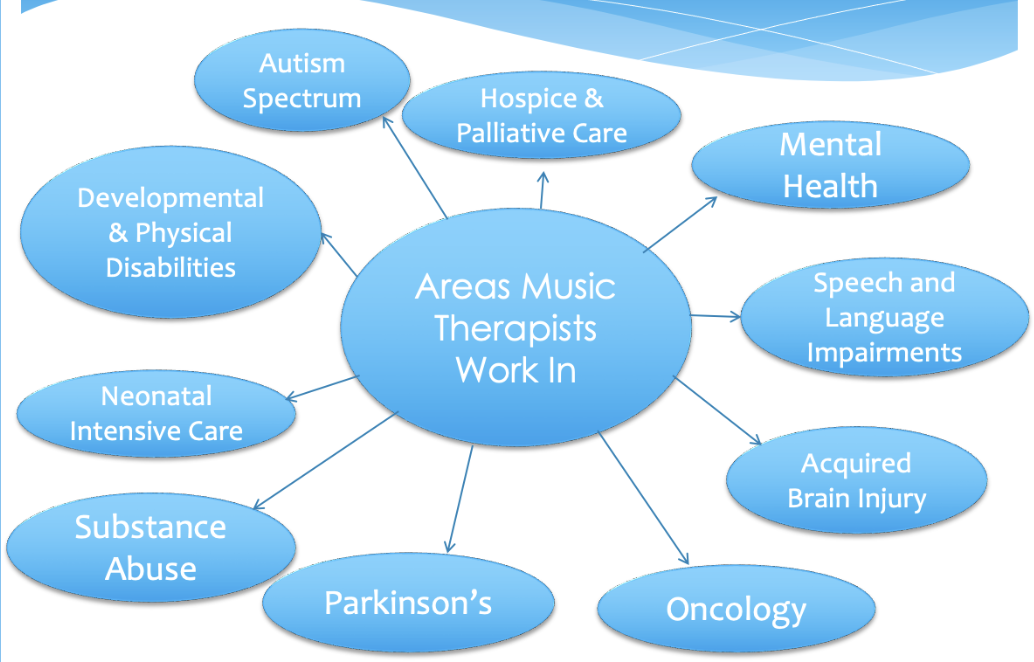
areas that music therapists work in
music therapists work with numerous clients of all ages across many contexts
MT’s often have fluctuating careers
mental health is an overarching theme amongst the fields they work within
MT is collaborative → they may work with physiotherapists, speech therapists, psychologists, etc
what are the two types of music therapy interventions?
active music therapy
passive music therapy
hospital settings often favour ____ interventions because they are more feasible
passive
types of music therapy interventions → active music therapy
when the client is actively engaged in the music therapy
ex: improvisation, singing, songwriting
types of music therapy interventions → passive music therapy
when individuals passively participate in the music therapy
ex: listening, pre-composed music
Why do we need research on music therapy?
To gain credibility in the medical world
To provide evidence for funding
To increase access to music therapy services
To prove something (an intervention) works
components of research papers
a clear statement of purpose and what is to be investigated
clear described and justified methodology
a report of the results
conclusions that are subsequently related to existing knowledge
research
a systematic, self-monitored inquiry which leads to a discovery or new insight, which, when documented and disseminated, contributes to or modifies existing knowledge or practice
types of data
quantitative
qualitative
mixed-method
types of data → quantitative
primarily relies on objective forms of data, and most
often requires quantification and statistical analysis
ex: cortisol levels, survey responses
takes an objectivist approach
types of data → qualitative
relies on subjective data, such as verbal, musical, and artistic materials or qualities
ex: interviews, observations, etc
takes an interpretivist approach
there there are three types
phenomenological → how a person feels
meaning focused → how a person makes meaning
case approached → one individuals experience
mixed methods data
research that involves both qualitative and quantitative methods
Very common in music therapy!
using both qualitative and quantitative methods ate important for understanding/furthering music therapy
what outcomes can we obtain through music therapy research?
physiological effects
ex: cortisol levels, adrenaline, heart rate patterns, breathing patterns, EEG, etc
psychological effects
ex: mood changes, use of coping strategies, changes in mental health outcomes
what are the two types of research?
basic
applied
basic research
researching basic knowledge and observable information about a phenomena
there are no specific applications toward processes or products in mind
done more often in disciplines other than music therapy
applied research
expanding basic research to provide a real world application
what type of research is done most common in music therapy?
applied research, as music therapy aims to help people
Evidence based practice
Clinician observed, patient reported, and research derived evidence
Helps us make the best decisions for patients and ensures safety
What factor strengthens research validity?
larger sample sizes
control groups
standardized measures
what are some common dependent variables in music therapy research studies?
self reports → for stress anxiety, depression, etc
observations from staff or children’s parents
physiological measures
What is a barrier/obstacle for research in music therapy?
Many variables are involved (music, interventions used, therapists, patients’ individual differences)
What is neurologic music therapy (NMT)?
Using musical experiences, the elements of music or music-based tasks to reach non-musical goals
there are several standardized clinical techniques (20+) that can be paired to address the following domains:
(MAINLY) sensorimotor function
cognitive function
speech and language
psychosocial function
the focus is on brain function and rehabilitation
it promotes neuroplastic changes in the brain
what is the most common NMT technique for improving sensorimotor function?
rhythmic audiotory stimulation
rhythmic auditory stimulation
The most researched, evidence based example of sensorimotor rehabilitation
Based on the principle of rhythmic entrainment and involves rhythmic cueing
In Parkinson’s patients, an 8-week RAS program with music improved gait, increased sensorimotor activation, and reduced fall risk, illustrating “use it or lose it”
named as a “best practice” by the Canadian Stroke Association
rhymthic entrainment
the synchronization of motor neurons in response to a regular, pulsating sound
rhythmic structure gives the brain a predictable pattern and structure to move to - the brain responds in the silence between beats
what is a common tool used for rhythmic entrainment?
a metronome
what is the most common NMT technique for improving speech and language?
melodic and intonation therapy
Aphasia
damage to the language sections of the brain, which can result in impaired production or comprehension of written and spoken words
SAM aphasia group in hamilton helps individuals with aphasia meet and work on speech
people may sing better than they speak (ex: politician from Arizona)
Melodic Intonation Therapy (MIT)
uses melody/rhythm to improve speech
language rehabilitation can be supported by engaging both brain hemispheres, helping “rewire” speech areas
therapy involves singing meaningful phrases with simple melodies, tapping the left hand, and gradually fading musical support to transition from singing to natural speech
music and the brain
music activates all areas of the brain
ex: the corpus callosum, the sensory cortex, the visual cortex, the nucleus acumens, and the amygdala
it also increases the release of several important neurotransmitters → dopamine, endorphins, acetylcholine, glutamate, GABA neurons
common symptoms associated with neurologic conditions
weakened muscles
loss of coordination
seizures
confusion
pain
altered speech patterns
who can take neurologic music therapy training?
Music therapists
Speech and language pathologists
Occupational therapists
Recreation therapists
Physiotherapists
but, only MTA’s can use the NMT credentials
NMT Pilot study: long-known music exposure effects on brain imaging and cognition in early stage cognitive decline
Individuals with early stage dementia where assigned to 3 weeks of daily listening to songs they knew; they where also given cognitive assessments
Individuals who where musicians previously had greater improvements in cognition + memory
This shows music may be helpful for improving cognitive function and memory, especially if individuals are musicians
in the context of NMT, why does music help?
Rhythm drives speech
• Repetition
• Memory support
• Whole-brain activatio
trauma
Challenging emotional consequences from living through distressing events (ex: abuse, neglect in early life, car accidents, brain injury, war, etc)
Can be divided into little T (accumulation of stressors over time) and big T trauma (big life events)
Impacts of trauma
having a constant sense of danger
disrupted memories → repressed memories, flashbacks
stress becomes stored in the body
difficulty calming doen
expecting the worst
What are the two parts of the nervous system?
the parasympathetic nervous system
rest and digest
includes the vagus nerve → ventral = calm and dorsal = stress
the sympathetic nervous system
helps us deal with emergencies (increases adrenaline, perspiration, heart rate)
people with trauma may have increased or persistent activity in the sympathetic NS
glimmers
Small moments of joy or peacefulness that calm the nervous system
They add up and help you rewire the brain to notice more positive things
trauma responses
the ways our body and mind respond to a traumatic event
What are the 4 different types of trauma responses?
fight → anger/aggression
flight → anxiety/restlessness
freeze → being numb or disconnected
fawn → people pleasing
Value of humming
Activates the vagus nerve and the parasympathetic nervous system
Helps us regulate emotions
Lowers stress and heart rate
general stages for treating trauma
safety → establish secure environment + build therapeutic trust
remembrance → process an express trauma
reconnection → rebuild one’s identity and regain empowerment
TRAUMA paper 1: Heroines’ Journey‑ Emerging story by refugee women during group analytic music therapy
a qualitative interpretivist study featuring 6 refugee women new to Canada
all the participants completed 8 weekly therapy sessions featuring improvisation art, guided imagery and music
they found that the group co-regulation and storytelling led to increased social support, decreased isolation/shame, and an overall shift from victim to survivor narrative
limitations → small sample, limited generalizability, short duration
Guided Imagery and Music (GIM)
a MT technique where the therapist guides a person into an altered state of conciousness using specially selected (often classical) music
TRAUMA paper 2: in search of the self - the use of vocal holding techniques with adults traumatized as children
Diane Austin implemented vocal holding and free associative singing in a study featuring a sample of traumatized clients with broken identities
One’s voice was thought to be a psychological and physical anchor
Traumatized individuals may survive by forfeiting their own voice→ this helps them get it back
in the case of vicky, she was able to heal her mind-body split
What where the two vocal psychotherapy techinques created by Diane Austin?
Vocal holding → the therapist is holding the space for the client to allow them to explore their feelings in a safe space; usually consists of 2 chords
Free associative singing → sing whatever comes to mind so it can be processed and analyzed later
Parkinson’s disease
A progressive neurodegenerative disorder characterized by several motor and non-motor symptoms
Involves a lack of dopamine production which impacts the Basal Ganglia (responsible for initiating movement)
Significantly impacts quality of life and speech
Currently there is no cure, but it can be treated pharmacologically with Levodopa (stimulates dopamine release)
Issues with speech in Parkinson’s
Occurs in 80% of people with Parkinson's
Quieter speech and a monotone voice
Frequent voice arrests
Lower phonotational range
Speech therapy most effective treatment for speech impairments resulting from PD BUT less than 5% of PD access it
Parkinson’s Community groups
Community groups have been shown to help individuals with Parkinson’s improve their functioning (post therapy)
Examples:
McMaster and Hamilton City Ballet's Dance for Parkinson's
Hamilton Parkinson's Chorus started by Zachary Levine
Beat inception
at 5 months old, infants can perceive rhythms + beats; it is intrinsic and helps us learn language
PARKINSON’S Paper 1: Music Therapy in Parkinson’s disease
this was a literature review focused on analyzing the scientific use of MT for treating PD
Results for motor symptoms → 4 of the studies saw no improvement or worse performance when music was present
Results for non-motor symptoms → singing interventions helped with speech longitudinally; attention, memory, dysarthria, and swallowing improved
Results for QoL: most significant improvements for mood and QOL when interventions included both singing and rhythm
Overall, longer treatment = better patient outcomes , but music may not be effective for all people with PD due to the increased cognitive load
The Ronnie Gardiner Method
A multisensory exercise method designed to help people with diseases/injuries of the brain and CNS
Uses rhythm and movement to stimulate neuro-plasticity
PARKINSON’S Paper 2: the effects of participation in a group music therapy voice protocol on the speech of individuals with Parkinson's disease
Wanted to test the efficacy of the applied group music therapy voice protocol for PD
They adapted Lee Silverman Voice Treatment principles (loud voice, effortful phonation, intensity) into group singing/speaking exercises with warmups, breathing, scales, and preferred-song singing
Overall, they saw improved vocal intensity, maintained vocal ranges, and benefits due to the social support
Limitations: small n, more men than women in the sample, no control group
Aging and voice production
Affects men and women differently
Women's fundamental frequency get lower and men's get higher
Men tend to have a more significant decrease in their vocal range and this happens earlier on (and is more profound)
Specifically, 70ya men range is lower then 60ya men
Palliative care
An approach that improves quality of life for patients (and their families) who have life-threatening illness by preventing and relieving suffering through early identification, assessment, and treatment of physical, psychological, and spiritual problems
Provided at the same time as other treatments while trying to cure the illness or combat symptoms
MT in palliative care involves receptive, improvisational, and compositional techniques
Palliative care → validation therapy
Accepting a person where they're at; listening to the person as they approach the end of life; help them process this time
Hospice care
Hospice care is provided when someone has less than 6 months left to live and treatment to cure illness has stopped
embraces whole person care
Whole person care
Care that seeks to integrate the physical aspect of personhood along with the psychosocial and existential/spiritual ones, and to better understand how to respond to suffering experienced by the whole person
Catharsis
the process of releasing, and thereby providing relief from, strong or repressed emotions
What is the most common symptom experienced by individuals in palliative care?
pain
Music and pain perception
In hospice/pain care, music can reduce perceived pain, anxiety, and improve mood
studies showing decreased cortisol and higher pain tolerance in comparison to white noise/relaxation
Effects are strongest when the music is personally chosen, though overall findings are mixed
Audioanalgesia
the use of music (more effective) or white noise to reduce pain and anxiety
PALLIATIVE CARE Paper 1: outcomes of music therapy interventions on symptom management in palliative medicine patients
this was a large retrospective review of palliative care music therapy (5,970 sessions; 547 patients analyzed)
they wanted to identify common music therapy goals, interventions and their effects
they found that palliative care led to a significant improvement in pain, anxiety, depression, shortness of breath, mood, facial expression, and vocalization
overall, there was a 96% positive response rate to music therapy
PALLIATIVE CARE Paper 2: a pilot study on the effectiveness of MT in hospice in Japan
this was a pilot study on MT in Japanese Hospice care
previous to this, there was limited use of MT in palliative settings despite a large amount of certified therapists
they had participants complete weekly group MT (~40min) and pre/post measures of mood and salivary cortisol
positive mood and refreshment, alertness, and excitement increased and anxiety and depression decreased in 6/10 patients
MT shows promise for reducing stress/anxiety and improving quality of life in end-of-life care
Acquired brain injury (ABI)
Damage to the brain occurring after birth
Can be caused by:
Tumors
Aneurism
Infections
Alcohol + toxins
etc…
Many people’s entire way of life is disrupted, so the healing process usually involves a reintegration of the self
Common symptoms of ABI
memory loss
impaired reasoning skills
emotional and personality change s
physical disabilities
speech problems
headaches or seizures
Psychosocial impacts associated with ABI
Loss of role and self-identity
Difficulties with maintaining relationships
Struggles with family, communication, and social skills
Increased isolation
Higher risk of unemployment
Poorer financial circumstances
Case studies in music therapy research
quite common
pros → provides rich and detailed information about individuals, accessible to readers, multiple research methods can be used
cons → low generalizabilty, requires large amount of time
ABI paper: exploring self-concept, wellbeing and distress in therapeutic songwriting participants following acquired brain injury
this was a case study featuring 5 male participants with ABI (stemming from different sources) who where tasked with writing 3 songs over 3 weeks
data collection was extensive and self-report; it took place pre-, mid, and post-intervention
Key themes extracted from the songs: finding new life meaning; importance of relationships + family; post-traumatic growth
Limitations → small time frame, heterogeneous sample
Post-traumatic growth
Making meaning from an experience and re-evaluating future goals and priorities
Autism spectrum disorder
a neurodevelopmental disorder characterized by impaired social interactions, challenges with verbal and nonverbal communication, narrow interests, and repetitive behaviours
people experience unique functional difficulties in communication, learning, and playing → no two people are the same
has high co-morbidity with other illnesses
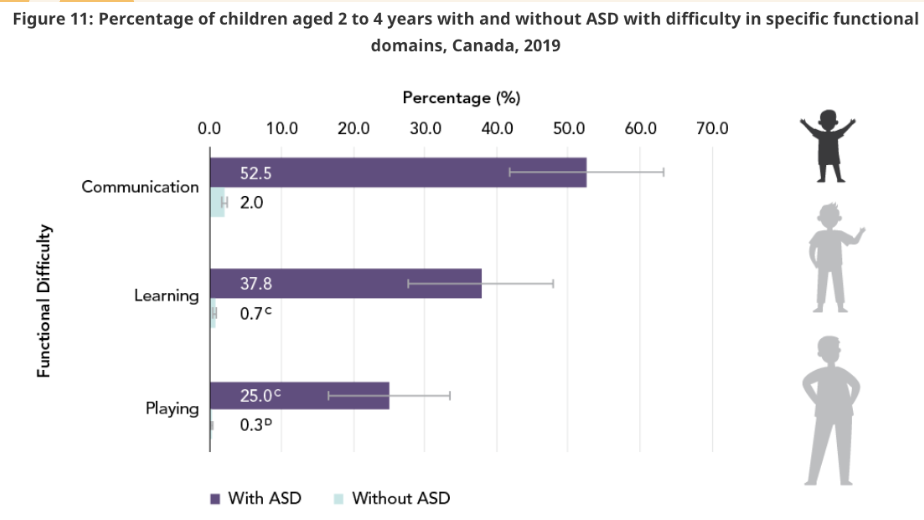
Prevalence of ASD
About 1 in 50 people or in 2% of Canadian children and youth
Men are 4x more likely to be diagnosed
Most children (53%) are diagnosed between ages 0-4; very few people are diagnosed in adolescence
ASD comorbidity
ASD high co-morbidity with other mental illnesses, such as ADD/ADHD, learning disabilities, and anxiety
68.7% of autistic children have another long-term health condition compared to 21.9% of children without ASD
What are the criteria for being diagnosed with ASD?
Social communication and social interaction deficits
Restrictive or repetitive behaviors, interests, or activities
Early signs and symptoms of ASD → 6-12 months
limited smiles or other joyful expressions directed at people
limited or NO eye contact
limited reciprocal sharing of sounds, smiles, or facial expressions
diminished, atypical, or no babbling/gesturing
limited response to ones name
Early signs and symptoms of ASD → 9-12 months
emerging repetitive behaviours
unusual play (ex: intense visual or tactile exploration of toys)
Early signs and symptoms of ASD → 12-18 months
no single words
an absencse of compensatory gestures llike poinying
a lack of pretend play
limited joint attention
when are most individuals diagnosed with autism?
early in life, between the ages of 0-4
the autism wheel
A tool that does a great job visually representing how autism may appear in different people → it shows their strengths and weaknesses (not just weaknesses!)
Provides a more in-depth way to understand people's unique complexities at the individual level
i.e, the spectrum (ranging from low functioning to high functioning) simplifies the autistic experience
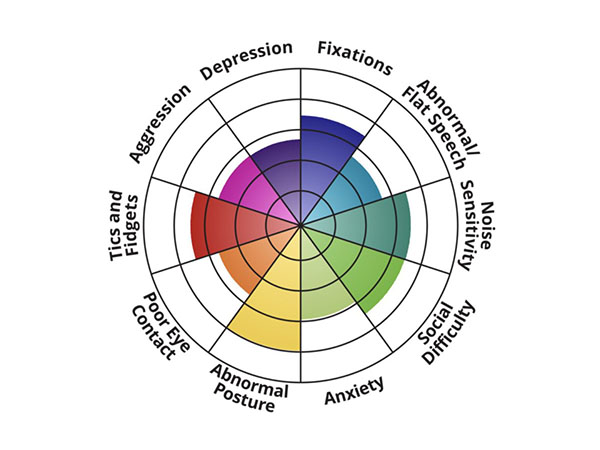
How to read the autism wheel
more filled in areas = closer to neurotypical functioning
more empty areas = more intense autistic trait
Advocacy work and ASD
We are seeing an expansion of the neurodiversity movement
ex: sensory friendly concerts
In addition, we are seeing greater recognition of identity first language → autistic individual, not individual with autism
Neurodiversity
the concept that neurological differences are natural variations in human brain development rather than deficits to be cured
Music therapy for ASD
music therapy is a relief for individuals with ASD to help them address their emotional, physical, cognitive, and social needs
the music intervention may involve singing, dancing, listening, or creating
the music therapist works with the individual and meets them where they’re at → they tailor the intervention specifically to them
ultimately, it gives the individual the ability to express themselves
Echolalia (in ASD)
the uncontrolled repetition of words heard in the environment
Musicophilia by Oliver Sacks
This book discusses how music affects the brain and how it can help people with different neurological conditions, including autism
Music can be a helpful therapy for people with autism because their brains often process music and sound very well, making it easier to connect, communicate, and express emotions
Early MT + Autism research
only 3 RCT on Autistic individuals came out betwee 1950 and 1989
majority of the research that came out was case studies that had small sample sizes
Early MT + Autism research → 1953 Paper
autistic individuals had…
an unusual interest in music
a tendency to sing differently from the average child
an oftentimes unusual ability to reproduce familiar pieces with extrodinary accuracy
Early MT + Autism research → 1964 paper
Amongst autistic individuals, music promoted communication, emotional expression, and social engagement
Early MT + Autism research → 1969 case study
music fostered social connection and communication for people with ASD
Which celebrity visited the Nordoff-Robbins MT centre?
Paul McCartney
How does music have an important role in the lives of autistic individuals?
They frequently demonstrate strong musical skills and abilities
Autistic traits may be associated with the musical genius of notable artists
ASD paper 1: finding our voices - examining how QoL domains manifested in a singing group for autistic adults → purpose
See how music can improve quality of life for people with ASD
There is increased support needed for such individuals
They wanted to see how music acted as a tool for self-expression and as an alternative to verbal communication
There is currently a limited scope of publications on MT for autistic adults
ASD paper 1: finding our voices - examining how QoL domains manifested in a singing group for autistic adults → methods
n = 8 high functioning autistic adults
they used a mixed method design
qualitative data → collected throughout the research process
quantitative data → self-report measures where taken before and after the intervention
all participants completed 12 group singing sessions (1.5h long) in a university research centre
ASD paper 1: finding our voices - examining how QoL domains manifested in a singing group for autistic adults → definition and coding of QoL
health and well-being reflect a holistic psychosocial perspective that encompasses body, mind, spirit, society, culture, and environment
all of these factors come together to affect one’s QoL
to code QoL, they used three subdomains:
being - expressing who one is
belonging - connection
becoming - ways of achieving one’s personal goals, hopes, and aspirations
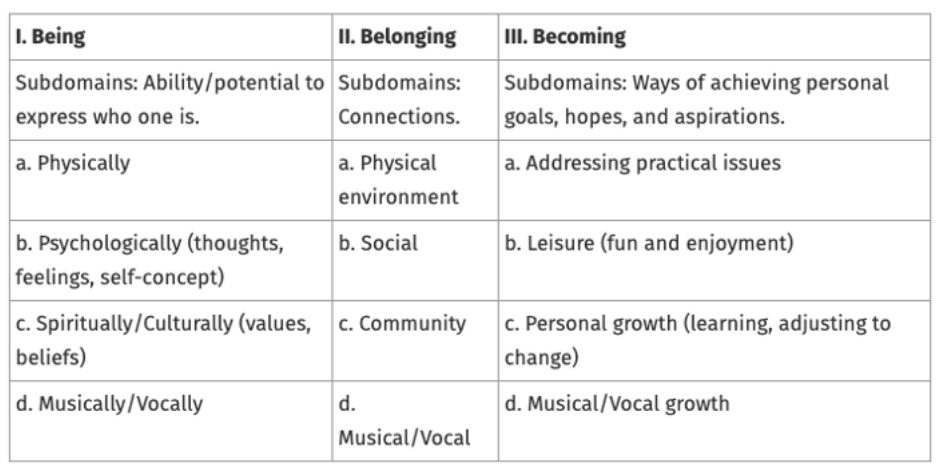
ASD paper 1: finding our voices - examining how QoL domains manifested in a singing group for autistic adults → results
They saw significant personal growth amongst the participants where they became more comfortable using their voices, they made trustworthy friendships, learned new coping skills, and improved mood regulation
Participants rated their perceived level of anxiety as significantly lower during the group compared to their perceived level of anxiety in their daily lives
The CD they created and personal solos where incredibly meaningful
ASD paper 1: finding our voices - examining how QoL domains manifested in a singing group for autistic adults → discussion
Group singing appeared to have multiple benefits for the participants in this study → it was empowering, safe, and an understanding environment
this has implications for training programs for MT’s
This study included participants who where verbal and highly capable; thus, the results may not extend to Autistic individuals who are differently abled
ASD Paper 2: music improves social communication and auditory motor-connectivity in children with autism → purpose
This was an RCT too see the benefits of a music based intervention on language and social communication in school aged children with ASD
Music has the potential to produce changes in the brain, and research suggest ASD is related to over connectivity in sensory networks and under connectivity in fronto-temporal networks
brain connectivity in autism
ASD is related to over connectivity in sensory networks and under connectivity in fronto-temporal networks