Markets and Regulations
 Call Kai
 Learn
Learn Practice Test
 Spaced Repetition
 Match
Match Flashcards
 Knowt Play
1/57

There's no tags or description
Looks like no tags are added yet.
Name | Mastery | Learn | Test | Matching | Spaced | Call with Kai |
|---|
No analytics yet
Send a link to your students to track their progress
58 Terms
Economic analysis of law
application of economic theory to predict effects of legal sanctions on behavior
Legal sanctions function like prices that influence behavior
Laws as incentives and prices
traditional definition: laws are obligations backed by state sanctions
economic perspective: laws create implicit prices for behaviors
Core principles of economics
efficiency
welfare
transaction
Efficiency
A change is efficient if total benefits are greater than total costs
pareto efficiency: at least one person is made better off while making no one worse off (win-win)
kaldor-hicks efficiency: an allocation can be efficient even if someone loses, as long as the winners could compensate the losers (potential win-win)
limitations of efficiency as a goal:
efficiency is not equity: focuses on total welfare, not distribution
efficiency is not fairness: considers outcomes, not process
efficiency is not maximizing happiness: based on willingness to pay, not utility
Welfare
Welfare = utility = satisfying desires
monetoary or non-monetary
subjective (similar phenomenon increases welfare for some, decreases for others)
indifferent (we don’t judge people’s desires)
Transaction
transfer of property rights
simultaneous economic and legal change:
physical/digital transfer of good or service
economic transfer of money
legal transfer of property rights
Transaction costs: information, bargaining, decision-making, monitoring, enforcement costs
Measuring costs-benefits
consider opportunity costs: the value of the next-best alternative foregone
ignore sunk costs: costs that will be incurred whether or not an action is taken
use marginal analysis: focus on additional costs and benefits
perfect competition
many suppliers and consumers
homogeneous goods
no transaction costs:
perfectly transparent
(property) rights defined
free entry and exit
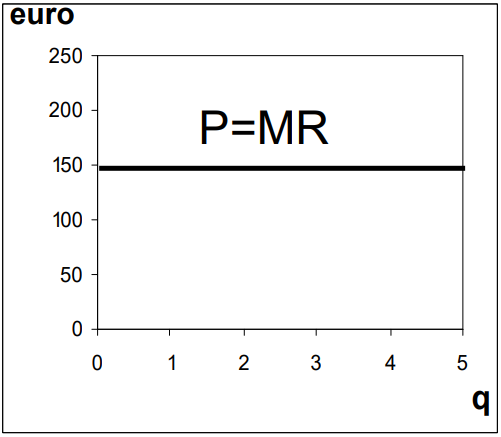
Price is given because it is based on what people are willing to pay/supply and demand
P=MR because in perfect competition, MR would only equate to the price someone pays for the good (MR is also equal to MC in perfect competition)
Demand
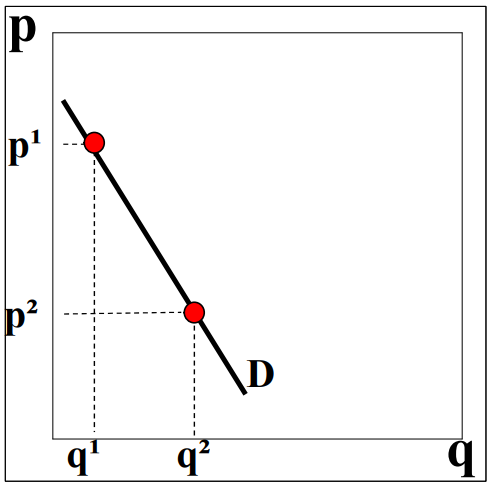
Demand = consumers
Demand curve = willingness to pay
Demand curve decreases (the higher p, the lower q)
price elasticity
how much the quantity demanded of a product changes in response to a change in its price.
elastic demand: effect on q is large (> -1%) → price increases but demanded quantity decreases strongly
inelastic demand: effect n q is small (< -1%) → price increases and demanded quantity hardly decreases
profit
revenue - cost
Revenues
price x quantity
Total Revenue = price x quantity
MR = Marginal revenue (the revenue you get if you sell one more good)
Costs
fixed costs: machines or land costs that are given
variable costs: labor or other factors that can change
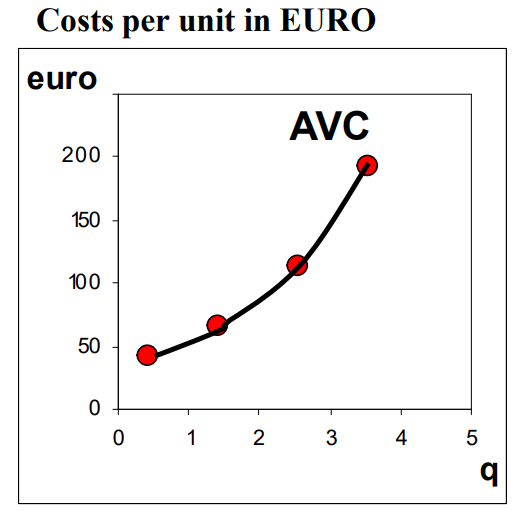
Average variable cost curve (AVC)
Total variable cost (TVC) = average wage rate x number of workers
Average variable cost (AVC) = TVC/quantity
Average fixed cost curve (AFC)
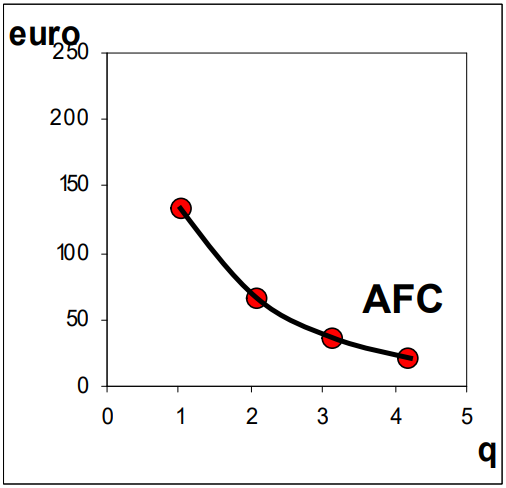
TFC = total fixed costs
independent of production level
average fixed costs (AFC) declines
AFC = Fixed Costs (FC)/quantity
Average total cost curve (ATC)
Total costs (TC) = Total Variable Costs + Total fixed Costs
Average Total Costs = Total Costs/quantity
Average Total Costs = Average Variable Costs + Average Fixed Costs
ATC curve includes payment to shareholders and/or banks (hence profit)
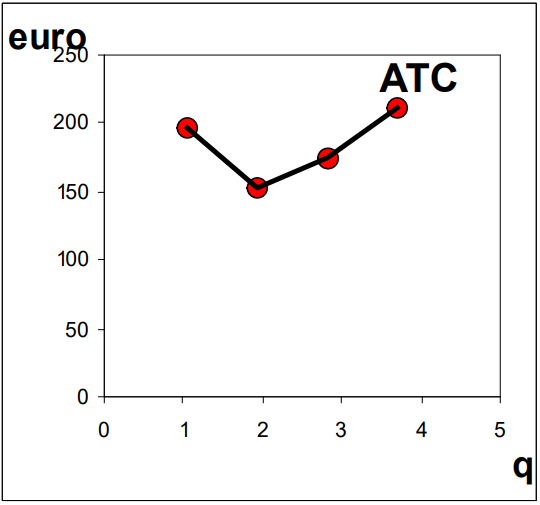
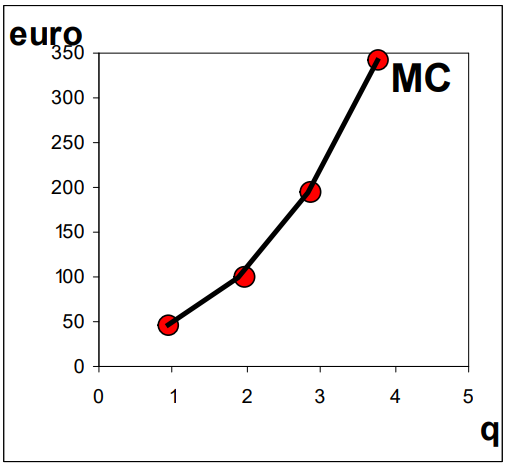
Marginal Cost Curve (MC)
Marginal costs = extra costs when production is expanded with 1 unit (exactly the inverse of MR)
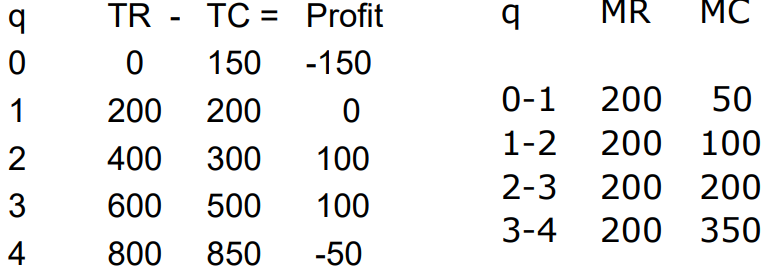
When is profit maximized?
When MR=MC in perfect competition
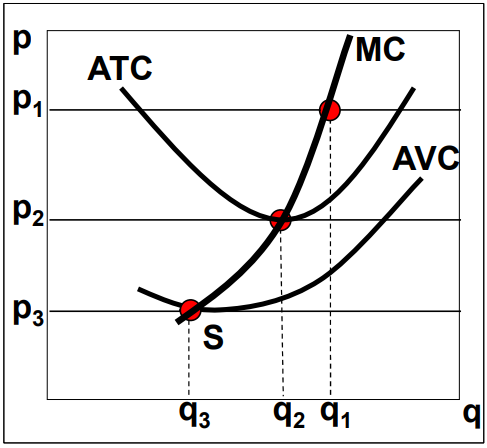
MC curve as supply curve
MC until S = supply curve for producer
price lower than ATC: loss
price below S: shutdown point
Line of reasoning:
P = MR with perfect competition
profit is maximized at MR = MC
MC = supply curve
Optimal production level
MR is greater than MC: expand → more profit
MR is less than MC: expand → less proft
Optimal: MR = MC
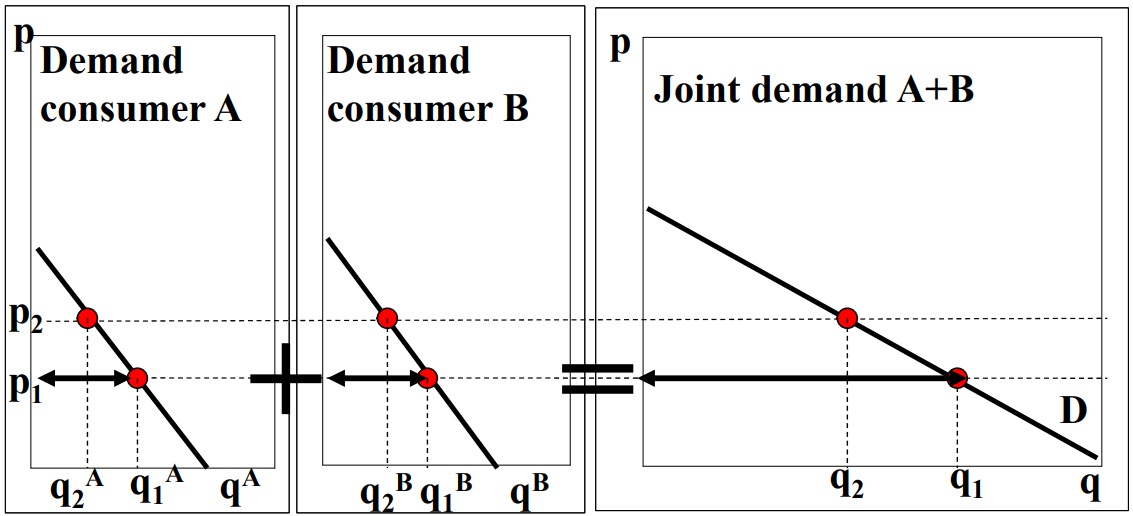
Market demand curve
add up all demand curves
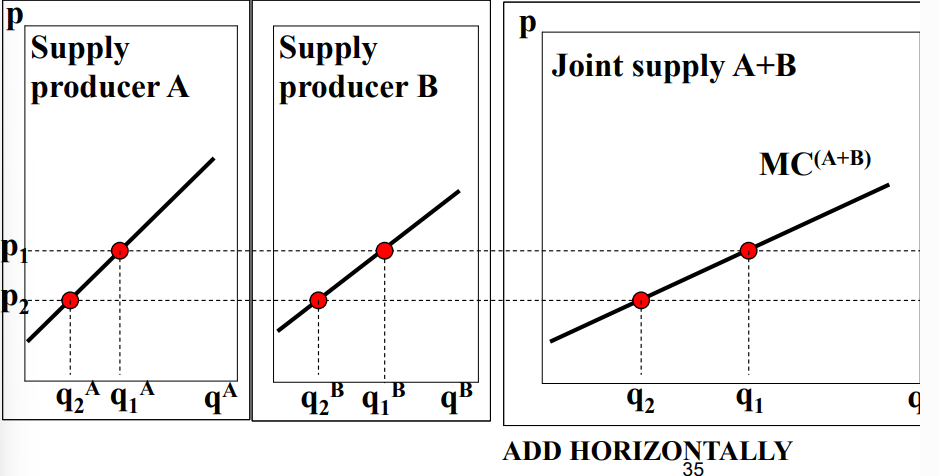
Market supply curve
shows the relationship between price and the total quantity producers are willing to supply.
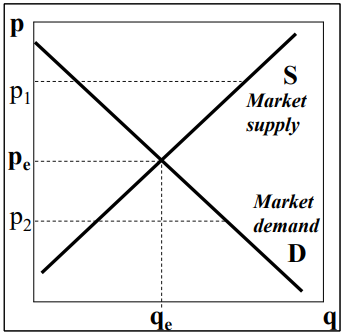
Market equilibrium
Pe = equilibrium price
Qe = equilibrium quantity
(p > Pe → impossible)
(p < Pe → impossible)
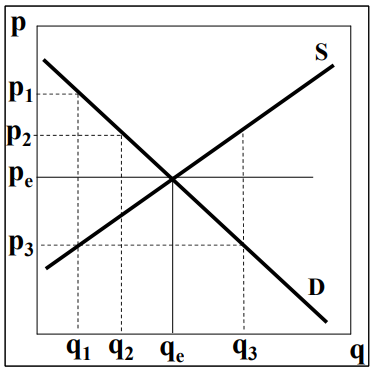
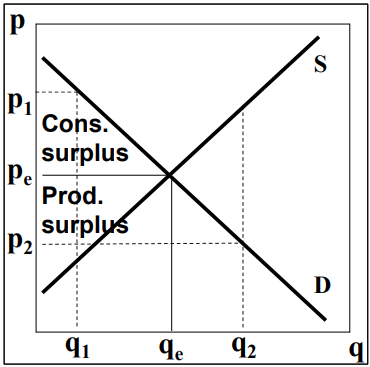
Pareto-efficient market equilibrium
only one equilibrium price: Pe
at P1 & q1 (and P2 & q2) both producer and consumer can increase welfare
continues until pe & qe: consumer and producer surplus is maximal
At p3 & q3 welfare decreases for both
Surplus
Consumer surplus: difference between price that consumers are willing to pay and equilibrium price
Producer surplus: difference between equilibrium price and price that entrepreneurs want to receive
Total surplus: consumer surplus + producer surplus
trading implies that both consumers and producers are better off (both welfare gain)
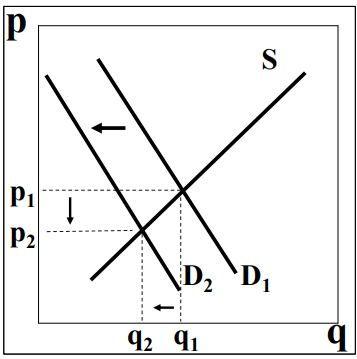
Changing demand
Demand curve D1 shifts:
preferences change
number of consumers changes income distribution changes
price of another good changes
less demand: D-curve to the left)
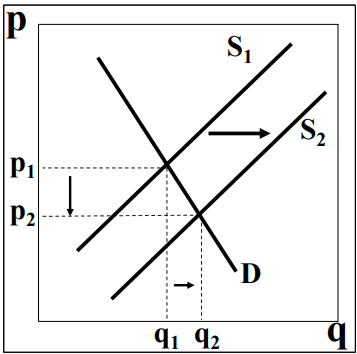
Changing supply
Supply curve S1 shifts:
price of some production factors changes
technology changes
(more supply or lower costs: S-curve to the right)
(MC decrease or: producing more at similar cost level)
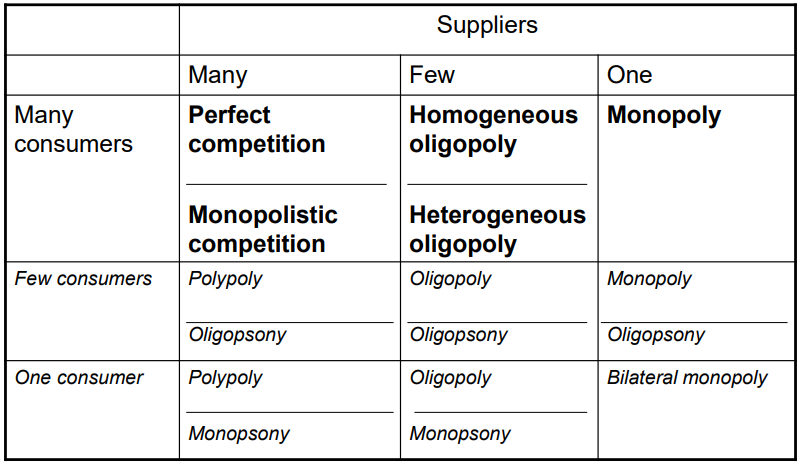
Market structure
the amount of suppliers and consumers dictates whether the market will have perfect competition, monopoly, oligopoly, oligopsony or others
Monopoly
1 supplier: price setter
reasons for monopoly:
technical monopoly
legal monopoly
natural monopoly
advantage: low production costs
disadvantage: high price
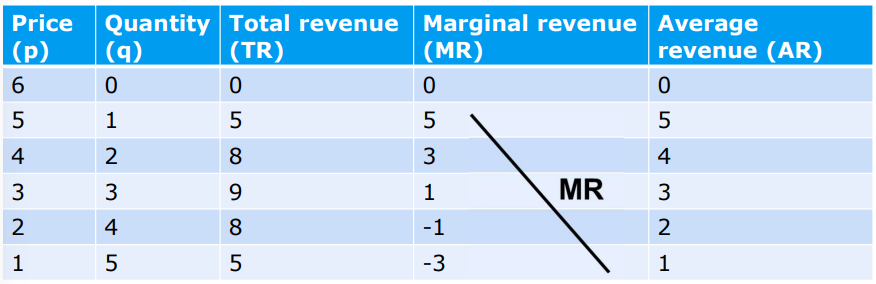
Monopolist’s revenues
demand curve = price
MR downward sloping (MR curve hits horizontal axis between O and A)
TR is maximal when MR = 0
this is not maximum profit
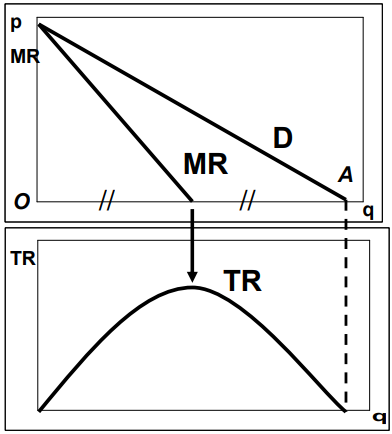
Monopolist’s costs
assumption: cost curves identical to firm under perfect competition
profit is maximal where MR = MC (in point H)
Point H gives ATC of point C and price of point B
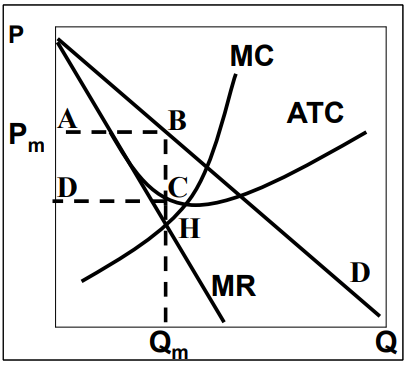
Monopolist’s profit
profit per unit is BC
costs pre unit is QmC
Sales is OQm
total (excess) profit: ABCD (namely profit per unit x sales)
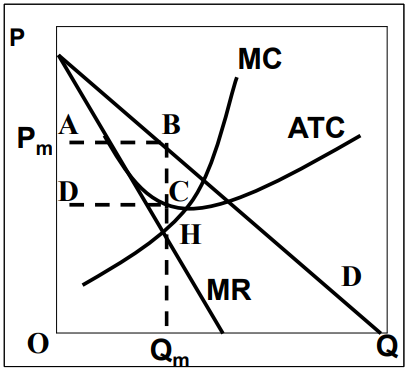
Additional welfare costs of monopoly
rent-seeking: welfare costs of maintaining monopoly position
X-inefficiency: relatively weak incentive to control costs
Dynamic inefficiency: relatively weak incentive to innovate
Oligopoly
Few suppliers
Homogeneous oligopoly (identical products)
Heterogeneous oligopoly (non-identical/differentiated products
Cartel
oligopolists acting together as monopolist
unstable because:
free riding: produce more than illegally agreed
collective-action problem: cartel only enforceable in a small group or firms
entry: cartel’s excess profits attract new competitors
Monopolistic Competition: long term
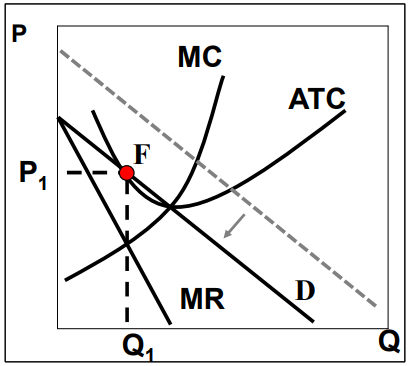
excess profit attracts newcomers that may take away demand from existing firms
individual demand curve shifts to the left and ends in point F; P1 = ATC and MR = MC
Monopolistic competition: welfare effect
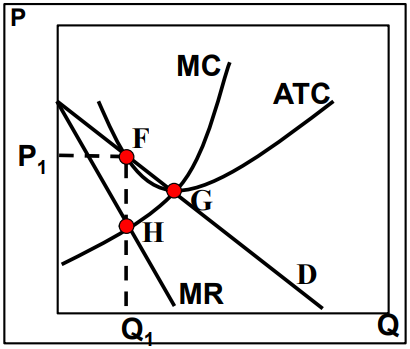
prices above MC while perfect competition has P = MC
production does not occur at minimal cost (and quantity less than under perfect competition) which would be in point G
Deadweight loss FGH
Sources of market failure
imperfect competition
public goods
external effects
information asymmetries
government regulation is needed
Types of goods
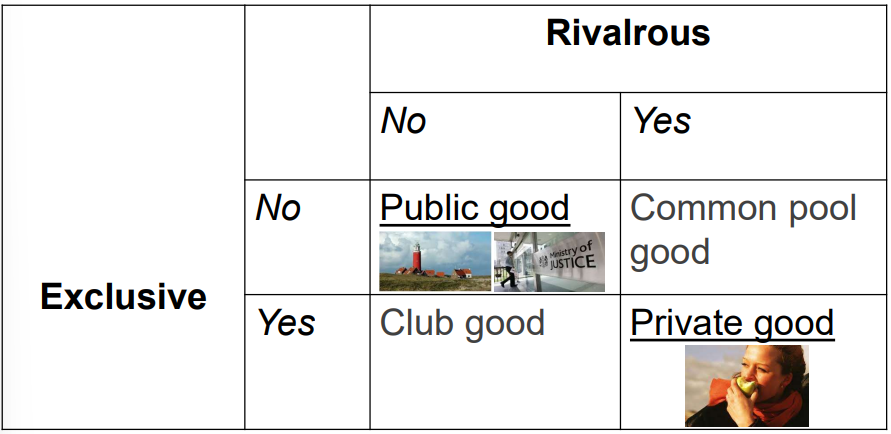
Can be rivalrous and/or exclusive
What are public goods?
non-exclusive and non-rivalrous goods (no individual can be excluded from its use and the use by one individual does not reduce the availability to others
causes free-riding (why pay?)
Tragedy of the commons
Refers to the tendency for a resource that has no price to be used until its marginal benefit falls to zero
solution: regulation
Quasi-public goods
private goods that are partly financed by the government
health care
education
External effects
advantages or disadvantages associated with the consumption and/or production of a good that fall on or accrue to other people than the direct users of that good without financial compensation
Positive externalities
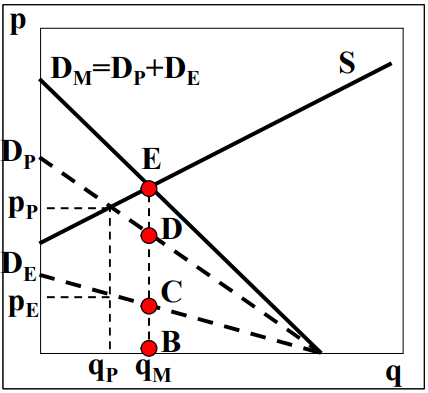
Dp = demand curve paying consumers → quantity qp
qp has monetary value Pe for non-paying consumers with demand curve De (Free riding)
total social demand is Dm = Dp + De and optimal quantitiy is qm
Too little is produced ( qp instead of qm)
direct (paying) consumers versus indirect consumers (free-riders)
too low production, because supply is only tuned to direct consumers’ demand
achieve social optimum by adding demand of indirect consumers
consumer subsidy to direct users
producer subsidy
force free-riders to pay
Negative externalities
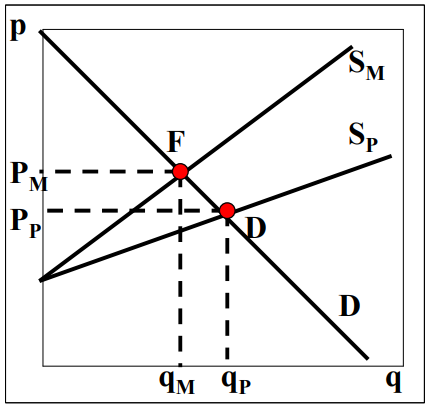
Sm = MC society costs
Sp = MC producers costs
Producers take into account Sp instead of Sm because they do not include the social costs (damage) in their MC
Too much production (qp vs qm) at a price that is too low (Pq vs Pm): socially sub-optimal
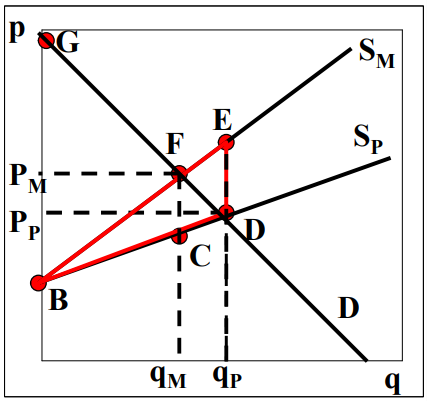
including social cost hence Sm:
consumer surplus: GFPm
Producer surplus BFPm (if production based on Sm)
No negative external effect but firms only consider Sp:
consumer surplus: GDPp
Producer surplus: BDPp
total welfare: BDG minus negative external effect
size of negative external effect
production according to Sp (instead of Sm): equilibrium D
at qp social costs of E
negative external effect: BDE
total welfare at Sp: BDG - BDE
Welfare loss at Sp: FDE
Is government regulation always necessary?
No - Cosean (market-based) approach: if property rights are clear, parties can negotiate so that the efficient outcome will emerge
Coase theorem
Bargaining leads to the (same) efficient outcome - damage is prevented or compensated irrespective of who has (or receives) the property rights. Must have:
no or low transaction costs
no public good
parties have sufficient means to compensate
clear property rights
Asymmetric information
Seller has more/better information than potential buyer = information asymmetry. Consequences:
the reservation price of potential buyers falls
lower prices than if there was perfect information
owners of quality goods have an incentive to keep them rather than sell for less than they’re worth
this causes the average quality of used goods to decline eve further
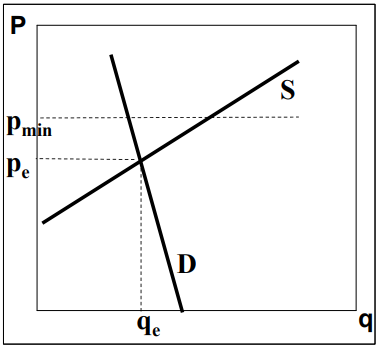
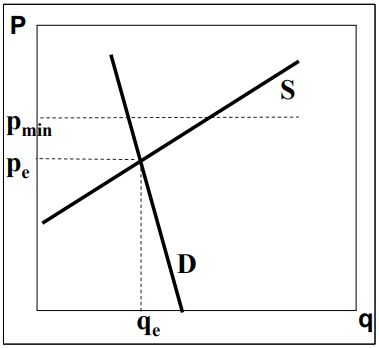
What is the effect of the minimum price Pmin on the quantity supplied and the quantity demanded?
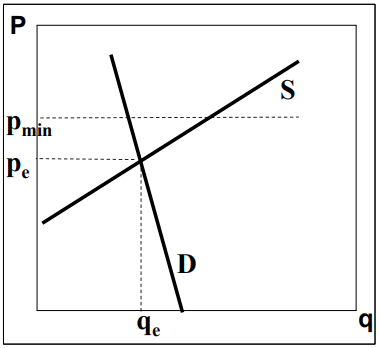
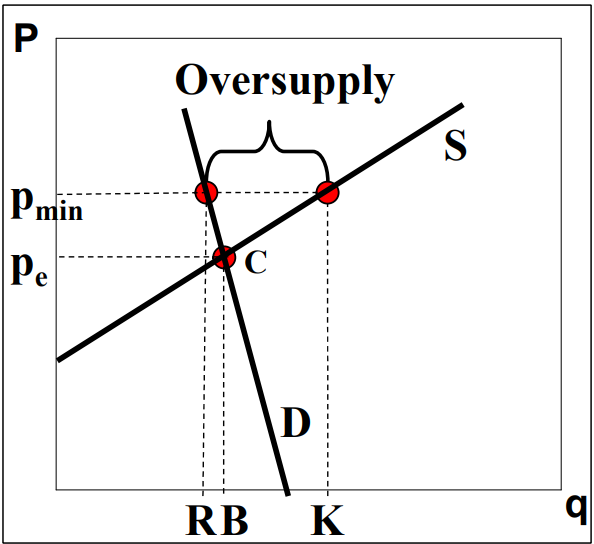
Effect minimum (or: floor) price Pmin:
supply = q(K)
demand = q(R)
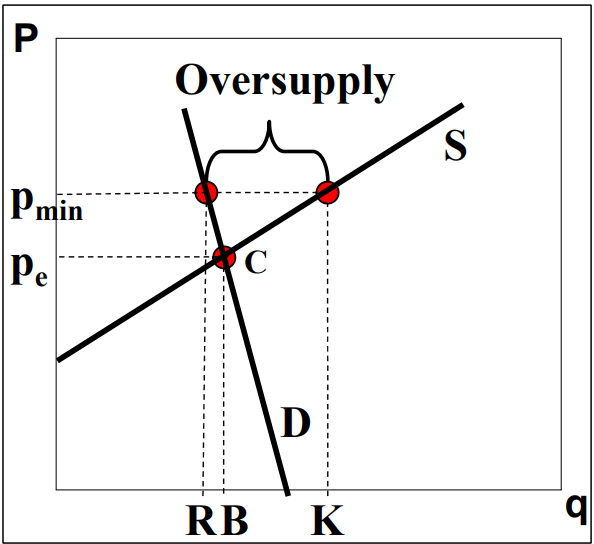
Oversupply q(RK) = milk lake
should the government buy it up?
What is the effect of the minimum price on milk producers’ revenues?
effect minimum price on producers’ revenues:
in equilibrium revenue = Pe x q(B)
now higher revenue: Pmin x q(R)
Do milk consumers gain or lose from a minimum price?
Consumer pays twice:
higher price for milk (smaller consumer surplus)
Extra tax money needed to buy up milk lake
Would a minimum price for milk be efficient or inefficient for society at large?
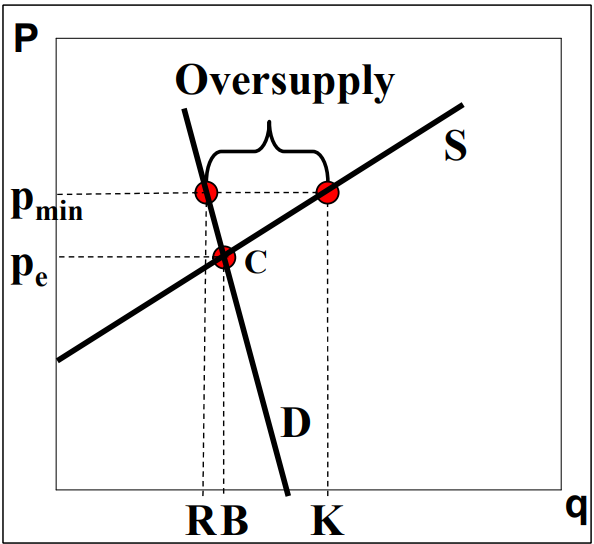
at Pmin demand is at qmin
consumer surplus is EFPmin
producer surplus is HKFPmin
Welfare loss is KCF, hence: (Pareto) inefficient
Minimum price for milk could be seen as fair (for producer) or as unfair (for consumer); but: consumer pays twice…
Minimum price for milk is inefficient due to welfare loss for society at large
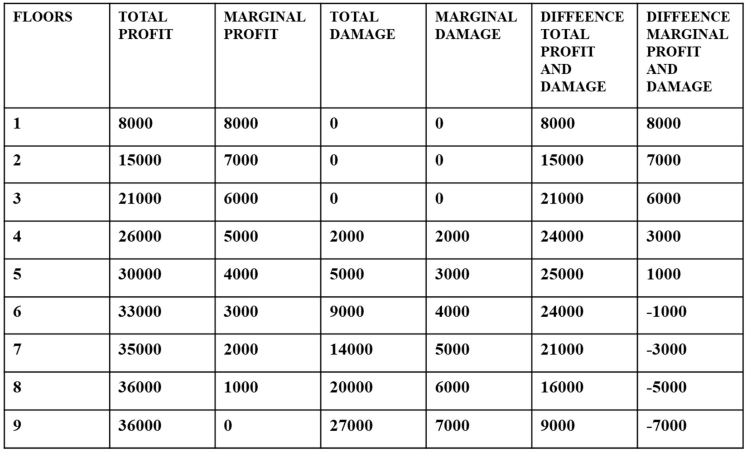
How many floors should the judge allow to ensure an efficient allocation of rights?
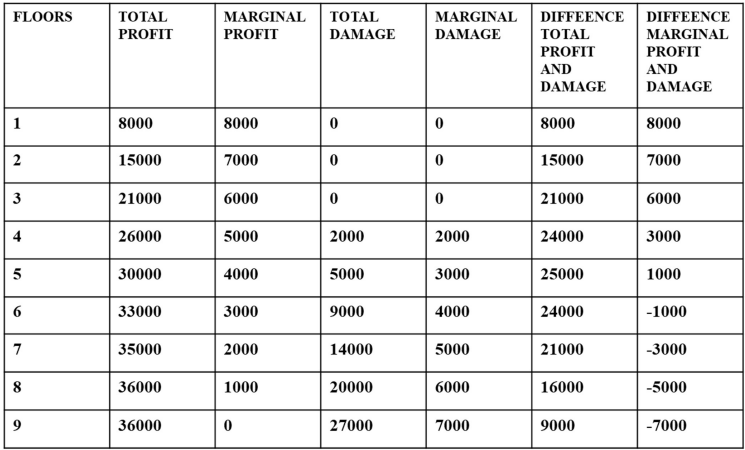
Efficient allocation is realized with 5 floors where MR=MC, namely where marginal profit is equal to or at least still higher than marginal damage (or: where the difference between total profit and total damage is the biggest)
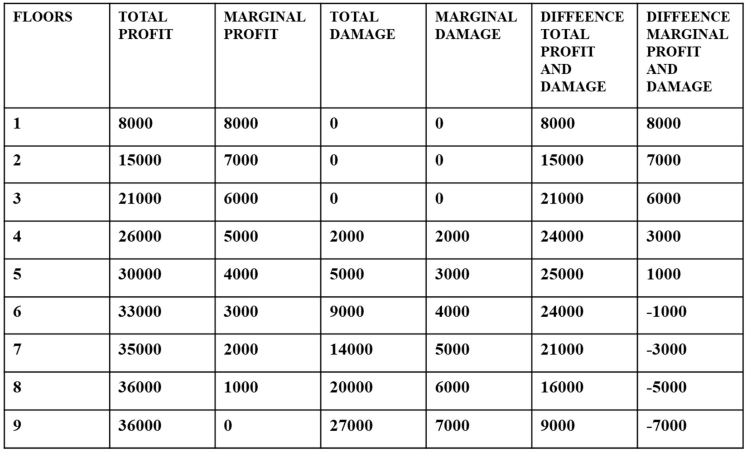
Suppose the judge allows 3 floors: will the project developer comply or build more floors in case of a liability protection of local residents?
When the judge allows 3 floors, the project developer will still build 5 floors, because he can increase his profit by building 2 extra floors even though he has to compensate the damage for the local residents
Emissions trading is a market-based instrument to achieve an emission reduction target cost-effectively by allowing companies to buy and sell emission allowances. In the EU, companies are legally obliged to cover their yearly CO2 emissions with (an equal amount of) emission allowances.
Prior to 2013, electricity producers received their tradable emission allowances for free, but they passed through the market value of those rights in the electricity price.
Consumers then accused producers of making ‘windfall profits’ and argued in favour of more competition in the oligopolistic electricity market to stop or at least reduce those windfall profits.
Will more competition in the electricity market reduce or even make an end to those windfall profits from free allowances?
The opportunity costs of free emission allowances will be passed through to consumers irrespective of the electricity market structure.
However, more competition implies a bigger electricity price increase (hence a larger pass-through rate of the opportunity costs) which policymakers (non-economists) strangely refer to as higher “windfall profits”
Reason: in a (perfectly) competitive market, prices are more aligned with costs (P = MC)
More competition is good for consumers because the electricity price will be lower when competition increases
Passing through opportunity costs is economically correct. “windfall profits” are inherent to emission allowances being allocated for free, because their opportunity costs have to be passed on to consumers
Windfall profits can be avoided if politicians don’t like it: emissions allowances should then be auctioned to energy firms - which was actually done as of 2013
A higher electricity price as result of emissions trading is efficient if a previously unpriced externality, such as CO2 is not priced
What is a property right?
A bundle of rights:
right of use
right of enjoyment
right of exclusion
right of disposition
right to split this bundle of rights
3 key messages by Coase
1: social cost = externalities such as environmental pollution
problem: by negotiating over rights externalities can be internalized, so that social costs cannot exist in the classic, micro-economic model
extra assumption necessary for social cost: the existence of transaction costs
Irrelevance of the allocation of rights: to whom the rights are allocated does not matter for efficiency because without transaction costs, parties can negotiate to internalize the externality
Validity of Coase theorem is limited due to transaction costs such as:
finding information and searching for contract party
negotiating and drafting a contract
verifying behavior and, if needed, enforcing the contract