Chapter 9
 Call Kai
 Learn
Learn Practice Test
 Spaced Repetition
 Match
Match Flashcards
 Knowt Play
1/74

There's no tags or description
Looks like no tags are added yet.
Name | Mastery | Learn | Test | Matching | Spaced | Call with Kai |
|---|
No analytics yet
Send a link to your students to track their progress
75 Terms
Master trusts
multi-employer pension scheme structure with board of independent trustees, cheaper than own with more protection
NEST has
public service obligation to accept all employers under Pensions Act 2008
Eligible jobholder
Between 22 and State Pension age (SPA) earning > £10k py MUST be enrolled but can opt out
Non-eligible jobholder
MUST be provided info on how to opt-in if between 16-21 or SPA-74 earning >£10k or 16-74 earning between £6,240-£10k
Entitled worker
between 16-74 earning less than £6,240 MUST be provided info on how to opt in, employers NOT obliged to meet min contribution requirements
Employers can delay the date they enrol employee into pension by
up to three months from deadline given by pensions regulator, must provide postponement notice
Exemptions from auto-enrolment
consist of a sole director
consist of a number of directors but no more than one has employment contract
Qualifying earnings
earnings (including bonuses etc) between £6,240 and £50,270
Key stages of retirement planning
current financial position (A+Ls)
aspirations in retirement
capital needed
income for intended lifestyle
risk profile
existing retirement plans
identify appropriate solutions
implement strategy and keep reviewing
Risk profile elements
tolerance
attitude
capacity
Uses of cash in pension
to fund PCLS and first few years income payments
Uses of bonds in pension
match the maturity dates of bonds to intended retirement date
Uses of equities in pension
real return after inflation, suitable for drawdown where funds need to achieve growth to maintain income payments
Uses of property in pension
diversification, ensure pension fund maintains value during market volatility, could provide rental income for regular income stream
Lifestyling option
moves away from equities and more into bonds and cash
Lifestyling works by
switching 5-10y before, locks in gains then reinvests in cash/bonds, assumes retiree will take PCLS so target mix is 75% gilts, 25% cash
Gilts in lifestyling
protect against annuity rates falling as annuity rates are calculated from gilt yields
Disadvantages of lifestyling
switching occurs automatically at pre-set times so could lock in lower values, stops further growth also
could retire early or later so could happen too early or too late
not suitable for phased retirement or drawdown
Lifestyling assumes member will
retire on predetermined date
take PCLS
purchase annuity with remaining funds
Common characteristics of target date funds
fund has target date (a year) at beginning focus on cap growth, then gradually shifts to preserve capital
typically multi-asset funds
likely to be more dynamic management
gives discretion over timing
Pension KID
key details, illustration of annual pension, effect of charges on growth using reduction in yield figure
Since 2010
don’t have to retire to take benefits
don’t have to take benefits by 75
can take benefits before 55 if retiring due to ill health
PCLS
For defined contribution schemes, up to 25% tax free up to £268,275
Other options
invest some of it to provide income or use it to pay for planned purchases
take it all as pension and have certainty of higher pension income
Small pension pot commutation
pension less than £10k, can take all as lump sum, max three non-oc schemes can be commuted this way
Trivial commutation
can take if all pension scheme benefits lower than £30k, must be taken within 12m
do tax rules (25%) still apply
yes
UFPLS
no limit to number of payments
max tax-free cash £268,275
Taking UFPLS triggers
MPAA which limits amount that can be contributed in all future tax years to £10k
Dangers of UFPLS
risk individuals will cash in too early
can force individuals into higher tax bracket
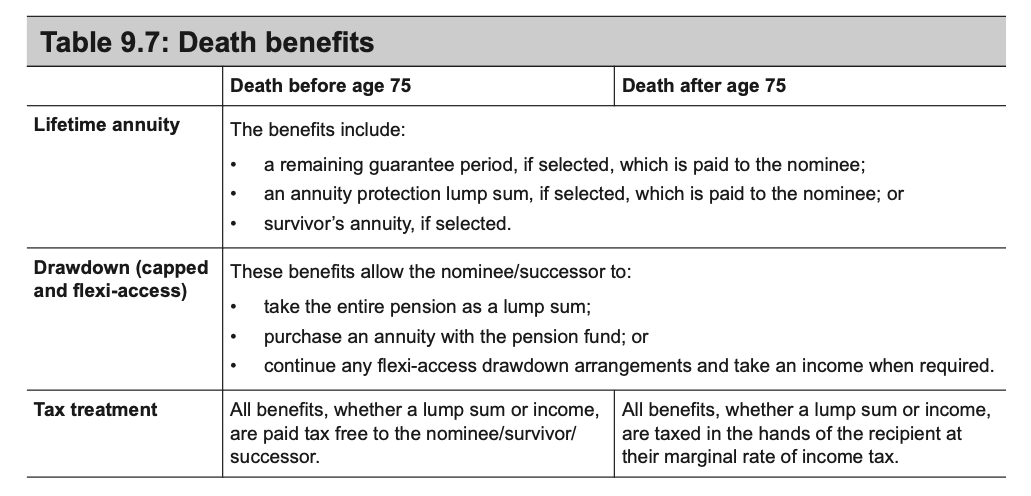
Lifetime annuity
payable by insurance company chosen
Drawdown pension
allows drawdown of income through flexible payments, can be capped or flexible
Annuity key features
monthly, quarterly, half-yearly or yearly payment
income is taxable
annuitant chooses if income stays same or increases (level or escalating)
can choose whether the income stops on death or continues to spouse, civil partner or dependant
Income provided depends on
annuity rates and pension pot
annuity rates depend on life expectancy and gilt yields
life expectancy increased and gilt yields fallen, so reductions in annuity rates
depends on the options selected
A guaranteed annuity
pays for a minimum period even if the annuitant dies during period but reduces income provided, usually 5-10y term
impaired life or enhanced annuity
impaired life pays higher cos will live less (cancer), enhanced pays higher cos of lifestyle features like smoking or obesity
Does lifetime annuity trigger MPAA
no
Capped drawdown
subject to a maximum income level (150% of income from GAD tables), but no minimum
not available now
not subject to MPAA
Flexi-access drawdown
can withdraw any amount over any period they choose
MPAA only triggered once individual takes income from the arrangement
Phased retirement
allows individual to access pension benefits while still in some form of employment, with a portion crystallised each year combining tax-free cash and taxable income
Tax benefits of phased retirement
level of taxable income can be tailored to fit in a low tax bracket
benefits of phased retirement
leaves unused funds invested in pension for potential investment growth
tax-free cash available to take in future years
annuity rates tend to get better the older an individual gets
Delayed retirement
leave their pension benefits uncrystallised when they reach their retirement age, can use other sources (ISA) and leave pension to family on death tax efficiently
Nominees
nominated beneficiaries, individuals who pension member has formally requested to receive pension benefits on their death
Survivors
refers to the individual(s) who continue to receive annuity income from a joint annuity on death of the annuitant
Successors
individuals who have been subsequently nominated, by the nominee, to receive pension benefits on the death of the nominee
Dependents
scheme pensions, those who qualify, within the scheme rules, to receive death benefits on the death of the member.
SIPPs can invest in
collective funds authorised or recognised by FCA
securities listed on stock exchanges
commercial property
bank deposits
SIPPs can be used as a
wrapper to manage a directly invested portfolio of shares and bonds
means of investing in commercial (not residential) property
structure through which to operate drawdown pension
way to finance the member’s business
Small self-administered schemes (SSASs)
occupational defined contribution schemes aimed at company directors and senior employees
How many members will a SSASs have
twelve members and all of them must be trustees
What do SSASs provide
greater control over investment of funds, ability to lend 50% of assets to sponsoring employer
Key features of ISAs
allow individuals to hold cash deposits, bonds, UK and overseas shares and certain life assurance policies
investments can be held directly or through collective investment schemes
can only be operated by HMRC approved account managers
Tax benefits of ISAs
interest on cash ISAs can be paid free of tax
dividends received from an ISA are free of income tax
there is no additional tax liability for higher- and additional-rate taxpayers
all gains are free of CGT
Eligibility rules for ISAs
only individuals
must be over 18
must be resident in UK
must not exceed subscription limit
Can ISAs be held in trust
no
Returns for innovative finance ISAs
larger than cash ISAs as its available for others to borrow
Lifetime ISAs
18-40 to open
for first home or retirement
can contribute till 50
LISA subscriptions
own limit of £4k a year
LISA early withtdrawals
25% charge even on transfers to another ISA
LISA first home
less than £450k and purchased with mortgage, can combine LISAs if home in joint names
Are ISA managers obliged to accept transfers in
no
When the investor dies, how long will the tax advantaged growth continue
earliest of
closure of ISA
completion of the administration of the deceased’s estate
three years and one day after the death
If a life insurance policy inside an ISA triggers a gain at death
that gain is also treated as tax‑free
When someone dies, any interest, dividends, or capital gains that happened before the date of death
keep their ISA tax exemption
Annual Permitted Subscription
additional allowance from deceased’s ISA benefits being passed to their spouse or civil partner (either value of ISA on death or transfer)
Can transfers be made from CTF to JISA
yes
Investment bonds are unique in that they are set up as
single premium whole of life policies, but focus primarily on investment
Do investment bonds have a min/max like ISAs
no
Tax-deferred income withdrawals
5% of the initial investment up to a maximum of 20 years after it has been made
The value of all tax-deferred withdrawals is
added to the gain on encashment to determine whether the withdrawals will attract income tax
Tax treatment of onshore bond
20% tax has been paid within the underlying investment funds so only further liability if higher-rate or additional-rate
Tax treatment of offshore bond
no tax paid, so benefits from gross roll up with investment growing at faster rate because no tax deducted, but then has to pay full income tax on gains
top-slicing relief
spreading the tax liability on a bond over its lifetime