Orgo 2 Exam 3
 Call Kai
 Learn
 Practice Test
 Spaced Repetition
 Match
 Flashcards
 Knowt Play
1/31

Earn XP
Description and Tags
32 Terms
acetal
an organic molecule formed by the condensation of two alcohol molecules with an aldehyde

hemiacetal
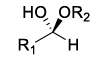
ketal
an organic compound formed when a ketone reacts with alcohol, replacing the carbonyl oxygen with two ether-linked oxygen atoms.

hemiketal
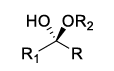
aldehydes and ketones o-nucelophiles
7 step mechanism: H+ on the O, attack, H+ off the attacking nuc, H+ on alcohol, LG leaves (H2O), Attack, H+ off the attacking nuc
imine
made from primary amine

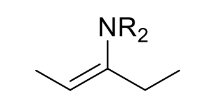
enamine
made from secondary amine
imine mechanism
6 steps: H+ on O, Attack, H+ off the attacking nuc, H+ on the alcohol, LG leaves (H2O), H+ off the N. there will be no second attack!
Aldehydes + Ketones N-nucleophiles can be hydrolyzed back to C=O
H+,H2O or H3O+ or [H+],H2O

NaBH3CN (or H2/Pt or H2/PdC)
reducing agent that waits for imine or enamine, then reduces (adds 2H’s across the double bond). also functions in intramolecular reductive animations

NaBH4
will attack ketone, aldehydes, and RC(O)Cl. So strong!
aldehydes + Ketones C & H nucleophiles
RMgBr (ketone makes tertiary alcohol, aldehyde makes secondary alcohol), RLi, KCN (makes cyanohydrin)
LAH
attacks everything
Wittig Reaction
ketones and aldehydes make alkenes in the presence of phosphonium ylide. PhP is a good nuc, attacks SN2, then remove the H with a very strong base (n-BuLi). should be made from the less substituted side of the double bond

stability ladder
can go down using one step, requires more steps to go up

COOH O & N nucleophiles
1 attack, kicks off LG. before → attack → reform/leave → end
transesterification
Fischer RCOOH → RC(O)OR. 6 steps in acid (H+). same as acid hydrolysis but retain OR
COOH C/H nucleophiles
RMgBr (R nucleophile, good more multi-steps like down the ladder), RLi (R nucleophile), LAH (H- nucleophile)
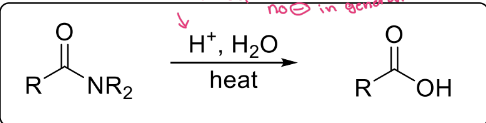
Amides can by hydrolyzed to COOH with what
acid or base catalysis (heat)
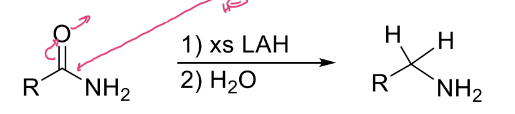
Amide x LAH
H2, Pt also works in forming an amine. Only reaction where carbonyl O-atom leaves, N-atom stays
Amide x SOCl2 (or P2O5)
“dehydration” to make a nitrile

nitrile x 1.LAH 2.H2O or H2/Pd or Ni
forms amide

nitrile x RMgBr
makes a ketone

nitriles can
hydrolize
reduce w/ LAH
RMgBr
alpha proton
enolate ion
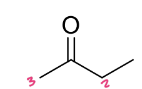
bulky bases attack where there are more alpha protons (at low T) kinetic, small bases attack where there are less alpha protons (room T) thermo
Bulky bases
LDA, KOC(CH3)3. attack where there are more alpha protons
Small bases
NaOH, NaH, NaOMe. attack where there are fewer alpha protons
Alpha Alkylation
remove proton with appropriate base, then send it in for SN2
Alpha Halogenation
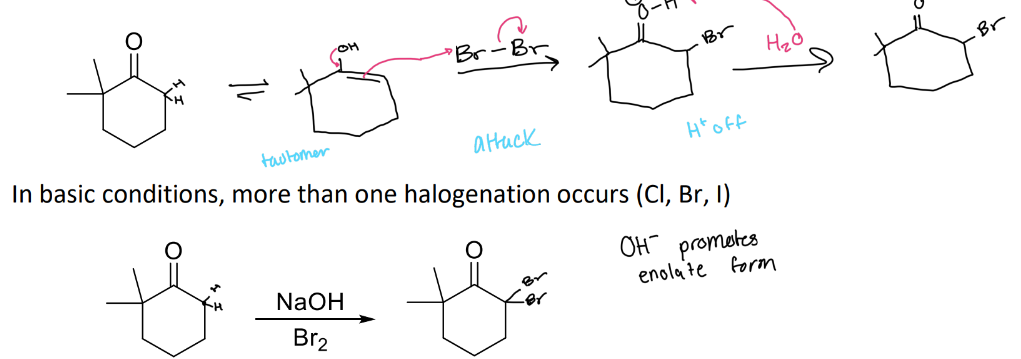
H+ promoted - one Br atom to most substituted (in acid)
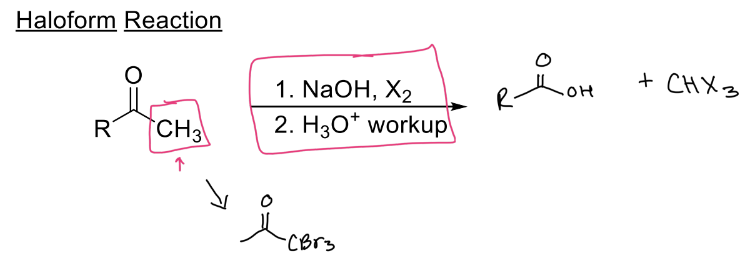
OH- promoted → multiple halogenations (takes off EVERY alpha proton) → haloform
Haloform
Aldol
watch for rings (count carbons). Regular (attacks itself), crossed, condensation (heat), conjugation to double bond (C=O)
Claisen
esters. Watch for rings. regular and crossed