unit 12
 Call Kai
 Learn
Learn Practice Test
 Spaced Repetition
 Match
Match Flashcards
 Knowt Play
1/124

There's no tags or description
Looks like no tags are added yet.
Name | Mastery | Learn | Test | Matching | Spaced | Call with Kai |
|---|
No analytics yet
Send a link to your students to track their progress
125 Terms
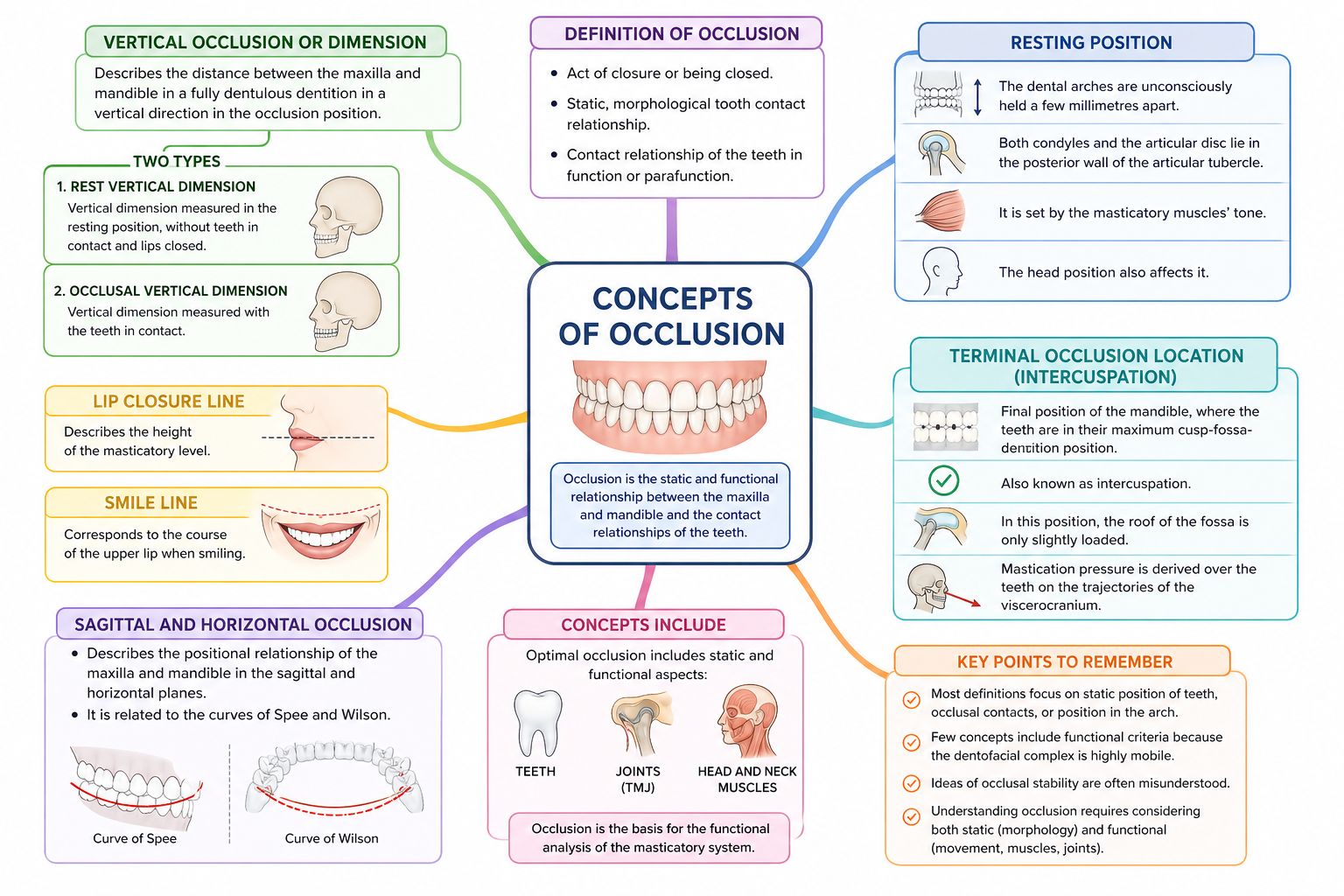
what is occlusion (basic definition)?
act of closure or being closed
what type of relationship does occlusion describe (structurally)
static, morphological tooth contact relationship
what type of relationship does occlusion describe (functionally)?
a contact relationship of teeth in function or parafunction
most definitions of occlusion are based on what
static positions of teeth, occlusal contacts, or position in the arch
what has recently been included in some occlusion concepts
functional criteria
why are functional criteria important in occlusion
because the dentofacial complex is highly mobile
what is often misunderstood about occlusion
occlusal stability
what aspects are included in optimal occlusion concepts
static and functional aspects (teeth, joints, head and neck muscles)
occlusion is the basis for what?
functional analysis of the masticatory system
Vertical occlusion/dimension
what does vertical occlusion describe
distance between maxilla and mandible in vertical direction
Vertical occlusion/dimension
in which condition is vertical occlusion measured
fully dentulous dentition (all teeth) in occlusion
Vertical occlusion/dimension
it describes the distance of the maxilla and mandible position om a fully dentulous dentition in a vertical direction in the occlusion position,
there are 2 types what are they
rest vertical dimension
occlusal vertical dimension
Vertical occlusion/dimension
rest vertical dimension - very simple what does this mean
teeth not in contact and lips closed
Vertical occlusion/dimension
occlusal vertical dimension - simple what does this mean
teeth in contact (distance less)
Vertical occlusion/dimension
what is rest vertical dimension
vertical dimension when teeth are not in contact and lips are closed
Vertical occlusion/dimension
what is occlusal vertical dimension
vertical dimension when teeth are in contact
lip closure line
what does a lip closure line describe
height pf the masticatory level
(how far teeth can be apart with lips closed)
Smile Line
what does the smile line represent
corresponds to the course of the upper lip when smiling
sagittal and horizontal occlusion
what does this describe
relationship of the maxilla and mandible in sagittal and horizontal planes
sagittal and horizontal occlusion
what curves are related to saggital.horizontal plane
curves of Spee and Wilson
resting position
what happens to the dental arches in the resting position
they are unconsciously held a few millimetres apart
resting position
where are the condyles and articular disc located in the resting position
in the posterior wall of the articular tubercle
resting position
what determines the resting position
tone of the masticatory muscles
resting position
what external factor also affects the resting position
head position
resting position
what muscle maintains the resting position
temporalis muscle
resting position
simple terms tell me what this is and what it takes into account
teeth are NOT in contact
takes into account TMJ and muscle activity
terminal occlusion location
what is terminal occlusion location
final position of the mandible, where the teeth are in their maximum cups-fossa-dentition position
terminal occlusion location
what is another name for terminal occlusion location
intercuspation
terminal occlusion location
what happens to the fossa roof in intercuspation
it is only slightly loaded
terminal occlusion location
why is the roof of the fossa only slightly loaded
mastication pressure is distributed over teeth along viscerocranium trajectories
terminal occlusion location
simple terms what does this mean and what does it include
all the teeth are in contact
does not take into account TMJ or muscle activity
look
done
primary dentition
it is arranged in 2 arches called what
maxillary and mandibular
primary dentition
what describes the outline of the maxillary dental arch
the buccal and labial surfaces of the maxillary teeth
primary dentition
what is the shape of the maxillary arch outline
an ellipse
primary dentition
how does the maxillary arch compare in size to the mandibular arch
it is larger
primary dentition
how many opposing teeth does each primary tooth usually occlude with
2
primary dentition
what is the general rule for occlusion in primary dentition
each tooth occludes with 2 teeth on the opposite arch
primary dentition
why do most teeth occlude with 2 antagonists
to maintain stability and continuous occlusal contact
primary dentition
which primary tooth occludes with only 1 instead of 2 - MANDIBULAR
mandibular central incisor
primary dentition
which primary tooth occludes with only one tooth instead of two - MAXILLAR
second maxillary molar
primary dentition
by what age should primary teeth be bin normal alignment and occlusion
around 2 years old
primary dentition
by what age are the roots of primary teeth completely formed
around 3 years old
primary dentition
what happens to occlusion after age 2?
teeth should be in their usual alignment and occlusion
primary dentition
why is primary dentition important for oral motor function?
It is essential for correct development of oral motor function
primary dentition
what system does occlusion influence during development
the nervous system
primary dentition
how does occlusion affect the nervous system
it impacts its maturation and interaction with the environment
primary dentition
what does rapid growth of the maxilla and mandible create
interdental spaces
primary dentition
what is another term for interdental space
Diastema
primary dentition
which teeth show an increased separation over time
anterior teeth
primary dentition
why do anterior teeth separate more over time
growth of the maxilla and mandible and the approach of permeant teeth from the lingual aspect
primary dentition
at what age do permanent teeth begin approaching from the lingual aspect
around 4-5 years
primary dentition
do canine and molars develop spacing like anterior teeth
no
primary dentition
what supports and improves occlusion after spacing develops ?
eruption of first permenant molars
primary dentition
where do the first permanent molars erupt
distal to the primary second molars
primary dentition
at what age do first permanent molars erupt
around 6 years old
CHRONOLOGY
what mainly determines the timing of tooth eruption
Heredity
CHRONOLOGY
how much do environmental factors affect eruption timing?
only slightly
CHRONOLOGY
is primary tooth development linked to general body development
no, it is independent
CHRONOLOGY
what type of environmental factors can influence occlusion development
local environmental factors
CHRONOLOGY
what does learning mastication depend on
stage of occlusion development and neuromuscular maturation
CONTRACT RELATIONS (primary dentition)
what do contract relations in primary dentition vary with?
the degree of bruxism
CONTRACT RELATIONS (primary dentition)
what is bruxism
grinding or clenching of teeth
CONTRACT RELATIONS (primary dentition)
is bruxism normal in children
yes
CONTRACT RELATIONS (primary dentition)
what are 5 factors influencing development of contract relations
position of the tooth germ
present of permanent teeth
development of the condyles
cuspal inclines
neuromuscular influences
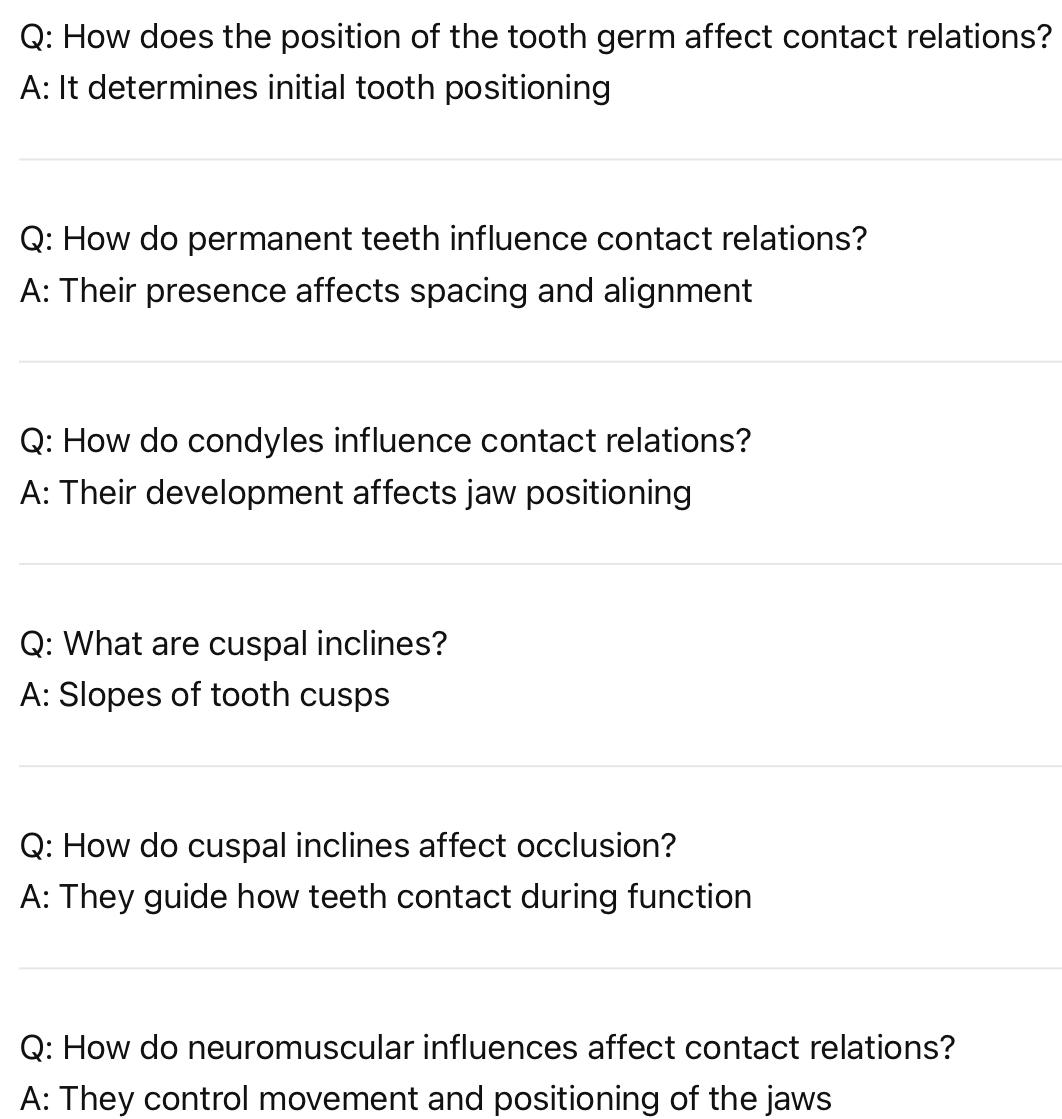
this isn’t included in the document but its useful i think
done
ARCH FORM
by what age is the form and width of dental arches established
around 9 months
ARCH FORM
why might this early development seem surprising
because facial appearance change later
ARCH FORM
what dimension of the arches changes significantly after 9 months
anteroposterior dimension
ARCH FORM
what determines the shape if dental arches
alveolar bone and basal bone
INTERDENTAL SPACING/ DIASTEMA
what happens with interdental spacing with age
it decreases slightly
INTERDENTAL SPACING/ DIASTEMA
what does interdental spacing relate to
size of primary teeth , position of permanent teeth, and size of dental aches
MOLAR RELATIONSHIP - IN EXAM
who describes the terminal plane relationship
Moyers
MOLAR RELATIONSHIP - IN EXAM
what determines the molar relationship in primary dentition
terminal plane relationship
MOLAR RELATIONSHIP - IN EXAM
what anatomical factor determines the terminal plane
greater mesiodistal (M-D) diameter of the second mandibular molar
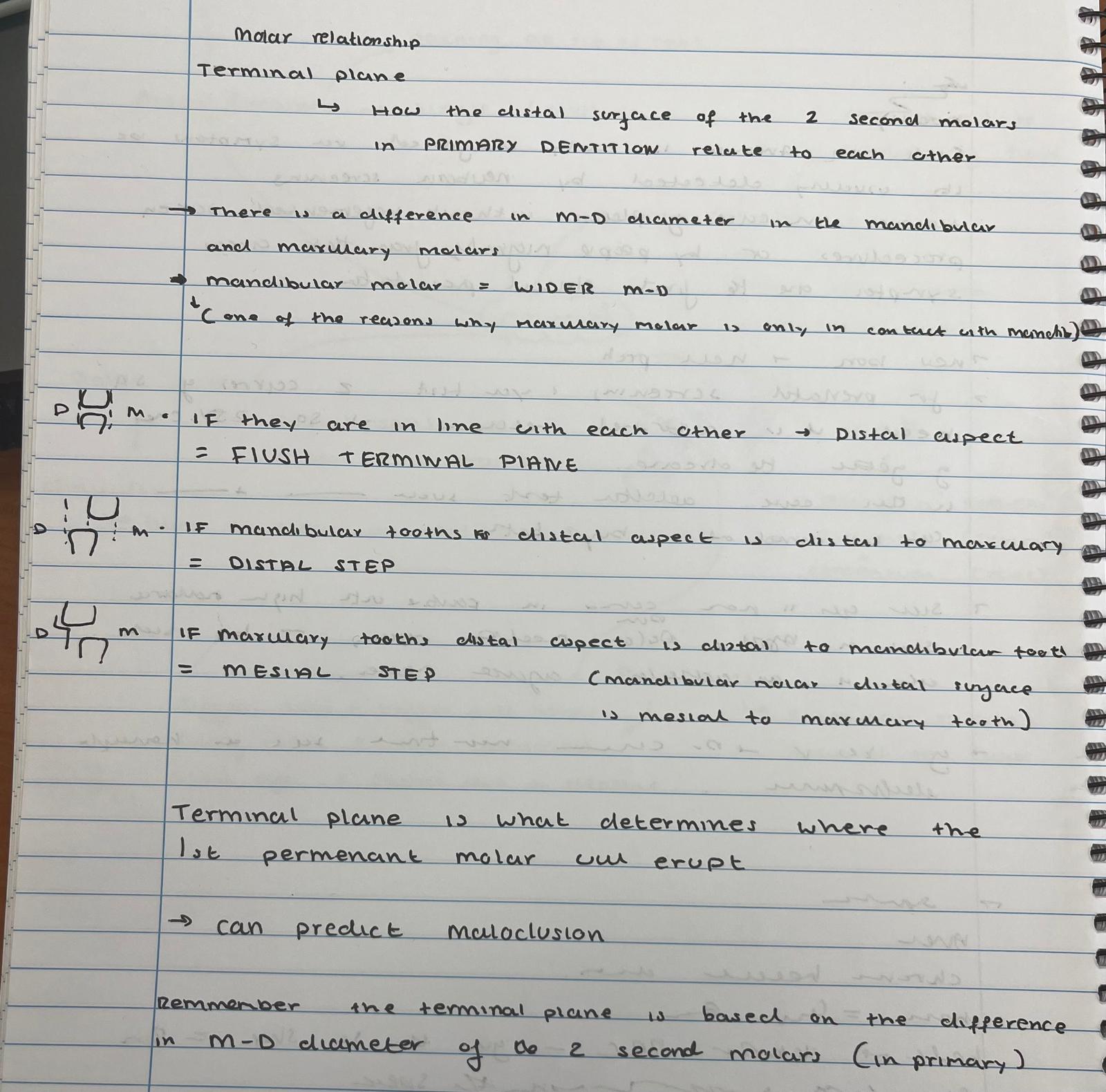
MOLAR RELATIONSHIP - IN EXAM
\READ
done
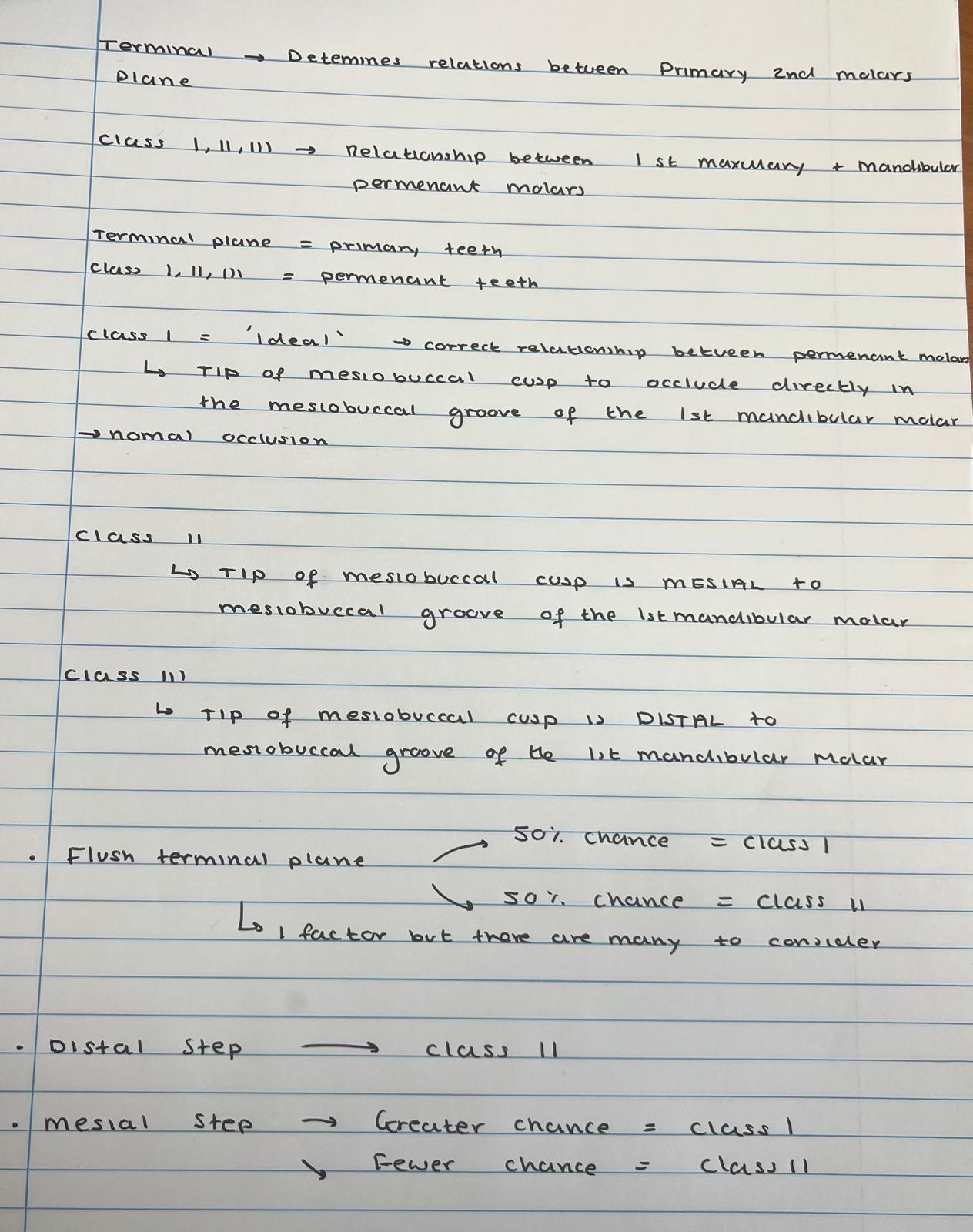
MOLAR RELATIONSHIP - IN EXAM
read
done
MOLAR RELATIONSHIP - IN EXAM
what is the terminal plane describing
how the distal surface of the 2 second molars in primary dentition relate to each other
MOLAR RELATIONSHIP - IN EXAM
is there a difference in the mesial distal dimensions in the primary second molars
yes, the mandibular molar is wider mesiodistally than the maxillary molar
MOLAR RELATIONSHIP - IN EXAM
what are the 3 terminal plane options
flush terminal plane
distal step
mesial step
MOLAR RELATIONSHIP - IN EXAM
flush plane means what
if they are in line with each other from the distal aspect
MOLAR RELATIONSHIP - IN EXAM
what is the distal step
if the mandibular tooths distal aspect is distal to maxillary
MOLAR RELATIONSHIP - IN EXAM
what is mesial step
is mandibular tooths distal surface is mesial to maxillary tooth
MOLAR RELATIONSHIP - IN EXAM
what does the terminal plane determine
where the 1st permeant molar will erupt
what can the terminal predict
the possibility of malocclusion
MOLAR RELATIONSHIP - IN EXAM
what is the terminal plane based on
difference in M-D diameter of the 2 second molars (in primary dentition)
simple difference between terminal plane and class I, II and II
terminal plane = primary teeth
classes = permanent teeth
what does class I, II and III determine
relationship between 1st maxillary and mandibular permanent molars
class I is what
ideal/correct/normal occlusion
class I is the correct relationship between permanent molars what does this mean
tip of mesiobuccal cusp to occlude directly in the mesiobuccal groove of the 1st mandibular molar
what is class II
tip of mesiobuccal cusp is mesial to the mesiobuccal groove of the 1st mandibular molar
what is class III
tip of mesiobuccal cusp is distal to the mesiobuccal groove of the 1st mandibular molar
what does a flush terminal plane usually develop into ?
50% = class I
50% = class II
what does the distal step tend towards?
class II
what does mesial step tend towards?
greater chances of class I but small chance of class II
DETAILS OF OCCLUSION
how are the maxillary and mandibular central incisors aligned
their mesial surfaces align at the midline
DETAILS OF OCCLUSION
what teeth does the maxillary centra incisor occlude with
mandibular central incisor and mesial third of mandibular lateral incisor
DETAILS OF OCCLUSION
where does contact occur for the maxillary central incisor
lingually above the incisal edge
DETAILS OF OCCLUSION
which teeth does the maxillary lateral incisor occlude with?
distal 2/3 of mandibular lateral incisor and mesial half of mandibular canine
DETAILS OF OCCLUSION
which teeth does the maxillary canine occlude with
distal half of mandibular canine and mesial third of mandibular first molar