Metallic bonding
 Call Kai
 Learn
Learn Practice Test
 Spaced Repetition
 Match
Match Flashcards
 Knowt Play
1/5

There's no tags or description
Looks like no tags are added yet.
Name | Mastery | Learn | Test | Matching | Spaced | Call with Kai |
|---|
No analytics yet
Send a link to your students to track their progress
6 Terms
Metallic bonding
The electrostatic attraction between a lattice of cations and a sea of delocalized electrons
Why are metals malleable
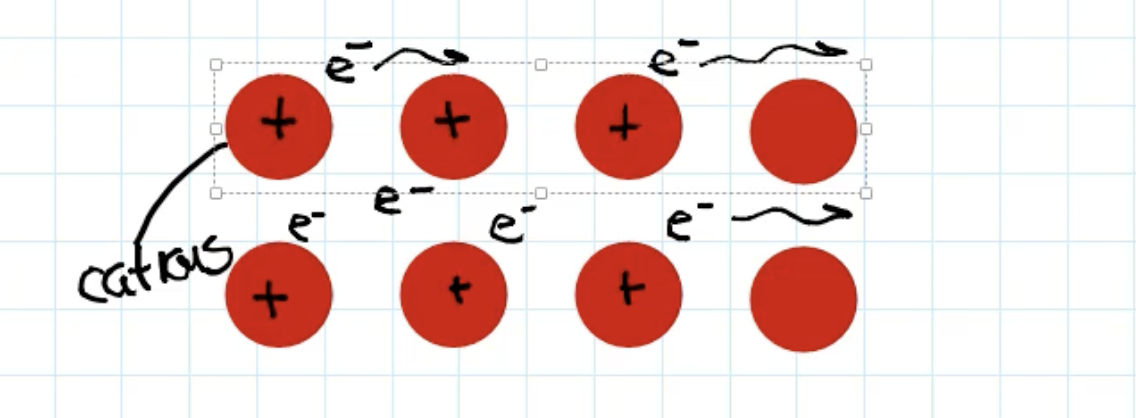
Due to their form - a cation lattice arranged with a sea of delocalized electrons - when force is applied, the layers of cations can slide over one another without breaking the metallic bonds/distorting them as the e- are free to move as well , there will still be an attraction.
How does charge affect the strength of the metallic bond
More charge = more electrons. Eg. Ca has a +2 charge which means it has double the valence electrons compared to Na +. A greater number of delocalized electrons creates a much stronger attraction between the cations and electrons. This influences melting/boiling points eg. K+ melts at 60 and calcium melts at 800 or so.
How does ionic radius affect the strength of the metallic bond
Ionic radius (Which measures the size of the ion. The ionic radius will always be smaller in cations compared to their atoms as the fewer electrons are more attracted to the nucleus and thus will be pulled in more). It measures the distance between the nucleus and the electrons, and if the nucleus is closer to the delocalized e- (if the ionic radius is smaller) then there will be a greater pull on those e-, so a greater attraction, thus more force is required to break it = higher melting point
What is an alloy
An alloy is a mixture of metals
How does an alloy (addition of a different metal) alter the properties of metals
Steel = iron + tungsten + carbon.
Bronze = copper + tin
Bronze is mainly copper, and tin is very large, so when tin is introduced the lattice is disrupted. When force is exerted onto the lattice, the cations can’t really slide over each other anymore due to this disruption with tin. So, alloys are usually more hard, less ductile, less malleable, etc.